The tallest trees are over 100 metres high, yet water reaches their topmost leaves. A tree has no heart and no pump, and the xylem vessels that carry the water are dead, empty tubes. In the potometer, a shoot with no roots at all still took up water. So what moves water up a plant? And what happens when a plant loses water faster than it can take it in?
This part is Supplement content (syllabus 8.3.5 and 8.3.7).
Supplement: the transpiration pull
Water moves up the xylem because of what happens in the leaves:
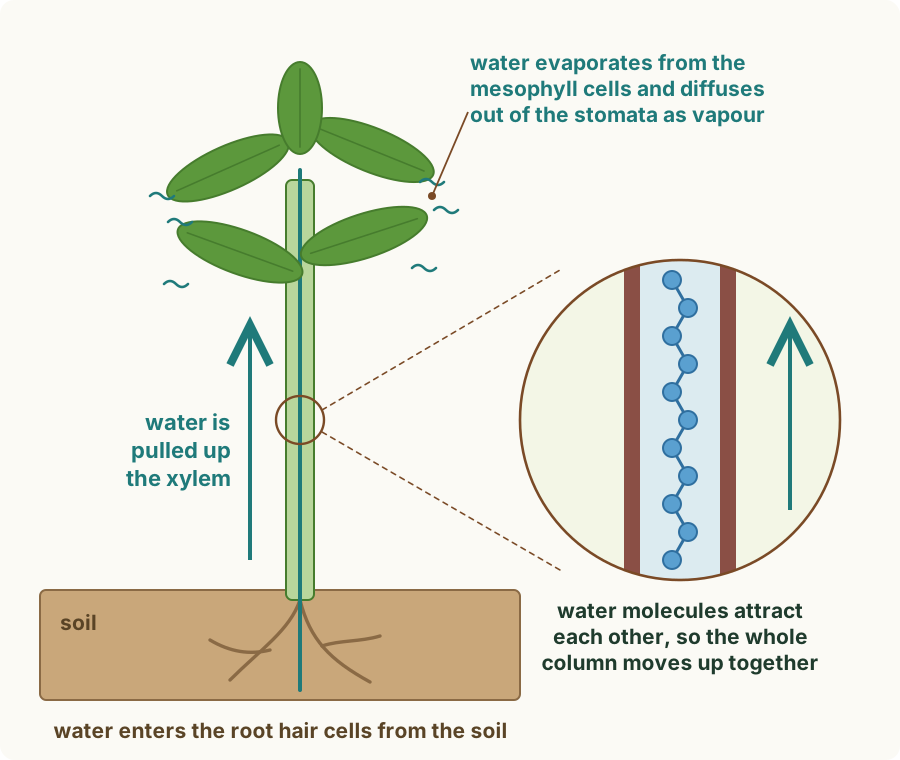
- Water evaporates from the surfaces of the mesophyll cells into the air spaces, and the water vapour diffuses out through the stomata.
- The mesophyll cells take in water from the xylem in the leaf veins to replace the water lost.
- Water molecules attract one another. These forces of attraction between water molecules hold the water in the xylem together as a continuous column, from the leaves right down to the roots.
- So when water leaves the top of the column, the whole column of water molecules is drawn up the xylem, like a chain being pulled from the top. Unlike a chain, the column is liquid: one air gap breaks it.
This pull, caused by transpiration from the leaves, is called the transpiration pull. At the bottom of the column, more water enters the root hair cells from the soil and moves across the root into the xylem. The faster the leaves transpire, the faster the column is pulled up.
 (enlarge)
The xylem suits this job: its vessels are long, continuous, empty tubes with no cross walls, so nothing breaks the column, and their thick, lignified walls stop them collapsing while the water is pulled up.
Trap: "The roots pump the water up to the leaves." The shoot in the potometer had no roots, yet it took up water. The pull comes from the leaves, where water evaporates.
Trap: "Living cells in the xylem squeeze the water up." Xylem vessels have no cell contents: they cannot squeeze. The water is pulled up from above.
Worked example
Faster on a warm, breezy afternoon
Supplement. Water moves up the xylem of a tree faster on a warm, breezy afternoon than on a cool, still, humid night. Explain why, using the transpiration pull.
Start in the leaves. On the warm, breezy afternoon water evaporates from the mesophyll cells and the water vapour diffuses out of the leaves quickly. The mesophyll cells take in water from the xylem to replace it, and this transpiration pull draws the column of water up the xylem. Forces of attraction between water molecules hold the column together, so the whole column moves up. On the cool, still, humid night less water evaporates and diffuses out, so the pull is weaker and the water moves up more slowly.
Supplement: keeping the column unbroken
An air bubble in a xylem vessel breaks the column of water: the forces of attraction act between water molecules, and the column cannot be pulled up past a gap of air. That is why, when you set up a potometer, you cut the shoot under water and fit it into the potometer under water: no air gets into the cut ends of its xylem vessels. A shoot cut in air may take up water only slowly, or not at all.
The air bubble in the narrow tube of the potometer is different: it stays in the glass tube, well away from the shoot, and only marks how far the water has moved.
Trap: "The bubble in the potometer goes up into the stem." The bubble stays in the narrow glass tube. It moves towards the shoot as water is taken up, but it is pushed back with the reservoir long before it reaches the shoot.
Supplement: wilting
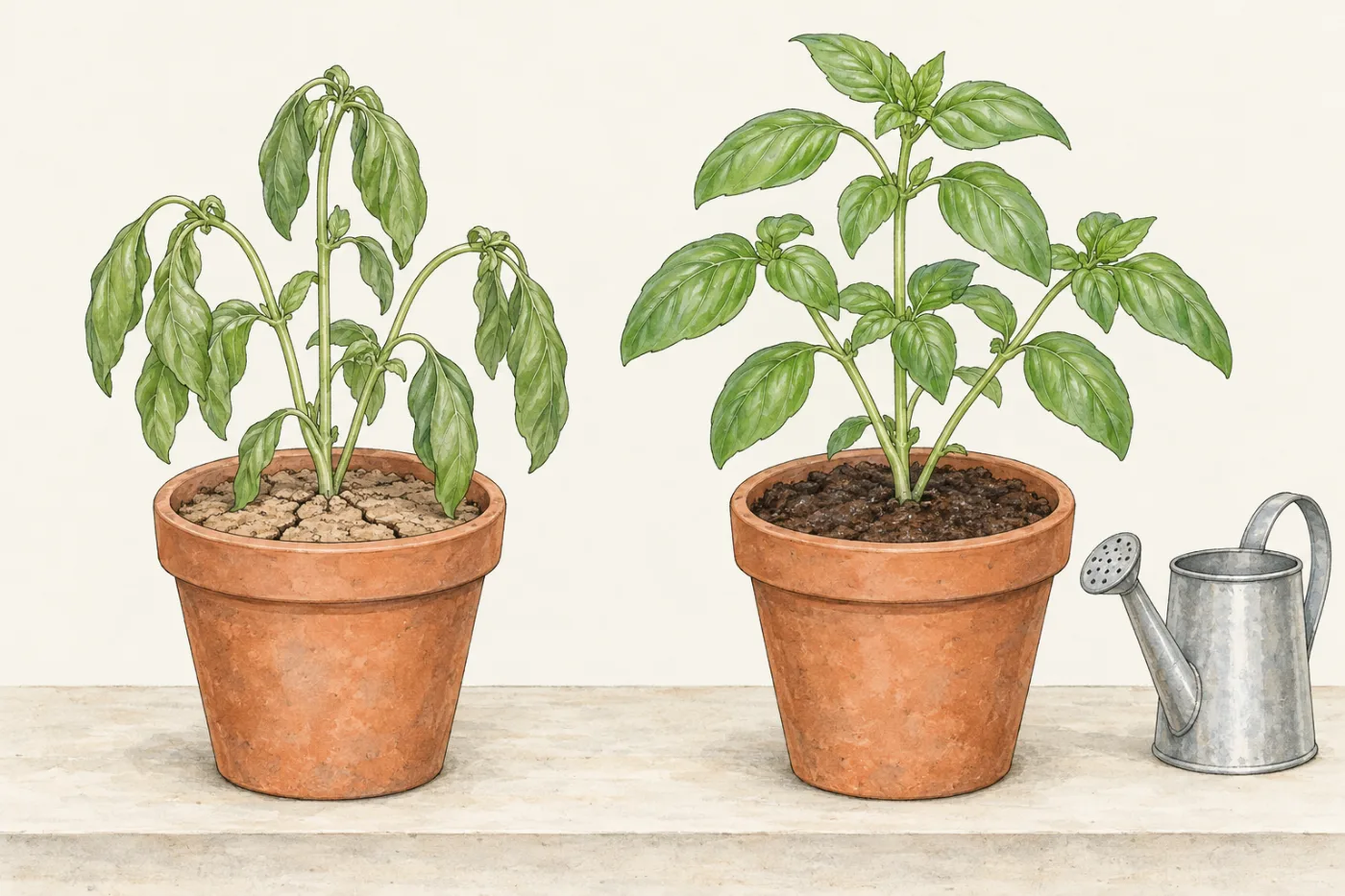
Leaves and young stems have no wood to hold them up. They stay firm because their cells are turgid: each cell is full of water, which presses outwards on its cell wall (the turgor pressure), and the turgid cells press against one another.
A plant wilts when it loses water by transpiration faster than its roots take water up. This can happen on a hot, windy, dry day, when transpiration is fast, or when the soil is dry, so that the roots cannot take up enough water.
- Water leaves the cells of the leaves and young stems and is not replaced fast enough.
- The cells lose water, their vacuoles shrink, and the turgor pressure falls: the cells become flaccid.
- Flaccid cells no longer press outwards on their walls or against one another, so they no longer hold the leaves and stems up.
- The leaves and stems droop: the plant has wilted.
If the plant is watered in time, water enters the root hair cells from the soil by osmosis: water diffuses through a partially permeable membrane from a dilute solution into a more concentrated one. It is carried up the xylem, and the cells of the leaves and stems take it in by osmosis too. The cells become turgid again, and the leaves and stems are held up once more.
 (enlarge)
Wilting also slows the water loss a little: drooping leaves hang away from the sun, so less of their surface is heated by it. A plant that is short of water also closes its stomata, which slows transpiration further, but it then takes in less carbon dioxide for photosynthesis.
Trap: "A wilting plant has run out of food." Wilting is about water: the cells have become flaccid because the plant lost water faster than it took it up.
Trap: "Wilted cells burst." Plant cells lose water and become flaccid when they wilt. They do not burst: the cell wall stops a plant cell from bursting when it takes water in.
Worked example
Roots eaten by larvae
Supplement. Larvae of the cabbage root fly have eaten most of the fine roots of a cabbage plant. On the next warm, breezy afternoon the plant wilts, although the soil is moist. Explain why it wilted.
Compare the water lost with the water taken up. On the warm, breezy afternoon the leaves lost water quickly by transpiration, but with most of its fine roots and root hairs gone, the plant took up water slowly. The cells lost more water than they gained: their vacuoles shrank and they became flaccid, no longer pressing outwards on their walls. Without that pressure the leaves and stems could not hold themselves up, so they drooped. Until it grows new roots, it will wilt whenever it loses water faster than its damaged roots can take it up.
Key idea: Supplement: water evaporates from the mesophyll cells and diffuses out of the leaf; the mesophyll cells take in water from the xylem, and this transpiration pull draws up a continuous column of water molecules, held together by forces of attraction between them. An air bubble breaks the column, so a shoot for a potometer is cut under water. A plant wilts when it loses water by transpiration faster than its roots take it up: its cells become flaccid, no longer press outwards, and the leaves and stems droop; watering makes the cells turgid again.