A basil plant on a sunny windowsill needs watering almost every day. Where does all that water go? The plant keeps very little of it, and no water drips out of it. Most of the water its roots take up escapes from its leaves, as an invisible gas: water vapour. In this part you measure how fast a leafy shoot takes up water, and find out how the water gets out of a leaf.
 (enlarge)
Transpiration
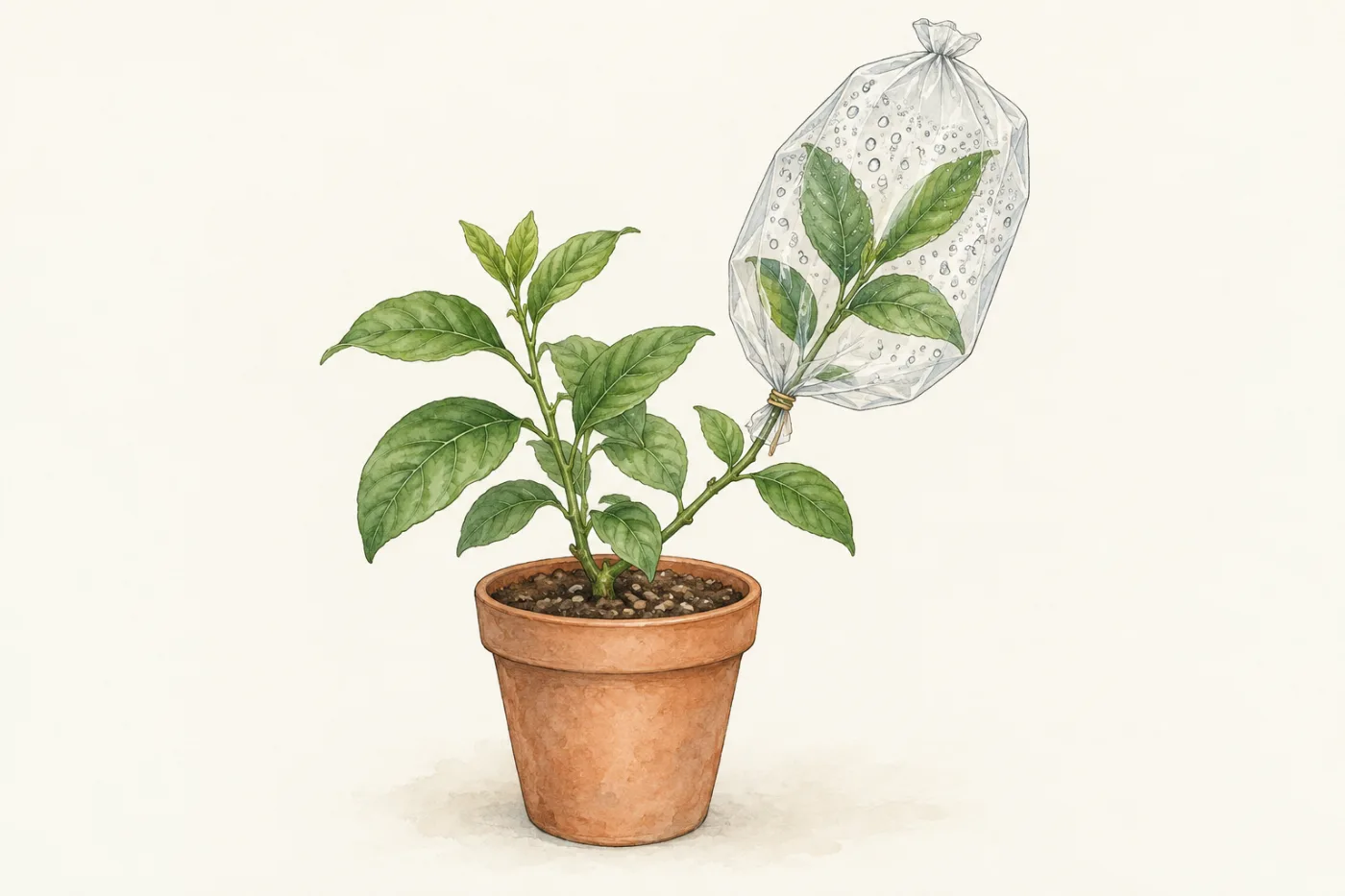
You cannot see water vapour, but you can catch it. Tie a clear plastic bag over a few leaves of a pot plant, and leave it in a warm, bright place for an hour or two. Droplets of liquid water appear on the inside of the bag. The leaves lost water vapour; trapped in the bag, some of it condensed on the cooler plastic.
 (enlarge)
This loss of water vapour from leaves is called transpiration. The water was taken up by the roots and carried up the stem to the leaves in the xylem. A leaf uses a little of it, for example in photosynthesis, but most of it is lost from the plant as water vapour.
Trap: "Transpiration is water moving up the stem." Water does move up the stem, but transpiration is the loss of water vapour from the leaves. That loss is what keeps the water moving up.
Trap: "The droplets in the bag came out of the leaves as liquid." The leaves lose water vapour, a gas. It turns back into liquid only when it meets the plastic.
Measuring water uptake: the potometer
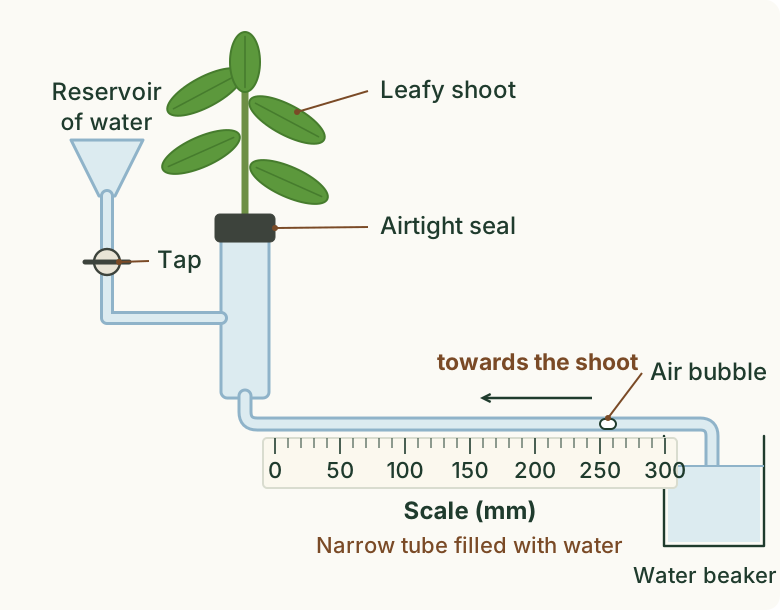
A potometer measures how fast a leafy shoot takes up water. In a bubble potometer the shoot is sealed, airtight, into a tube full of water. A long, narrow tube with a scale beside it joins on at the bottom, and its far end dips into a beaker of water. When the shoot takes up water, water is drawn along the narrow tube towards the shoot. An air bubble in the narrow tube moves with the water, so the bubble shows how fast the water is taken up.
 (enlarge)
A school method:
- Cut the shoot under water and fit it into the potometer under water, so that no air gets into its xylem. Make the joint airtight.
- Lift the end of the narrow tube out of the beaker for a moment, so that one air bubble goes in, then put the end back in the water.
- Open the tap of the reservoir: water from it pushes the bubble back to the starting mark, 250 mm on the scale. Close the tap again before you time anything.
- Start the stop-clock. After 2 minutes, read how far the bubble has moved. Always read the same edge of the bubble.
- Push the bubble back with the reservoir and repeat, so that you have three runs.
The rate of water uptake is the distance the bubble moves divided by the time: in mm per minute.
A potometer measures the water the shoot takes up, not the water it loses. Nearly all the water taken up is lost by transpiration, so the uptake is a good estimate of the rate of transpiration, not exactly the same.
Predict first: the narrow tube is full of water, and soon there will be one air bubble in it. The shoot stands in still air at room temperature. Will the bubble move towards the shoot, away from it, or stay where it is? Write your prediction down now.
Below you can try the first steps: letting in the bubble, pushing it back with the reservoir, then timing the first 2-minute run. The full experiment repeats the run, then tests a fan, warmer air and a clear bag over the leaves. Then read on and compare.
After the experiment: working out the rate
The distances here come from an illustrative model of a leafy shoot, set up to behave the way real shoots usually do. A real shoot's rate depends on its size, its number of leaves and the room.
The bubble moved towards the shoot: the shoot was taking up water. Its left edge, the edge nearer the shoot, was at 250 mm when the clock started and at 226 mm after 2 minutes.
- Distance moved: 250 − 226 = 24 mm.
- Rate of water uptake: 24 mm ÷ 2 minutes = 12 mm per minute.
Three runs in still air at 20 °C:
| Run | Distance in 2 minutes (mm) | Rate (mm per minute) |
|---|---|---|
| 1 | 24 | 12 |
| 2 | 22 | 11 |
| 3 | 26 | 13 |
| Mean | 24 | 12 |
The three runs are close to each other, so the mean of 12 mm per minute is a reliable rate for this shoot in still air. Repeating also shows up a run that is very different from the others, which you would check.
Trap: "The rate is 226 mm per minute." 226 mm is where the bubble stopped, not how far it moved. Subtract to find the distance, then divide by the time.
Trap: "A potometer measures transpiration exactly." It measures the water taken up. A little of that water is used or stays in the cells, so uptake is a close estimate of transpiration.
Without the width of the narrow tube you cannot turn the distance into a volume of water, so the rate stays in mm per minute. That is enough to compare one condition with another on the same potometer.
Worked example
A rate from two readings
A second shoot is set up in the same potometer. The left edge of the bubble is at 250 mm when the clock starts and at 222 mm after 4 minutes. Work out the rate of water uptake.
Read the same edge both times and subtract: the bubble moved 250 − 222 = 28 mm. Divide by the time: 28 mm ÷ 4 minutes = 7 mm per minute. The rate is a distance moved in each minute; 222 mm is only where the bubble stopped, so it is not the answer.
How water vapour leaves a leaf
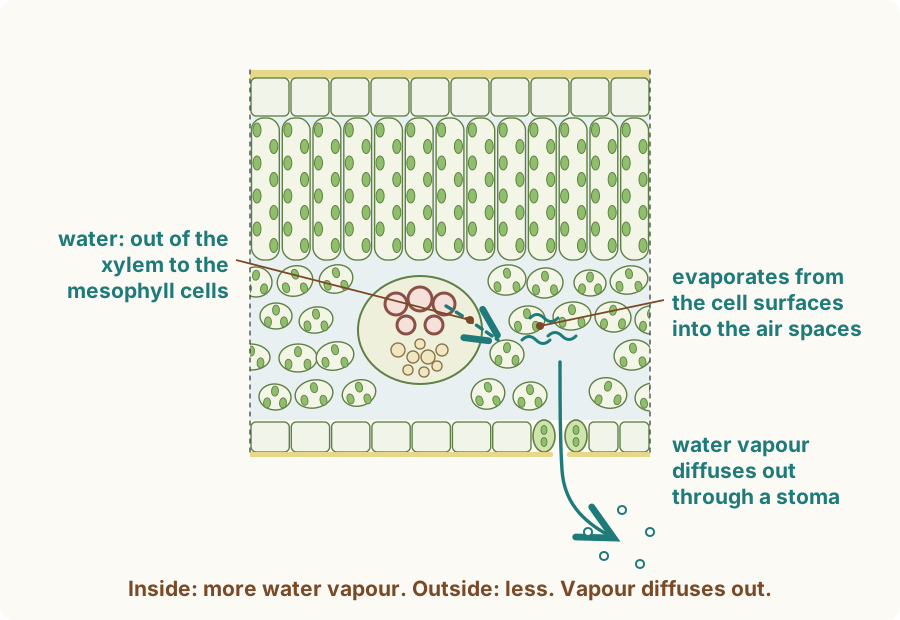
Inside a leaf, the mesophyll cells have wet surfaces. Between the cells are air spaces, which join up with one another and open to the air outside through the stomata: tiny pores, most of them in the lower epidermis (the thin layer of cells on the underside of the leaf), each between two guard cells.
- Water reaches the mesophyll cells from the xylem in the veins.
- Water evaporates from the surfaces of the mesophyll cells into the air spaces.
- The air spaces fill with water vapour. There is more water vapour inside the leaf than in the air outside, so the water vapour diffuses out of the leaf through the stomata.
 (enlarge)
Evaporation happens inside the leaf, and the water leaves as a gas. Diffusion is the net movement of particles from a higher concentration to a lower concentration, so the vapour spreads out of the leaf into the drier air.
Trap: "Water is pushed out of the stomata as drops of liquid." Nothing pushes it. Water evaporates inside the leaf, and the vapour diffuses out through the stomata.
Trap: "Water evaporates straight from the veins." The veins carry water into the leaf. The water evaporates from the surfaces of the mesophyll cells.
Worked example
A picked leaf gets lighter
A leaf is picked and hung up in a warm room. Two hours later it is lighter and has started to droop. Describe how the water left the leaf.
Water evaporated from the wet surfaces of the mesophyll cells into the air spaces inside the leaf. There was more water vapour in the air spaces than in the room, so the water vapour diffused out through the stomata. This loss of water vapour from the leaf is transpiration. A picked leaf is no longer joined to the plant, so no more water comes up the xylem to replace the water it loses, and it gets lighter.
Supplement: air spaces and stomata
This section is Supplement content (syllabus 8.3.4).
A large internal surface area. The mesophyll cells, especially the rounded spongy mesophyll cells, are loosely packed, with interconnecting air spaces between them. So a great deal of wet cell surface faces the air inside the leaf: a large internal surface area. The larger the surface that water can evaporate from, the faster the air spaces fill with water vapour, and the more water vapour diffuses out.
The number and size of stomata. Water vapour leaves through the stomata, so the more stomata a leaf has, and the larger (the wider open) they are, the faster water vapour diffuses out. When stomata close, the gap between the guard cells shuts and very little water vapour can leave.
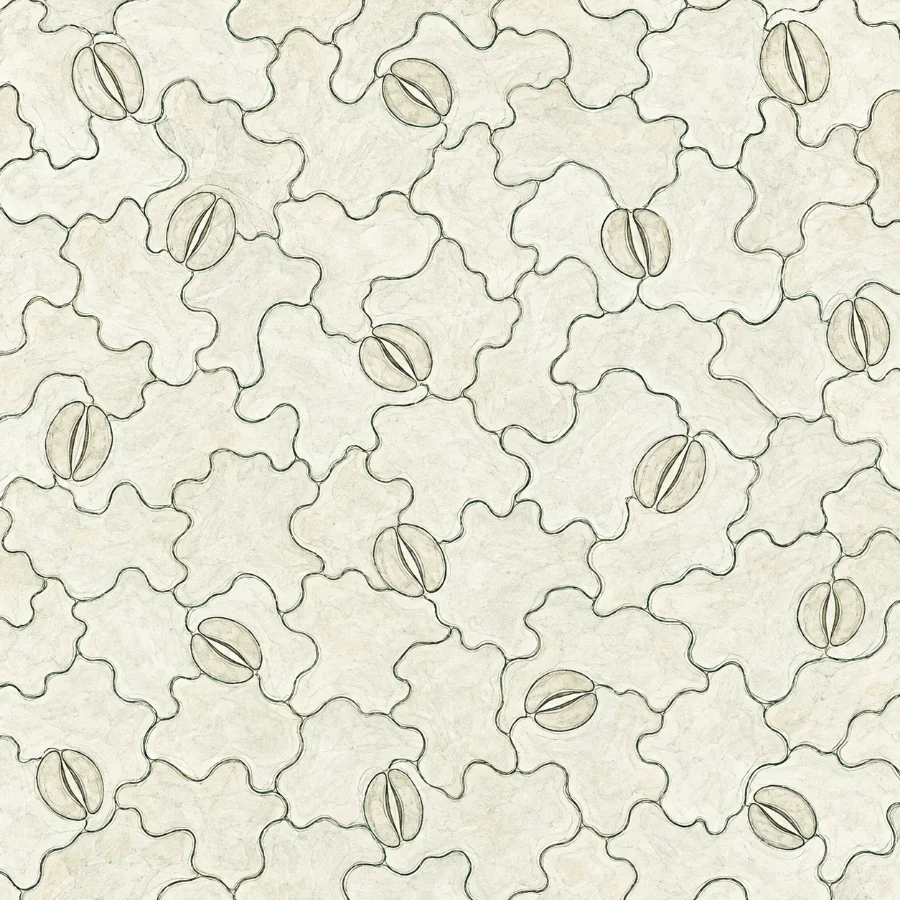
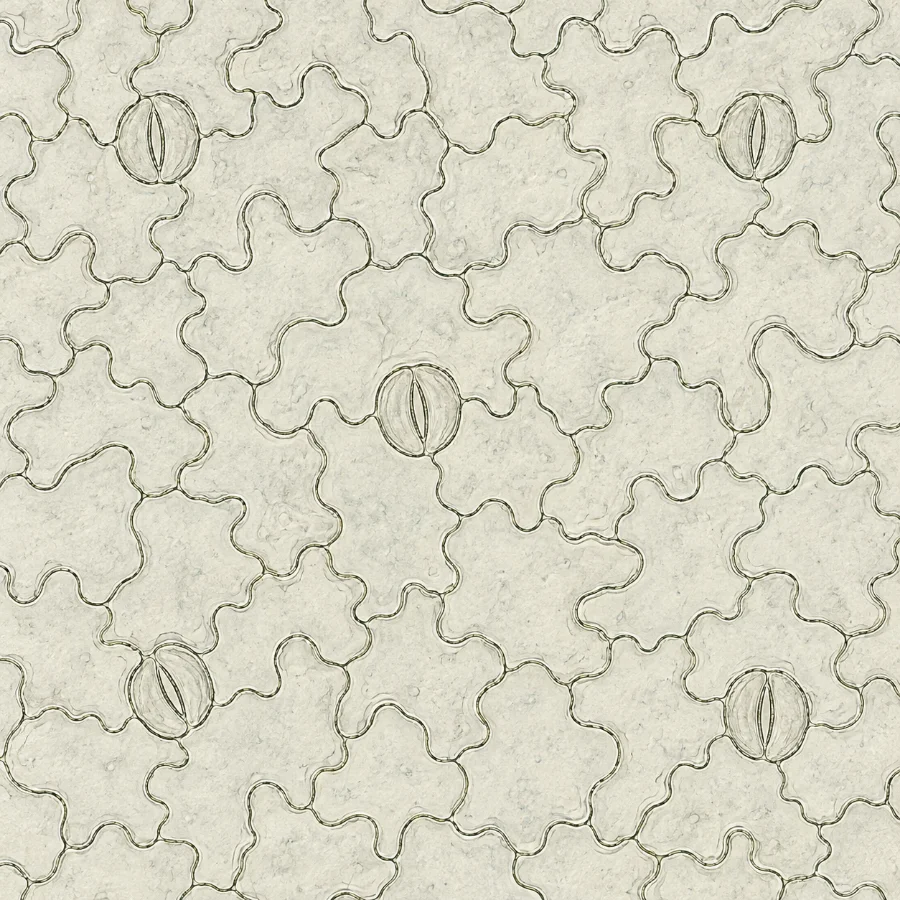
The two drawings below show the same area of the lower and the upper epidermis of one leaf, under a microscope. In this view the lower epidermis has 16 stomata and the upper epidermis has 5. So this leaf loses more water vapour from its lower surface.
 (enlarge)
 (enlarge)
Trap: "The air spaces are wasted space in the leaf." The interconnecting air spaces give the mesophyll cells a large internal surface area that faces air, so water can evaporate (and gases can be exchanged) quickly.
Worked example
Many stomata or few
Supplement. Leaf P has about 250 stomata in each square millimetre of its lower surface; leaf Q, from a plant of a dry place, has about 90. The leaves are the same size, in the same conditions, with their stomata open as wide. Which leaf loses water vapour faster? Explain.
Leaf P. Water vapour leaves the air spaces by diffusing out through the stomata, so more stomata in each square millimetre give the vapour more ways out, and it diffuses out faster. Wider-open stomata would do the same; closed stomata let very little out. Inside both leaves, loosely packed mesophyll cells with interconnecting air spaces give a large internal surface area, so water evaporates into the air spaces fast enough to keep them full of vapour.
Key idea: Transpiration is the loss of water vapour from leaves. A potometer measures water uptake: time how far an air bubble moves along a narrow tube, reading the same edge, and divide the distance by the time, in mm per minute; uptake is a close estimate of transpiration. Water evaporates from the surfaces of the mesophyll cells into the air spaces, and the water vapour then diffuses out of the leaf through the stomata. Supplement: the interconnecting air spaces give a large internal surface area for evaporation, and more and larger stomata let more water vapour diffuse out.