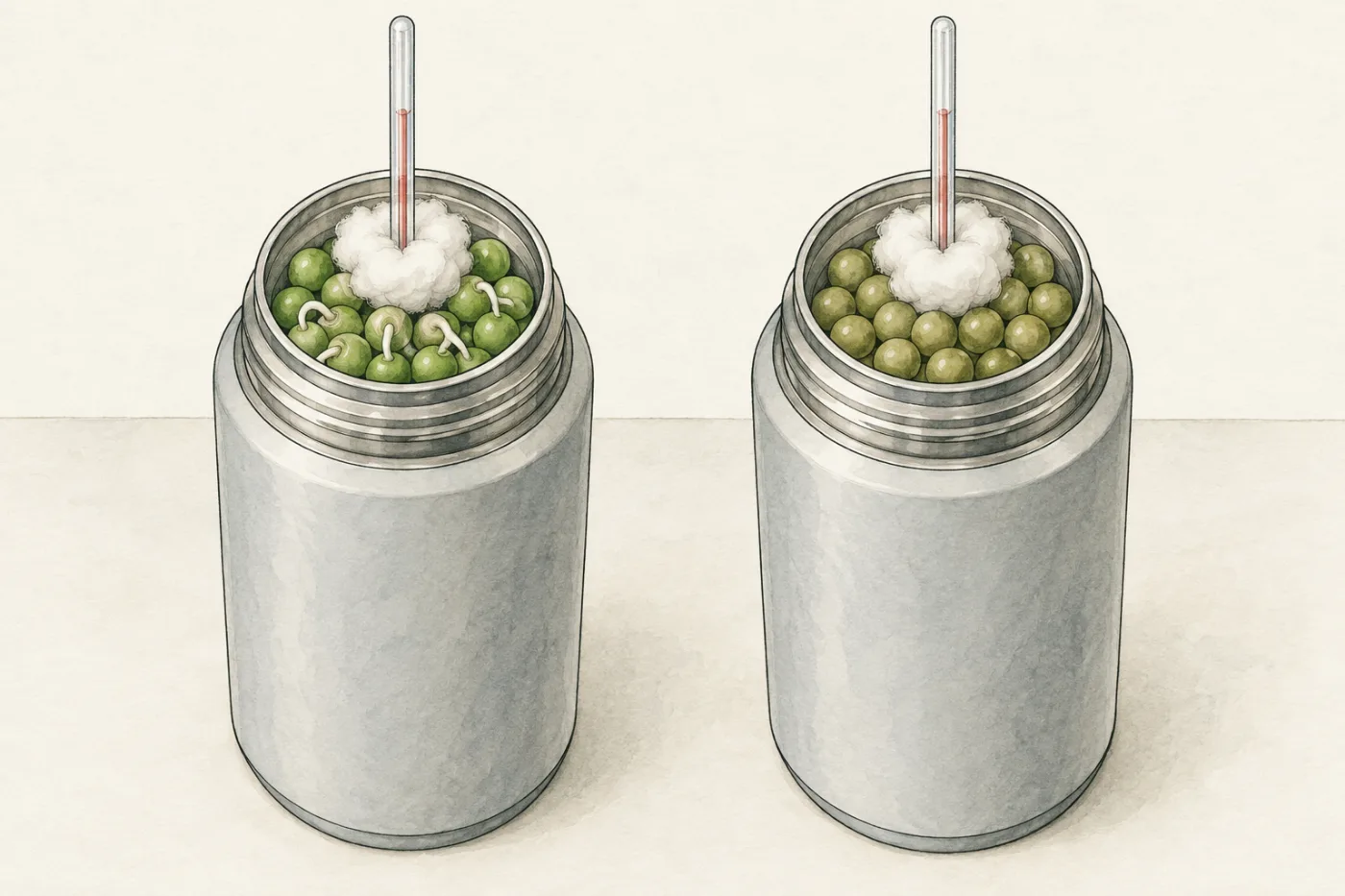
Two vacuum flasks stand side by side, each full of peas, each with a thermometer pushed through a plug of cotton wool. The peas in one flask were soaked in water and have started to sprout. The peas in the other were boiled. After three days, the flask of sprouting peas is several degrees warmer. Nothing heated it: the warmth came from the peas themselves. In this part you find out what living things need energy for, and how their cells release it from food.
 (enlarge)
What living things use energy for
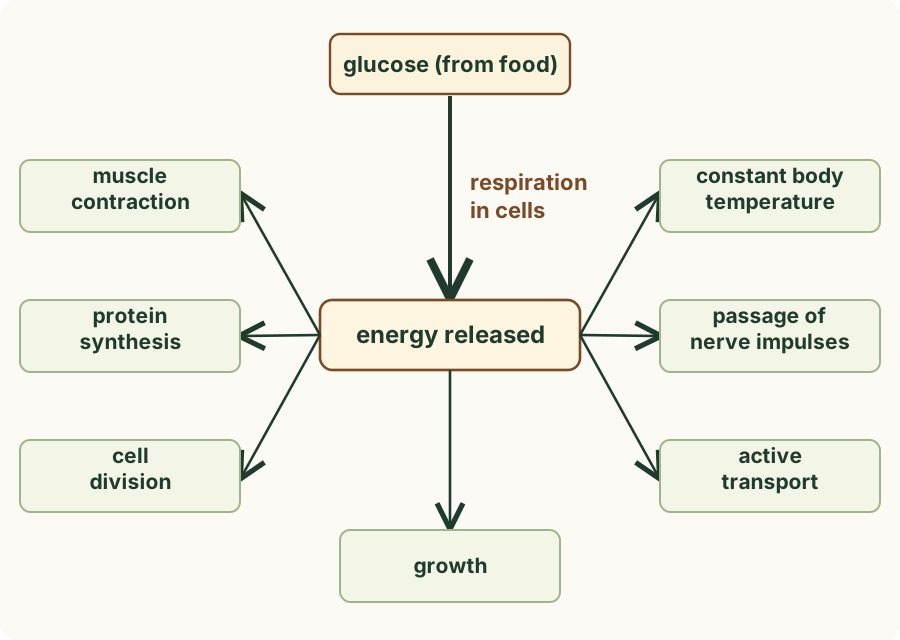
Right now your heart muscle is contracting, your nerves are carrying signals to and from your brain, and your cells are making new proteins. Every one of these needs energy, and every living cell needs a steady supply of it, all the time. Living organisms use energy for:
- muscle contraction: moving, and also the beating of the heart;
- protein synthesis: making proteins, for example enzymes, from amino acids;
- cell division: making new cells;
- active transport: moving substances into or out of cells against a concentration gradient;
- growth: for example, a child getting taller or a seedling growing a root;
- the passage of nerve impulses: for example, the signal that makes you pull your hand away from something hot;
- the maintenance of a constant body temperature, in mammals and birds.
 (enlarge)
The energy comes from nutrient molecules in food, most often glucose. Cells release it by respiration.
Trap: "Plants do not need energy, because they get it from sunlight." Plants use light energy to make glucose by photosynthesis. Then every plant cell respires that glucose to release the energy it needs, day and night, as animal cells do.
Worked example
A penguin on the ice
A penguin stands on the ice for weeks in the middle of winter, with an egg resting on its feet, while the chick inside the egg grows. Which uses of the energy from respiration does each of them need, and what is each one for?
The penguin keeps its body warm while the air around it is far below freezing: that is the maintenance of a constant body temperature. Its heart beats and its muscles hold it upright: muscle contraction. The chick inside the egg makes new cells by cell division and builds proteins from amino acids by protein synthesis, so it shows growth. All of this energy is released by respiration in their cells, from nutrient molecules such as glucose.
Aerobic respiration
Aerobic respiration is the chemical reactions in cells that use oxygen to break down nutrient molecules to release energy.
The word equation for aerobic respiration is:
glucose + oxygen → carbon dioxide + water
Supplement (syllabus 12.2.3): the balanced chemical equation is
C6H12O6 + 6O2 → 6CO2 + 6H2O
Respiration happens inside every living cell, all the time, and enzymes control each of its reactions. The cell uses some of the energy released, but some always escapes as heat, and that heat is what warmed the peas in the flask.
Trap: "Respiration makes energy." Energy cannot be made. Respiration releases energy that was stored in glucose.
Trap: "Respiration is breathing." Breathing moves air into and out of the lungs. Respiration is the chemical reactions inside cells that release energy. Breathing supplies the oxygen that respiring cells use, and removes the carbon dioxide they make.
Worked example
A goldfish swimming
A goldfish swims around its pond. Describe the process that releases the energy in its muscle cells, and write the word equation for it.
The process is aerobic respiration: the chemical reactions in cells that use oxygen to break down nutrient molecules, such as glucose, to release energy. In the goldfish's muscle cells: glucose + oxygen → carbon dioxide + water. The blood brings glucose from the fish's food and oxygen from its gills, and carries the carbon dioxide back to the gills, where it passes out into the water. The muscles use some of the energy released to contract, and some escapes as heat. Respiration goes on in every living cell of the fish, all the time, not only in its muscles.
Worked example
Counting molecules
Supplement. A muscle cell respires aerobically and uses 42 molecules of oxygen. How many molecules of glucose does it break down, and how many molecules of water does it make?
Use the balanced chemical equation: C6H12O6 + 6O2 → 6CO2 + 6H2O. It is written for one glucose molecule, which uses 6 oxygen molecules. So 42 oxygen molecules break down 42 ÷ 6 = 7 glucose molecules. Each glucose molecule gives 6 water molecules, so the cell makes 7 × 6 = 42 water molecules, and 42 carbon dioxide molecules too: for each glucose molecule, the numbers of oxygen, carbon dioxide and water molecules are all 6.
Germinating peas give off heat
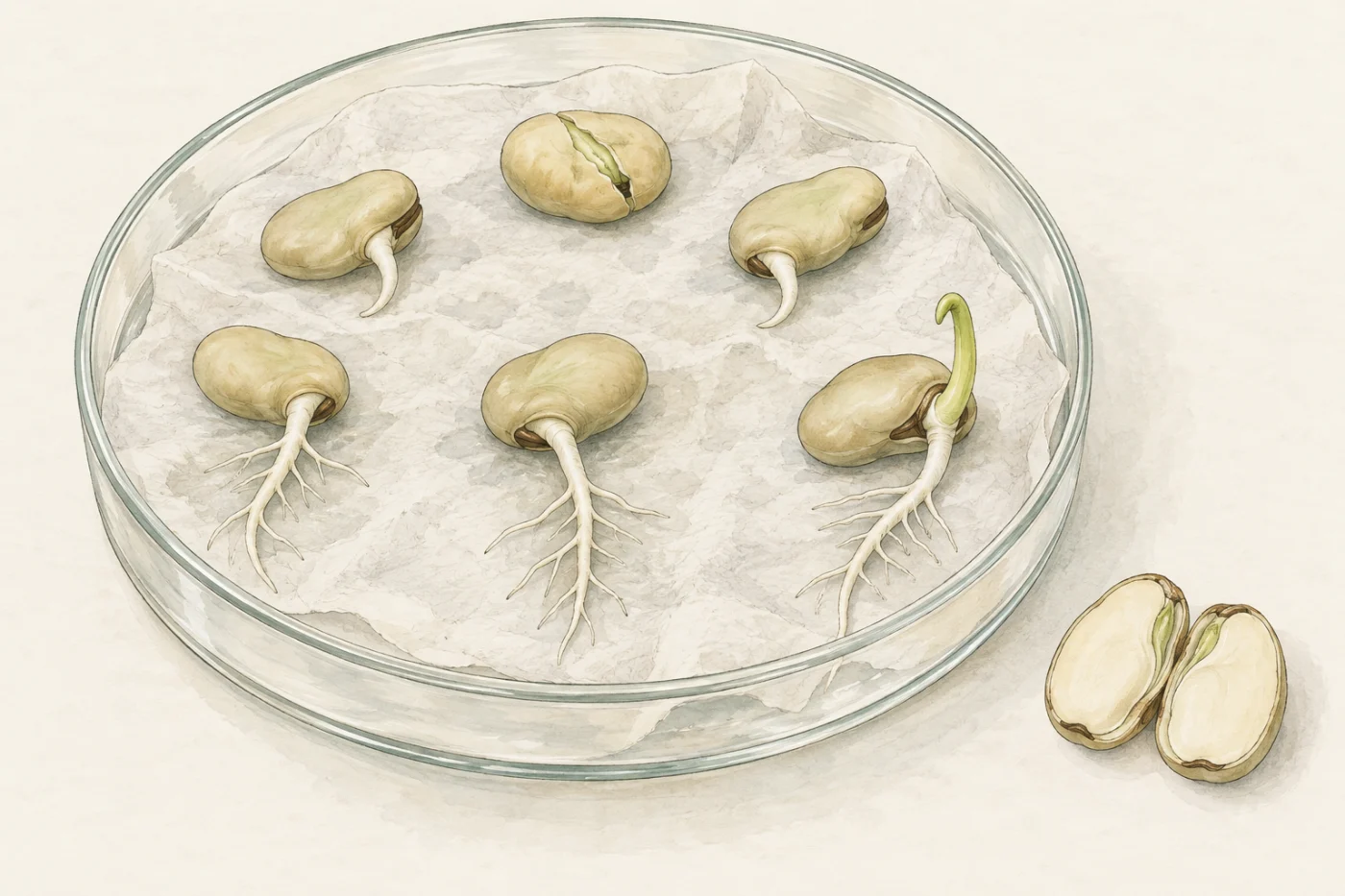
A germinating seed grows fast: its cells divide and make new proteins, so it needs a lot of energy. It respires the food stored in the seed. You can detect the heat released by its respiration.
 (enlarge)
A school method:
- Soak some peas in water for a day, so that they start to germinate. Boil a second batch of peas for 5 minutes to kill them, then let them cool.
- Rinse both batches in a dilute disinfectant. This kills microorganisms on the peas, which would respire too and give off heat of their own.
- Fill two vacuum flasks, one with each batch. Push a thermometer into the peas through a plug of cotton wool: it lets air in and out, so the peas have oxygen.
- Read both thermometers at the same time each day for three days.
A vacuum flask lets very little heat escape, so even a small amount of heat builds up and raises the temperature. The boiled peas are the control: they are the same in every way except that they are dead.
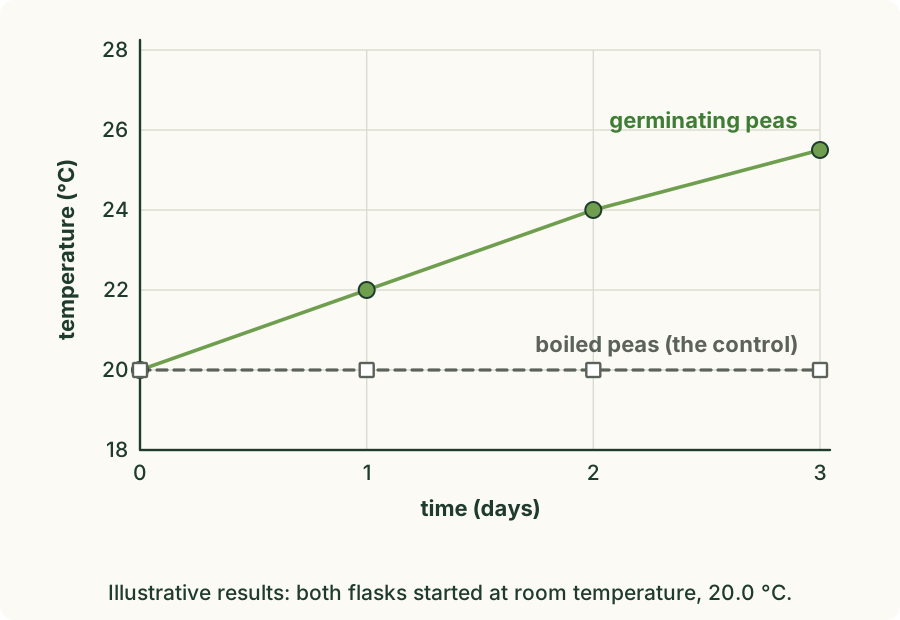
Illustrative results:
| Day | Germinating peas (°C) | Boiled peas (°C) |
|---|---|---|
| 0 | 20.0 | 20.0 |
| 1 | 22.0 | 20.0 |
| 2 | 24.0 | 20.0 |
| 3 | 25.5 | 20.0 |
 (enlarge)
The germinating peas warmed up by 5.5 °C in three days because they were respiring, and some of the energy they released escaped as heat. The boiled peas stayed at 20.0 °C because dead peas do not respire.
Trap: "The boiled peas cooled down because they were boiled." They were cooled to room temperature before the experiment started, and they stayed there. The difference is that they are dead, so they do not respire.
Mammals and birds use the heat released by respiration in the same way, to keep their bodies at a constant temperature.
Key idea: Living organisms use energy for muscle contraction, protein synthesis, cell division, active transport, growth, the passage of nerve impulses and the maintenance of a constant body temperature. Aerobic respiration is the chemical reactions in cells that use oxygen to break down nutrient molecules to release energy: glucose + oxygen → carbon dioxide + water (Supplement: C6H12O6 + 6O2 → 6CO2 + 6H2O). Respiration releases energy, it does not make it, and it is not the same as breathing. Germinating peas in a vacuum flask warm up because they respire; boiled peas, the control, do not.