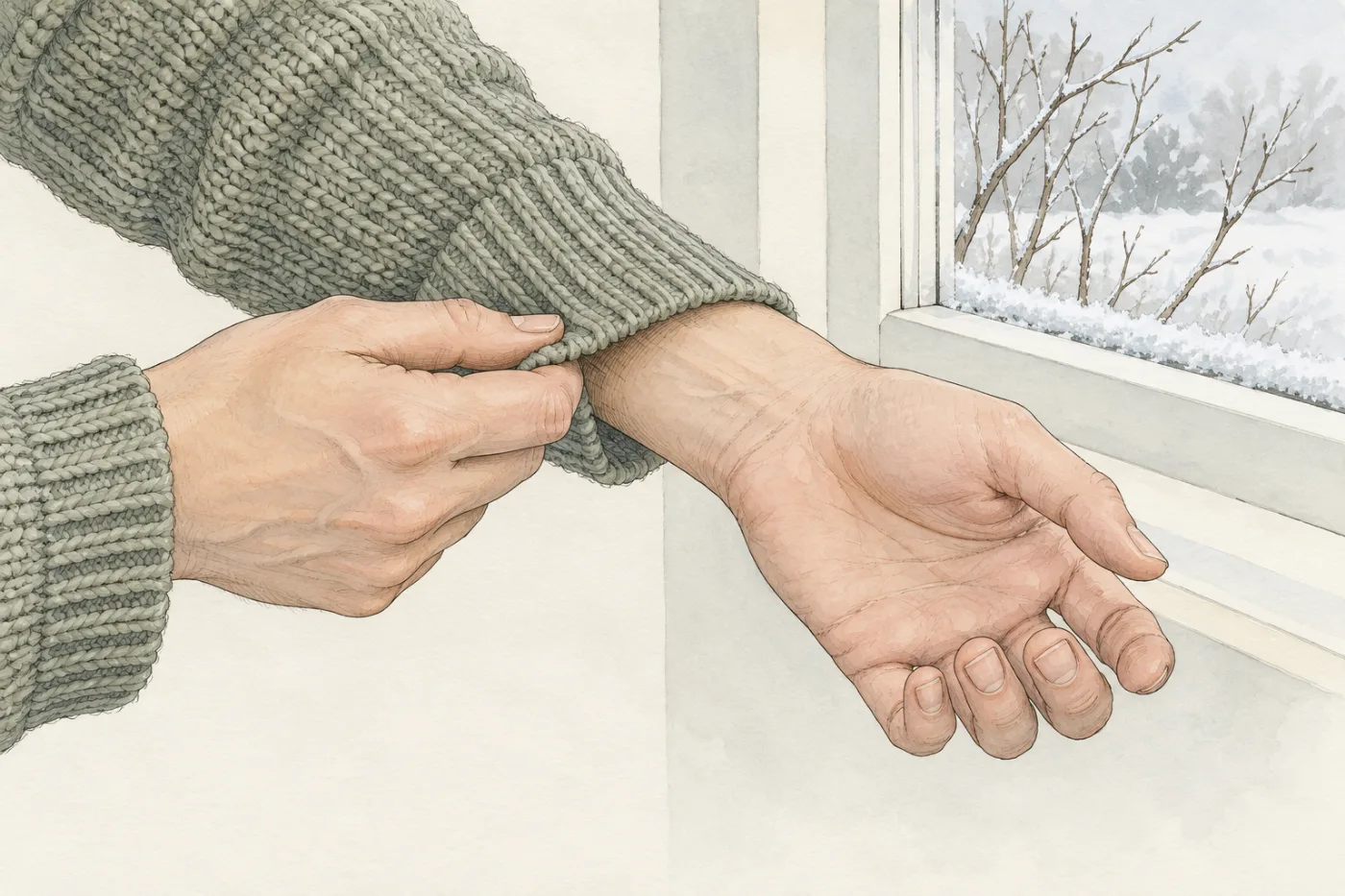
On a winter morning you step out of a warm kitchen into a cold porch to fetch something. Within a minute your hands and face feel cold, and you pull your sleeves down over your wrists. Yet a thermometer under your tongue would show almost exactly the same reading as in the kitchen. The outside of your body has changed a lot; the inside has hardly changed at all. In this part you measure both on a model person and find out how the body keeps its inside steady.
 (enlarge)
A constant internal environment
The cells of your body are bathed in a liquid, and the conditions in that liquid are called the internal environment: for example its temperature and the concentration of glucose dissolved in the blood. Your cells work best when these conditions stay within narrow limits. The enzymes that speed up the reactions in your cells, for example, work fastest close to 37 °C.
Homeostasis is the maintenance of a constant internal environment. "Constant" does not mean that nothing ever changes. It means that each condition is kept close to one value, its set point, and that when it moves a little away from it, the body brings it back. For the temperature inside the body the set point is about 37 °C.
Trap: "Homeostasis keeps everything in the body exactly the same." It keeps conditions close to a set point. They still change a little, for example by a few tenths of a degree, and the body brings them back.
Two temperatures: core and skin
The body has two temperatures worth measuring, and they behave very differently:
- the core temperature: the temperature deep inside the body, around the brain, heart and liver. This is the one that homeostasis keeps near 37 °C;
- the skin temperature: the temperature at the surface of the body, for example of the forearm. It changes a lot with the surroundings.
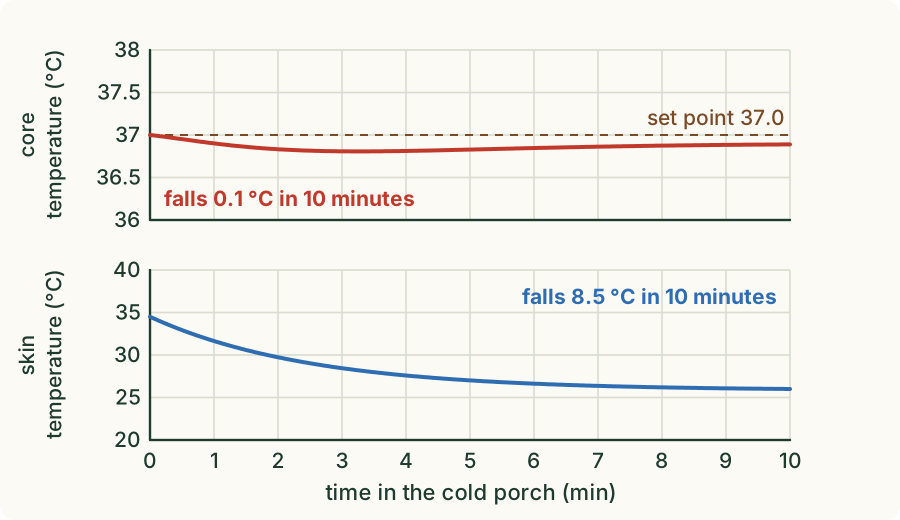
The graphs show both for a model person: typical values, not anyone's own body. The person stands still in indoor clothes for 10 minutes in a cold porch at 5 °C after being in a warm room. Each graph has its own scale: the core temperature from 36 to 38 °C, the skin temperature from 20 to 40 °C.
 (enlarge)
The skin temperature falls from 34.5 °C to 26.0 °C: by 8.5 °C. The core temperature dips to 36.8 °C after about 3 minutes and then comes back up: after 10 minutes it is 36.9 °C, only 0.1 °C below where it started. The surroundings changed by 25 °C (from 30 °C in the warm room to 5 °C in the porch), the skin by 8.5 °C and the core by a tenth of a degree. That is homeostasis on a graph.
Trap: "The skin temperature is the body temperature." The skin's temperature changes a lot with the surroundings. The temperature that homeostasis keeps constant is the core temperature, deep inside the body.
(Supplement) Keeping warm in the cold
When the core temperature starts to fall, the body reduces the heat it loses and releases more heat. Four things help:
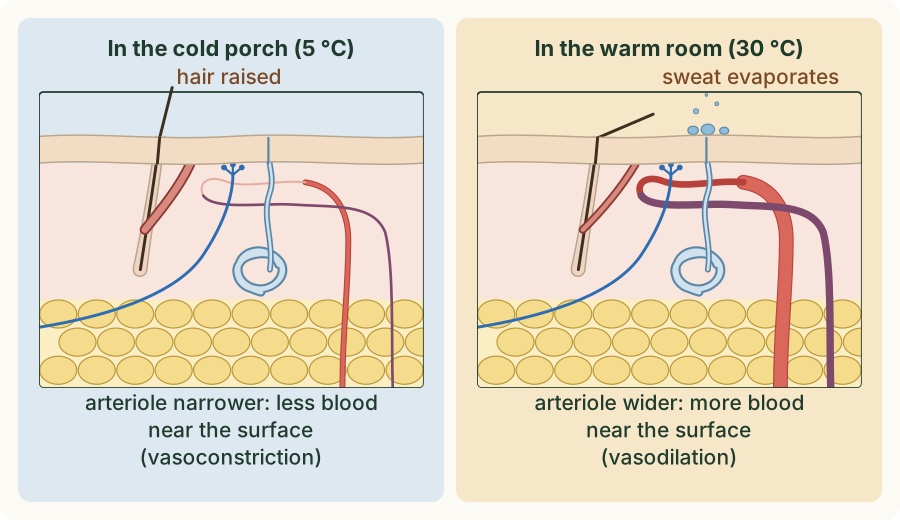
- Vasoconstriction. The arterioles (small arteries) that supply the capillaries near the skin surface become narrower. Less blood flows close to the surface, so less heat is carried to the skin and lost to the air. This is why the skin cools so much: the body lets the skin get cold to keep the core warm.
- Shivering. Muscles contract and relax quickly, over and over. The muscle cells respire faster, and respiration releases heat.
- Hairs raised. A tiny hair erector muscle joined to each hair contracts and pulls the hair upright, giving goose bumps. Raised hairs trap a layer of air, which is a poor conductor of heat. In furry mammals this is good insulation; in humans the hairs are so short that it helps very little.
- Insulation by fatty tissue. The layer of fatty tissue under the skin conducts heat poorly and slows the loss of heat from the core all the time.
Trap: "In the cold, the blood vessels move away from the skin surface." Blood vessels do not move. The arterioles that supply the surface capillaries become narrower, so less blood flows through the capillaries near the surface.
(Supplement) Cooling down in the warm
When the core temperature starts to rise, the body increases the heat it loses:
- Vasodilation. The arterioles that supply the surface capillaries become wider. More blood flows close to the surface, and more heat is lost from the skin to the air. The skin looks pinker and feels warm.
- Sweating. Sweat glands in the skin release sweat onto the surface. When the water in sweat evaporates, it takes heat from the skin, and the skin cools.
- The hairs lie flat, so little air is trapped next to the skin.
 (enlarge)
Trap: "Sweat cools you because sweat is cold." Sweat comes out at about skin temperature. It cools the skin because evaporating water takes heat from the skin.
Run the experiment below before you read on. First predict what the cold porch will do to the core temperature. Then walk the person into the porch: the 10 minutes are sped up, and the monitor above the doorway draws the core and the skin temperature. Read both after 10 minutes. With the Supplement steps, look through the skin magnifier at what changes in the cold. Then walk the person back into the warm room and watch the skin again.
What the experiment showed
In the porch the skin temperature fell from 34.5 °C to 26.0 °C, but the core temperature dipped only to 36.8 °C and was back at 36.9 °C after 10 minutes. In the magnifier, the arteriole supplying the surface capillaries narrowed, the hair erector muscle raised the hair and the person shivered. Back in the warm room the arteriole widened, sweat appeared on the surface and evaporated, and the core temperature rose only to 37.1 °C before settling at 37.0 °C. Whatever the room, the core stayed within a few tenths of a degree of 37 °C.
Worked example
What homeostasis means
A student writes: "Homeostasis means the body temperature never changes." Correct the statement.
Homeostasis is the maintenance of a constant internal environment: conditions such as the core temperature are kept close to a set point (about 37 °C), not exactly the same. The core temperature does change a little, for example from 37.0 °C to 36.8 °C in a cold porch, and the body brings it back. The skin temperature changes much more.
Worked example
Reading the two graphs
From the porch graphs, find how much the skin temperature and the core temperature fell in 10 minutes, and say what the difference shows.
The skin fell from 34.5 °C to 26.0 °C: 34.5 − 26.0 = 8.5 °C. The core fell from 37.0 °C to 36.9 °C: 37.0 − 36.9 = 0.1 °C. Read each value on its own graph's scale. The core changed far less than the skin: the core temperature is kept near its set point, which is homeostasis.
Worked example
(Supplement) Pale in the cold, flushed in the warm
Explain why a person's skin looks paler after some time in a cold porch and pinker after some time in a warm room, and how each change helps to keep the core temperature near 37 °C.
In the cold the arterioles supplying the capillaries near the skin surface become narrower (vasoconstriction). Less blood flows near the surface, so the skin looks paler, and less heat is carried to the skin and lost to the air. In the warm the same arterioles become wider (vasodilation). More blood flows near the surface, so the skin looks pinker, and more heat is lost. Either way the core temperature stays near 37 °C. Blood vessels do not move: only the width of the arterioles changes.
Key idea: Homeostasis is the maintenance of a constant internal environment: conditions such as the core temperature are kept close to a set point (about 37 °C) while the surroundings and the skin temperature change a lot. In the cold, arterioles supplying the skin surface capillaries narrow (vasoconstriction), muscles shiver, hairs are raised and fatty tissue insulates. In the warm, the arterioles widen (vasodilation) and sweat glands release sweat, which cools the skin as it evaporates.