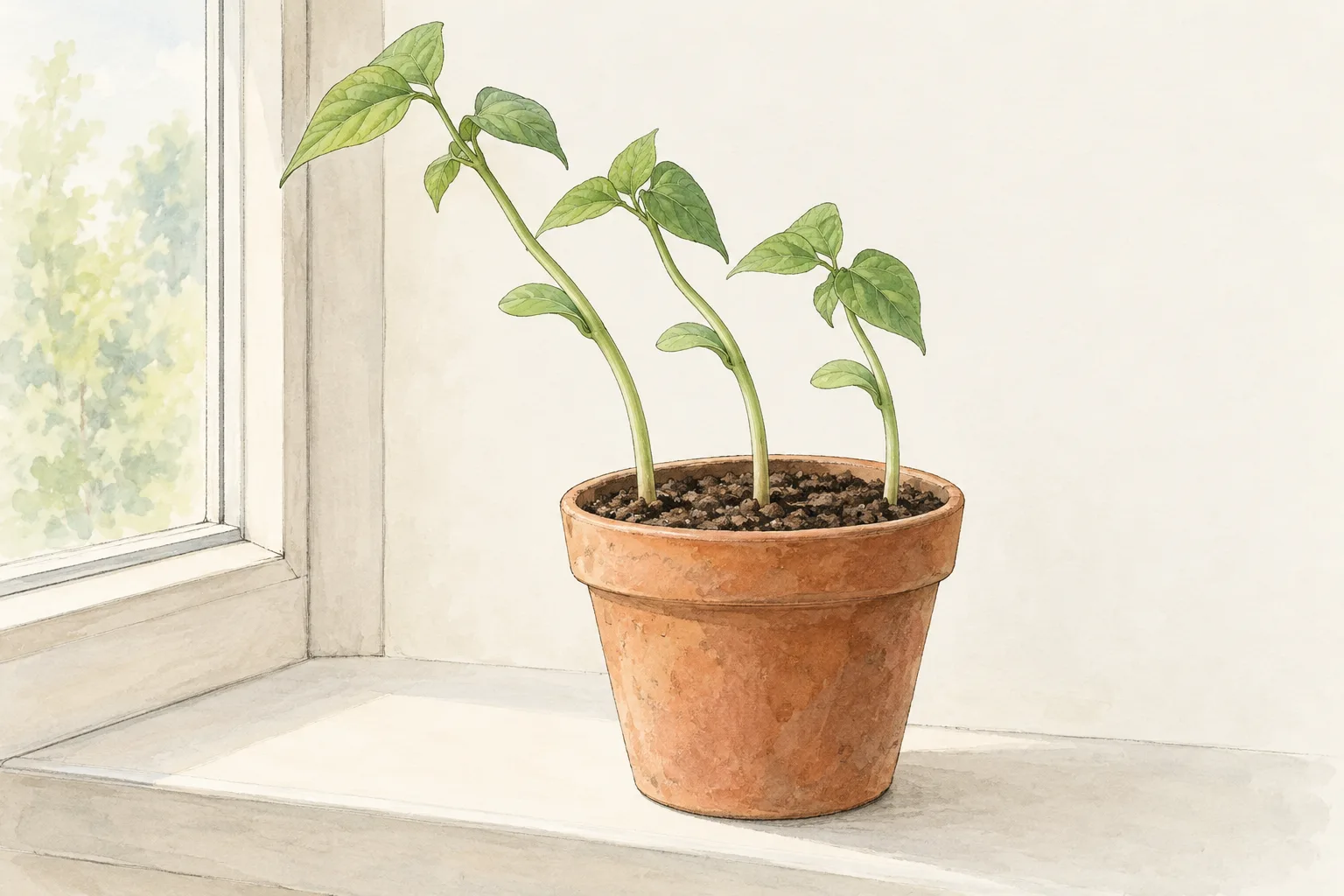
Leave a pot of seedlings on a windowsill for a few days and every shoot ends up leaning towards the glass. Turn the pot round and within a day or two the shoots lean the other way. Nobody pushed them, and a shoot has no muscles to bend with, so how does it end up pointing at the window? In this part you grow young oat seedlings in a box lit from one side, cover different parts of them, and measure how far each one bends. That tells you which part of a shoot reacts to the light.
 (enlarge)
Growing towards the light
Look closely at a shoot on the windowsill and you will see that it is not bent at a joint, like a finger. It is curved smoothly, because it has grown more on the side away from the window than on the side facing it. Over a day or two the extra growth on the shaded side turns the shoot round until its tip points at the light.
Phototropism is a response in which parts of a plant grow towards or away from the direction of the light source. Shoots grow towards the light. Some roots grow away from it, as you will see in the next part. Because the shoot responds by growing, the response is slow: it takes hours, not seconds.
Trap: "The shoot bends towards the light because it wants light for photosynthesis." A plant has no wants and decides nothing. The cells on the two sides of the shoot grow by different amounts, and the curve is the result. Growing towards the light does help the leaves absorb more light for photosynthesis: that is why the response is useful, not what makes it happen.
Oat seedlings in a box with a slit
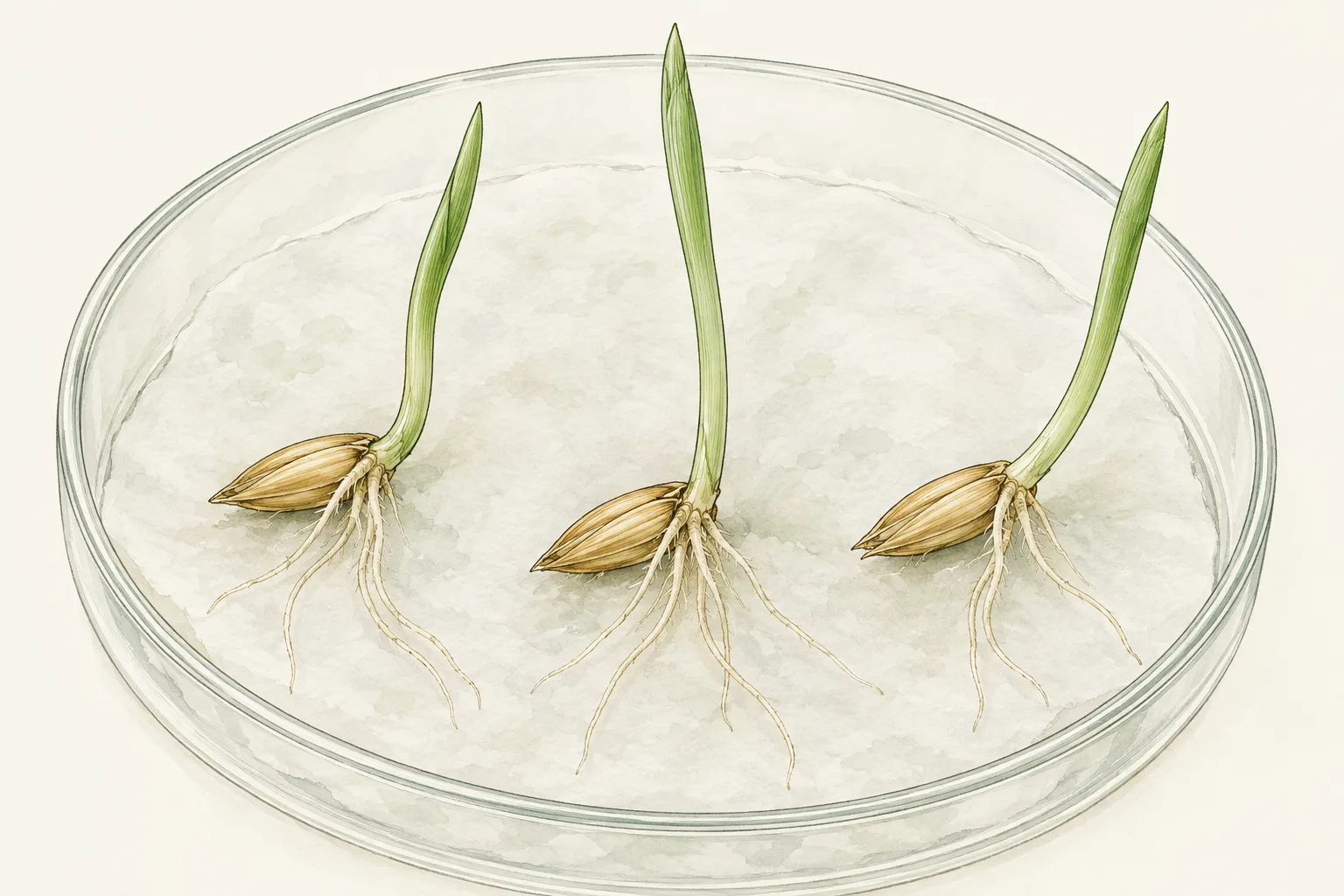
Which part of a shoot reacts to the light: the tip, the middle or the base? To find out you need a shoot that is easy to cover in parts, and a young oat seedling is ideal. Its first shoot is a coleoptile: a smooth, pale green sheath that grows straight up out of the grain and protects the first leaf folded inside it. It has no leaves to get in the way, and its tip is a neat point that a small cap fits over.
 (enlarge)
The seedlings grow in four pots, five in each, inside a box that is black inside. The only light comes from a lamp through a narrow slit in the left side of the box, so it reaches the shoots from one side only. Each pot gets one change:
- Pot A: the shoots are left as they are.
- Pot B: each tip is covered with a small cap of aluminium foil, which light cannot pass through.
- Pot C: each tip is covered with a cap of clear plastic, which lets the light through.
- Pot D: each shoot has a narrow collar of foil just below its tip, and the tip itself is uncovered.
Pots C and D are controls for pot B. If the shoots with foil caps behave differently, you want to be sure that it is because their tips are in the dark. Pot C rules out the cap itself: its shoots wear caps too, but clear ones. Pot D rules out covering any part of the shoot: its shoots wear foil too, but not on the tip. Everything else is kept the same for all four pots: seedlings of the same age, the same compost and water, the same temperature and the same lamp.
Before you read on, predict: under the light from the slit, which of the four pots will bend, and which way?
Measuring the bend
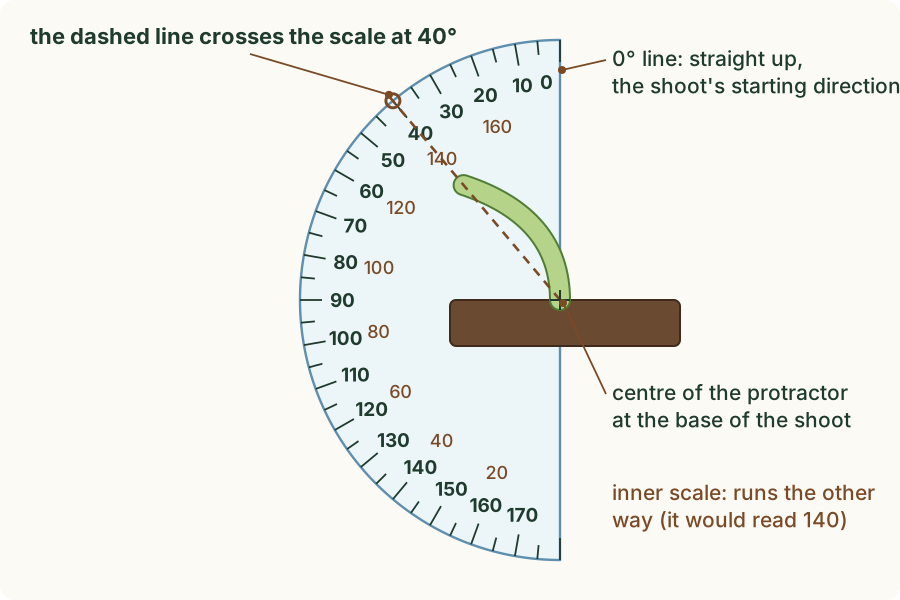
"It bent a bit" is hard to compare, so you measure a bend angle. In each pot one seedling is marked, and the same seedling is measured every 6 hours for a day. Place the centre of the protractor at the base of the shoot, where it comes out of the compost, with the 0° line along the shoot's starting direction, straight up. Then read the scale where the straight line from the base to the tip crosses it.
 (enlarge)
Trap: "Read the protractor where the shoot touches it." The shoot is curved, so it touches the scale nowhere useful. Read where the straight line from the base to the tip crosses the scale, on the scale that starts at 0° on the upright line.
Run the experiment below before you read on. First predict what the foil caps will do. Then cap the tips in pot B, choose the controls for pots C and D, and switch on the lamp: the day is sped up. Read the bend angle of the marked seedling in pot A yourself, then measure the others and watch the graph.
What the experiment showed
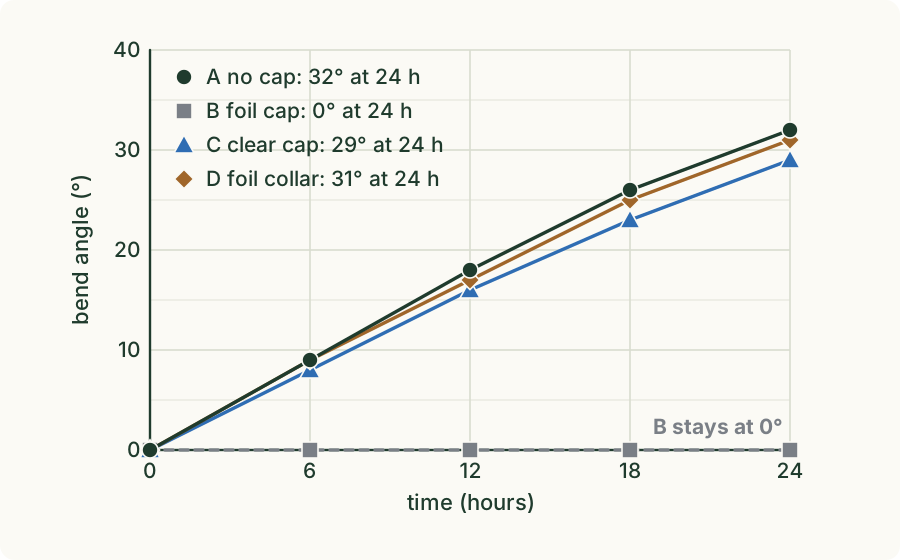
After a day, the shoots in pots A, C and D had all curved towards the slit, and the marked seedlings had bend angles of 32°, 29° and 31°. The shoots with foil caps in pot B grew just as tall as the others, from 20 mm to 30 mm, but they stayed straight: 0°.
 (enlarge)
So the direction of the light is detected by the tip. Only when the tip was in the dark did the shoot fail to bend; a clear cap or a foil collar below the tip made almost no difference. Yet the curve itself forms a little way below the tip, in the part of the shoot that is still growing longer. Something must pass from the tip to the region below it, and the Supplement part finds out what it is.
Trap: "The foil caps stopped the shoots growing." The capped shoots grew as much as the others, by 10 mm in a day. The caps stopped them bending, not growing.
A shoot lit evenly from above grows straight up, as all four would in an ordinary greenhouse. It is light from one side that makes a shoot bend.
Worked example
Is it phototropism?
A house plant on a table is lit only by a window on its right. After a week its shoots point to the right. Describe the response.
The shoots have grown towards the direction of the light source, so this is phototropism. The shoots grew more on their shaded (left) side than on their lit side, so they curved round to the right, towards the window. It is a growth response: it took days, and the shoots did not move like a muscle.
Worked example
Reading a bend angle
A cress seedling is lit from one side for a day. The protractor is centred at the base of its shoot with 0° straight up, and the line from the base to the tip crosses the scale at 40°. At the start, the same shoot read 0°. What is its bend angle, and has it responded?
The bend angle is read where the base-to-tip line crosses the scale: 40° from the upright. It started at 0°, so the shoot has turned by 40° towards the light: it has responded. Check that you read the scale that starts at 0° on the upright line; the other scale on the same protractor would give 140°.
Worked example
What the controls show
A student covers the tips of some oat shoots with foil caps, and leaves other shoots uncovered. Only the uncovered shoots bend towards the light. The student concludes that the tip detects the light. Explain why a teacher asks for shoots with clear caps and shoots with foil collars as well.
The capped and uncovered shoots differ in two ways: the capped tips are in the dark, but they also carry a cap. Shoots with clear caps carry a cap but are lit at the tip; if they bend, the cap itself does not stop the response. Shoots with foil collars have foil on them but a lit tip; if they bend, covering part of a shoot does not stop it either. Only then is darkness at the tip the one difference left.
Worked example
An anomaly, a mean and a rate
Five cress shoots in one dish were lit from one side for a day. Their bend angles were 34°, 30°, 11°, 32° and 28°. One of them also grew from 18 mm to 29 mm long in the 24 hours. Find the anomalous result, the mean bend angle without it, and the shoot's mean rate of growth to 2 significant figures.
The anomaly. Four angles lie between 28° and 34°, close together, but 11° is far from all of them, so 11° is the anomalous result. Perhaps that shoot was damaged or its tip was covered. You leave it out of the mean, because it would pull the mean down.
The mean. Add the other four and divide by how many you added: (34 + 30 + 32 + 28) ÷ 4 = 124 ÷ 4 = 31°.
The rate. A rate is a change divided by the time it took. First find the increase in length: 29 − 18 = 11 mm. Then divide by the time: 11 ÷ 24 = 0.4583… mm per hour. To 2 significant figures this is 0.46 mm per hour. Dividing the final length, 29 mm, by the time would be wrong, because the shoot was already 18 mm long at the start.
A rate of decrease. The same method works for something that gets smaller. A shoot's angle from the upright fell from 65° at 1 hour to 35° at 6 hours. The decrease is 65 − 35 = 30°, and the time between the two readings is 6 − 1 = 5 hours, so the mean rate of decrease is 30 ÷ 5 = 6° per hour.