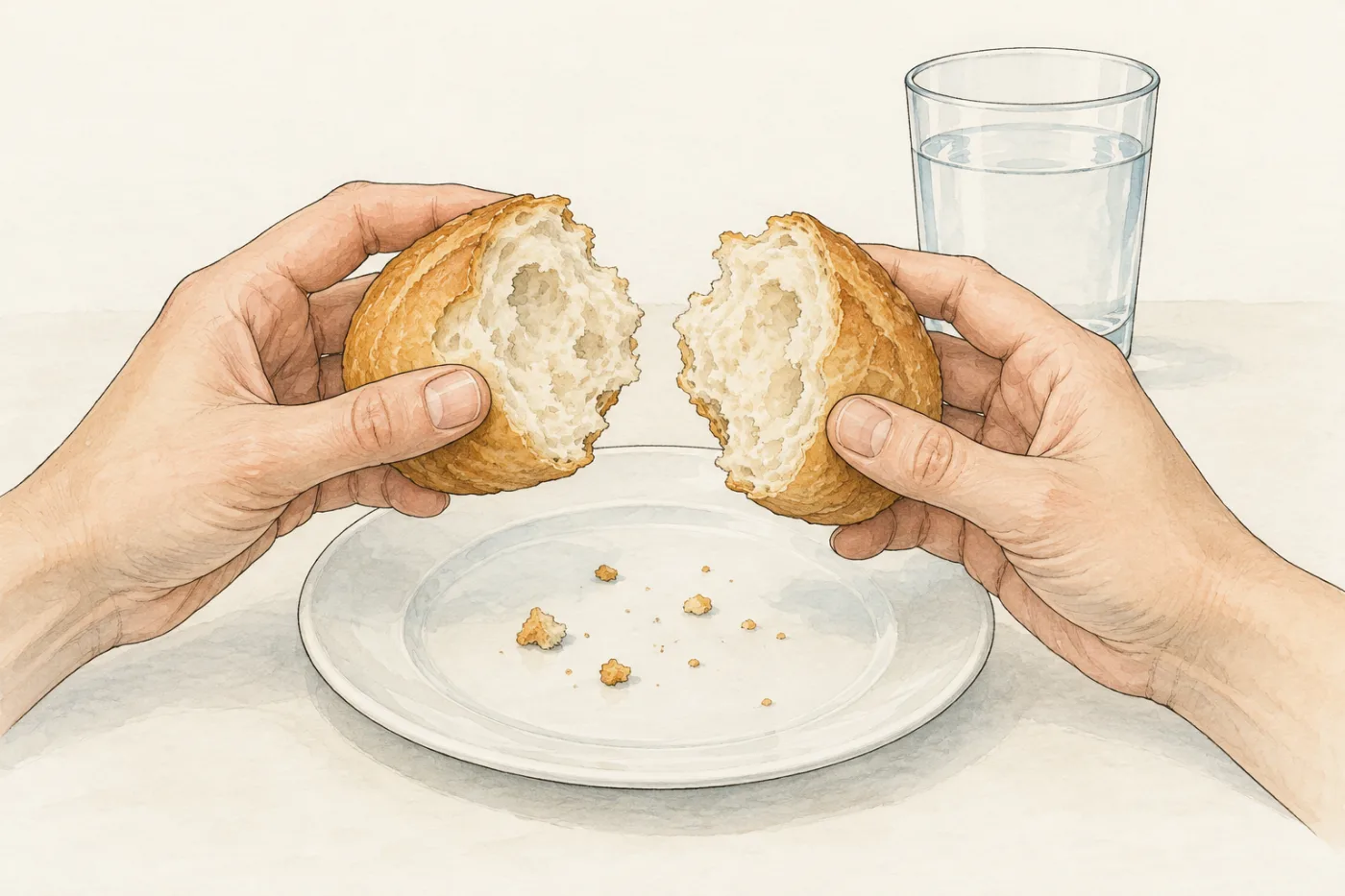
A bread roll is mostly starch. An hour after you eat it, there is more glucose in your blood. Yet the bread has hardly any glucose in it, and a starch molecule never gets into your blood. So somewhere between your mouth and your blood, the starch has been changed. In this part you build a model gut out of thin, see-through tubing and find out what changes the starch and why the change matters.
 (enlarge)
Two bags of starch
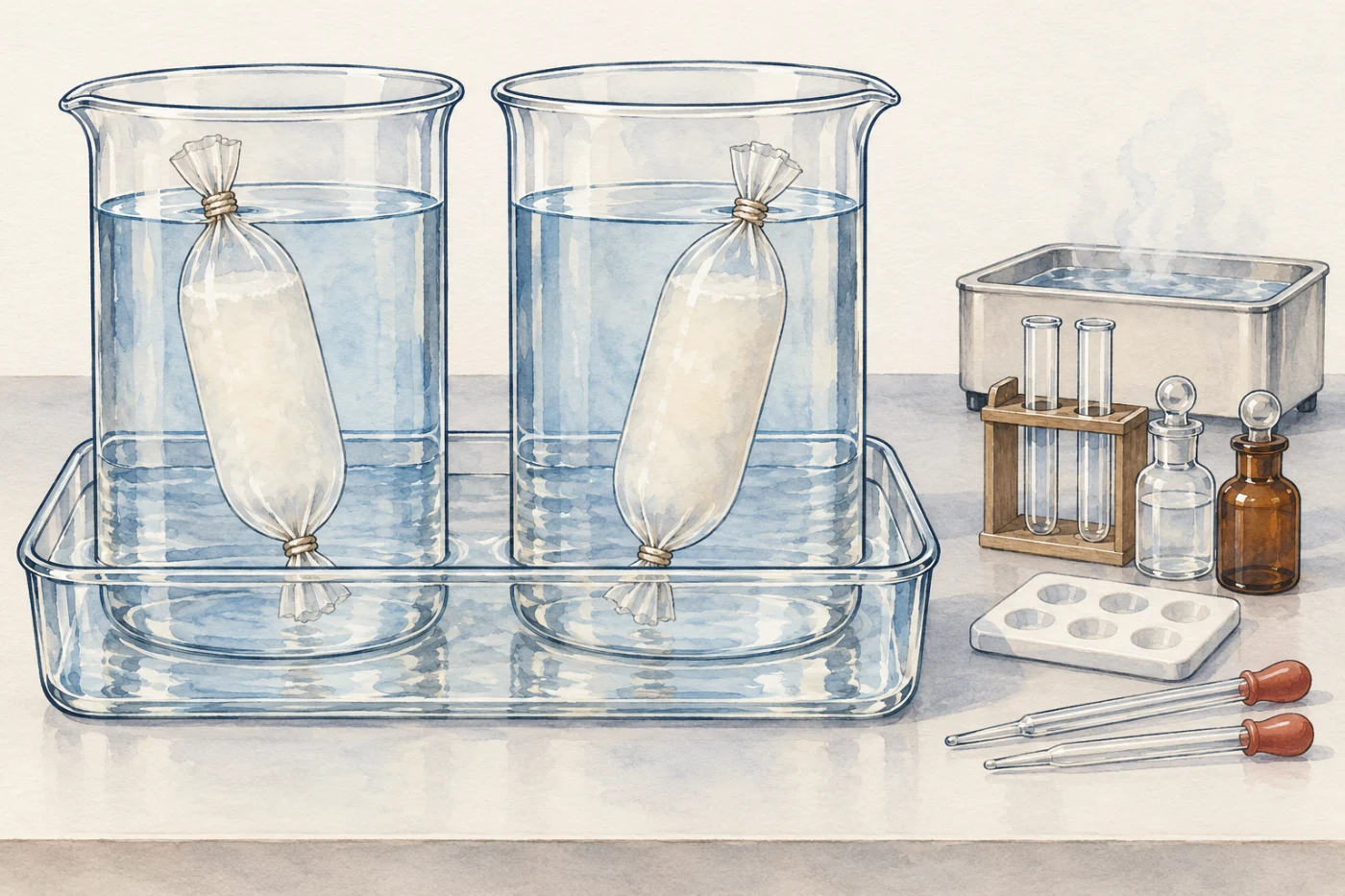
Visking tubing is a thin tube of cellulose with tiny holes in its wall, far too small to see. Water and small molecules can pass through the holes; large molecules cannot. A piece of tubing knotted at one end makes a bag, a little like a short piece of gut.
Two bags are filled with the same volume of a cloudy starch suspension: starch stirred into water. Bag A also gets a little amylase, an enzyme made in your salivary glands and pancreas. Bag B gets the same volume of water instead. Bag B is the control: it is set up like bag A in every way except the one thing being tested, the amylase. Each bag hangs in a beaker of water in a water bath at 37 °C, the temperature of the body.
Every 10 minutes you take a sample of the water outside each bag, with a separate clean pipette for each beaker, and test it twice:
- one drop goes onto a white spotting tile with a drop of iodine solution. Iodine stays yellow-brown on its own and turns blue-black if there is starch;
- the rest goes into a test tube with Benedict's solution, which is blue. In a hot water bath at about 80 °C it turns green, yellow, orange or brick red if there is a reducing sugar, such as the sugar made from starch. The more sugar there is, the further along that list the colour goes.
The reagents never go into the bags: you test only the water you have taken out.
Predict first: after 20 minutes, what will the water outside bag A contain? Sugar only, starch and sugar, starch only, or neither? Make your prediction, then run the experiment below before you read on.
 (enlarge)
What the tests showed
| Sample of the water outside | Iodine | Benedict's after heating |
|---|---|---|
| bag A, 0 min | yellow-brown | blue |
| bag A, 10 min | yellow-brown | green |
| bag A, 20 min | yellow-brown | orange |
| bag B, 0, 10 and 20 min | yellow-brown | blue |
Iodine never turned blue-black, so no starch got out of either bag. Outside bag A, Benedict's went from blue to green to orange: a reducing sugar was coming out through the tubing, more and more of it as time went on. Outside bag B there was never any sugar.
The two bags were the same except for the amylase, so the amylase must have made the sugar. Without bag B you could not be sure: perhaps starch slowly breaks down on its own in warm water. Bag B shows that it does not. At 0 minutes both bags give the same result, which shows that the water outside started with no sugar in it.
The times and colours come from the experiment's model, a simple teaching model of a strong amylase solution. A real experiment can take longer, depending on how much amylase is used, but the pattern is the same.
Too big to get through
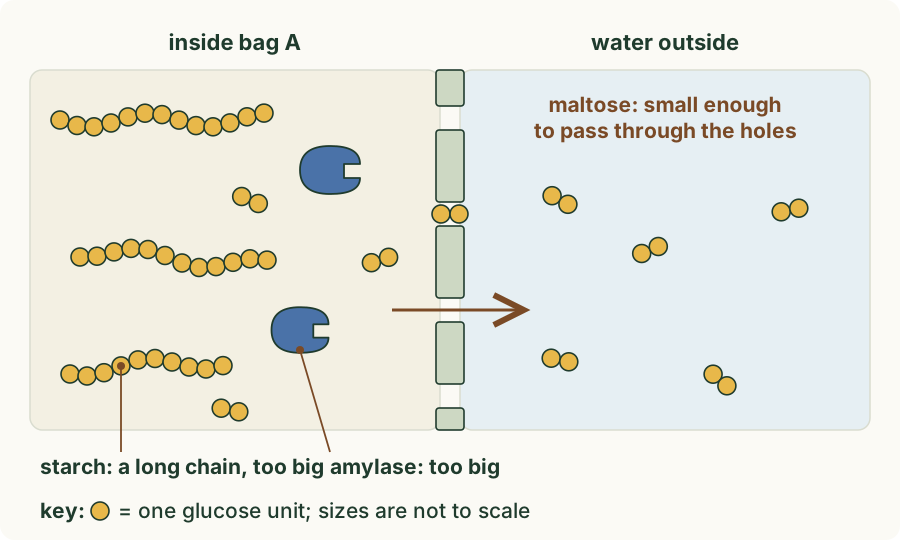
A starch molecule is a very long chain of glucose units joined together, thousands of them. It is a large, insoluble molecule: far too big to pass through the holes in the tubing, and it does not dissolve in water. Amylase breaks the chain into pieces only two glucose units long. That piece is a reducing sugar called maltose: a small, soluble molecule that dissolves in water and slips through the holes. Amylase is a protein, also a large molecule, so it stays in the bag.
 (enlarge)
This is chemical digestion: the breakdown of large insoluble molecules into small soluble molecules. It is done by enzymes, and it makes new substances, so it is a chemical change. Chewing, the physical digestion of the last module, only breaks food into smaller pieces of the same molecules.
Trap: "The starch got out of bag A and then showed up as sugar." Iodine never turned blue-black outside either bag, so no starch got out. The sugar was made inside bag A, and only the small sugar molecules could pass through the wall.
Worked example
A bag of egg white
A Visking bag holds crumbs of boiled egg white, which is mostly protein, mixed with a protease, an enzyme that digests protein. It hangs in water at 37 °C for 30 minutes. Which of these could be found in the water outside the bag: protein, protease, amino acids? Explain.
Ask of each substance: is it a small soluble molecule that can pass through the holes? Protein molecules are large and insoluble, so they stay in the bag. The protease is a protein too, a large molecule, so it stays in the bag as well. The protease breaks protein down into amino acids, small soluble molecules, so only the amino acids pass through the tubing into the water outside.
Why food has to be digested
Your gut has a wall too. After a meal, small food molecules pass through the wall of the small intestine into your blood, which carries them to every cell: this is absorption. Like the tubing, the wall lets small soluble molecules through but not large insoluble ones. A starch molecule cannot be absorbed; the small sugar molecules made from it can. That is why food has to be digested chemically before your body can use it.
The tubing is only a model of the gut wall. The real wall is made of living cells, and the inside of the small intestine is folded into millions of tiny projections that give it a huge surface for absorption; a later module looks at them.
Key idea: Chemical digestion is the breakdown of large insoluble molecules into small soluble molecules. Its role is to make small soluble molecules that can be absorbed through the wall of the small intestine into the blood.
Worked example
Which molecules can be absorbed?
A meal contains starch, protein and fat. Which of these molecules can be absorbed through the wall of the small intestine: starch, glucose, protein, amino acids, fat, fatty acids, glycerol?
Ask of each one: is it a small soluble molecule? Glucose, amino acids, fatty acids and glycerol are small soluble molecules, so they can be absorbed. Starch, protein and fat are large insoluble molecules, so they cannot be absorbed until enzymes have broken them down into those small molecules: starch into sugars, protein into amino acids, fat into fatty acids and glycerol. Part 2 looks at the enzymes that do each job.
Supplement: from starch to maltose to glucose
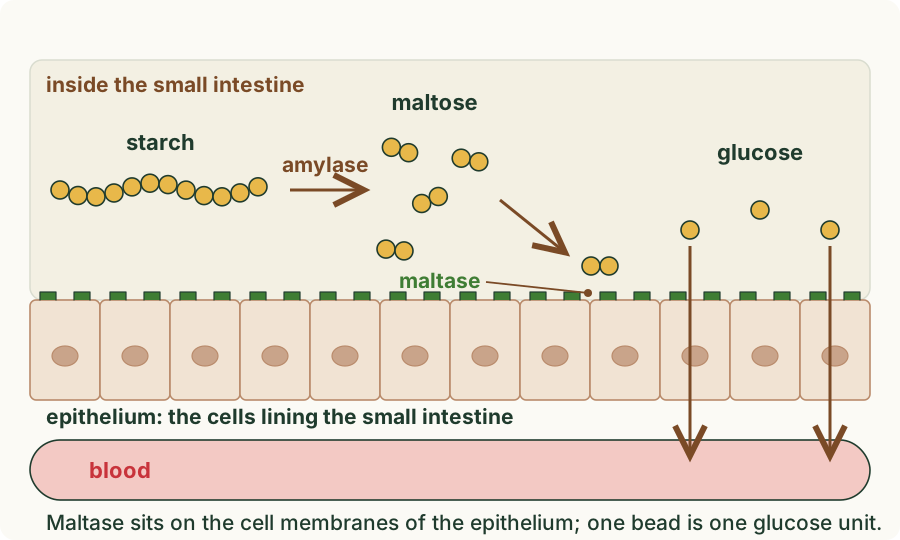
Maltose is still two glucose units joined together. The last step happens in the small intestine. Another enzyme, maltase, breaks each maltose molecule into two glucose molecules. Maltase is not poured into the gut like amylase: it sits on the cell membranes of the epithelium, the layer of cells lining the small intestine. Glucose is made right where it is absorbed.
 (enlarge)
Trap: "Amylase turns starch into glucose." Amylase breaks starch only as far as maltose. Maltase, on the membranes of the epithelium lining the small intestine, breaks maltose into glucose.
Worked example
The starch in a cracker
Supplement. Follow the starch in a cracker from your mouth into your blood, naming each enzyme and its product.
In the mouth, chewing breaks the cracker into small pieces, and amylase from the salivary glands starts breaking the starch down into maltose. In the small intestine, amylase from the pancreas breaks down the rest of the starch into maltose. Then maltase, on the membranes of the epithelium lining the small intestine, breaks the maltose down into glucose. Glucose is a small soluble molecule, so it is absorbed through the wall of the small intestine into the blood.