Breathe onto a cold mirror and a grey mist spreads across the glass, then fades. The air you breathe out has changed on its way through your body, but you cannot see how, because every gas in it is colourless. In this part you test the air you breathe in and the air you breathe out side by side, with two simple chemical tests, and find out what is different about them.
 (enlarge)
Two airs to compare
The air you breathe in is called inspired air, and the air you breathe out is expired air. Both are mixtures of gases. Most of each is nitrogen, and the rest is oxygen, a little carbon dioxide and some water vapour: water as a gas, which you cannot see. So the question is not which gases are there, but how much of each.
You can test two of them in a school laboratory.
- Limewater is a clear, colourless solution that turns cloudy (milky white) when carbon dioxide bubbles through it. The carbon dioxide reacts with it and makes tiny white specks of a solid that does not dissolve. The more carbon dioxide passes through, the sooner the limewater turns cloudy.
- Cobalt chloride paper is blue when it is dry and turns pink when it takes up water.
Limewater, air in and air out
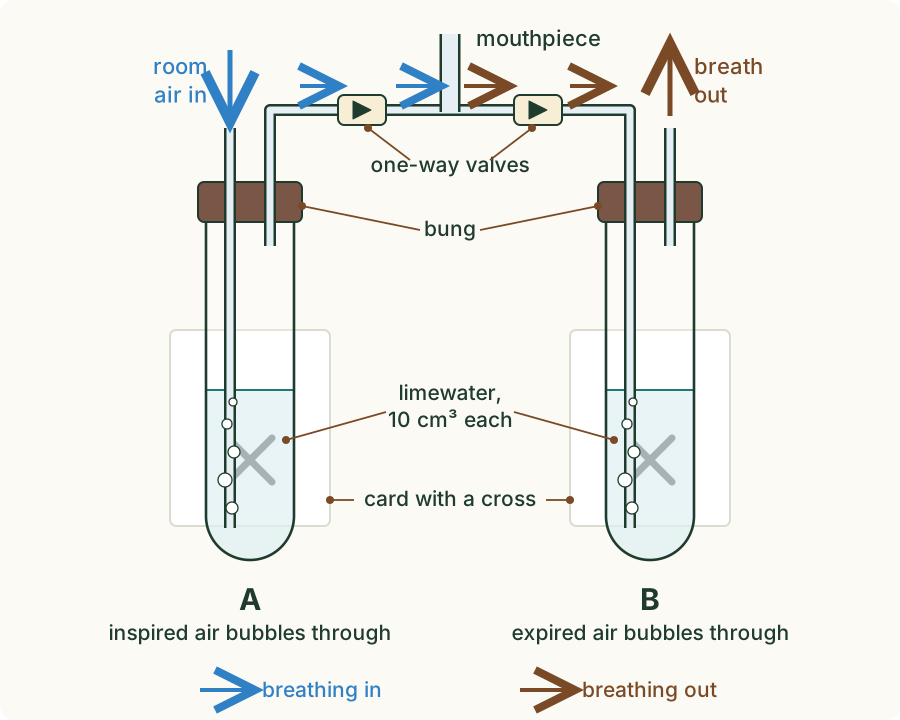
The apparatus has two boiling tubes (wide test tubes), A and B, with the same volume of limewater in each, joined to one mouthpiece. Each tube has a bung with two glass tubes through it: a long one that dips into the limewater, and a short one that ends above it.
 (enlarge)
- When you breathe in through the mouthpiece, you draw air out of tube A from above its limewater. Room air flows in to replace it down A's long tube, so the room air bubbles through A's limewater on its way to your mouth.
- When you breathe out, your breath goes down B's long tube and bubbles through B's limewater, then leaves through B's short tube.
Each tube to the mouthpiece has a one-way valve, a small part that lets air pass in one direction only. So breathing in can draw air only through A, and breathing out can push air only through B. The tube from A to the mouthpiece starts above the liquid, so it carries air, never limewater.
For a fair comparison, the two tubes must differ in one thing only: the air that passes through them. So they hold the same volume of limewater, they are the same size, and the breaths are ordinary ones. A black cross on a card behind each tube makes "cloudy" the same for both: you count the breaths until you can no longer see the cross through the limewater.
Run the experiment below before you read on. First predict which tube turns cloudy sooner; then breathe in and out through the mouthpiece, and afterwards breathe onto a cold mirror with cobalt chloride paper on it.
What the tubes showed
After 5 breaths, the cross behind tube B had disappeared: the limewater that your breath bubbled through was cloudy. After 20 breaths, the cross behind tube A could still be seen clearly. Both tubes had the same limewater and about the same amount of air through them, so the difference comes from the air. Expired air contains much more carbon dioxide than inspired air.
Trap: "Inspired air contains no carbon dioxide." It contains a little, about 0.04%. That is far too little to turn the limewater cloudy in 20 breaths, but if you kept going for hundreds of breaths, tube A would turn cloudy too.
What the mirror showed
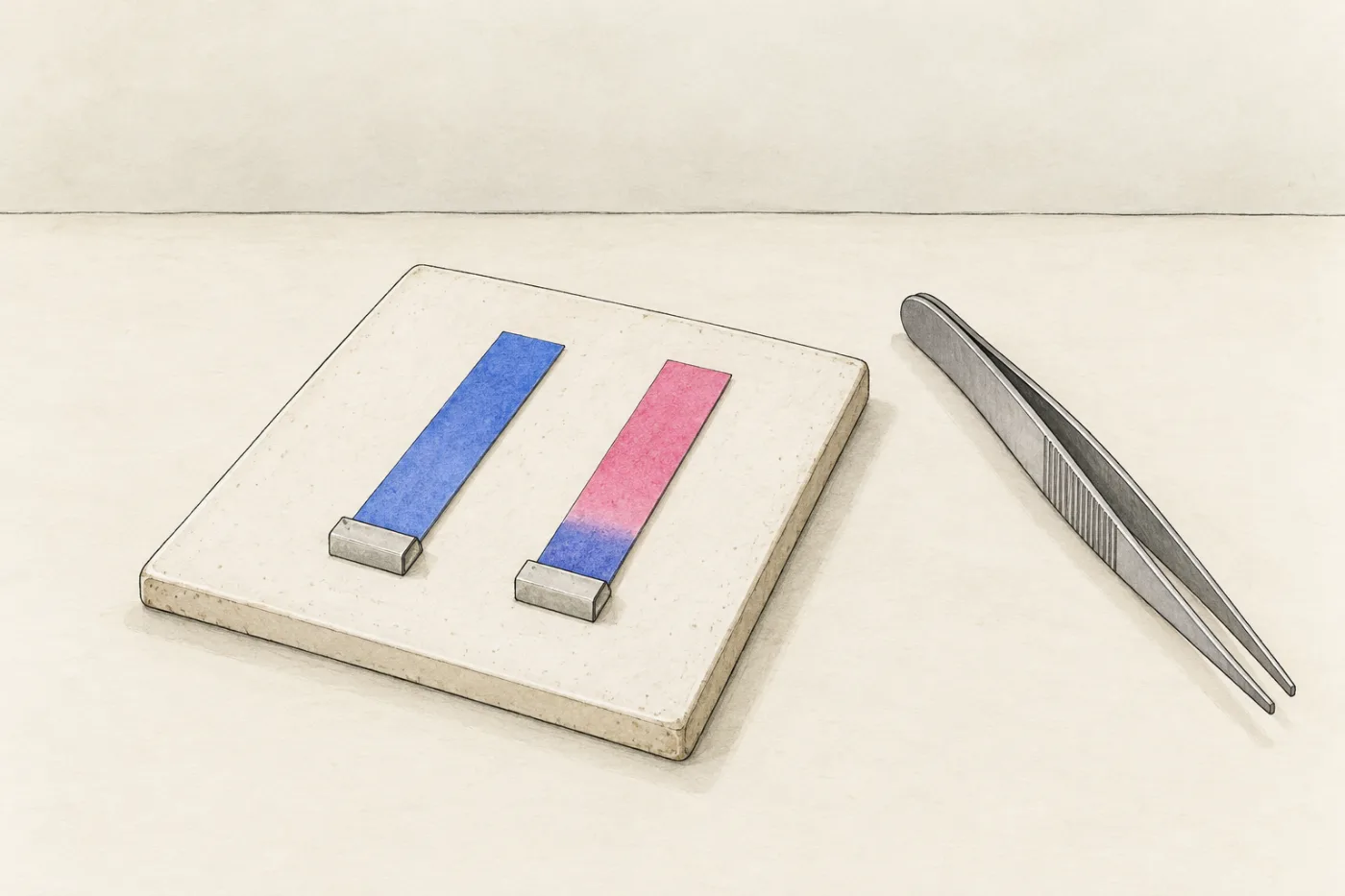
You breathed onto a cold mirror for 10 seconds with a strip of blue cobalt chloride paper stuck to it. The mirror misted over with tiny drops of water, because the water vapour in your breath condensed (turned back into liquid) on the cool glass, and the strip turned pink. A second strip, left on the tile in the room air for the same 10 seconds, stayed blue. That second strip is the control: it shows that room air alone does not turn the paper pink in that time. So expired air contains more water vapour than inspired air.
 (enlarge)
Inspired and expired air compared
Measurements with a gas analyser, a machine that measures how much of each gas a sample contains, give these typical figures:
| Gas | Inspired air | Expired air |
|---|---|---|
| Oxygen | 21% | 16% |
| Carbon dioxide | 0.04% | 4% |
| Water vapour | less (it varies with the weather) | more (the air is saturated) |
Saturated air holds as much water vapour as it can at its temperature. Expired air is also warmer than most room air. The nitrogen, about 78% of both, is not used by the body, so it does not change.
Your two tests agree with the table. Limewater showed the carbon dioxide: 4% is a hundred times 0.04% (4 ÷ 0.04 = 100), which is why tube B turned cloudy so much sooner. Cobalt chloride paper showed the water vapour. Neither test showed the oxygen: limewater does not react with oxygen, so the drop from 21% to 16% comes from the gas analyser, not from your tubes.
Trap: "We breathe in oxygen and breathe out carbon dioxide." Expired air still has plenty of oxygen in it, 16%, and only 4% carbon dioxide. Your body takes about a quarter of the oxygen out of each breath, and adds carbon dioxide and water vapour.
(Supplement) Why the air changes
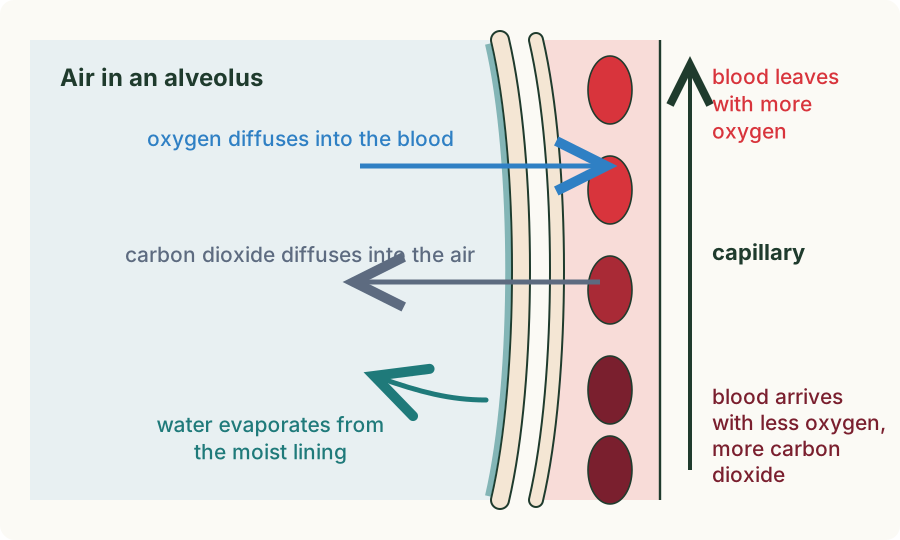
Deep in the lungs, the air reaches millions of tiny air sacs called alveoli, each wrapped in blood capillaries; part 2 looks at them closely. Everything that changes in the air happens there.
 (enlarge)
- Less oxygen. The air in an alveolus has a higher concentration of oxygen than the blood arriving in the capillary, so oxygen diffuses into the blood (it spreads from where there is more of it to where there is less). The blood carries it to the body's cells, which use it in aerobic respiration: glucose + oxygen → carbon dioxide + water.
- More carbon dioxide. The cells make carbon dioxide in respiration, and the blood carries it to the lungs. The blood arriving at an alveolus has a higher concentration of carbon dioxide than the air in it, so carbon dioxide diffuses out of the blood into the air, and you breathe it out.
- More water vapour. The lining of the alveoli is moist. Water evaporates from it into the air, which is warmed to body temperature on its way in, so the air leaves the lungs warm and saturated with water vapour.
Worked example
Reading the tubes
A pupil uses the two-tube apparatus. The cross behind tube B disappears after 6 breaths. After 25 breaths, the cross behind tube A can still be seen. What can the pupil conclude, and what can they not conclude?
The same volume of limewater was used in each tube and both received air from the same breaths, so the only difference is the air: expired air through B, inspired air through A. B turned cloudy far sooner, so expired air contains more carbon dioxide than inspired air. The pupil cannot conclude that inspired air contains no carbon dioxide: A might turn cloudy after many more breaths, and in fact inspired air has about 0.04%. Limewater says nothing about oxygen either.
Worked example
Making it fair
Another pupil puts 20 cm³ of limewater in tube A and 5 cm³ in tube B, and says that B turned cloudy first, so expired air has more carbon dioxide. Explain why the result is not a fair test, and how to make it fair.
A smaller volume of limewater turns cloudy with less carbon dioxide, so B, with only 5 cm³, would turn cloudy sooner even if both airs were the same. The result might come from the volumes, not from the air. To make it fair, put the same volume of limewater in each tube (for example 10 cm³), use the same size of tube, and judge "cloudy" the same way for both, such as counting the breaths until a cross behind the tube disappears.
Worked example
How many times more?
Use the table to find how many times more carbon dioxide there is in expired air than in inspired air, and what fraction of the oxygen in inspired air is kept by the body.
Carbon dioxide: 4% ÷ 0.04% = 100 times as much in expired air. Oxygen: 21% − 16% = 5% of the air is oxygen kept by the body, and 5 ÷ 21 ≈ 0.24, so the body keeps about a quarter of the oxygen it breathes in. Both answers are ratios of percentages, so they have no unit.
Worked example
Explaining the differences
(Supplement) Explain why expired air contains less oxygen, more carbon dioxide and more water vapour than inspired air.
In the alveoli, oxygen diffuses from the air into the blood, because the air has the higher concentration of oxygen; the blood takes it to the cells for aerobic respiration, so less oxygen leaves in expired air. The cells' respiration makes carbon dioxide, which the blood carries to the lungs, where it diffuses from the blood into the air in the alveoli, so expired air has more. Water evaporates from the moist lining of the alveoli into the air, so expired air leaves saturated with water vapour.
Key idea: Expired air contains less oxygen (about 16% instead of 21%), more carbon dioxide (about 4% instead of 0.04%) and more water vapour than inspired air. Limewater turns cloudy sooner with expired air, showing its extra carbon dioxide, and blue cobalt chloride paper turns pink with it, showing its extra water vapour. (Supplement) In the alveoli, oxygen diffuses into the blood and is used by cells in respiration, carbon dioxide made by respiration diffuses out of the blood into the air, and water evaporates from the moist lining.