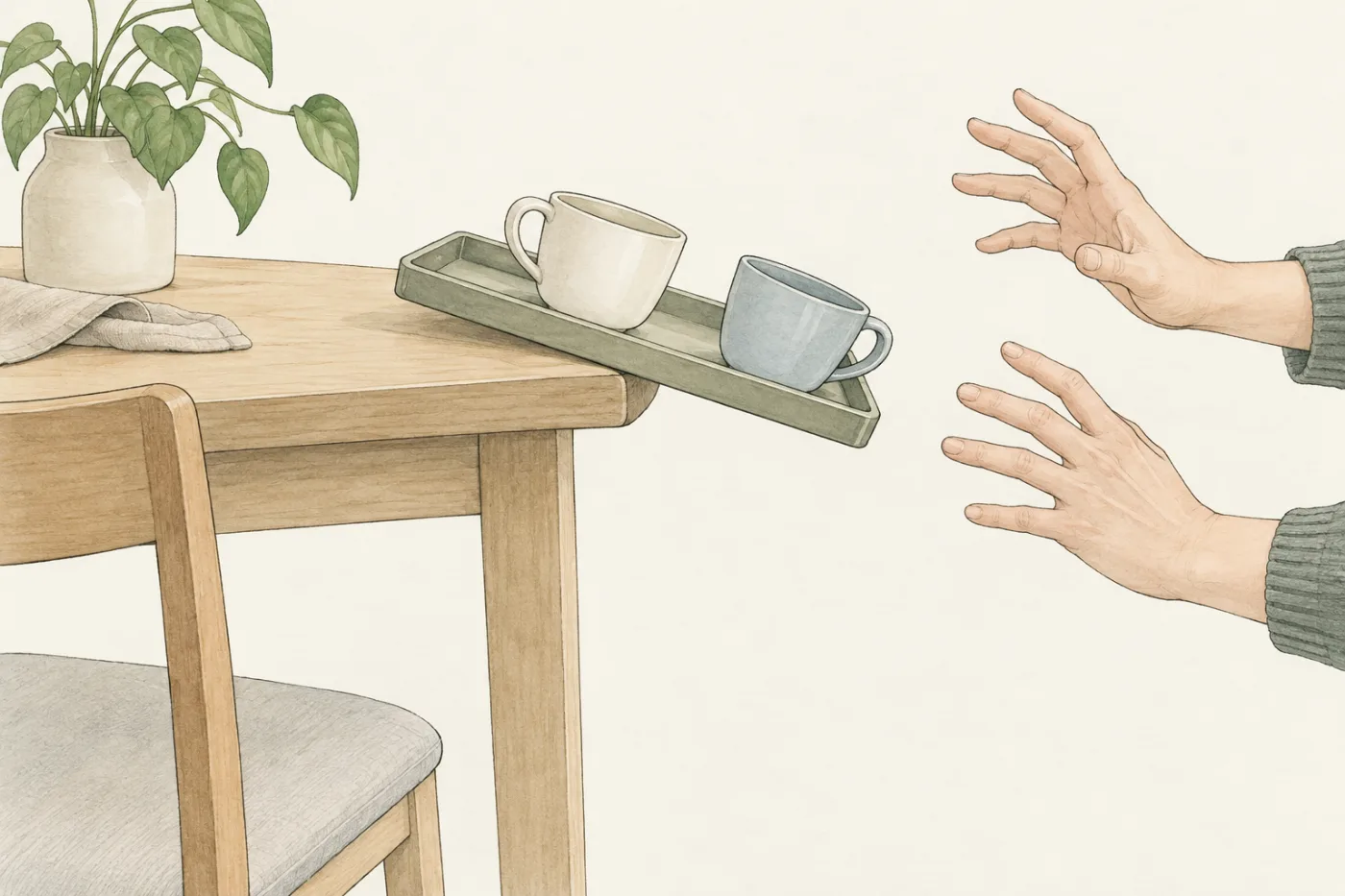
Your hand touches a mug that is far too hot, and before you have thought about it your hand is back in your lap. A minute later a tray of cups slips off the table behind you. You jump, and your heart is still pounding long after the cups have stopped rolling. Both are responses to a stimulus, but they are controlled in two different ways. In this part you compare them by how fast they act and how long their effect lasts, and you read both from a graph.
 (enlarge)
Two ways to control the body
In the module on nerves and reflexes you met nervous control: electrical impulses travel along neurones to an effector, such as a muscle, and the muscle responds. The body has a second way of coordinating its organs: hormonal control. A hormone is a chemical substance made by a gland. It passes into the blood, and the blood carries it round the body to the organs it acts on. You meet hormones properly in the next part; here the question is how the two kinds of control compare.
They differ in two ways that you can see on a graph:
- the speed of action: how soon after the stimulus the response starts and builds up to its full size;
- the duration of effect: how long the response lasts.
| Nervous control | Hormonal control | |
|---|---|---|
| Speed of action | fast: within a fraction of a second | slower: seconds to minutes |
| Duration of effect | short: usually over within a second or so | longer: lasts for minutes or more |
Impulses travel along neurones very quickly, and when they stop, the muscle stops contracting. A hormone has to be made, pass into the blood and be carried to its target organs before it acts, which takes longer. Once it is in the blood it keeps acting until it is broken down, so its effect lasts longer.
Trap: "A hormone acts faster than a nerve, because the blood is everywhere." The blood does reach every part of the body, but a hormone acts more slowly than a nerve impulse. Impulses take a fraction of a second; a hormone takes seconds to minutes to reach its targets and act.
A reflex on a graph
 (enlarge)
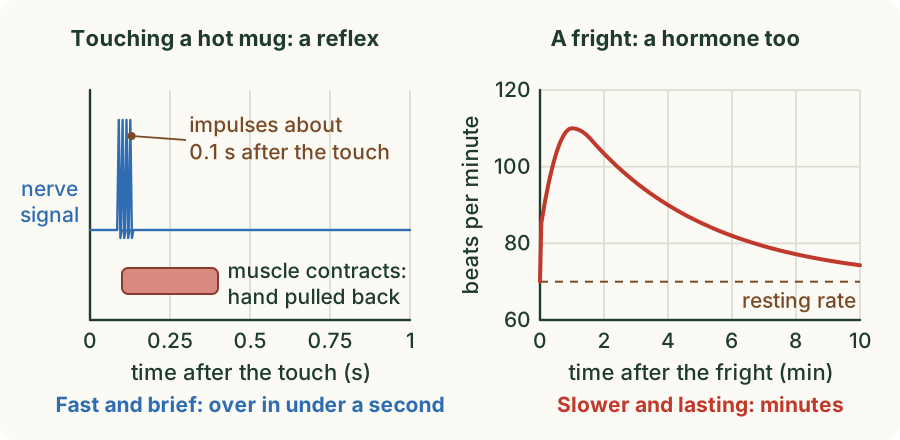
Touching a hot mug starts a reflex: an automatic, rapid response that you do not decide on. The left-hand graph shows the impulses in the neurone to the arm muscle. They come in a short burst about 0.1 seconds after the touch, the muscle contracts, and the hand is pulled back by about 0.4 seconds. The whole response is over in well under a second. That is nervous control: fast to act and short in effect.
A fright on a graph
 (enlarge)
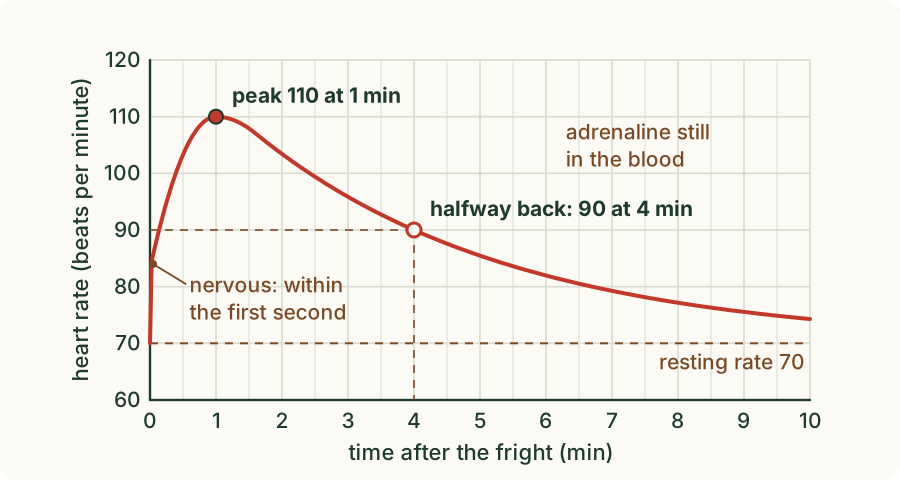
The graph shows the heart rate, in beats per minute, of a model person: typical values, not anyone's own heart. Before the fright the heart beats 70 times a minute: this is the resting rate, shown by the dashed line. A fright has two parts:
- The nervous part. Within the first second, impulses from the brain reach the heart and the heart rate jumps from 70 to 84 beats per minute.
- The hormonal part. At the same time, impulses reach two glands, the adrenal glands, which release the hormone adrenaline into the blood. As adrenaline reaches the heart, the heart rate rises further, to a peak of 110 beats per minute at 1 minute. Adrenaline stays in the blood for several minutes, so the heart rate falls back only slowly.
So a fright uses both kinds of control. The nervous part acts first; the hormonal part is slower to build up and lasts much longer.
Trap: "The whole fright response is hormonal." The very first jump in heart rate, within a second, is nervous: impulses reach the heart before any adrenaline can. Adrenaline adds the slower, longer part.
Reading a time course
Two readings describe how quickly a response rises and how long it lasts:
- the time to the peak: the time from the stimulus to the highest value. Here, 1 minute.
- the time to fall halfway back: the time from the stimulus until the value is halfway between the peak and the resting rate. Halfway between 110 and 70 is (110 + 70) ÷ 2 = 90 beats per minute, and the trace reaches 90 at 4 minutes.
The halfway reading is useful because the heart rate takes a very long time to get all the way back to the resting rate: at 10 minutes it is still about 74. Halfway back is a point you can read clearly.
To read a time from the graph, find the value on the vertical axis, go across to the trace, then go down to the time axis. Each small division of the time axis here is half a minute.
Run the experiment below before you read on. First predict which response will last longer. Then touch the hot mug and watch the nerve monitor, and let the tray of cups fall and watch the heart-rate monitor. You choose how much time each monitor shows, so that you can see each response whole. The fright in the experiment is simulated: there is no sound, and you can see the tray before it slips.
What the experiment showed
The reflex filled the 1-second window: a short burst of impulses and a brief contraction of the arm muscle, over well within a second. In the 10-minute window it was squeezed into a thin line at the start. The fright needed the 10-minute window: the heart rate jumped within the first second, rose to its peak at about 1 minute and took about 4 minutes to fall halfway back. The nervous response was faster and shorter; the hormonal response was slower and longer.
Worked example
Speed and duration
A student touches a sharp pin and pulls the hand away. Later, the same student nearly misses a bus and feels the heart still pounding five minutes afterwards. Compare the two responses by their speed of action and duration of effect.
The pin reflex is nervous control. Its speed of action is fast: the hand moves within a fraction of a second. Its duration of effect is short: the movement is over within a second. The pounding heart is mostly hormonal control (adrenaline). Its speed of action is slower, and its duration of effect is longer: it lasts for minutes. A comparison names both features for both kinds of control.
Worked example
Reading the time to the peak
A heart-rate graph has a resting rate of 60 beats per minute and a peak of 100 beats per minute. Each small division of the time axis is half a minute, and the peak lies above the sixth division after zero. Find the time to the peak and the heart rate halfway back.
Six divisions of half a minute each make 6 × 0.5 = 3, so the time to the peak is 3 minutes. Halfway back is halfway between the peak and the resting rate: (100 + 60) ÷ 2 = 80 beats per minute, not half of the peak. To find when it is reached, go across from 80 on the vertical axis to the falling part of the trace, then down to the time axis.
Worked example
Why the heart keeps pounding
Explain why, after a fright, the heart rate stays high for minutes, but the hand pulled back from a hot mug relaxes within a second.
The hand is moved by nerve impulses: when the impulses stop, the muscle stops contracting, so the effect is short. The heart rate stays high because of adrenaline, a hormone carried in the blood. It goes on acting on the heart for as long as it stays in the blood, which is several minutes, so the effect lasts longer.
Key idea: Nervous and hormonal control can be compared by their speed of action and their duration of effect. Nervous control is fast (a fraction of a second) and its effect is short; hormonal control is slower (seconds to minutes) and its effect lasts longer (minutes). A fright uses both: a nervous jump in heart rate within a second, then adrenaline keeps it high for minutes. On a time course, read the time to the peak and the time to fall halfway between the peak and the resting rate.