After the tray fell, your heart rate stayed high for minutes. Something kept acting on your heart long after the nerve impulses had stopped. That something was a chemical carried in your blood. In this part you find out what makes a chemical a hormone, follow adrenaline from the glands that make it to the organs it acts on, and see what it changes in each one. The sections marked Supplement are for the Extended course.
 (enlarge)
What a hormone is
 (enlarge)
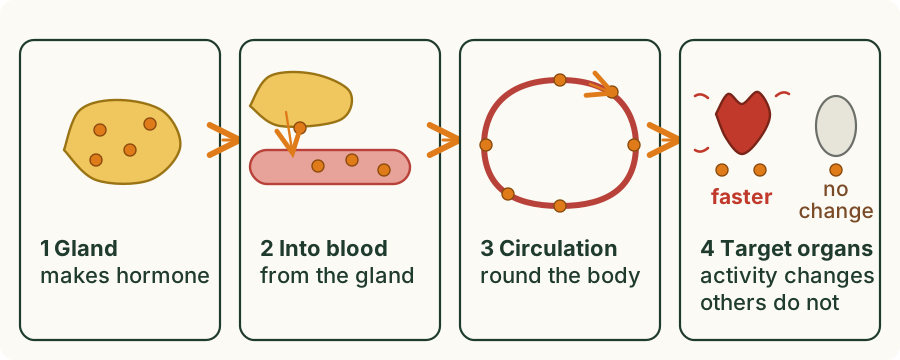
A hormone is a chemical substance, produced by a gland and carried by the blood, which alters the activity of one or more specific target organs. Each part of that description matters:
- It is a chemical, not an electrical impulse.
- It is produced by a gland. The glands that make hormones are called endocrine glands; they release their hormones straight into the blood flowing through them.
- It is carried by the blood, so it reaches every part of the body.
- It changes what specific target organs do. A target organ is an organ that responds to the hormone. The blood carries the hormone to every organ, but only its target organs respond; an organ that is not one of its targets is not affected.
Trap: "Hormones travel along nerves." Hormones are carried in the blood. Nerves carry electrical impulses. That is why a hormone reaches its targets more slowly than an impulse.
Trap: "A hormone acts on every organ it reaches." The blood takes a hormone everywhere, but it alters the activity of specific target organs only.
Adrenaline: fight or flight
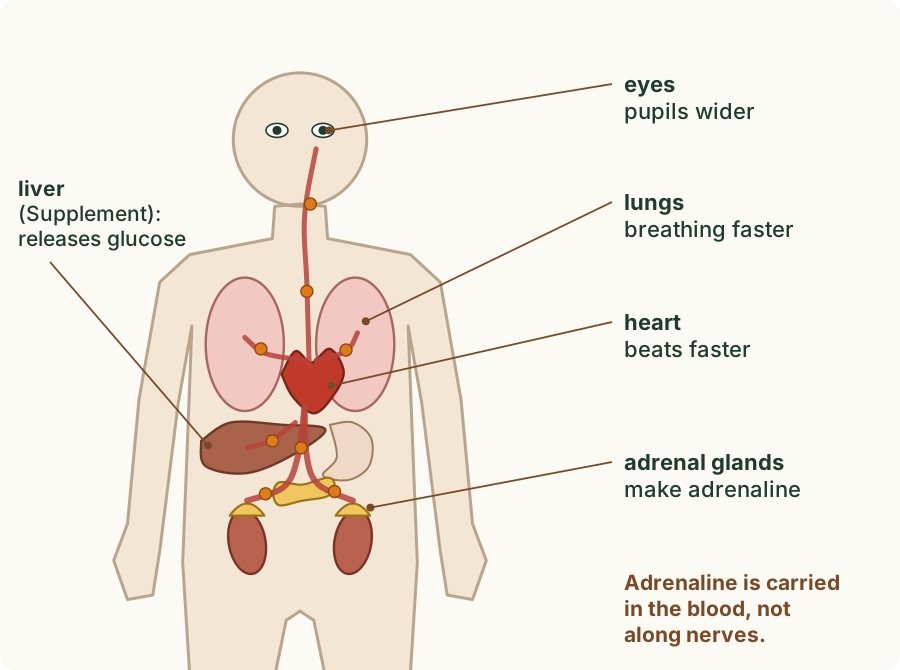
Adrenaline is the hormone secreted (released) by the adrenal glands in "fight or flight" situations: moments of sudden danger, fear or excitement, when the body may need to fight or to run. There are two adrenal glands, one on top of each kidney.
 (enlarge)
Adrenaline passes into the blood and is carried round the body. It has three effects that you need to know:
| Effect of adrenaline | Model person before | Model person during the fright |
|---|---|---|
| increased breathing rate | 14 breaths per minute | 22 breaths per minute |
| increased heart rate | 70 beats per minute | up to 110 beats per minute |
| increased pupil diameter | 3.5 mm | 6.0 mm |
The numbers are typical values for a model person, not measurements of your own body. Each change helps in danger: faster breathing takes in more oxygen, a faster heart rate carries it round the body faster, and wider pupils let more light into the eyes.
Trap: "Adrenaline makes the pupils smaller." Adrenaline increases the pupil diameter: the pupils get wider. (In the eye module, the pupils got smaller in bright light: that was a reflex, not adrenaline.)
Run the experiment below before you read on. First predict how adrenaline gets from the adrenal glands to the heart. Then watch it pass into the blood and follow it to each target organ in turn.
What the experiment showed
The adrenaline did not travel along a nerve: it passed from the adrenal glands into the blood flowing past them and was carried round the body. At each target organ it changed something: the heart beat faster, breathing got faster, and the pupils got wider. It reached the other organs too. Adrenaline has more target organs than these, such as the stomach, but the ones you need to know are the heart, the lungs and the eyes (and, for the Supplement, the liver).
(Supplement) Adrenaline and metabolic activity
 (enlarge)
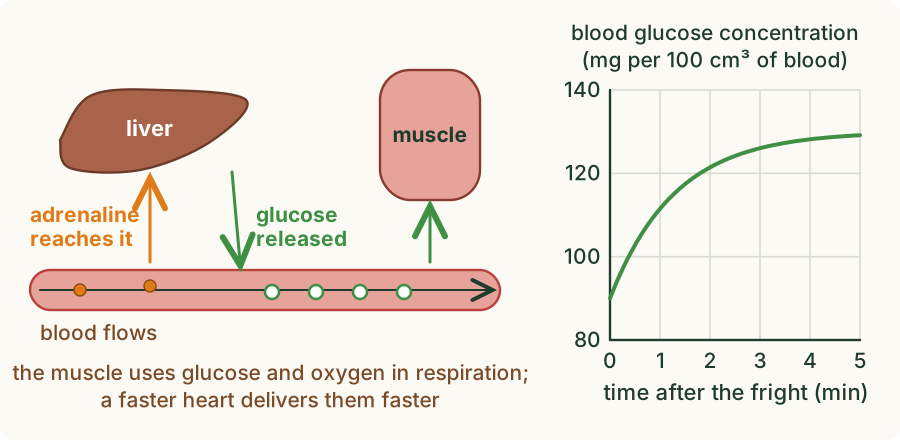
Adrenaline also helps to control metabolic activity: the chemical reactions in the body's cells, such as respiration. It does this in two ways:
- it increases the blood glucose concentration: adrenaline reaches the liver, which releases glucose into the blood. In the model person, the blood glucose concentration rises from 90 to about 130 mg per 100 cm³ of blood. ("mg per 100 cm³" means milligrams of glucose in every 100 cubic centimetres of blood.)
- it increases the heart rate, so the blood carries glucose and oxygen to the muscles faster.
The muscles use the glucose and oxygen in respiration, which releases the energy they need to contract. So adrenaline gets the muscles ready to work hard, to fight or to run.
Trap: "Adrenaline lowers the blood glucose concentration." Adrenaline raises it, by making the liver release glucose. (Another hormone, insulin, lowers it: you meet it in the module on homeostasis.)
Worked example
Is it a hormone?
A student says: "Impulses in a motor neurone make a muscle contract, so impulses are hormones." Use the description of a hormone to explain why the student is wrong.
A hormone is a chemical substance, produced by a gland and carried by the blood, which alters the activity of specific target organs. Impulses are electrical signals, not chemicals; they are not produced by a gland; and they travel along neurones, not in the blood. So they are not hormones. Checking each part of the description in turn is the safest way to decide.
Worked example
The effects of adrenaline
A runner hears a dog bark close behind her and sprints away. State three changes that adrenaline causes in her body, and say how each helps.
- Her breathing rate increases: she takes in more oxygen.
- Her heart rate increases: blood carries the oxygen round her body faster.
- Her pupil diameter increases: more light enters her eyes.
Each change is an increase. Name the quantity that increases (rate, rate, diameter), not just "the heart" or "the eyes".
Worked example
(Supplement) Glucose for the muscles
Explain how adrenaline helps the leg muscles of the runner in W05 to keep contracting.
Adrenaline makes the liver release glucose into the blood, so the blood glucose concentration increases. It also increases the heart rate, so the blood delivers glucose and oxygen to the leg muscles faster. The muscle cells use them in respiration, which releases the energy for contraction.
Key idea: A hormone is a chemical substance, produced by a gland and carried by the blood, which alters the activity of one or more specific target organs. Adrenaline is secreted by the adrenal glands in fight or flight situations; it increases the breathing rate, the heart rate and the pupil diameter. (Supplement) Adrenaline controls metabolic activity: it increases the blood glucose concentration (the liver releases glucose) and increases the heart rate, so more glucose and oxygen reach the muscles for respiration.