You have a streaming cold, a box of tissues on the table and a friend who says, "Just get some antibiotics from the doctor." The doctor listens, checks your throat and says no. Is the doctor being unkind, or do antibiotics really do nothing for a cold? To answer that you need to know what a drug is, what an antibiotic does to bacteria, and how a lab compares antibiotics on a plate of bacteria. In this part you run that test yourself.
 (enlarge)
What counts as a drug
Think about what a cup of strong coffee does. Within about half an hour you feel more awake, because the caffeine in it reaches your brain in the blood and changes some of the chemical reactions in your nerve cells. A painkiller works in a similar way: some painkillers slow down an enzyme that makes the chemicals that cause the feeling of pain, so the reaction that makes them runs more slowly.
Both are examples of a drug: any substance taken into the body that modifies or affects chemical reactions in the body. "Taken into the body" means swallowed, breathed in, injected or absorbed through the skin. "Modifies or affects" means the substance speeds a reaction up, slows it down or stops it. Medicines are drugs used to treat or prevent illness, but plenty of drugs are not medicines: caffeine and the nicotine in tobacco are drugs too.
Trap: "A drug is something illegal." In biology the word covers every substance that is taken in and changes the body's chemical reactions, so a cough medicine from a pharmacy is a drug as much as caffeine is. A disinfectant sprayed on a kitchen worktop kills bacteria, but it is not a drug, because it is not taken into the body.
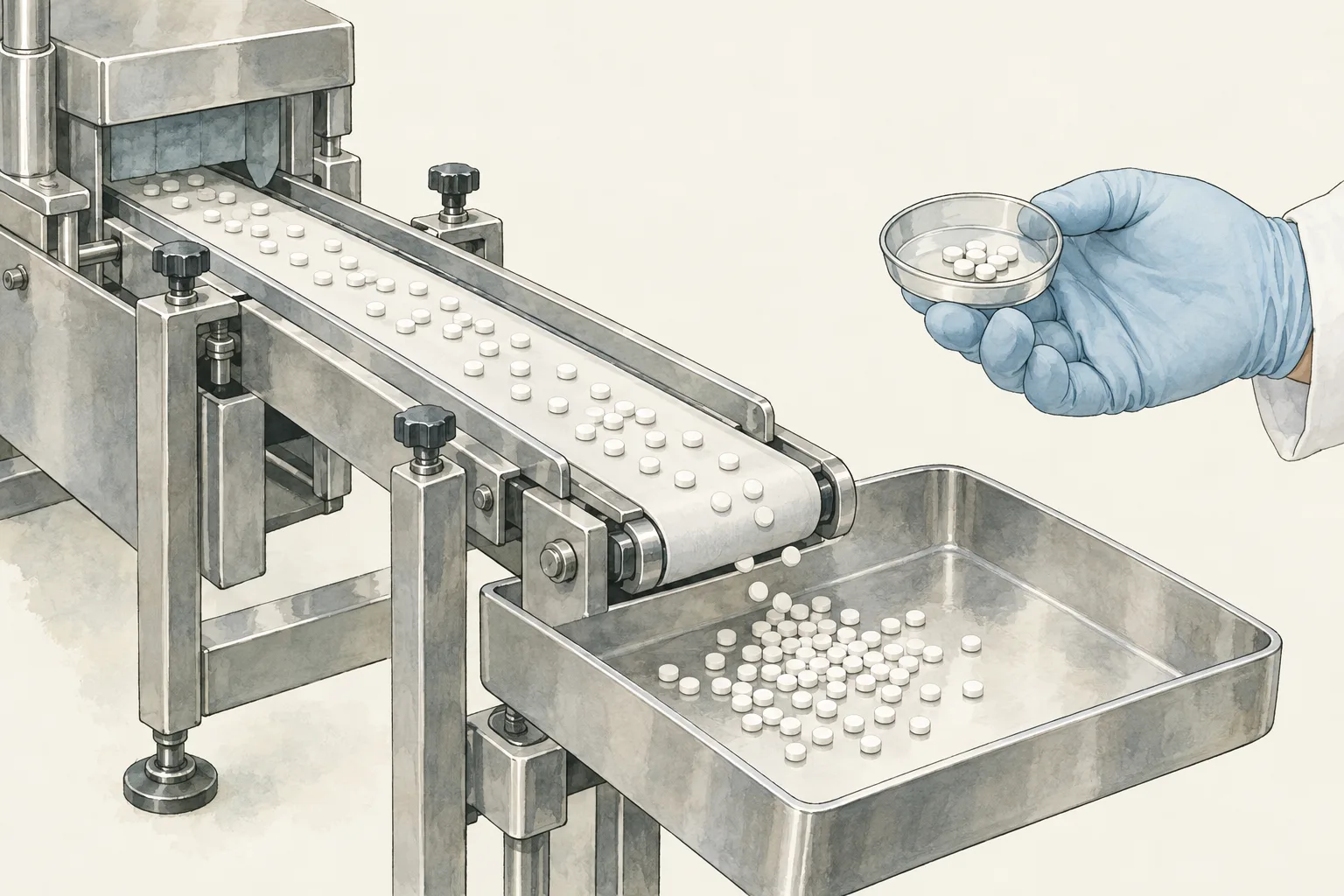
You cannot tell what a tablet does by looking at it. Tablets made in a factory all look much the same; what matters is the substance inside and which reactions it changes once it is in the body.
 (enlarge)
Bacteria, infections and antibiotics
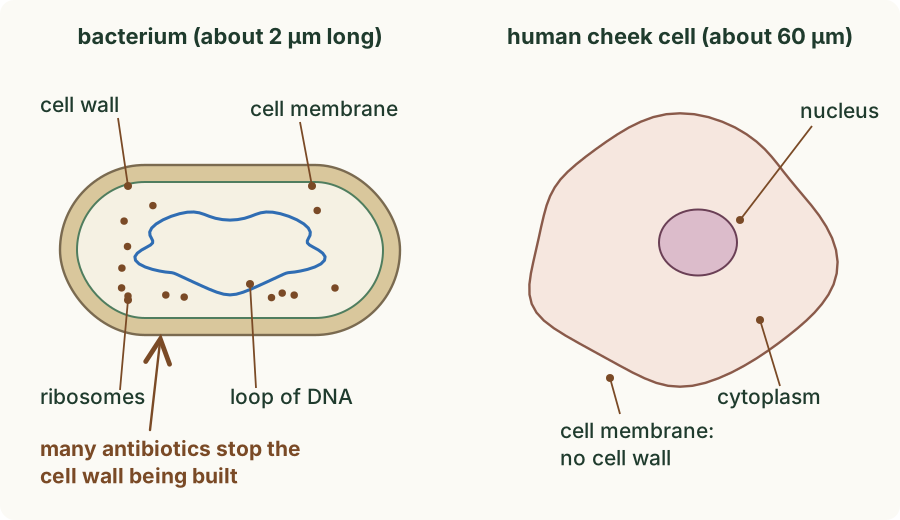
Bacteria are single living cells, far smaller than your own cells: a typical one is only 1–5 µm long. Each has a cell wall outside its cell membrane, cytoplasm with ribosomes in it, and a loop of DNA instead of a nucleus. Most bacteria are harmless, and many live on your skin and in your gut all the time. A few kinds cause an infection when they get into the body and multiply there: some sore throats, an infected cut and some kinds of pneumonia are caused by bacteria.
An antibiotic is a drug that kills bacteria or stops them growing. Antibiotics are used to treat bacterial infections: once the number of bacteria falls, the body's own defences can clear the rest, and the patient gets better. An antibiotic can do this without harming the patient's cells because it acts on something that bacterial cells have and human cells do not. Many antibiotics, for example, stop bacteria from building their cell walls, so a growing bacterium bursts. Your cells have no cell wall, so they are not affected in that way.
 (enlarge)
Trap: "An antibiotic works by making the patient stronger." The antibiotic acts on the bacteria themselves: it kills them or stops them growing. The body's defences then have far fewer bacteria to deal with.
The disc test
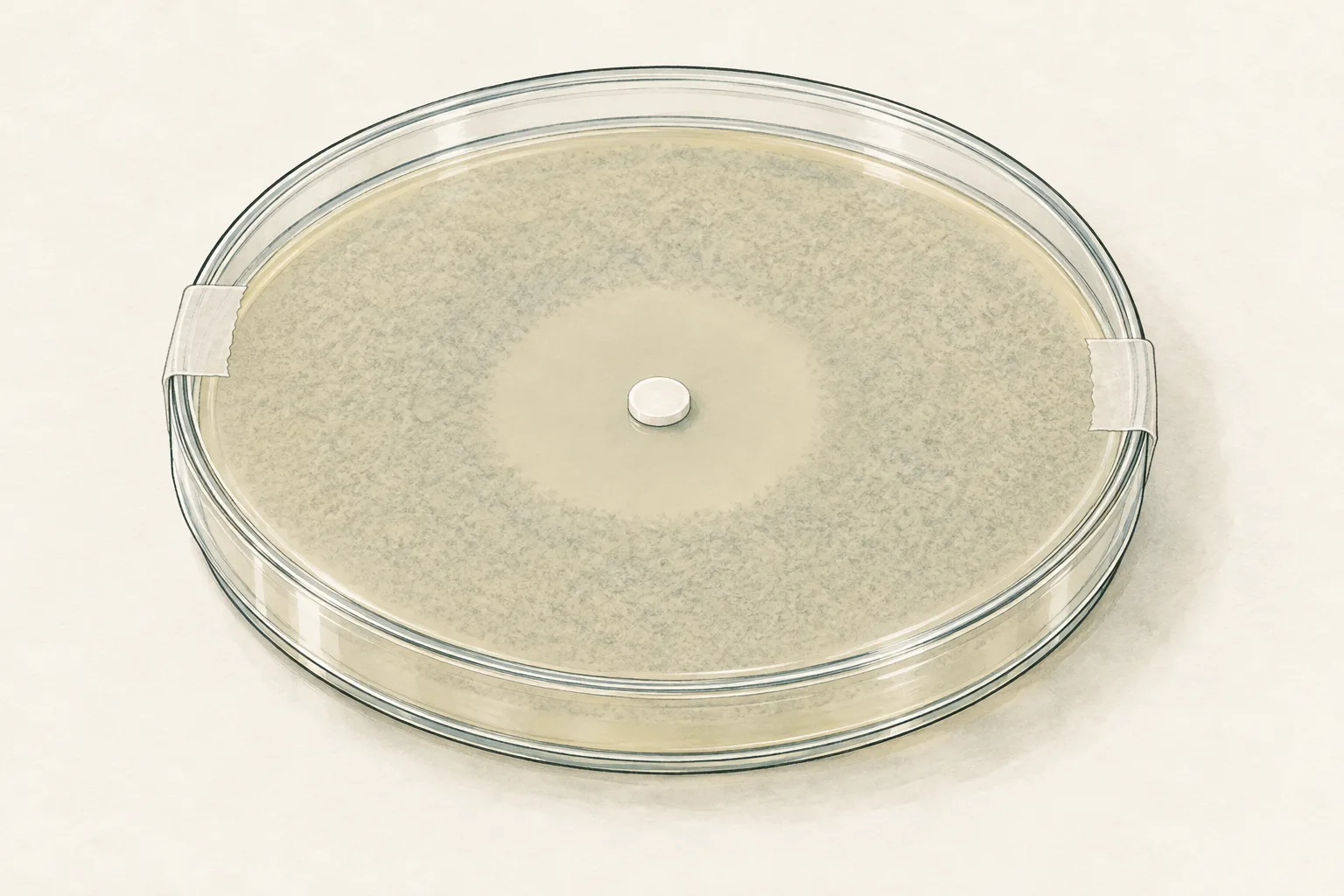
So how does a lab compare antibiotics? It grows a lawn of bacteria: a safe kind of bacterium is spread evenly over a plate of agar, a jelly with nutrients in it. Small paper discs, each soaked in a different antibiotic, are pressed onto the agar straight away, while it still looks clear, spaced well apart and away from the edge. The forceps are sterile, and they are cleaned and sterilised again between discs, so that no antibiotic or other microorganism is carried from one disc to the next. Over the next two days the bacteria multiply until the lawn is a cloudy layer over the whole plate, except where the antibiotic has spread out of a disc into the agar. There the bacteria cannot grow, and a ring of clear agar, a clear zone, is left round the disc.
A clear zone means "no visible growth". From the plate alone you cannot tell whether the antibiotic killed the bacteria there or only stopped them multiplying.
 (enlarge)
One disc is different from the others. It is soaked in sterile water, with no antibiotic in it, and it is the control. It has the same paper, the same soaking and the same pressing onto the agar as the antibiotic discs; only the antibiotic is missing.
In a school lab a plate like this is held shut with two short strips of tape rather than sealed all the way round, so that oxygen can still get in: bacteria that grow without oxygen, which include some that cause disease, then do badly. It is kept upside down, so that drops of condensation from the lid do not fall onto the agar, at 25 °C rather than at body temperature, 37 °C, because many of the bacteria that cause disease in humans grow best near 37 °C. After incubation it is never opened.
Before you read on, predict: after two days, what will you see round the water disc, and round the antibiotic discs?
Measuring a clear zone
You compare zones by their diameter, in millimetres. Lay a ruler across the zone so that its edge passes through the centre of the disc. Read the ruler where each edge of the clear zone meets it, then subtract the smaller reading from the larger. The diameter includes the disc itself. If the bacteria have grown right up to a disc, there is no clear zone, and you record the diameter of the disc, which is 6 mm for the discs in the experiment.
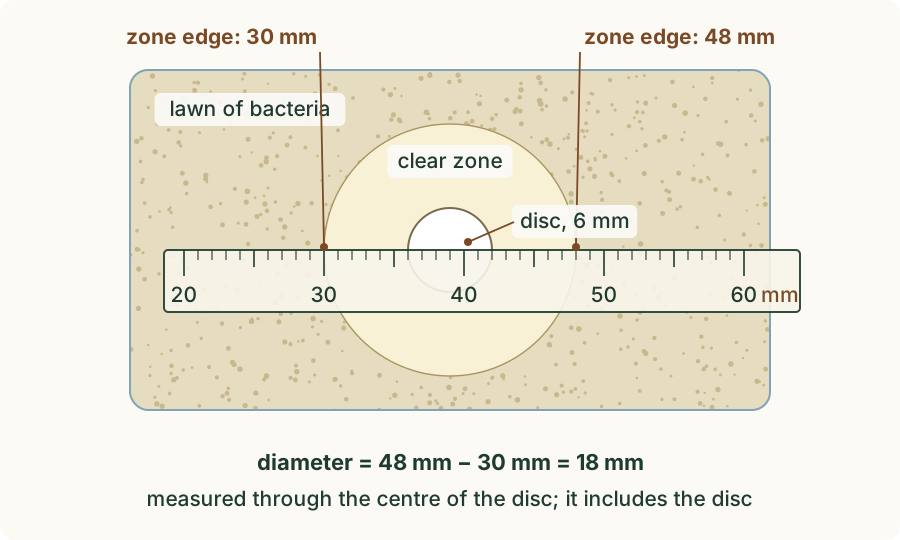 (enlarge)
Trap: "Measure from the edge of the disc to the edge of the zone." That is only part of one side. Measure the whole width of the zone, through the centre of the disc, and include the disc.
Run the experiment below before you read on. First predict what will grow round the discs, then choose what goes in the fourth place on the plate. Place the discs with the forceps, tape the lid and incubate the plate: the two days are sped up. Measure the zone round disc A yourself, then the others, and compare your plate with two more from the class.
What the plates showed
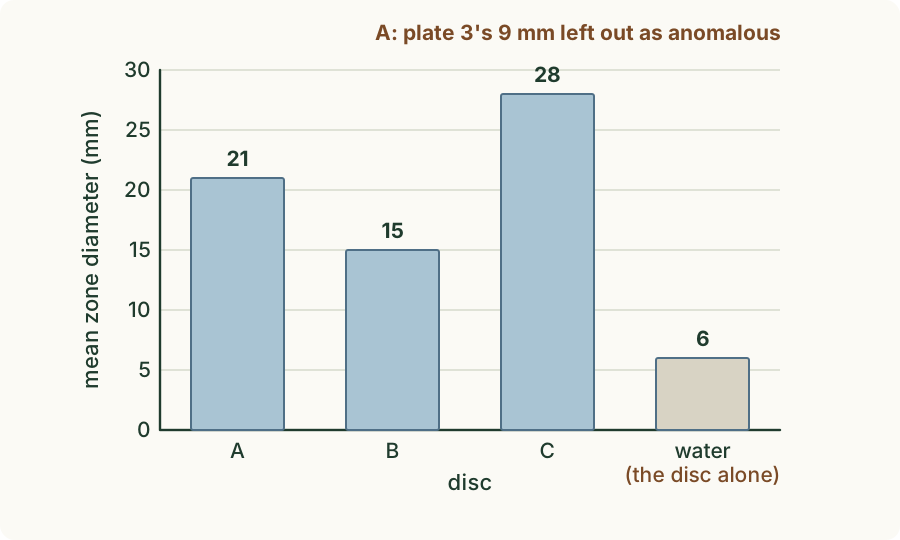
On your plate the bacteria grew right up to the water disc: its "zone" was just the disc, 6 mm. Round the antibiotic discs there were clear zones of 22 mm (A), 15 mm (B) and 28 mm (C). The water disc shows that the paper, the soaking and the pressing do not stop the bacteria growing, so the clear zones were caused by the antibiotics.
One result from the class stood out. On plate 3, disc A gave a zone of only 9 mm, while the other two plates gave 22 mm and 20 mm. A result that does not fit the pattern of the others is anomalous; perhaps that disc was not soaked properly. You leave it out of the mean, because it would pull the mean down: with it the mean for A would be 17 mm, without it (22 + 20) ÷ 2 = 21 mm. The means from the three plates were A 21 mm, B 15 mm, C 28 mm and water 6 mm.
 (enlarge)
So, under these conditions, antibiotic C gave the largest zone of no visible growth. That is a fair comparison on this plate, but it does not make C the best medicine for every infection. The size of a zone also depends on how quickly each antibiotic spreads through the agar and how much was on the disc. The antibiotic becomes more dilute the further it spreads from the disc, and the edge of the zone is where too little is left to stop the bacteria. So a disc soaked in a stronger solution of the same antibiotic gives a wider zone, and a weaker solution a narrower one. A doctor's choice also depends on how a drug works in the body and which bacteria are causing the infection.
Trap: "The biggest zone means the best antibiotic." The biggest zone means the widest area of no visible growth in this test, with these bacteria. An antibiotic that spreads slowly through agar can give a small zone and still work well in the body.
Worked example
Is it a drug?
Which of these is a drug: the caffeine in a can of cola, an antibiotic syrup, a disinfectant wiped over a hospital bed rail? Explain each.
The caffeine is a drug: it is swallowed, and it changes chemical reactions in nerve cells. The antibiotic syrup is a drug: it is swallowed, and it changes the reactions in bacteria inside the body, so that they die or stop growing. The disinfectant is not a drug: it kills bacteria on the rail, but it is never taken into the body. Both parts of the definition are needed: taken into the body, and changing the body's chemical reactions.
Worked example
Reading a zone diameter
A ruler is laid through the centre of a disc. The clear zone's edges meet the ruler at 41 mm and 57 mm. On a second plate the bacteria have grown right up to the same kind of 6 mm disc. Find both diameters.
First plate: 57 − 41 = 16 mm. Second plate: there is no clear zone, so you record the disc's own diameter, 6 mm, not 0 mm. Recording 6 mm keeps "no effect" on the same scale as the other results, because every diameter includes the disc.
Worked example
An anomaly and a mean
Four plates tested the same antibiotic disc. The zone diameters were 18 mm, 19 mm, 7 mm and 17 mm. Find the anomalous result and the mean without it.
Three results lie between 17 mm and 19 mm, but 7 mm is far below them all, so it is the anomaly. Leave it out and divide by the number of results you added: (18 + 19 + 17) ÷ 3 = 54 ÷ 3 = 18 mm.
Worked example
Why the water disc?
A student tests three antibiotic discs on a lawn of bacteria and sees a clear zone round each. With no other disc on the plate, the student concludes that the antibiotics stopped the bacteria growing. Explain why the plate also needs a disc soaked in sterile water.
The clear zones might have been caused by something other than the antibiotics: the paper itself, the soaking or the pressing of a disc onto the agar. A disc soaked in sterile water has all of those but no antibiotic. If the bacteria grow right up to it, none of those other things stops growth, so the zones round the other discs must have been caused by the antibiotics.