Back to the cold. Colds and flu are caused by viruses, not bacteria, and that is the whole reason the doctor said no. In this part you find out why an antibiotic that clears a lawn of bacteria does nothing to a virus, and you test a plate of bacteria that one of the antibiotics no longer stops. The Supplement section then shows how bacteria like that become common, and what slows it down.
Viruses are not cells
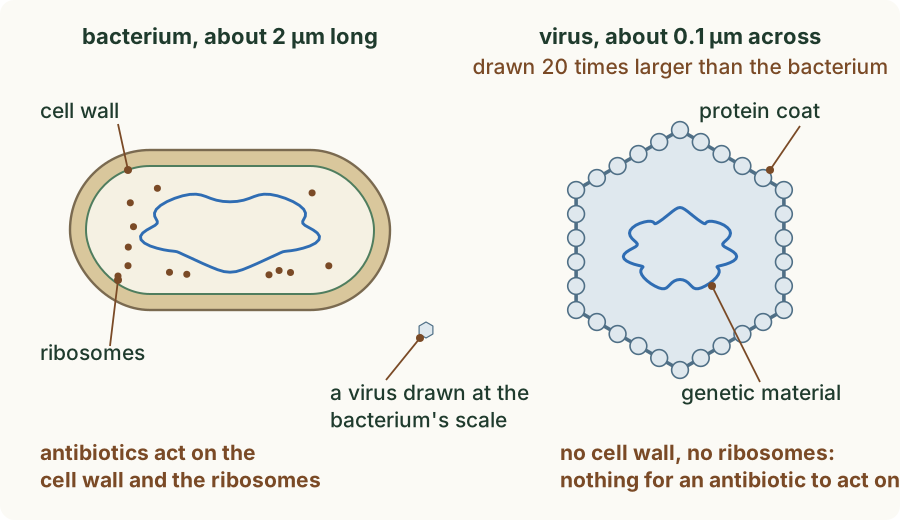
A virus is far smaller than a bacterium: most are between 0.02 µm and 0.3 µm across. A virus 0.1 µm across is a twentieth of a bacterium 2 µm long, so about twenty would fit along it end to end. A virus is not a cell at all. It is a coat of protein round a small piece of genetic material, with no cell wall, no cell membrane, no cytoplasm and no ribosomes of its own. On its own a virus does nothing. It can make copies of itself only inside a living cell, where it takes over the cell's own ribosomes and enzymes to build new viruses.
That is why antibiotics kill bacteria but do not affect viruses. An antibiotic acts on a part of the bacterial cell, such as the cell wall or the bacterium's ribosomes. A virus has neither, and while it is copying itself it is hidden inside one of your own cells. There is nothing in it for the antibiotic to act on.
 (enlarge)
Trap: "Antibiotics kill germs, and viruses are germs." "Germ" lumps together very different things. Antibiotics act only on bacteria. A cold, flu or measles is caused by a virus, so an antibiotic does not shorten it.
Most colds clear up on their own in about a week, as the body's defences destroy the virus. The doctor's "no" was not unkindness: an antibiotic would have done nothing for the virus, and every unnecessary dose, as you will see, makes trouble for later.
Bacteria that an antibiotic no longer stops
Some bacteria are resistant to an antibiotic: the antibiotic does not kill them or stop them growing. On a plate, resistant bacteria grow right up to the disc, as they did round the water disc on your first plate. A hospital lab is more careful: it compares each zone with a set width for that antibiotic and that kind of bacterium, so even a small zone can mean resistant. In this module the bacteria are simpler: either an antibiotic stops them, with a clear zone, or they are resistant and grow right up to the disc.
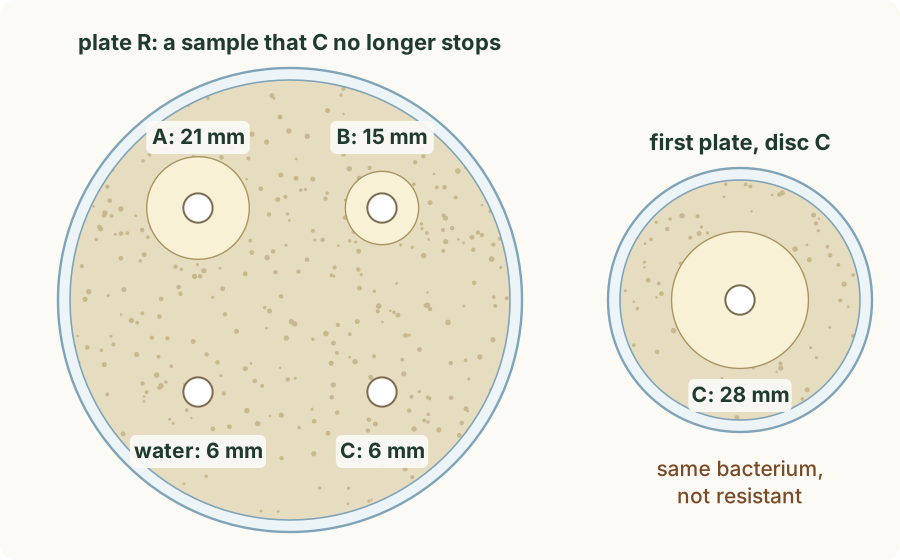
In the experiment you test a second plate, labelled R. It carries the same kind of bacterium as your first plate, but taken from a sample that antibiotic C no longer stops. Discs A, B and C are pressed onto the lawn in the same way, with a water disc as the control. Before you run it, predict: which zone will change, and how?
What plate R showed
Round discs A and B the zones were much the same as on the first plate, 21 mm and 15 mm. Round disc C the bacteria grew right up to the disc: its zone was only the disc, 6 mm, where the ordinary bacteria had given 28 mm. These bacteria are resistant to antibiotic C but not to A or B.
 (enlarge)
So resistance reduces the effectiveness of an antibiotic. If an infection is caused by bacteria that are resistant to the antibiotic a patient is given, the number of bacteria does not fall and the patient does not get better. A doctor then has to find another antibiotic that still works, and some bacteria are resistant to several antibiotics at once, which leaves very few to choose from.
Trap: "The patient's body gets used to the antibiotic and becomes resistant." Resistance belongs to the bacteria, not to the person. Bacteria resistant to an antibiotic can pass from one person to another, so someone who has never taken that antibiotic can still have an infection it does not treat.
(Supplement) How resistant bacteria become common
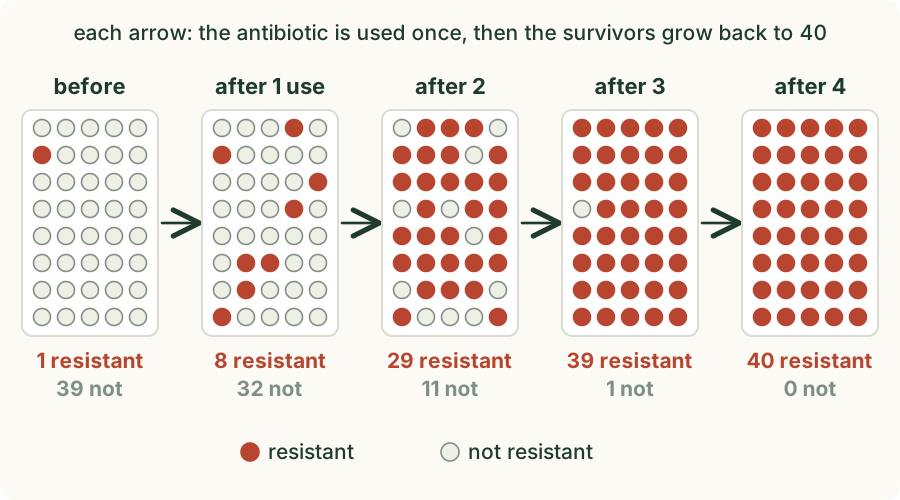
A population of bacteria is not all alike. Bacteria divide very often, and now and then a random change in a bacterium's DNA, a mutation, happens to make it resistant to an antibiotic. At first there might be one resistant bacterium among millions.
When the antibiotic is used, it kills the bacteria that are not resistant. The resistant ones survive, and with the others gone they have the nutrients and space to themselves, so they multiply. The next population has a larger share of resistant bacteria. Each time the antibiotic is used again, the same thing happens, until almost all of the bacteria are resistant and the antibiotic no longer works against them. The antibiotic does not cause the mutations; it removes the bacteria that are not resistant, so the resistant ones are left to multiply.
 (enlarge)
Trap: "The antibiotic teaches the bacteria to resist it." A bacterium does not change because the antibiotic is there. The resistant ones were already in the population, and the antibiotic only removes the others.
This is why using antibiotics only when essential limits the development of resistant bacteria. Every use of an antibiotic is a chance for resistant bacteria to survive while the others die. An antibiotic taken for a cold or for flu does nothing to the virus but still acts on the bacteria that live harmlessly in the body, so it removes the bacteria that are not resistant and leaves the resistant ones. The fewer times antibiotics are used, the fewer times resistant bacteria get that advantage, and the more slowly resistant bacteria become common. The same reasoning applies on farms: antibiotics given to healthy animals to make them grow faster select resistant bacteria too.
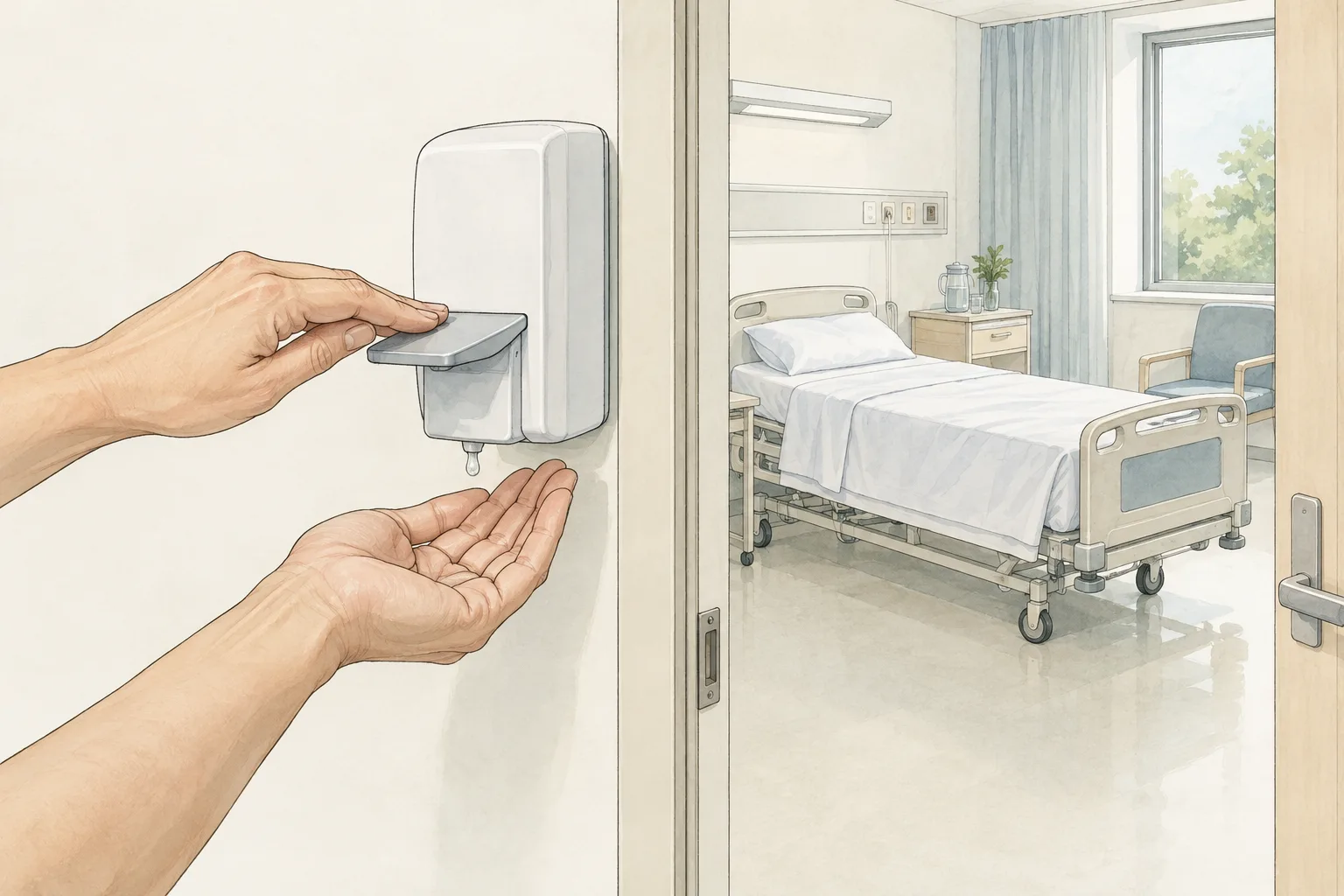
MRSA is one example. It is a strain of the bacterium Staphylococcus aureus, which many people carry harmlessly on their skin, that is resistant to several common antibiotics. An MRSA infection of a wound is difficult to treat. In hospitals, where many antibiotics are used and many patients are already ill, MRSA is also kept from spreading by high standards of hygiene: hands washed or gelled between patients, and equipment and surfaces cleaned.
 (enlarge)
Worked example
Antibiotics for which illness?
Three people are ill: one with flu, one with an infected cut caused by bacteria, one with a cold. Which of them could be treated with an antibiotic? Explain.
Only the infected cut. It is caused by bacteria, and an antibiotic acts on the bacterial cell, killing the bacteria or stopping them growing. Flu and a cold are caused by viruses. A virus has no cell wall or ribosomes of its own and copies itself inside the body's cells, so an antibiotic does not affect it.
Worked example
Reading a resistant plate
Bacteria from a patient's infected wound are grown as a lawn with three antibiotic discs, P, Q and S, and a water disc. The zone diameters are P 6 mm, Q 19 mm, S 24 mm, water 6 mm. On a plate of ordinary bacteria of the same kind, P gave 25 mm. What do the results show?
The water disc's 6 mm is the disc itself, so 6 mm means no effect. The bacteria grew right up to disc P, so they are resistant to antibiotic P, which stopped the ordinary bacteria (25 mm). In this simple model they are not resistant to Q or S, which both gave clear zones. Antibiotic P would be no use against this infection.
Worked example
(Supplement) Counting the resistant share
A population of 200 bacteria contains 4 resistant ones. An antibiotic kills three quarters of the bacteria that are not resistant and none of the resistant ones. Calculate the percentage of the surviving bacteria that are resistant.
Not resistant at the start: 200 − 4 = 196. Three quarters killed leaves a quarter: 196 ÷ 4 = 49 survive. Survivors: 49 + 4 = 53. Resistant share: 4 ÷ 53 × 100 = 7.5 %, up from 4 ÷ 200 × 100 = 2 % before. One use of the antibiotic has nearly quadrupled the share of resistant bacteria, before any of them has even divided.