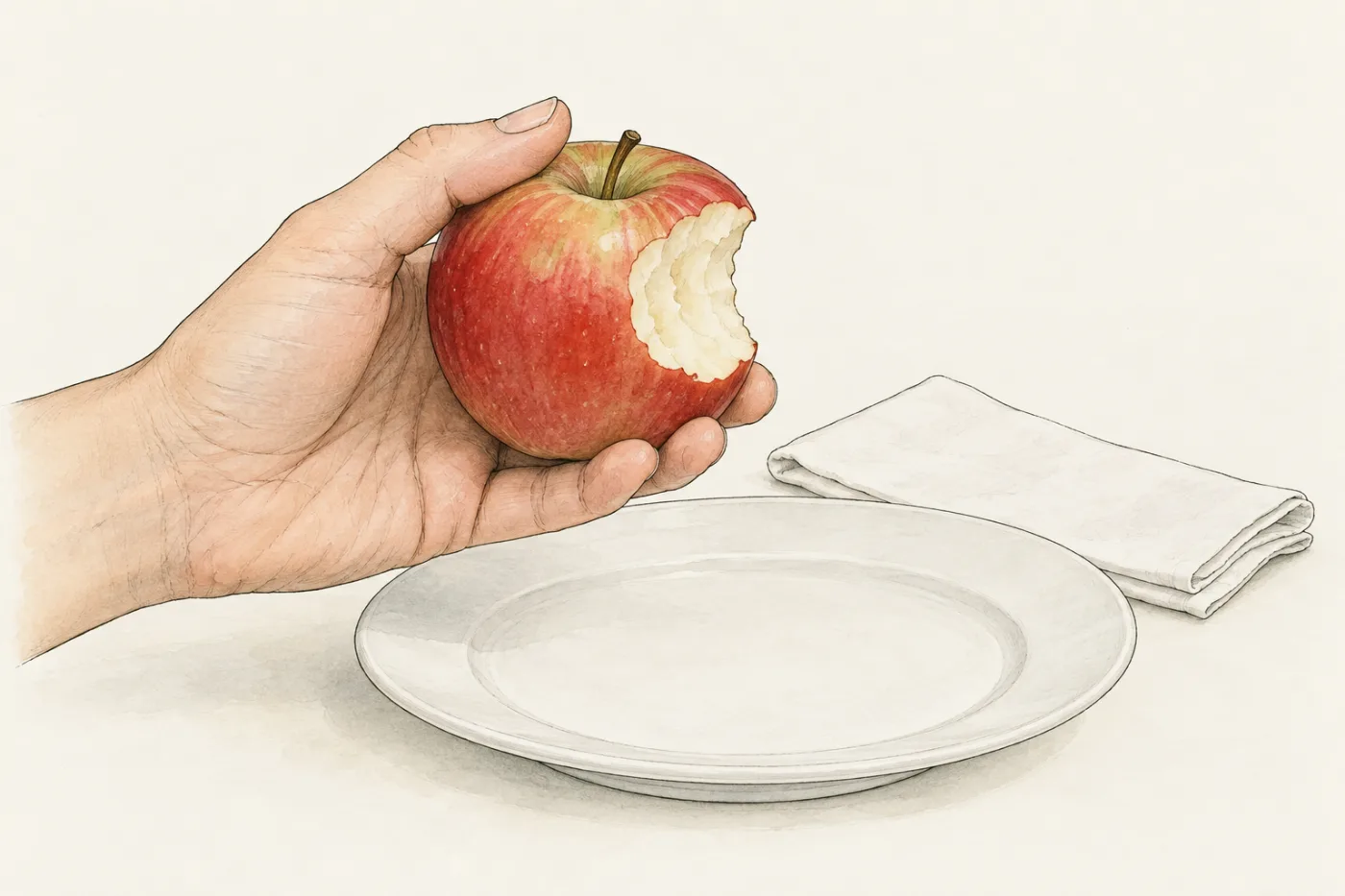
Take a bite of an apple. The piece in your mouth is about 2 cm across, yet you do not swallow it like that: you chew it for ten or twenty seconds, until it is soft and in tiny pieces. Your stomach could hold the whole piece, so why chew at all? In this part you put egg white into a solution of an enzyme that digests protein, and find out whether the size of the pieces matters.
 (enlarge)
Three samples of egg white
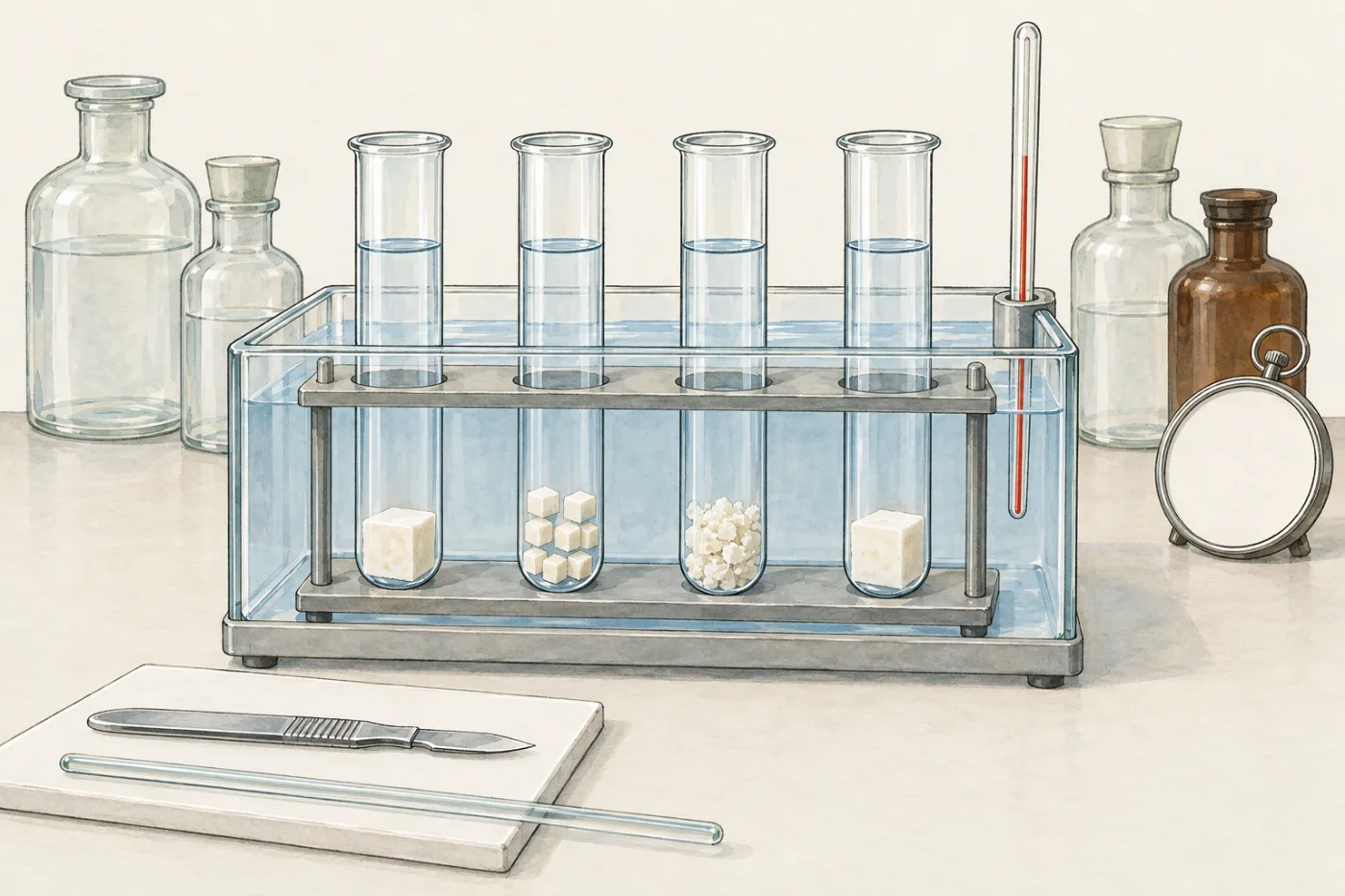
Boiled egg white is mostly protein and water. A protease is an enzyme that breaks protein down; your stomach and pancreas make proteases, which work in the stomach and small intestine. In this experiment four cubes of boiled egg white, each with sides of 1 cm, are cut from the same egg. One stays whole. The second is cut into eight small cubes with a scalpel. The third is mashed into crumbs with a glass rod. Each sample still has the mass of one cube: cutting and mashing change only the size of the pieces.
The three samples go into three tubes of the same protease solution, the same volume in each, in a water bath at 37 °C, the temperature of the body. The fourth cube goes in whole into a tube of water with no protease: this is the control. All four tubes are shaken gently in the same way. The end point is the moment when no solid egg white can be seen in a tube.
Predict first: which sample disappears first, and which one last? Make your prediction, then run the experiment below before you read on.
 (enlarge)
What the tubes showed
| Tube | Sample | Liquid | Time until no solid is left |
|---|---|---|---|
| 1 | one whole cube | protease | about 100 minutes |
| 2 | eight small cubes | protease | about 50 minutes |
| 3 | crumbs | protease | about 10 minutes |
| 4 | one whole cube | water | still there after 100 minutes |
The crumbs disappeared first and the whole cube last, although every tube had the same mass of egg white, the same protease and the same temperature. Every piece shrank from its surface inwards: its edges and corners rounded off, and it got smaller until nothing was left. The cube in water did not change at all: a whole cube does not break up in warm, gently shaken water. A control is set up like the test in every way except the one thing being tested, here the protease. This control matches tube 1: it shows what happens to a whole cube without the protease.
The times come from the experiment's model, a simple teaching model in which the protease eats into every face of a piece at the same steady rate, 0.05 mm each minute. Real times depend on the protease and on how strong its solution is, but the order is the same.
More surface for the enzyme
A protease molecule cannot get inside a solid piece of egg white. It can only work on the protein at the surface, where the egg white touches the solution. The more surface there is, the more protease molecules can work at the same time, so the egg white is digested faster.
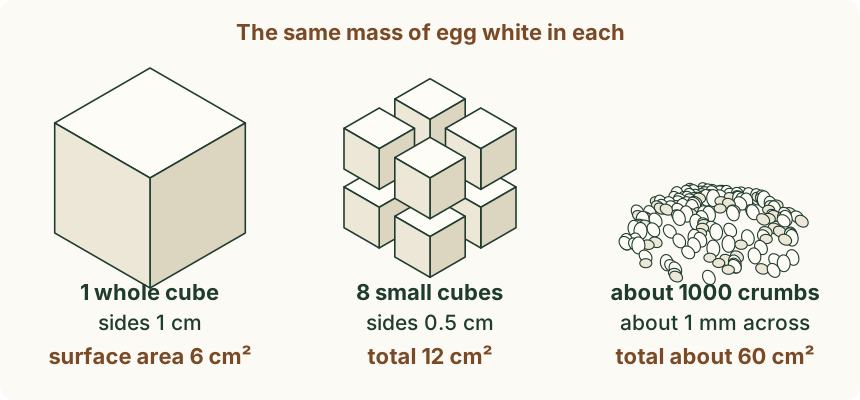
Cutting a piece of food into smaller pieces does not change its mass, but every cut makes new surfaces:
 (enlarge)
The whole cube has 6 faces of 1 cm × 1 cm, so its surface area is 6 cm². Each small cube has sides of 0.5 cm, so each face is 0.5 × 0.5 = 0.25 cm², and each cube has 6 × 0.25 = 1.5 cm². The eight small cubes together have 8 × 1.5 = 12 cm²: twice as much surface as the whole cube, and they disappeared in half the time.
The crumbs are about 1 mm (0.1 cm) across, so 10 of them fit along each edge of the cube, and 10 × 10 × 10 = 1000 of them fill it. Each has 6 × 0.1 × 0.1 = 0.06 cm², so together they have about 60 cm²: ten times the surface of the whole cube, and they disappeared ten times as fast.
Trap: "The crumbs went first because they are lighter." Every tube had the same mass of egg white. What changed is the total surface that the enzyme could reach.
Worked example
A cube of cheese
A cube of cheese with sides of 2 cm is cut into eight cubes with sides of 1 cm. Calculate the surface area before and after cutting, and explain why the cut cheese is digested faster.
Before: the cube has 6 faces of 2 cm × 2 cm, so its surface area is 6 × 4 = 24 cm². After: each small cube has 6 faces of 1 cm × 1 cm, so 6 cm², and the eight cubes together have 8 × 6 = 48 cm². The mass of cheese is the same, but the surface area has doubled. Enzymes act only at the surface of a solid piece, so twice the surface means that twice as many enzyme molecules can work on the cheese at the same time, and it is digested faster. Chewing it into crumbs would increase the surface area much more.
Physical digestion
Cutting and mashing did not change what the egg white is made of. The crumbs are still egg white, made of the same protein molecules as the whole cube, only in smaller pieces. This is physical digestion: the breakdown of food into smaller pieces without chemical change to the food molecules. Chewing is physical digestion, and so is the churning of the stomach (part 3 of this module).
What the protease did is different. It broke the large protein molecules down into smaller molecules: new substances, so a chemical change. That is chemical digestion, done by enzymes; the next module follows it along the gut. Physical digestion helps chemical digestion: it increases the surface area of the food for the enzymes to act on.
Trap: "Chewing digests the protein in food." Chewing only breaks the food into smaller pieces: the protein molecules are the same before and after. Only enzymes break the molecules down.
Key idea: Physical digestion, such as chewing, breaks food into smaller pieces without chemical change to the food molecules. It increases the surface area of the food for the action of enzymes in chemical digestion.
Worked example
Physical or chemical?
Decide whether each is physical or chemical digestion, and give the reason: (a) molars grinding a nut; (b) an enzyme breaking down the starch in bread into sugar; (c) the stomach churning a meal.
Ask the same question each time: are the food molecules changed into new substances? (a) Physical: the nut is broken into smaller pieces, but they are made of the same molecules as before. (b) Chemical: starch molecules are broken down by an enzyme into sugar molecules, a new substance. (c) Physical: churning breaks the food into smaller pieces and mixes it, but makes no new substance. Both (a) and (c) increase the surface area of the food for the enzymes of chemical digestion.