A sandwich you eat at lunch is in your mouth for less than a minute, in your stomach for a few hours and in your intestines for a day or more. The tube it travels through runs from the mouth to the anus. In this part you follow food along it, meet the organs that help on the way, and see two more kinds of physical digestion.
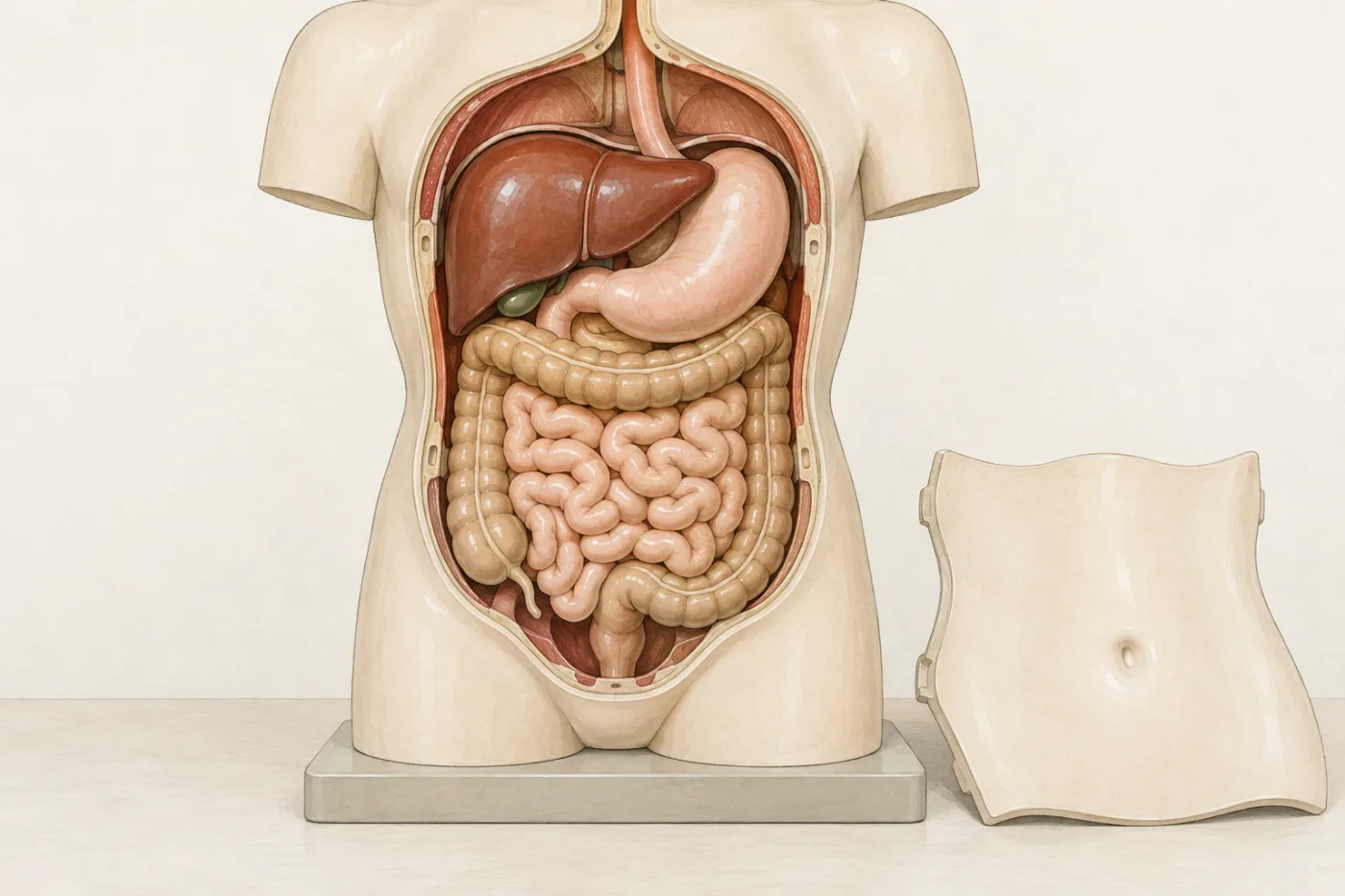 (enlarge)
The organs of the digestive system
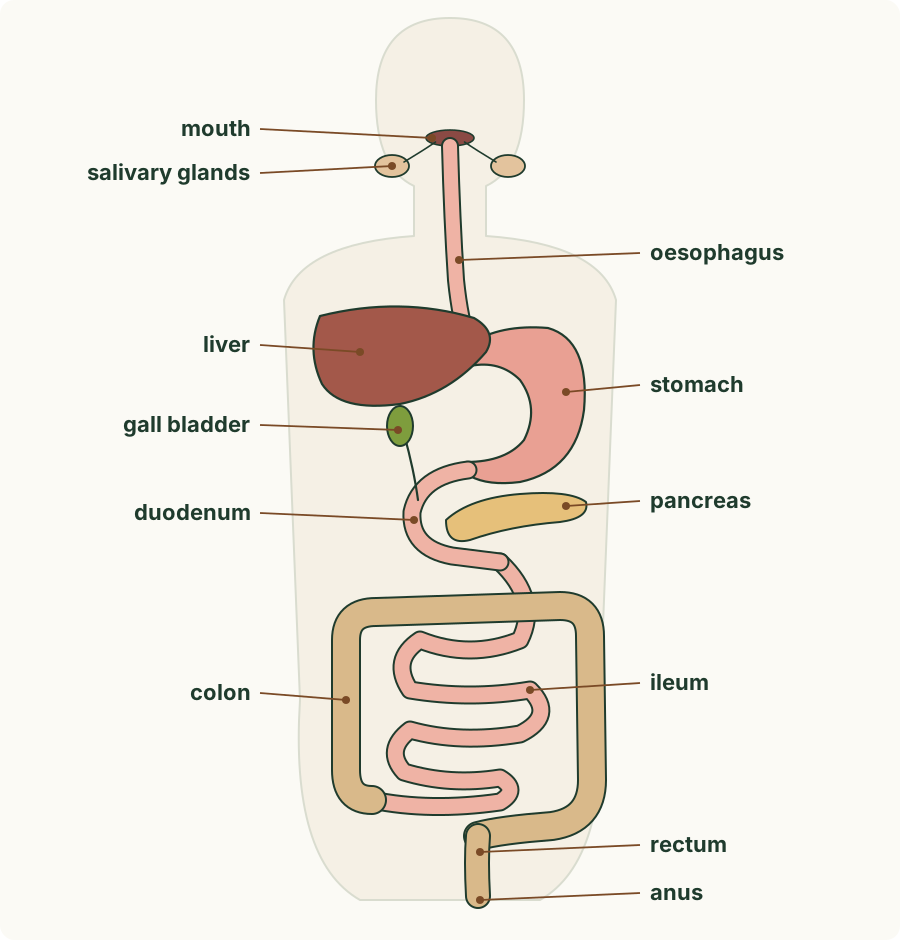
Food passes along the alimentary canal, a tube from the mouth to the anus: the mouth, the oesophagus, the stomach, the small intestine and the large intestine. The small intestine has two parts: first the short duodenum, then the long ileum. The large intestine has parts too: the colon, then the rectum, which ends at the anus.
Four associated organs belong to the digestive system, but food never passes through them: the salivary glands, the pancreas, the liver and the gall bladder. They make or store juices that flow into the canal along small tubes called ducts, and the liver also deals with nutrients that the blood brings to it.
 (enlarge)
Trap: "Food passes through the liver and the pancreas." Food stays inside the alimentary canal all the way. The pancreas sends its juice into the duodenum along a duct, and bile from the liver arrives the same way; food itself never enters them.
What each organ does
Five words name what happens to food:
- Ingestion: the taking of substances, for example food and drink, into the body.
- Digestion: the breakdown of food.
- Absorption: the movement of nutrients from the intestines into the blood.
- Assimilation: the uptake and use of nutrients by cells.
- Egestion: the removal of undigested food from the body as faeces.
| Organ | What it does |
|---|---|
| Mouth | Ingestion: food and drink enter here. The teeth chew food (physical digestion) and mix it with saliva. |
| Salivary glands | Make saliva, which wets food so it is easy to swallow; saliva contains an enzyme that starts digesting starch. |
| Oesophagus | Carries food from the mouth to the stomach, pushed along by the muscles in its wall. |
| Stomach | Churns food with its muscular wall (physical digestion) and mixes it with gastric juice, which contains an enzyme that starts digesting protein. |
| Pancreas | Makes pancreatic juice, which contains enzymes, and sends it into the duodenum. |
| Liver | Makes bile. Its cells also take up nutrients from the blood and use or store them (assimilation): for example, they build amino acids into proteins and store glucose as glycogen. |
| Gall bladder | Stores bile and releases it into the duodenum. |
| Duodenum | Receives pancreatic juice and bile; digestion continues. |
| Ileum | Digestion is completed, and the small, soluble molecules of digested food are absorbed into the blood (absorption), with much of the water. |
| Colon | Absorbs more water from the undigested food that is left. |
| Rectum | Stores the faeces. |
| Anus | Egestion: the faeces leave the body. |
Assimilation happens in cells all over the body: a muscle cell that takes up glucose and uses it in respiration is assimilating it.
Key idea: Food passes along the alimentary canal: mouth, oesophagus, stomach, small intestine (duodenum, ileum) and large intestine (colon, rectum, anus). The salivary glands, pancreas, liver and gall bladder add juices or deal with nutrients. Food is ingested, digested, absorbed, assimilated, and what is not digested is egested.
Worked example
Following a piece of bread
Follow a piece of bread from the mouth to the anus. Name, in order, the parts of the alimentary canal it passes through, and the process at each main stage.
Mouth: ingestion; the teeth chew the bread and saliva starts digesting its starch. Oesophagus: carries it down to the stomach. Stomach: churns it and mixes it with gastric juice. Duodenum: pancreatic juice and bile are added and digestion continues. Ileum: digestion is completed, and the small, soluble molecules are absorbed into the blood. The blood carries them to cells, which take them up and use them: assimilation. Colon: more water is absorbed from what is left, such as the fibre. Rectum: the faeces are stored. Anus: egestion. The bread never passes through the salivary glands, the pancreas, the liver or the gall bladder: their juices come to it.
Worked example
Which process?
Name the process in each case: (a) a baby drinks milk; (b) glucose passes from the ileum into the blood; (c) a liver cell builds amino acids into a protein; (d) faeces leave the body.
(a) Ingestion: taking food and drink into the body. (b) Absorption: a nutrient moves from the intestine into the blood. (c) Assimilation: a cell takes up nutrients and uses them. (d) Egestion: undigested food leaves the body as faeces. Do not call (d) excretion: excretion removes waste made by the body's own cells, but faeces are mostly food that was never digested or absorbed, so it was never part of the body's cells.
The churning stomach
The stomach is a muscular bag. Its wall has thick layers of muscle, which contract and relax again and again for hours after a meal. This churns the food: it squeezes and turns it, breaks it into smaller pieces and mixes it with gastric juice, until it becomes a thick, creamy liquid. This is physical digestion, like the glass rod mashing the egg white: the food molecules are not changed. Smaller pieces have a larger surface area for the enzymes in the gastric juice, and later in the small intestine. A little at a time, the liquid then passes on into the duodenum.
Trap: "The stomach digests food only with its juice." The muscular wall of the stomach also digests food physically: churning breaks it into smaller pieces and mixes it with the juice.
Worked example
A stomach in a bag
A pupil puts some pieces of cracker and a little water into a sealed plastic bag and squeezes the bag with both hands, again and again, for two minutes. The crackers turn into a thick paste. Explain what the squeezing stands for, and why it helps digestion in the real stomach.
The squeezing hands stand for the muscles in the stomach wall, which contract and relax again and again: they churn the food. The crackers are broken into smaller pieces and mixed with the water, which stands for the gastric juice. This is physical digestion: the cracker is still cracker, with no chemical change. Smaller pieces have a larger surface area, so the enzymes can act on more of the food at once and digest it faster. The model leaves out the enzymes: it shows only the physical part.
Supplement: bile and fat droplets
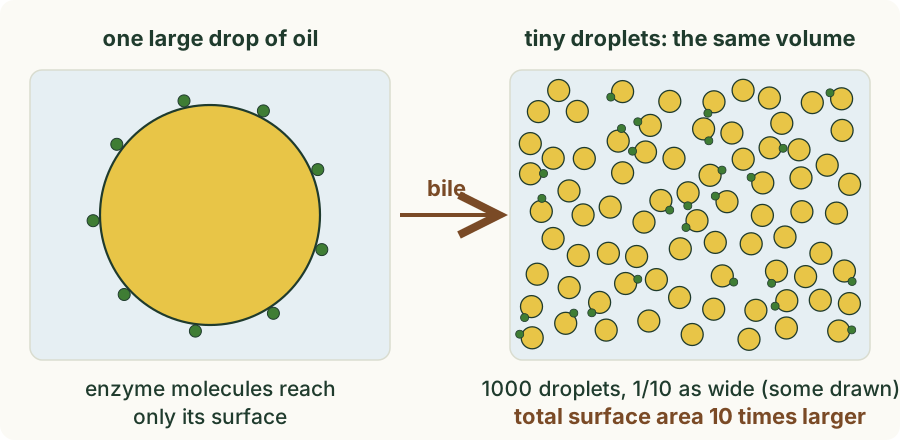
Fats and oils do not mix with water. In the duodenum, fat from a meal would stay in large drops, and the enzyme that digests fat could work only at the surface of each drop. Bile changes that. It is made in the liver, stored in the gall bladder, and flows along the bile duct into the duodenum. Bile emulsifies fats and oils: it breaks large drops into many tiny droplets, which stay spread through the watery liquid. This is physical, not chemical: the fat molecules are not changed. But the tiny droplets have a much larger surface area, so the enzyme can digest the fat much faster.
 (enlarge)
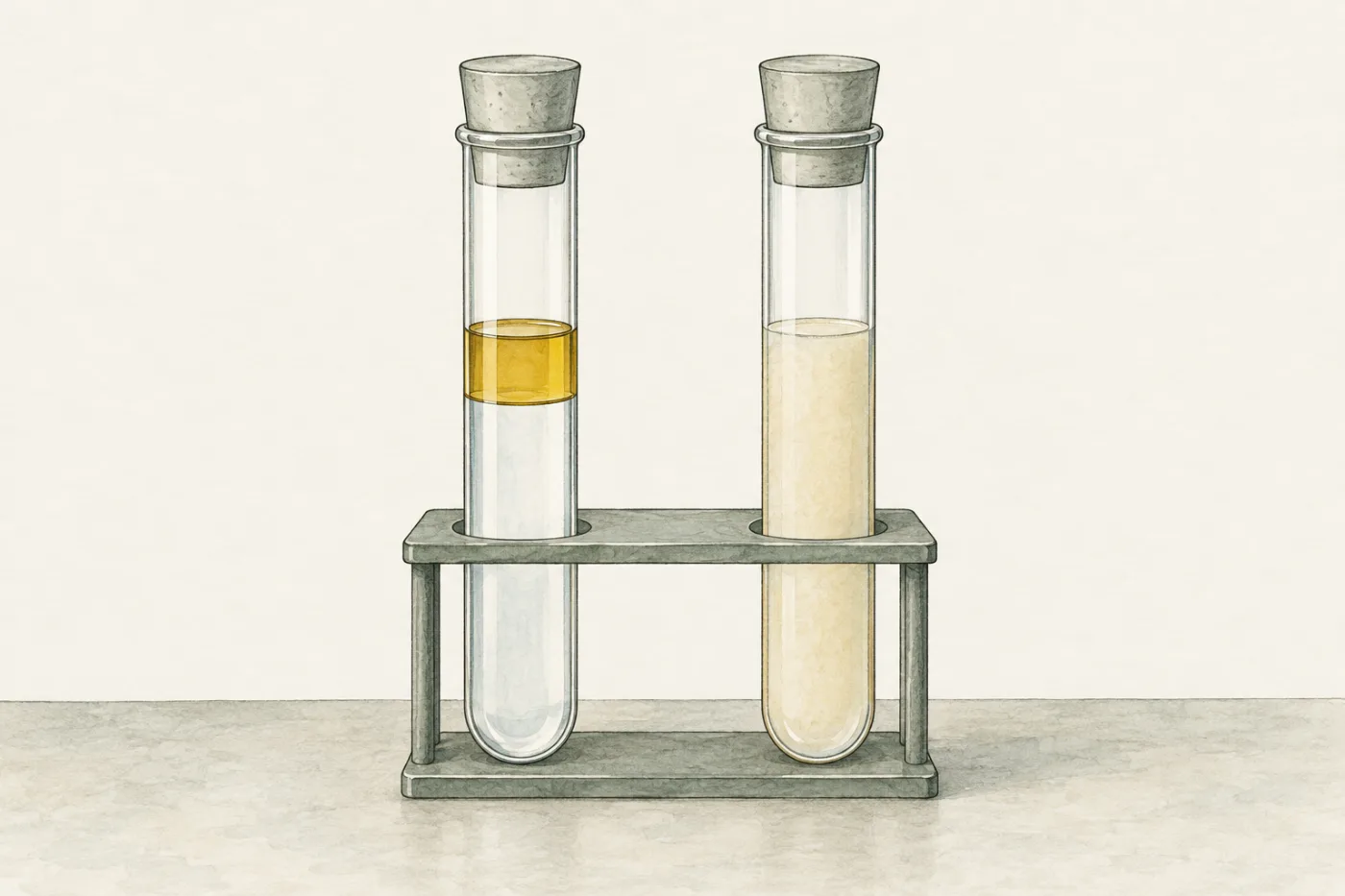
You can see an emulsion form in a test tube. Oil shaken with water alone soon floats back up as a separate layer. Shaken with water and a little bile, or with washing-up liquid, which emulsifies oil in the same way, it stays as a cloudy, creamy liquid of tiny droplets.
 (enlarge)
Key idea: (Supplement) Bile, made in the liver and stored in the gall bladder, emulsifies fats and oils in the duodenum: it breaks them into tiny droplets, with no chemical change. This increases their surface area for chemical digestion by enzymes.
Worked example
Without a gall bladder
Supplement. A patient has had their gall bladder removed. Their liver still makes bile, which now trickles slowly into the duodenum all the time. The doctor advises them to avoid large, fatty meals. Explain why.
Bile is made in the liver, so the patient still has some. But there is no gall bladder to store bile and release a large amount into the duodenum when a fatty meal arrives. After a large, fatty meal there is too little bile to emulsify all the fat, so much of it stays in large drops. Large drops have a small total surface area, so the enzyme that digests fat can reach only a little of it at a time, and the fat is digested slowly. A small meal with little fat needs less bile, so the bile that trickles in is enough.