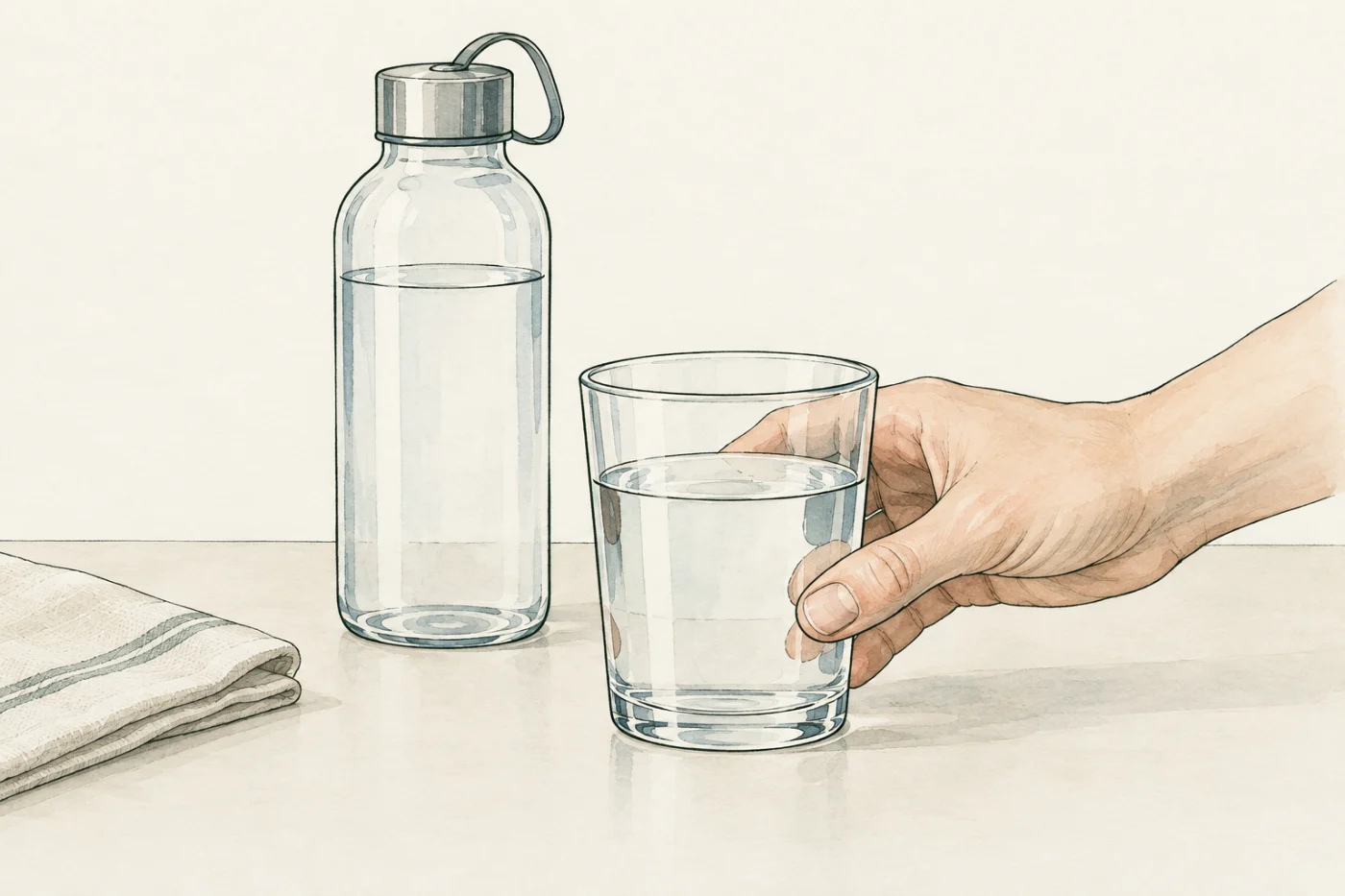
Drink a large glass of water, and within an hour or two you need to pass urine. Your body did not keep the extra water: it got rid of it. Your cells are also making waste all the time, even while you sleep, and some of that waste is poisonous if it builds up. In this part you find out which wastes your body gets rid of, through which organs, and how the kidneys and the tubes below them carry urine out of the body.
 (enlarge)
Waste from your own cells
Every cell in your body carries out chemical reactions all the time: respiration, building proteins, breaking down substances it no longer needs. All these reactions together are called metabolism. Some of the substances they make are of no use to the body, and some substances, such as water and ions from food and drink, arrive in larger amounts than the body needs. Biologists call these excess substances: more than the body needs.
Excretion is the removal from the body of the waste products of metabolism and of substances in excess. Two waste products matter most here:
- carbon dioxide, made by respiration in every cell;
- urea, a waste substance that contains nitrogen. You will find out where it is made in part 3.
Trap: "Getting rid of faeces is excretion." It is not. Faeces are mostly food that was never digested or absorbed: it passed along the gut without ever entering your cells, so it is not a waste product of metabolism. Getting rid of faeces is called egestion.
Two organs that excrete
 (enlarge)
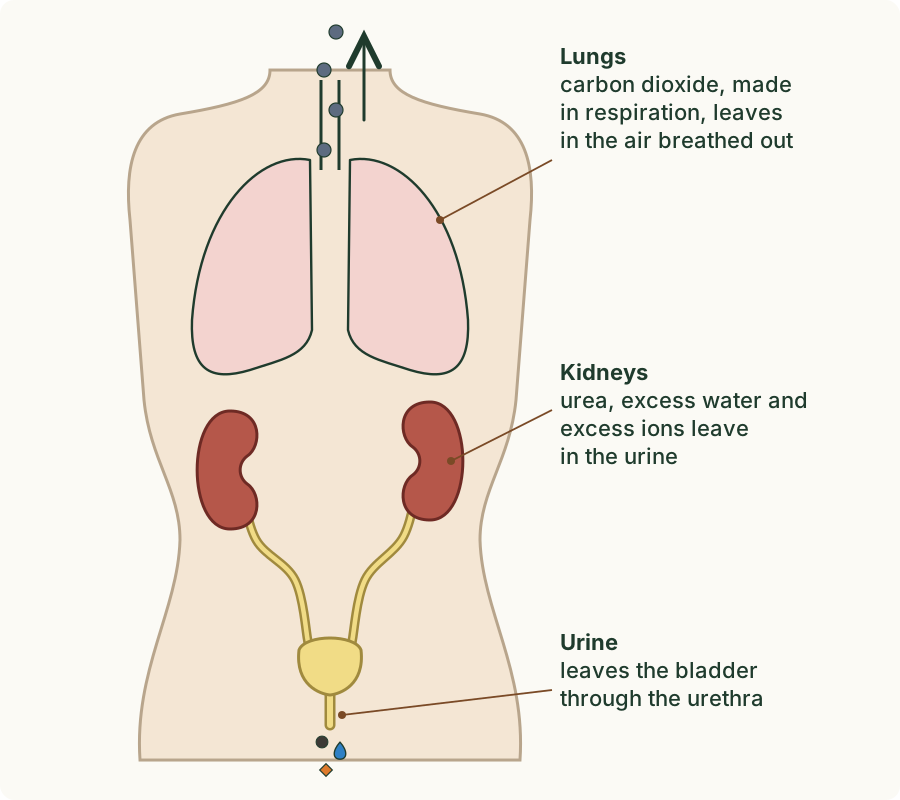
The lungs excrete carbon dioxide. Carbon dioxide made by respiration passes from the cells into the blood, which carries it to the lungs. There it diffuses into the air in the alveoli and leaves the body in the air you breathe out. You tested this in Breathing and gas exchange: expired air has about 4% carbon dioxide, a hundred times more than inspired air.
The kidneys excrete urea, excess water and excess ions. Blood flows through the kidneys all the time. They take urea out of it, together with the water and ions that the body does not need, and make urine: a solution of urea and ions in water.
Trap: "We breathe out to get rid of oxygen." The oxygen in expired air is oxygen that your body did not use. The waste product the lungs excrete is carbon dioxide.
The urinary system
 (enlarge)
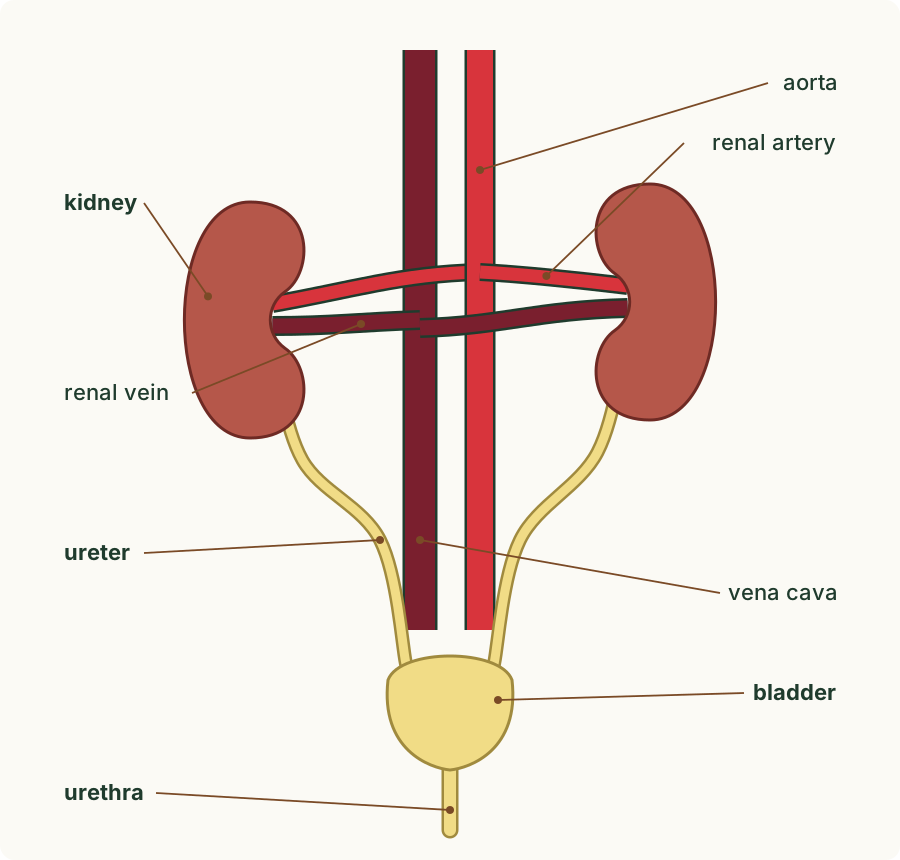
The organs that make, store and release urine are called the urinary system. The diagram shows them from the front, as if you were facing the person, so their right kidney is on your left.
- The two kidneys are bean-shaped organs, each about the size of your fist, high in the back of the abdomen on either side of the spine.
- Blood reaches each kidney through a renal artery, a branch of the aorta, and leaves through a renal vein, which joins the vena cava. ("Renal" means "of the kidney".)
- A narrow tube, a ureter, carries urine from each kidney down to the bladder.
- The bladder is a stretchy bag that stores urine until you choose to empty it.
- One tube, the urethra, carries urine from the bladder to the outside of the body.
Trap: The two tube names are easy to swap. There are two ureters, one from each kidney to the bladder. There is one urethra, from the bladder to the outside.
Run the experiment below before you read on. First predict which blood has less urea in it: the blood going into a kidney or the blood coming out. Then tap the renal artery to send blood through the kidney, and follow the drop of urine it makes all the way out of the body.
What the experiment showed
The blood in the renal artery carried urea, shown as dark dots. The blood leaving the kidney in the renal vein carried fewer, because the kidney had taken some of the urea out and put it into the urine. So blood leaving the kidney has less urea in it than blood entering it. Each time blood passes through, the kidneys remove only part of its urea, but all of your blood passes through them every few minutes, so urea never builds up. The urine then flowed down the ureter to the bladder, and later out through the urethra.
(Supplement) Inside a kidney
 (enlarge)
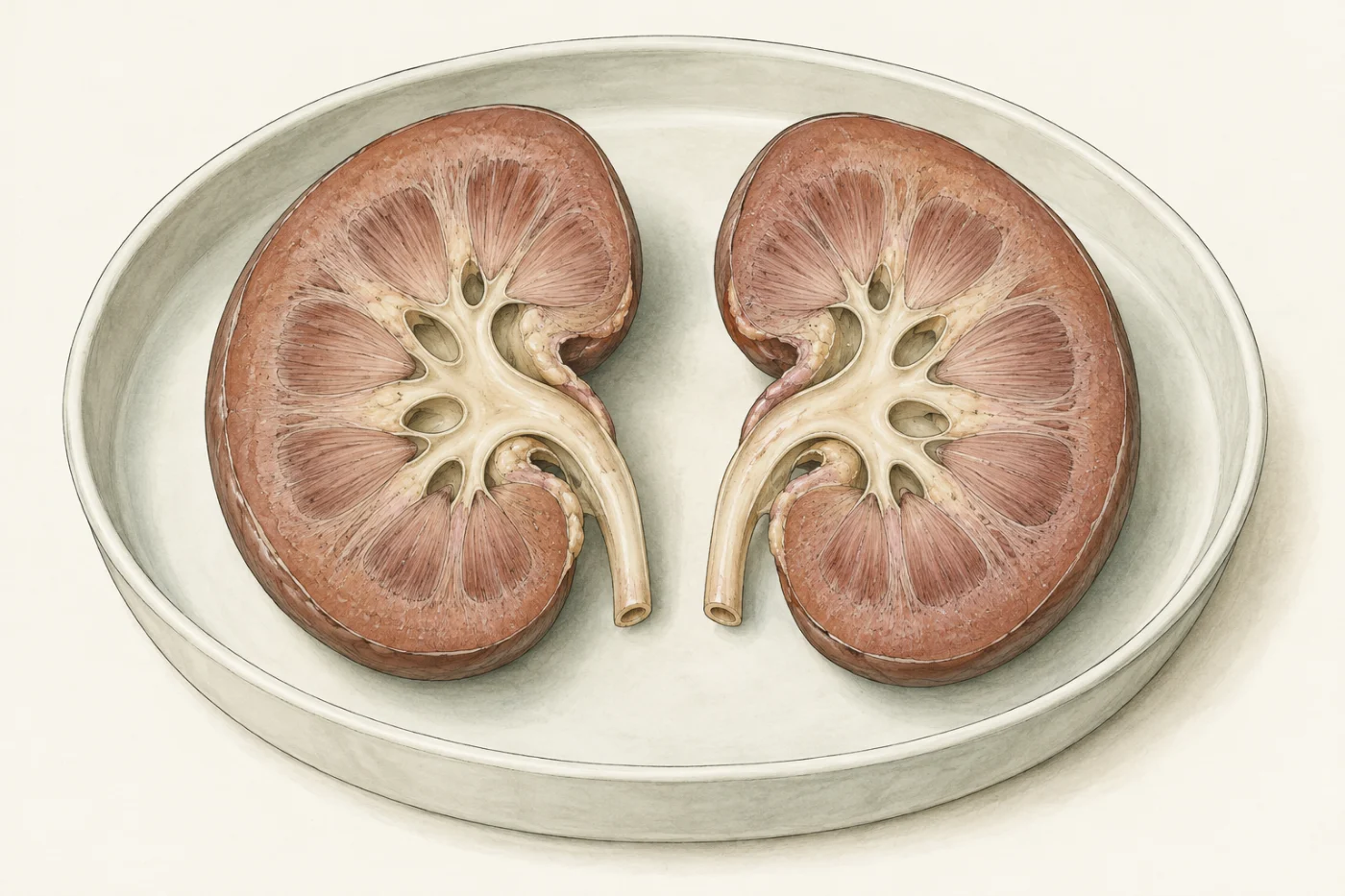
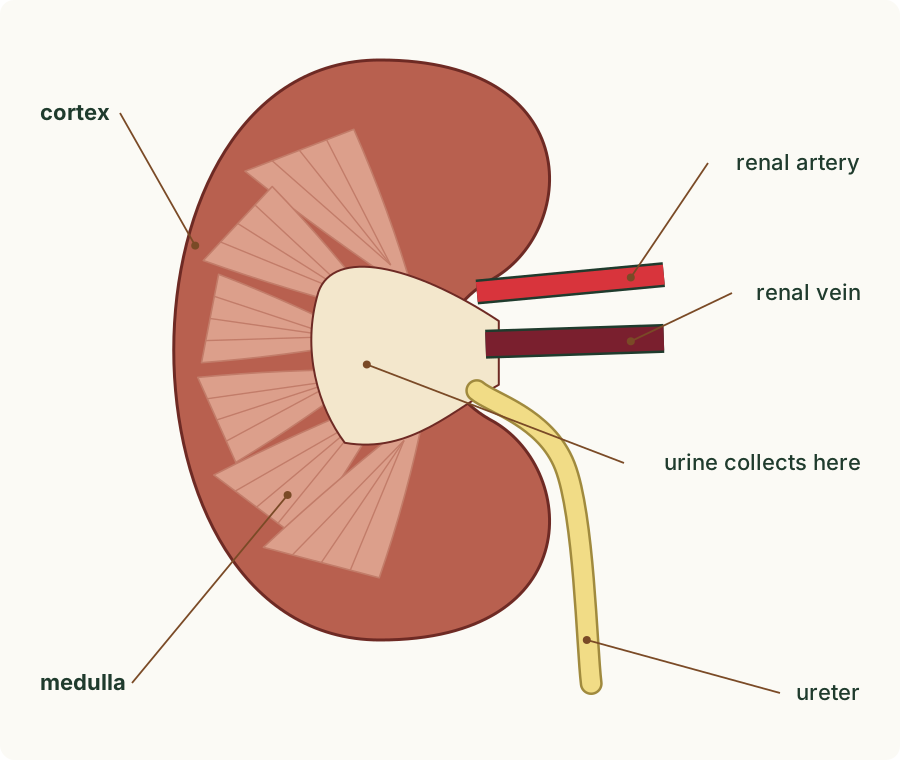
If a kidney is cut in half lengthways, from top to bottom, you can see two regions with the naked eye.
 (enlarge)
- The cortex is the outer layer, just under the surface. It looks darker and grainy.
- The medulla is the inner region. It is made of cone-shaped sections with fine stripes, which point towards the middle of the kidney.
Urine made in the cortex and medulla drains into a space in the middle of the kidney, and from there into the ureter. In part 2 you will see what the stripes are: tiny tubes, about a million in each kidney.
Worked example
Excretion or not?
Decide whether each of these is excretion, and give a reason: (a) breathing out carbon dioxide; (b) passing urine; (c) getting rid of faeces.
(a) Excretion. Carbon dioxide is a waste product of respiration, a reaction in your cells. (b) Excretion. Urine carries urea, a waste product of metabolism, and excess water and ions. (c) Not excretion. Faeces are mostly undigested food that never entered your cells, so they are not a waste product of metabolism; this is egestion.
Worked example
Ureter or urethra?
A drop of urine is made in the left kidney. Name, in order, the organs and tubes it passes through until it leaves the body.
The urine leaves the kidney through the left ureter, which carries it down to the bladder. It is stored there until the bladder is emptied, then it leaves the body through the urethra. Check: each kidney has its own ureter, so the drop could not pass through the right ureter, and there is only one urethra.
Worked example
(Supplement) Cortex or medulla?
A pupil looks at a kidney cut in half lengthways. They see a dark outer layer about 1 cm thick and, inside it, paler cone-shaped regions with fine stripes. Name the two regions.
The outer layer, just under the surface, is the cortex. The striped, cone-shaped regions inside it are the medulla. The pale space in the middle, where the cones point, is where urine collects before it enters the ureter: it is neither cortex nor medulla.
Worked example
Two days of urine
A pupil eats the same food on two days. On day 1 they drink 3.0 dm³ of water and pass 2.5 dm³ of pale urine. On day 2 they drink 1.0 dm³ and pass 0.8 dm³ of darker urine. Explain the difference.
On day 1 the body took in far more water than it needed, so the kidneys excreted the excess water: more urine was made. The food was the same, so about the same amount of urea had to be removed on both days. On day 1 that urea was dissolved in more water, so the urine was more dilute and paler; on day 2 the same urea was in less water, so the urine was more concentrated and darker.
Key idea: Excretion is the removal of the waste products of metabolism and of substances in excess. The lungs excrete carbon dioxide; the kidneys excrete urea, excess water and excess ions in urine. Urine flows from each kidney down a ureter to the bladder, and leaves the body through the urethra. (Supplement) A kidney cut lengthways shows an outer cortex and an inner medulla.