This part is Supplement content.
Your two kidneys filter about 180 dm³ of liquid out of your blood every day: more than a bathtub full, and about sixty times the volume of liquid in all your blood. Yet you pass only about 1.5 dm³ of urine a day. So almost everything the kidneys filter out must go back into the blood. In this part you follow substances through one of the tiny tubes that do this work, and find out what goes out of the blood, what comes back, and what is left to become urine.
One nephron and its blood vessels
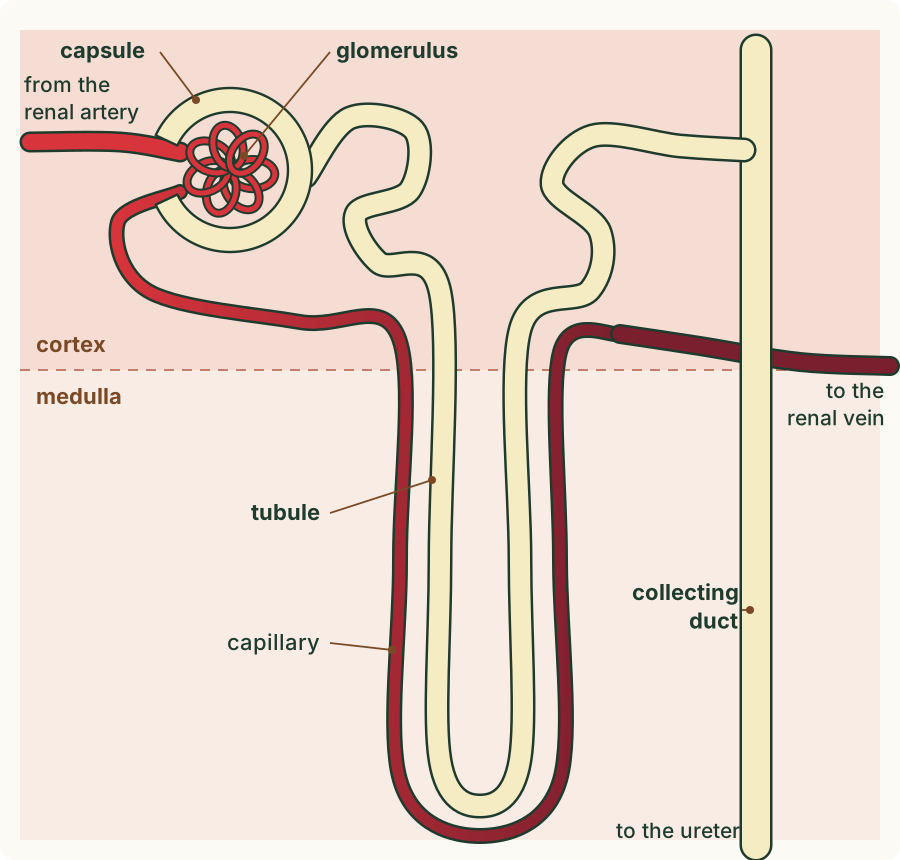
Each kidney contains about a million tiny tubes called nephrons. They are too small to see one at a time with the naked eye; together they make the fine stripes you saw in the medulla. The diagram shows one nephron, much enlarged, with the blood vessels that serve it.
 (enlarge)
- A small branch of the renal artery brings blood to a knot of capillaries called the glomerulus.
- The glomerulus sits inside a cup-shaped capsule, the start of the nephron.
- From the capsule a long, narrow tubule coils, loops down into the medulla and back up again.
- The tubule empties into a collecting duct, shared by many nephrons, which carries urine to the middle of the kidney and the ureter.
- The blood leaving the glomerulus flows on into capillaries that wrap round the tubule, and then into a vein that leads to the renal vein.
Free play: nothing here is marked or saved
A bathtub a day
Your kidneys filter about 180 dm³ of liquid, the filtrate, out of your blood every day, and almost all of the water goes back. How much urine is left if a little less goes back?Supplement
Still picture: your device asks for less motion.
Try: Take back 98 %, not 99 %. What happens to the urine?
- Filtrate a day
- 180 dm³
- Back into blood
- 178.2 dm³
- Urine a day
- 1.8 dm³
urine = 180 dm³ × (100 − 99.0) ÷ 100 = 1.8 dm³
back into blood = 180 dm³ − 1.8 dm³ = 178.2 dm³
- Taking back 98 % instead of 99 % doubles the urine: 2 % of the filtrate is left instead of 1 %.
- About 1.5 dm³ of urine a day means a little more than 99 % of the water goes back; worked example W08 finds it.
- Only water is counted here. Glucose, ions and urea come next in this part.
About this model. A model with water only, and every day the same 180 dm³ of filtrate. How much water goes back changes from day to day with how much you drink and sweat. A healthy person stays close to 99 %; both ends of the slider are far outside a normal day. The tub and the bottles show amounts, not places: the filtered water stays inside you; only the urine leaves.
Filtration in the glomerulus
 (enlarge)
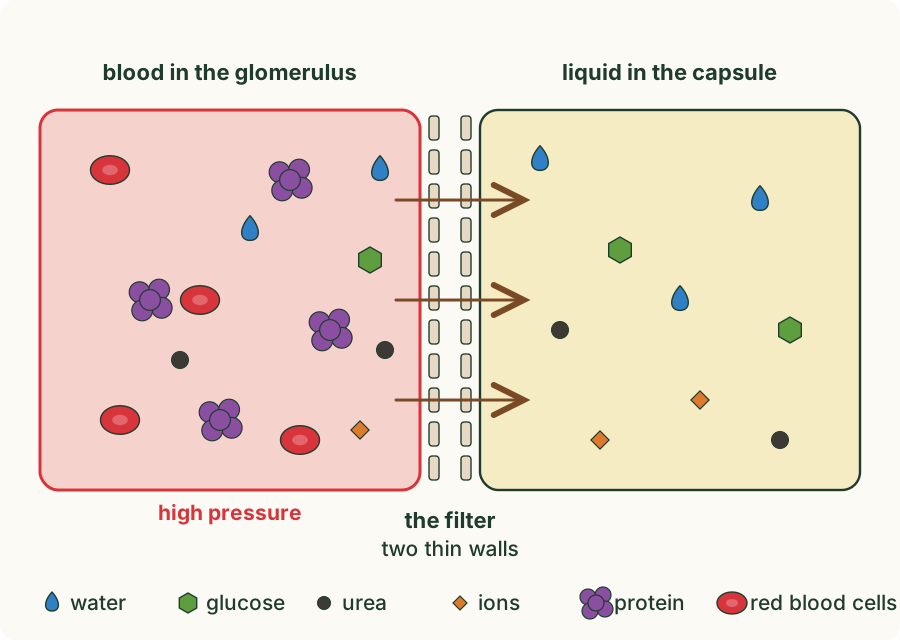
The blood in the glomerulus is under high pressure. The walls of its capillaries and the inner wall of the capsule together act as a filter: they have tiny gaps that small molecules can pass through, but large ones cannot. So the pressure squeezes water, glucose, urea and ions out of the blood into the capsule. Proteins and blood cells are too large: they stay in the blood. The liquid that collects in the capsule is called the filtrate.
Trap: "The glomerulus filters out only the waste." It filters out every small molecule, useful or not. Glucose and most of the water and ions are needed by the body, so they have to be taken back later, along the tubule.
Run the experiment below before you read on. First predict which particles pass into the capsule. Then tap the glomerulus to filter the blood, follow one glucose molecule along the tubule, and repeat with the other substances. In the full experiment you then look for a route that has been drawn wrongly.
Reabsorption along the tubule
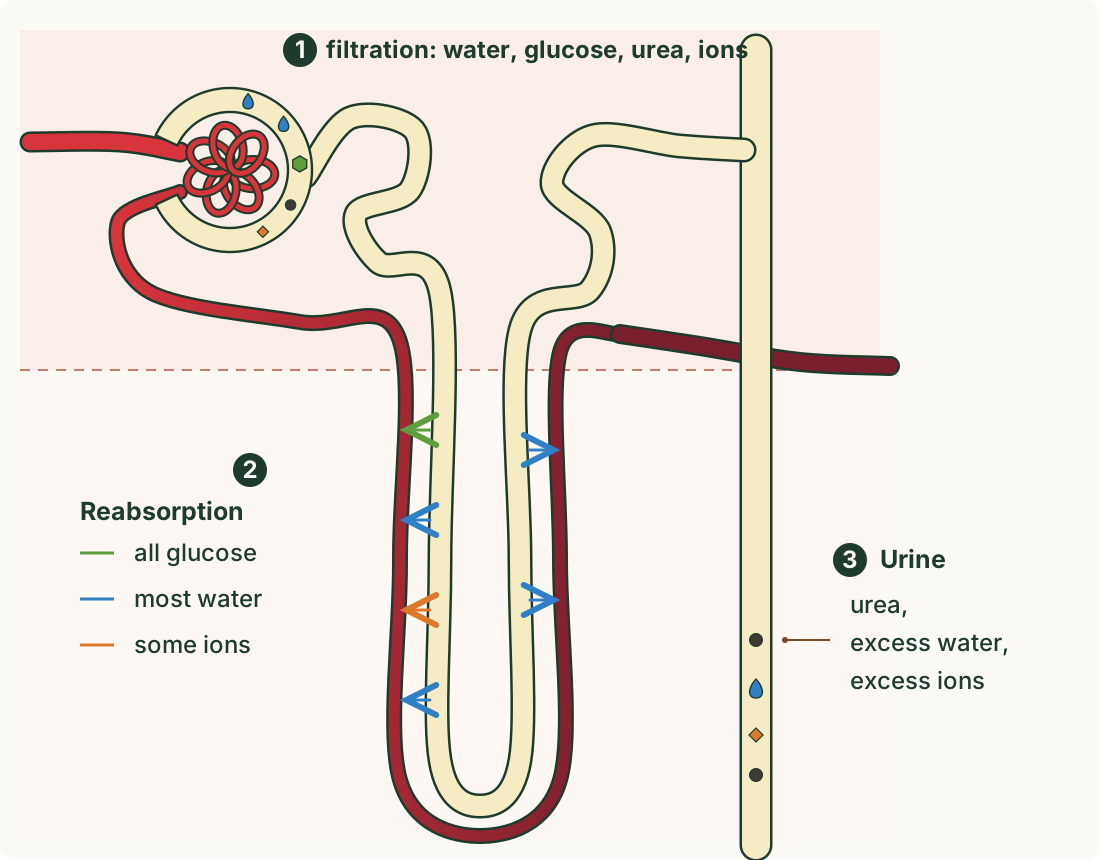
As the filtrate flows along the tubule, useful substances pass back out of it into the blood in the capillaries that wrap round it. Taking substances back into the blood like this is called reabsorption. Normally:
- all of the glucose is reabsorbed;
- most of the water is reabsorbed: about 99% of it;
- some of the ions are reabsorbed: as many as the body needs.
How the cells of the tubule do this is beyond this course. In the experiment's model, no urea goes back; in a real kidney some does, but most of it stays in the tubule.
Trap: "Urine is the filtrate." It is not: urine is what is left of the filtrate after reabsorption. The filtrate has glucose in it and is very dilute; normal urine has no glucose and far less water.
What is left: urine
 (enlarge)
What is left in the tubule flows into the collecting duct. It is urine: it contains urea, excess water and excess ions. From the collecting duct it drains into the middle of the kidney, then down the ureter to the bladder.
Plasma, filtrate and urine compared
Plasma is the liquid part of the blood. The table gives typical concentrations: how many grams of each substance there are in 1 dm³ of the liquid. The numbers vary from person to person and with what they have eaten and drunk.
| Substance | Plasma (g per dm³) | Filtrate (g per dm³) | Urine (g per dm³) |
|---|---|---|---|
| protein | 80 | 0 | 0 |
| glucose | 1.0 | 1.0 | 0 |
| urea | 0.3 | 0.3 | 20 |
| ions | 7 | 7 | 15 |
Worked example
What gets through the filter?
Use the table. Which substances pass from the plasma into the filtrate, and which do not? Explain using the size of the molecules.
Glucose, urea and ions have the same concentration in the filtrate as in the plasma, so they pass through the filter freely; so does water. Protein has a concentration of 80 g per dm³ in plasma but 0 in the filtrate: protein molecules are too large to pass through the gaps in the filter, so they stay in the blood. Blood cells are larger still, so they stay in the blood too.
Worked example
Why is there no glucose in urine?
The filtrate contains 1.0 g of glucose per dm³, but normal urine contains none. Explain why.
Glucose is small, so it is filtered out of the blood in the glomerulus: that is why the filtrate contains it. Then, as the filtrate flows along the tubule, all of the glucose is reabsorbed back into the blood in the capillaries round the tubule. None is left by the time the liquid reaches the collecting duct, so the urine has no glucose. The body keeps its glucose for respiration.
Worked example
Reading the table
The concentration of urea rises from 0.3 g per dm³ in the filtrate to 20 g per dm³ in urine. Calculate how many times more concentrated urea is in urine, and explain how this happens.
20 ÷ 0.3 ≈ 67 times. The kidney does not add urea to the tubule. Instead, most of the water is reabsorbed while the urea stays in the tubule, so the same urea ends up dissolved in far less water. Less water with the same amount of urea makes a higher concentration.
Worked example
How much water goes back?
The kidneys make about 180 dm³ of filtrate a day, and about 1.5 dm³ of urine. What percentage of the water in the filtrate is reabsorbed?
Water left in the urine: 1.5 dm³ out of 180 dm³, which is 1.5 ÷ 180 × 100 ≈ 0.8%. So the water reabsorbed is about 100% − 0.8% ≈ 99%. (This treats filtrate and urine as almost all water, which they are.)
Key idea: (Supplement) Each kidney has about a million nephrons. In each, the glomerulus filters water, glucose, urea and ions out of the blood into the capsule; proteins and blood cells stay in the blood. Along the tubule, all of the glucose, most of the water and some of the ions are reabsorbed back into the blood in the surrounding capillaries. What is left, urea with excess water and excess ions, is urine, which flows down the collecting duct to the ureter.