Contents
Independent final check
Explain without the key
identify
Final check
The picture shows the urinary system from the front. A nurse passes a thin, soft tube into the body from the outside to drain the urine that is being stored. Which row is correct?
identify: name or select.
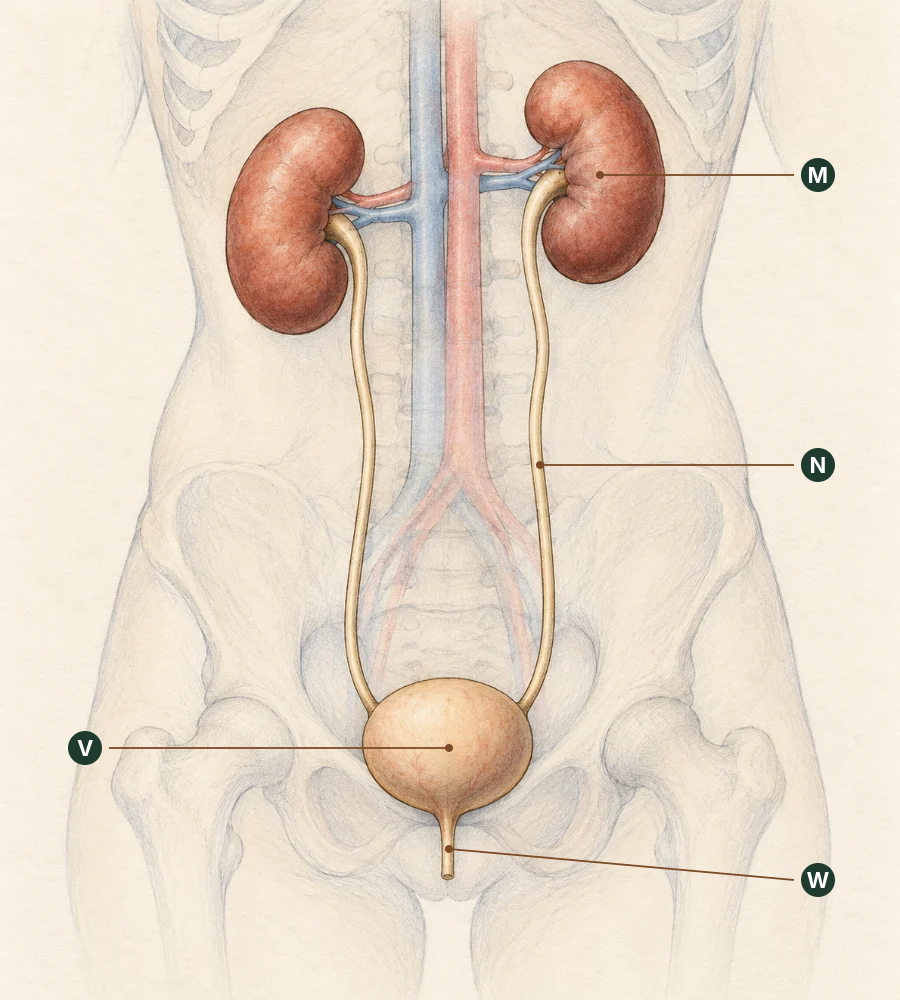 (enlarge)
| Row | Tube that the nurse's tube passes along | Organ that stores the urine | Tube for urine that a person has two of |
|---|---|---|---|
| A | W | V | N |
| B | N | V | W |
| C | W | M | N |
| D | N | M | W |
Your saved work
Answers, earlier attempts and your Pause and check notes stay in this browser. Export a copy to keep, to move to another device or to hand to your teacher. Importing a copy keeps your current answers and adds earlier attempts.
Scope and sources
Cambridge IGCSE Biology 0610 · 2026–2028 v3 · Original learning materials.
Excretion of carbon dioxide through the lungs (13.1.1) and of urea, excess water and excess ions by the kidneys (13.1.2); the kidneys, ureters, bladder and urethra (13.1.3); Supplement: the cortex and medulla of the kidney (13.1.4); the structure and function of a nephron and its blood vessels: filtration in the glomerulus, reabsorption of all of the glucose, some of the ions and most of the water, and urine (13.1.5); the liver assimilates amino acids by converting them to proteins (13.1.6); urea forms in the liver from excess amino acids by deamination (13.1.7, 13.1.8); the importance of excretion, limited to the toxicity of urea (13.1.9). The control of water and of body temperature is in Homeostasis; the detailed mechanisms of reabsorption, dialysis and transplants are not part of the syllabus. The numbers in the experiment are a model with far fewer particles than a real nephron.
Apparatus, amounts and times in the experiment are illustrative. Real practical work follows a teacher-approved safety method.
Official Cambridge syllabus