This part is Supplement content.
A meal of eggs, beans or fish is rich in protein. In the gut, proteases break the protein down into amino acids, which are absorbed into the blood. You found out in Blood vessels that the blood from the gut goes straight to the liver. In this part you follow those amino acids into the liver, and find out why some of them end up as urea in your urine.
Building proteins in the liver
 (enlarge)
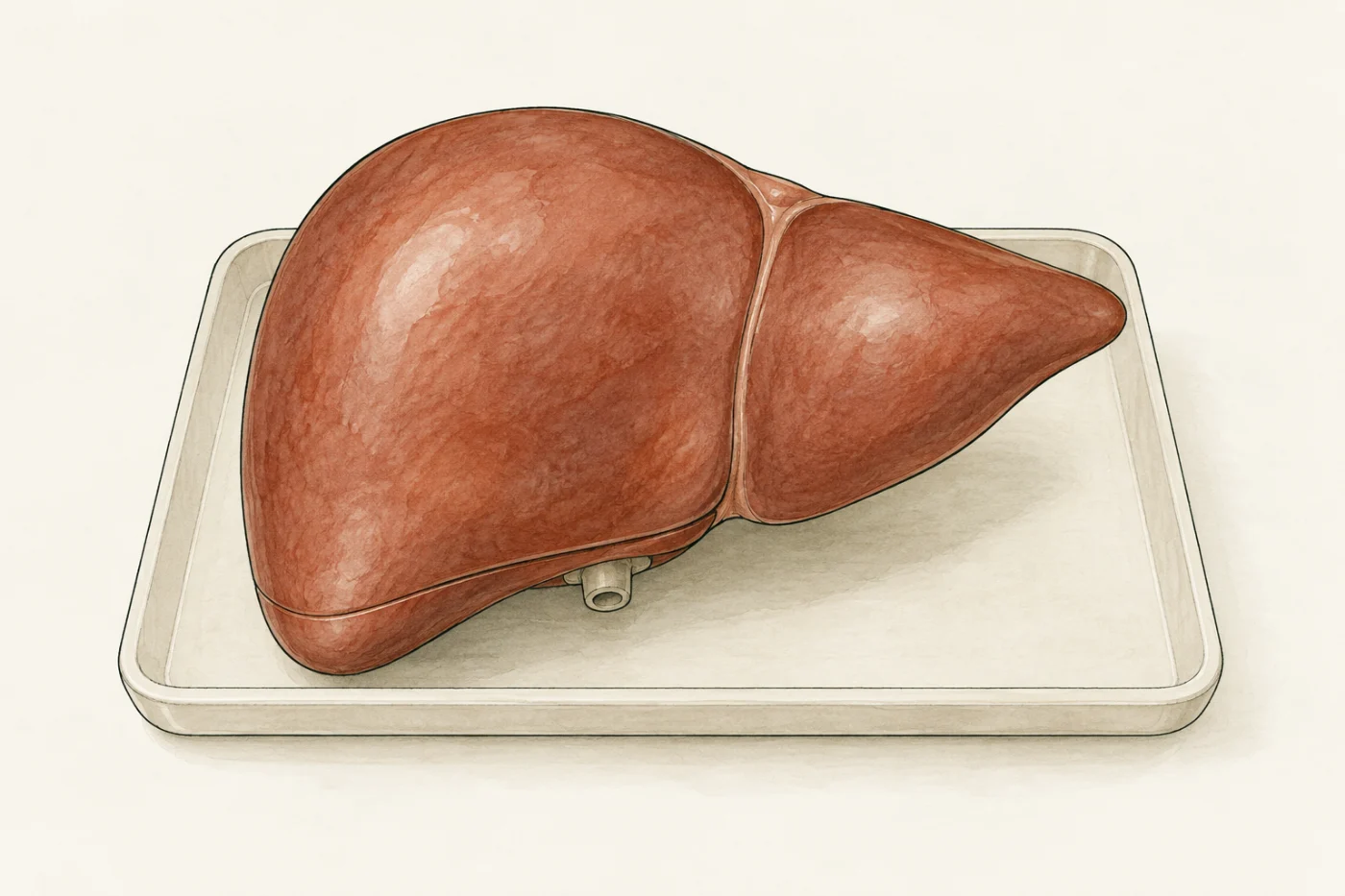
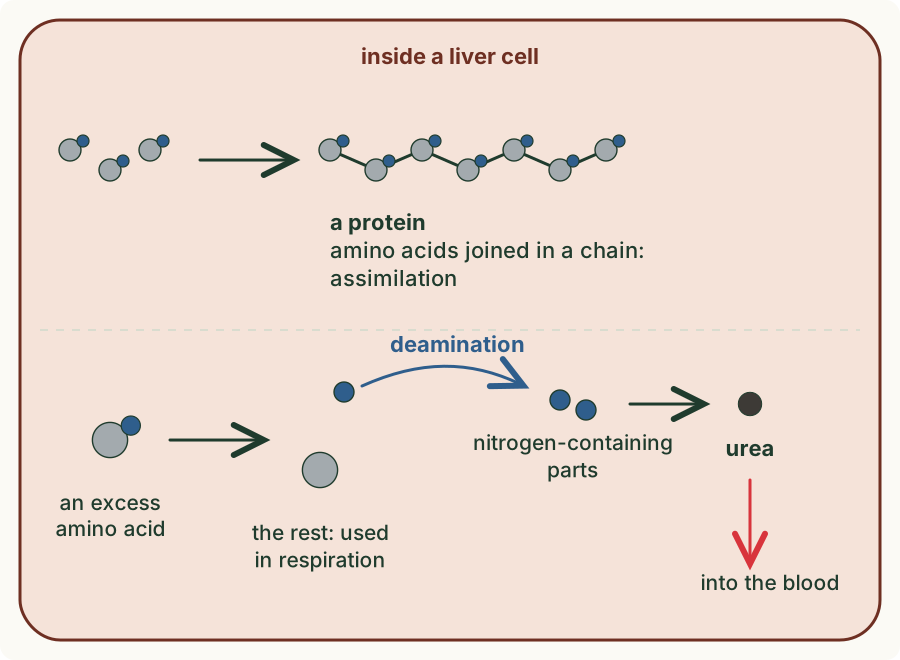
The liver is the largest organ inside the body. It lies just under the diaphragm, mostly on the right side. Its cells take amino acids out of the blood and join them together in long chains to make proteins, such as the proteins of the blood plasma. Making new parts of the body from digested food is called assimilation, so this is the assimilation of amino acids.
More amino acids than the body can use
Some days you eat more protein than your body needs for making new proteins. The body cannot store excess amino acids, so the liver breaks them down.
In each excess amino acid, the part that contains nitrogen is removed. This is called deamination: the removal of the nitrogen-containing part of an amino acid. The nitrogen-containing parts are turned into urea, which passes into the blood. The rest of each amino acid is not wasted: it can be used in respiration.
 (enlarge)
Trap: "The body stores the extra amino acids for later." It cannot. Glucose can be stored (as glycogen) and fat can be stored, but there is no store of amino acids, so the excess ones are deaminated.
Run the experiment below before you read on. First predict which organ makes urea. Then send the amino acids from a meal into a liver cell, build a protein from some of them, and remove the nitrogen-containing part from the rest. In the full experiment you then follow the urea out of the cell.
From the liver to the kidneys
 (enlarge)
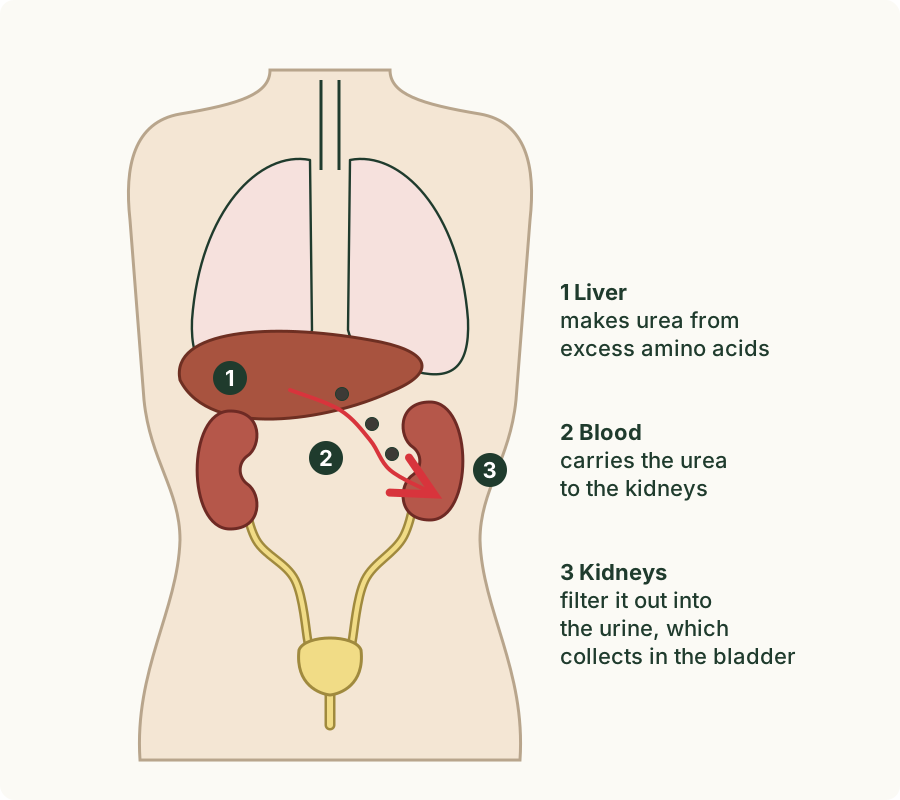
Urea dissolves in water, so it is carried in the blood plasma. The blood takes it from the liver, through the heart, to every organ, including the kidneys. In the kidneys it is filtered out of the blood, stays in the tubule and leaves in the urine, as you found in part 2.
Trap: "The kidneys make urea." They do not: the liver makes urea. The kidneys remove it from the blood and excrete it.
Why urea must be excreted
Urea is toxic: poisonous to cells if it builds up. While the kidneys work, they remove urea from the blood as fast as the liver makes it, so its concentration in the blood stays low. If the kidneys stop working, urea is still made every day, but none is removed, so its concentration in the blood keeps rising. Within days this makes a person very ill, and without medical treatment to remove the urea from their blood they would die. That is why excreting urea matters.
Worked example
Assimilation
A pupil eats a meal of beans. Describe what happens to the amino acids that the liver uses.
The protein in the beans is digested into amino acids, which are absorbed into the blood and carried to the liver. Liver cells take the amino acids and join them together into proteins, such as plasma proteins. Making new body substances from digested food in this way is assimilation.
Worked example
Deamination step by step
Describe what happens to an excess amino acid in the liver.
- The liver cell takes in an amino acid that the body does not need and cannot store.
- The nitrogen-containing part is removed from it: this is deamination.
- The nitrogen-containing parts are turned into urea, which passes into the blood.
- The rest of the amino acid can be used in respiration.
Worked example
Kidneys that stop working
A person's kidneys stop working. Predict what happens to the concentration of urea in their blood over the next few days, and explain why this is dangerous.
The liver still deaminates excess amino acids and makes urea every day, but the kidneys no longer remove it. So the concentration of urea in the blood rises day after day. Urea is toxic: as it builds up it harms the body's cells, and the person becomes very ill unless it is removed by medical treatment.
Worked example
A high-protein day
On day 1 a pupil eats 60 g of protein and excretes about 20 g of urea. On day 2 they eat 120 g of protein. Predict the mass of urea they excrete on day 2, and explain your prediction.
On day 2 they eat twice as much protein. Their body does not need twice as much new protein, so many more amino acids are in excess, and the liver deaminates them. More nitrogen-containing parts are removed, so more urea is made, and the kidneys excrete it. A sensible prediction is about 40 g, about twice day 1: twice the protein gives about twice the nitrogen to remove.
Key idea: (Supplement) The liver assimilates amino acids by joining them into proteins. The body cannot store excess amino acids, so the liver removes their nitrogen-containing part, which is deamination, and turns it into urea; the rest can be used in respiration. The blood carries urea to the kidneys, which excrete it in urine. Urea is toxic, so if the kidneys stop removing it, its concentration in the blood rises and harms the body.