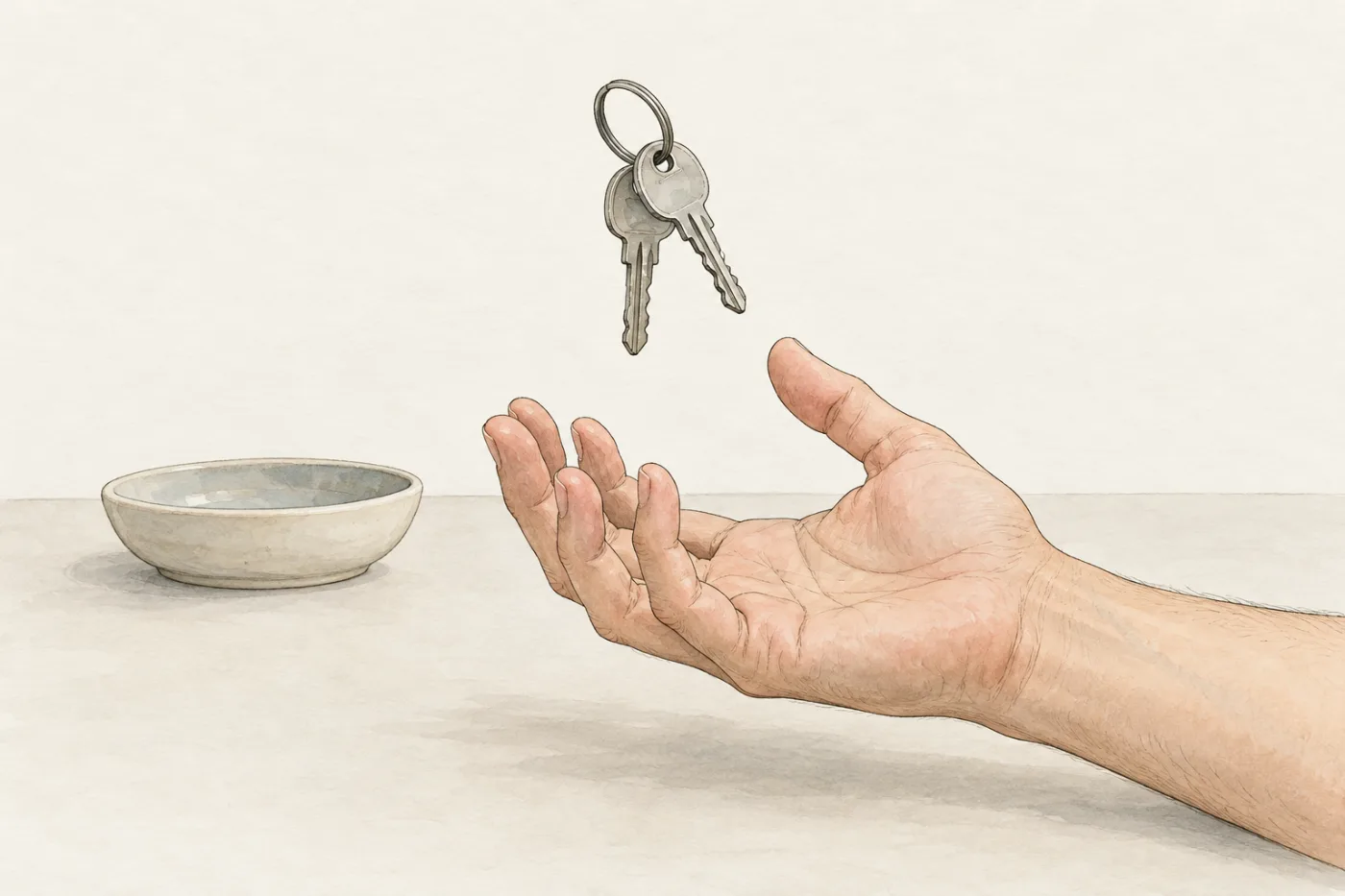
Someone knocks a set of keys off a table and, without thinking about it, your hand shoots out to catch them. In a fraction of a second your eyes saw the keys move, a message reached your brain, and another message reached the muscles of your hand. In this part you find out what carries those messages and which parts of the body they travel through, and you measure how long the whole journey takes for you.
 (enlarge)
Messages along neurones
Your nervous system is made of nerve cells called neurones. A neurone is a long, thin cell: some of the neurones in your leg are about a metre long. Messages travel along neurones as electrical impulses, tiny electrical signals that pass from one end of the cell to the other in a fraction of a second.
Trap: "The message is blood, or a liquid, flowing along the nerve." Nothing flows along a neurone. The impulse is an electrical signal that passes along the cell.
Two parts of the nervous system
 (enlarge)
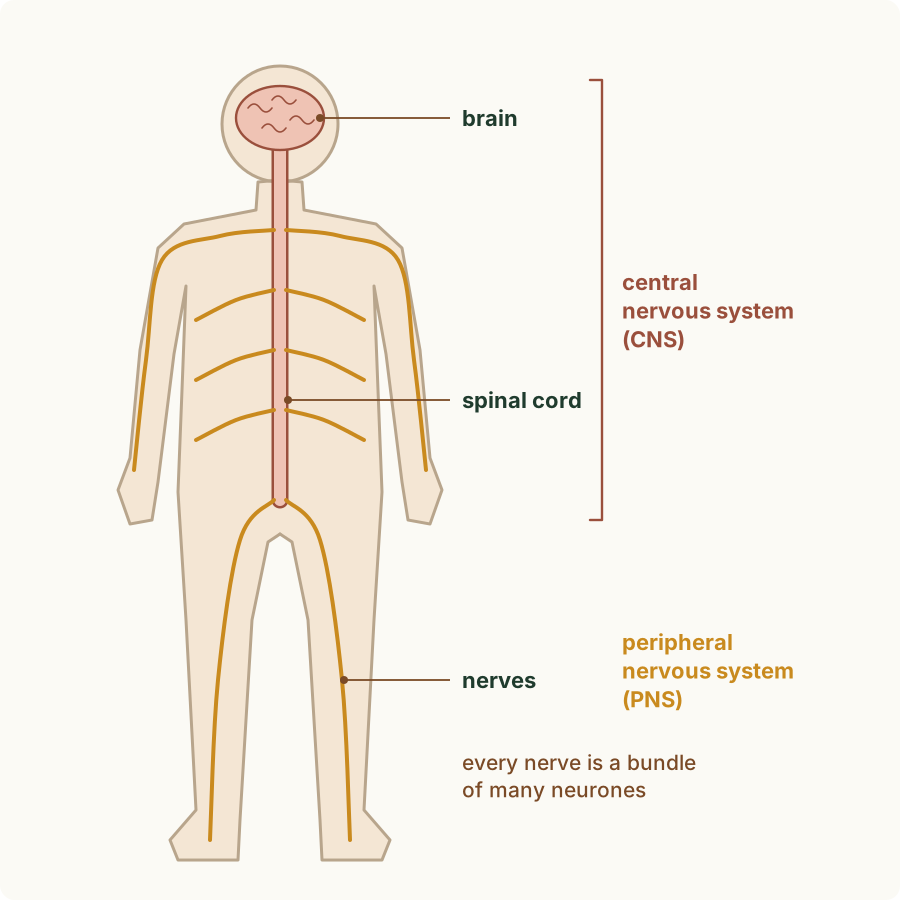
Biologists divide the nervous system of a mammal, such as a human, into two parts.
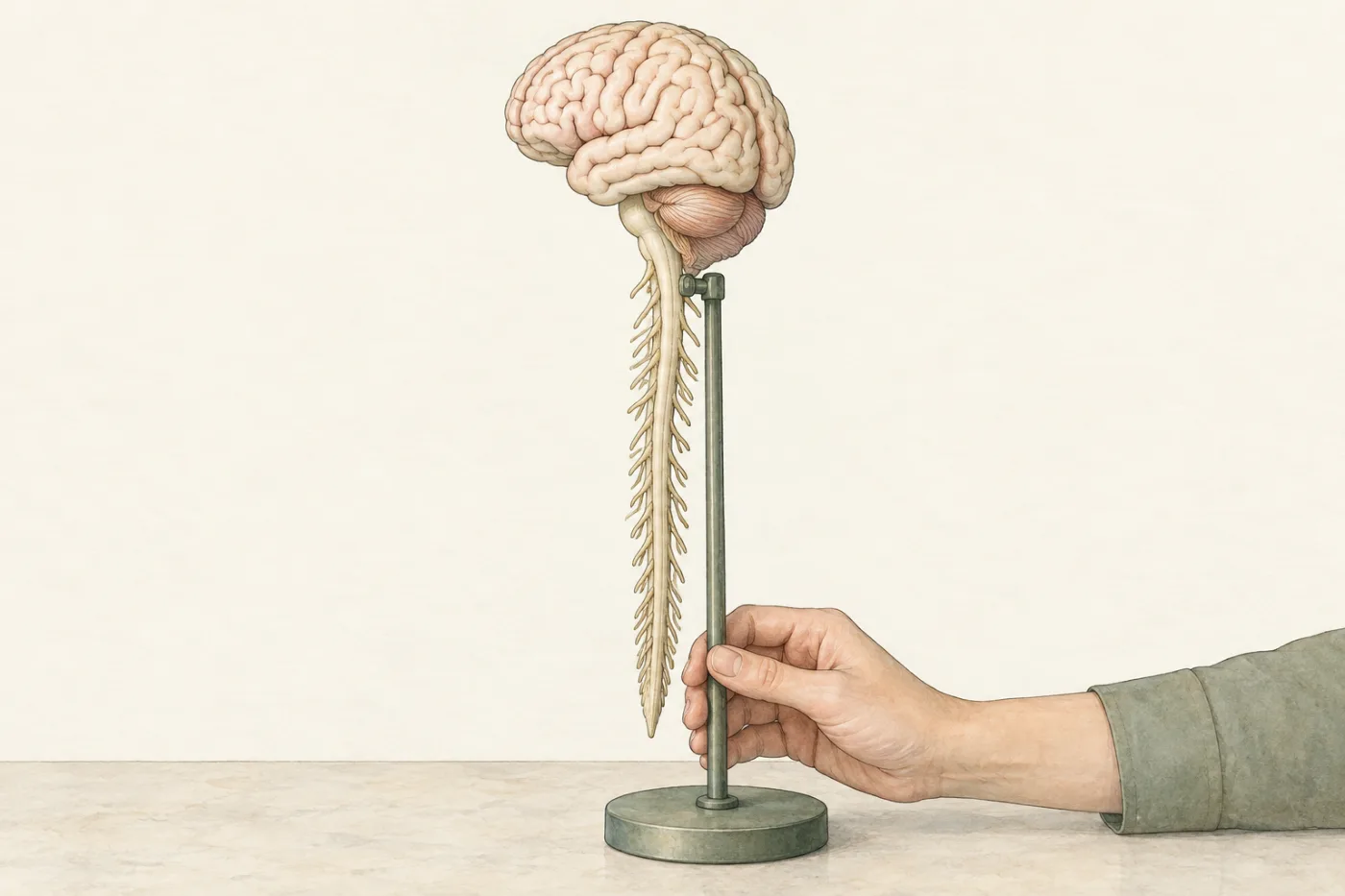
- The central nervous system (CNS) is the brain and the spinal cord. The spinal cord is a thick cord of neurones that runs from the brain down the back, inside the backbone, which protects it.
- The peripheral nervous system (PNS) is all the nerves outside the brain and spinal cord. ("Peripheral" means "at the edges".) The nerves link the CNS with every part of the body.
 (enlarge)
Trap: "The spinal cord is part of the peripheral nervous system, because it is outside the brain." The spinal cord is part of the central nervous system, together with the brain. The PNS is the nerves outside both of them.
Trap: "A nerve and a neurone are the same thing." A neurone is one cell. A nerve is a bundle of many neurones wrapped together, like the many wires inside one cable.
Coordination and regulation
The nervous system's job is the coordination and regulation of body functions. Three words help to describe how it does that.
- A stimulus is a change that the body can detect, such as a ruler starting to fall, a sound or a hot surface. (The plural is stimuli.)
- A receptor is a cell, or a group of cells, that detects a stimulus. Light-sensitive cells in the eye, and the heat and touch receptors in the skin, are receptors.
- An effector is the part of the body that carries out the response: a muscle, which contracts, or a gland, which releases a substance.
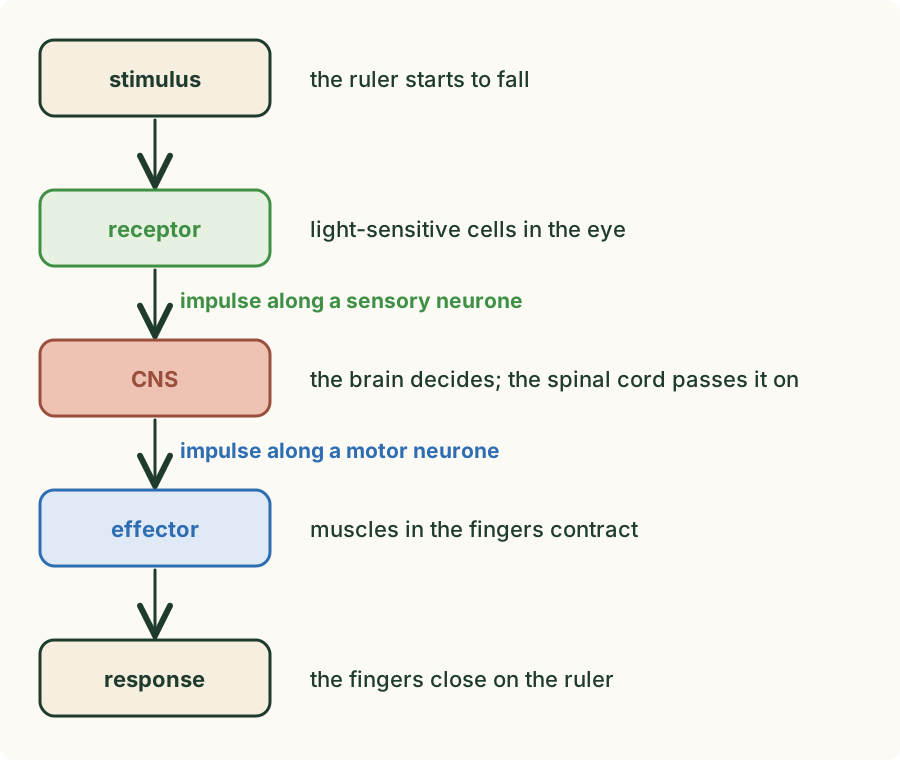
Impulses from a receptor travel to the CNS along a sensory neurone; impulses from the CNS travel out to an effector along a motor neurone.
 (enlarge)
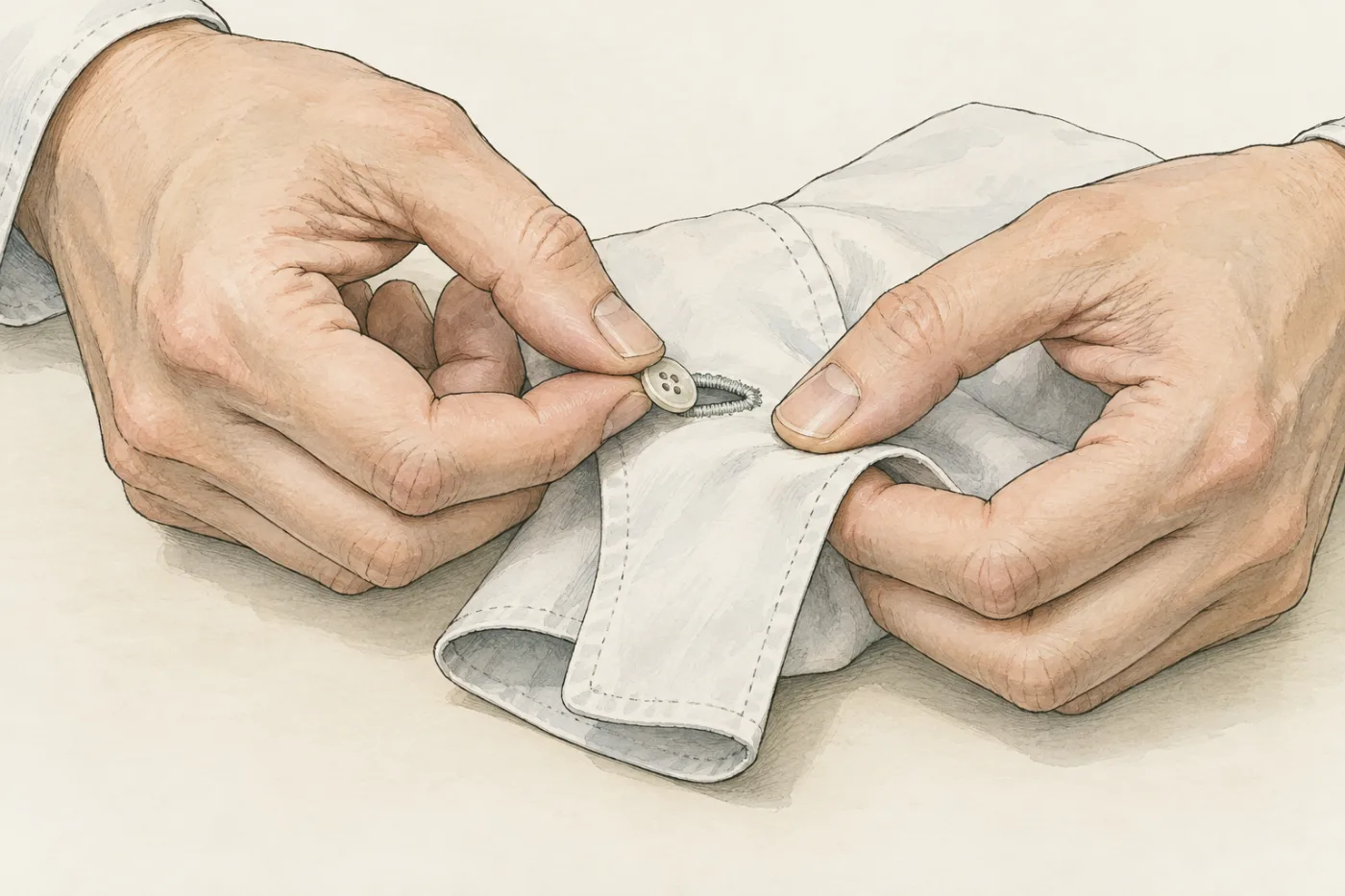
Coordination means linking the body's many receptors with its many effectors, so that the right muscles and glands act together at the right moment. Fastening a button needs your eyes, the touch receptors in your fingertips and the muscles of both hands to work together: your nervous system coordinates them.
 (enlarge)
Regulation means keeping the body's functions at the right level as conditions change. When you run, receptors detect the change and the nervous system makes you breathe faster and makes your heart beat faster; when you rest, both slow down again.
Measuring a reaction time
Your reaction time is the time between a stimulus and your response. You can measure it with a metre rule and a partner. The partner holds the rule upright at its top, with the 0 cm mark level with the top of your thumb; your thumb and finger are open on either side of the rule but not touching it. The partner lets go without warning, and you catch the rule as quickly as you can. The mark level with the top of your thumb shows how far it fell before you caught it.
The further the rule fell, the longer you took. A falling object speeds up as it falls, by 9.8 metres per second every second, so the distance can be turned into a time with this formula: time = √(2 × distance ÷ 9.8), with the distance in metres and the time in seconds. You do not need to use the formula: the table below has done it for you. (Why objects fall like this is physics, not biology.)
| Distance (cm) | Time (s) | Distance (cm) | Time (s) | Distance (cm) | Time (s) | Distance (cm) | Time (s) |
|---|---|---|---|---|---|---|---|
| 10 | 0.14 | 20 | 0.20 | 30 | 0.25 | 40 | 0.29 |
| 11 | 0.15 | 21 | 0.21 | 31 | 0.25 | 41 | 0.29 |
| 12 | 0.16 | 22 | 0.21 | 32 | 0.26 | 42 | 0.29 |
| 13 | 0.16 | 23 | 0.22 | 33 | 0.26 | 43 | 0.30 |
| 14 | 0.17 | 24 | 0.22 | 34 | 0.26 | 44 | 0.30 |
| 15 | 0.17 | 25 | 0.23 | 35 | 0.27 | 45 | 0.30 |
| 16 | 0.18 | 26 | 0.23 | 36 | 0.27 | 46 | 0.31 |
| 17 | 0.19 | 27 | 0.23 | 37 | 0.27 | 47 | 0.31 |
| 18 | 0.19 | 28 | 0.24 | 38 | 0.28 | 48 | 0.31 |
| 19 | 0.20 | 29 | 0.24 | 39 | 0.28 | 49 | 0.32 |
Further down the rule: 50 cm 0.32 s, 60 cm 0.35 s, 70 cm 0.38 s, 80 cm 0.40 s, 90 cm 0.43 s, 100 cm 0.45 s.
A ruler is better than a stopwatch here. To use a stopwatch you would have to start and stop it yourself, and each press has its own reaction time, as long as the time you are trying to measure.
One catch is not enough: your times vary from one catch to the next. Do five catches, turn each distance into a time first, then find the mean of the five times. Converting first matters because time is not in proportion to distance: 40 cm is 0.29 s, not twice the 0.20 s of 20 cm. So the time for the mean distance is a little longer than the mean of the times, and the more the catches spread, the bigger the difference. A catch far from all the others is an anomalous result (one that does not fit the pattern). Say so in your notes and leave it out of the mean or, better, do that catch again and use the repeat instead. A mistake in the method that you wrote down at the time, such as the partner dropping the rule before you were ready, is also a reason to do that catch again.
Trap: "Every catch counts, so keep them all in the mean." A catch far from all the others, perhaps after a blink or a moment of looking away, does not measure your usual reaction time: kept in, it pulls the mean away from it. Identify it, then leave it out or repeat it. But a catch that is only the slowest, and still fits the spread of the others, stays in.
Run the experiment below before you read on. First predict whether your fifth catch will be faster than your first, then decide how your partner should drop the rule, and catch it five times. The rule on the screen falls just as a real one does, but you catch it with a tap or a key, so your times are not directly comparable with a real ruler catch. If you would rather not use your own reactions, use the prepared results: five catches by a pupil with a real rule.
What the catches showed
Each catch gave a slightly different time, and the mean of the five is a better estimate of your reaction time than any one catch. Whether your fifth catch was faster than your first, five catches can only suggest a pattern: to show that practice really speeds you up you would need many more catches, or many people. A reaction time is not a score. It changes with how tired you are, how much attention you pay and how much you have practised, so a few catches are not a fair way to rank people: comparing people needs many catches by each of them, under the same conditions.
The catch also showed the path of a response that you decide to make. The stimulus was the rule starting to fall. Light-sensitive cells in your eye, the receptors, detected it, and an impulse travelled along a sensory neurone to your brain. The brain made the decision to catch, and an impulse travelled down the spinal cord and out along a motor neurone to the muscles of your fingers, the effectors, which contracted: the response.
Worked example
A time from the table
A pupil catches the rule at the 26 cm mark. Use the table to find their reaction time for this catch.
Find 26 cm in the distance column: the time beside it is 0.23 s. Check: 26 cm is a little further than 20 cm (0.20 s) and a little less than 30 cm (0.25 s), so a time between 0.20 s and 0.25 s makes sense.
Worked example
A mean of five catches
A pupil catches the rule at 20, 18, 19, 16 and 15 cm. Find their mean reaction time.
Turn each distance into a time first, from the table: 0.20, 0.19, 0.20, 0.18 and 0.17 s. Add them: 0.20 + 0.19 + 0.20 + 0.18 + 0.17 = 0.94 s. Divide by the number of catches: 0.94 ÷ 5 = 0.188 s, so the mean reaction time is about 0.19 s. The times are given to two decimal places, so the mean is too.
Worked example
Which catches to keep
Pupil A's catches are 21, 18, 34, 17 and 16 cm, with no notes. Pupil B's are 22, 19, 40, 18 and 17 cm, with the note "catch 3: partner let go before I said ready". Which catches should each pupil use?
Pupil A's 34 cm catch is far from the other four, which are all between 16 and 21 cm: it is anomalous. Pupil A should say so and leave it out of the mean (or, better, do it again). The other four times are 0.21, 0.19, 0.19 and 0.18 s, so their mean is 0.77 ÷ 4 = 0.1925 s, about 0.19 s. Pupil B should do catch 3 again: the note records a mistake in the method, so that catch did not measure their reaction time fairly.
Worked example
The route of a catch
Put these in the order an impulse reaches them when you catch a falling rule: motor neurone, eye, finger muscles, brain, sensory neurone, spinal cord.
Eye (the receptor detects the rule falling) → sensory neurone → brain (decides to catch) → spinal cord → motor neurone → finger muscles (the effector contracts). The brain and spinal cord are the CNS; the sensory and motor neurones run in nerves of the PNS.
Worked example
Regulation during a run
During a run, the working muscles need more oxygen and release more carbon dioxide into the blood. Describe how the nervous system regulates breathing during the run and afterwards.
The brain detects the change in the blood. Impulses from the brain travel along motor neurones to the breathing muscles, which contract more often and more strongly, so breathing becomes faster and deeper: more carbon dioxide is breathed out and more oxygen taken in. When the run ends the blood returns to normal, the brain detects the change, and breathing slows down again. That is regulation: the nervous system keeps a body function at the level the conditions need.
Key idea: Electrical impulses travel along neurones. The central nervous system (CNS) is the brain and spinal cord; the peripheral nervous system (PNS) is the nerves outside them. The nervous system coordinates and regulates body functions: receptors detect a stimulus, impulses travel through the CNS, and effectors (muscles and glands) make the response. A reaction time is measured with several catches, each turned into a time before the mean; an anomalous catch, or one with a recorded mistake, is left out of the mean or done again.