The first sections are for everyone; the sections and worked examples marked Supplement are for the Extended course.
In the reflex arc the impulse passed from the sensory neurone to the relay neurone, and from the relay neurone to the motor neurone. But neurones do not touch each other: where two of them meet there is a gap, far too narrow to see without a powerful microscope. An electrical impulse cannot jump across it. In this part you find out how the message still gets across, and why it can only cross one way.
Where two neurones meet
A synapse is a junction between two neurones: the place where the end of one neurone comes very close to the next neurone, with a tiny gap between them. An impulse has to cross a synapse each time it passes from one neurone to the next.
In the reflex arc for pulling your hand off something hot there are two synapses, both inside the spinal cord: one where the sensory neurone meets the relay neurone, and one where the relay neurone meets the motor neurone. Your brain and spinal cord contain billions of neurones, and each one forms synapses with many others.
Run the experiment below before you read on. First predict how the impulse crosses the gap between the relay neurone and the motor neurone. Then send an impulse along the relay neurone and watch what happens at the synapse, and try sending one the other way.
(Supplement) Inside a synapse
 (enlarge)
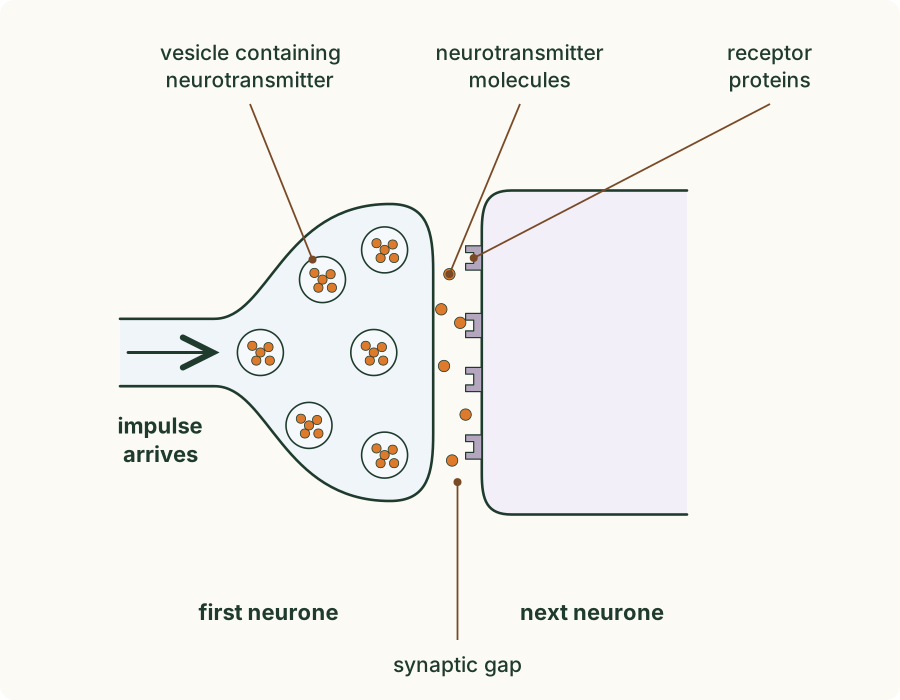
The diagram shows a synapse many thousands of times bigger than it really is.
- The end of the first neurone holds many vesicles: tiny sacs, each filled with molecules of a chemical called a neurotransmitter. ("Transmitter" means "something that passes a message on".)
- The synaptic gap is the narrow space between the two neurones.
- The membrane of the next neurone carries receptor proteins. Each has a shape that the neurotransmitter molecules fit, like a key in a lock.
(Supplement) The events at a synapse
 (enlarge)
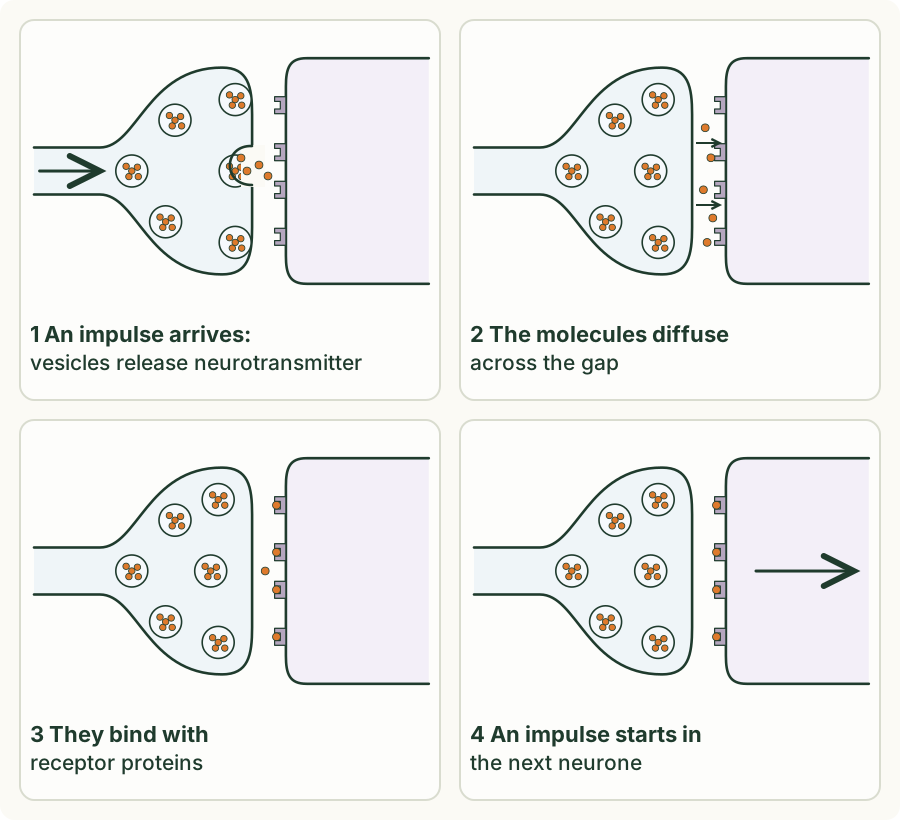
- An impulse arrives at the end of the first neurone. It stimulates the release of neurotransmitter molecules from the vesicles into the synaptic gap.
- The neurotransmitter molecules diffuse across the gap, from where there are many of them, beside the first neurone, to where there are few, beside the next neurone.
- They bind with receptor proteins on the membrane of the next neurone.
- This stimulates an impulse in the next neurone, which travels on along it.
So the message travels electrically along each neurone, and chemically across each synapse.
Trap: "The electrical impulse jumps across the gap." It does not. At the gap the message is carried by a chemical, the neurotransmitter, which diffuses across and starts a new impulse in the next neurone.
(Supplement) Only one way
Only the end of the first neurone has vesicles of neurotransmitter, and only the next neurone has the receptor proteins. An impulse that arrives at the next neurone's side of the synapse has no vesicles to release anything, so nothing crosses the gap backwards. Synapses ensure that impulses travel in one direction only.
That is why, in a reflex arc, the impulse always goes from the receptor towards the effector, and never the other way: each synapse on the path lets it through in one direction only.
Trap: "The neurotransmitter can carry the impulse back across the gap too." The next neurone has no vesicles of neurotransmitter on that side, and the first neurone has no receptor proteins for it to bind with. The synapse only works in one direction.
Worked example
Where the synapses are
How many synapses does an impulse cross in the reflex arc for pulling your hand off a hot iron, and where are they?
The impulse passes along three neurones: sensory, relay and motor. It crosses a synapse each time it passes from one neurone to the next, so it crosses two synapses: sensory to relay, and relay to motor. Both are inside the spinal cord, where the relay neurone is.
Worked example
(Supplement) The four events in order
Put these events at a synapse in order: the neurotransmitter binds with receptor proteins; an impulse arrives at the end of the first neurone; an impulse is stimulated in the next neurone; the neurotransmitter diffuses across the gap; vesicles release neurotransmitter into the gap.
An impulse arrives at the end of the first neurone → vesicles release neurotransmitter into the gap → the neurotransmitter diffuses across the gap → it binds with receptor proteins on the next neurone → an impulse is stimulated in the next neurone.
Worked example
(Supplement) Why not backwards?
In an experiment, an impulse is started part way along a motor neurone and travels back towards its cell body, which forms a synapse with a relay neurone. Explain why no impulse passes into the relay neurone.
The motor neurone is on the receiving side of that synapse. Its side of the synapse has no vesicles of neurotransmitter, so the impulse cannot release any into the gap, and the relay neurone's side has no receptor proteins to bind it. Nothing crosses the gap, so no impulse starts in the relay neurone: the synapse lets impulses through in one direction only.
Worked example
(Supplement) A blocked receptor
A scientist adds a substance to a synapse. Its molecules fit the receptor proteins on the next neurone and stay there, but they do not stimulate an impulse. Predict what happens when impulses then arrive at the first neurone, and explain.
The impulses still make the vesicles release neurotransmitter, and it still diffuses across the gap. But the receptor proteins are already filled by the added substance, so the neurotransmitter cannot bind with them. No impulse is stimulated in the next neurone, so the message stops at that synapse, and any effector beyond it does not respond.
Key idea: A synapse is a junction between two neurones. (Supplement) The end of the first neurone holds vesicles of neurotransmitter, and the next neurone carries receptor proteins across the synaptic gap. An impulse makes the vesicles release neurotransmitter into the gap; it diffuses across, binds with the receptor proteins, and stimulates an impulse in the next neurone. Because only one side has vesicles and only the other has receptors, synapses make impulses travel in one direction only.