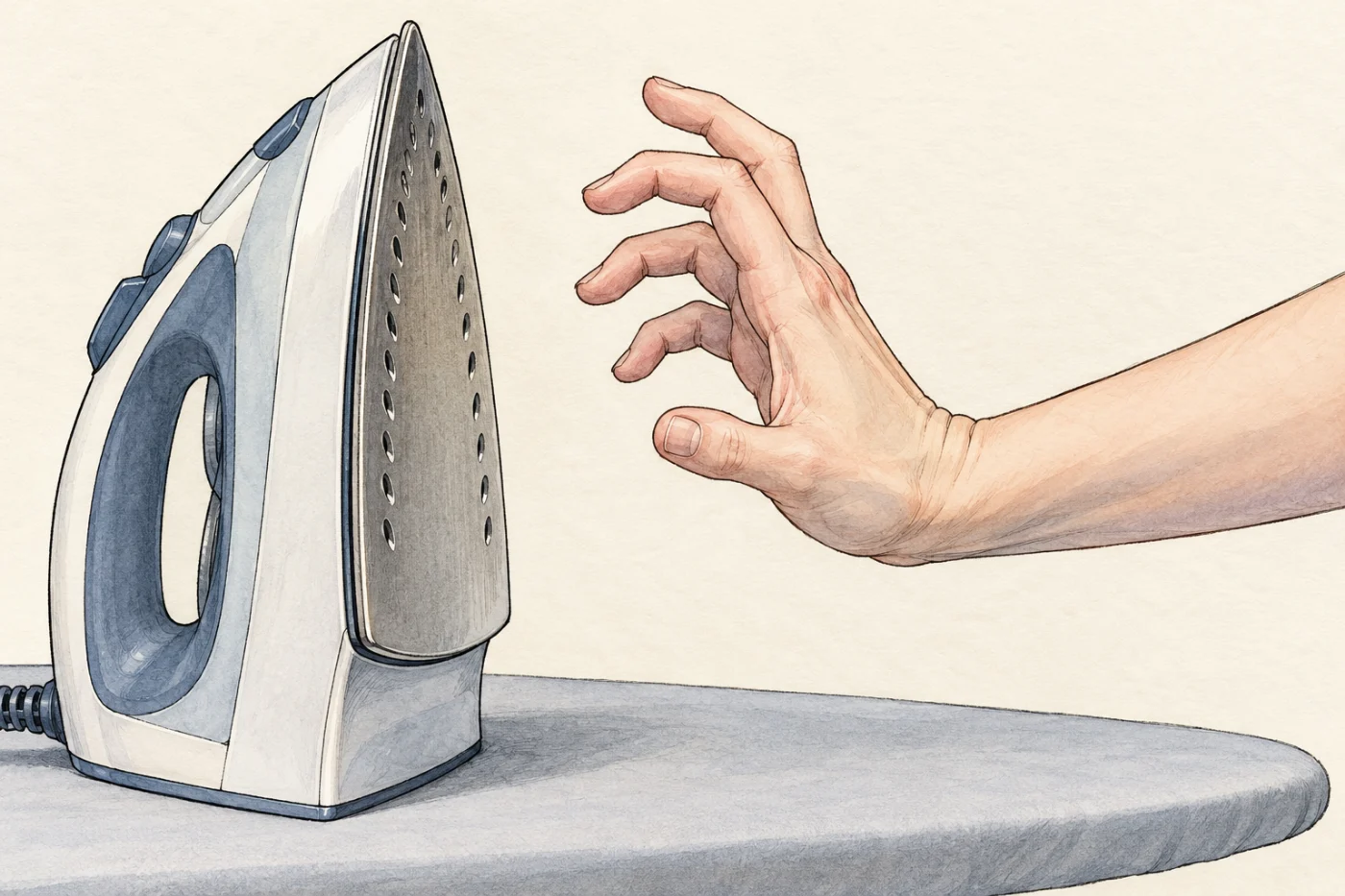
Brush your hand against a hot iron and it jerks away before you have even felt the heat. Catching a ruler needed a decision in your brain, but this movement did not wait for one. In this part you meet the three kinds of neurone, follow the short path an impulse takes in a reflex, and find out why reflexes are so quick.
 (enlarge)
Three kinds of neurone
 (enlarge)
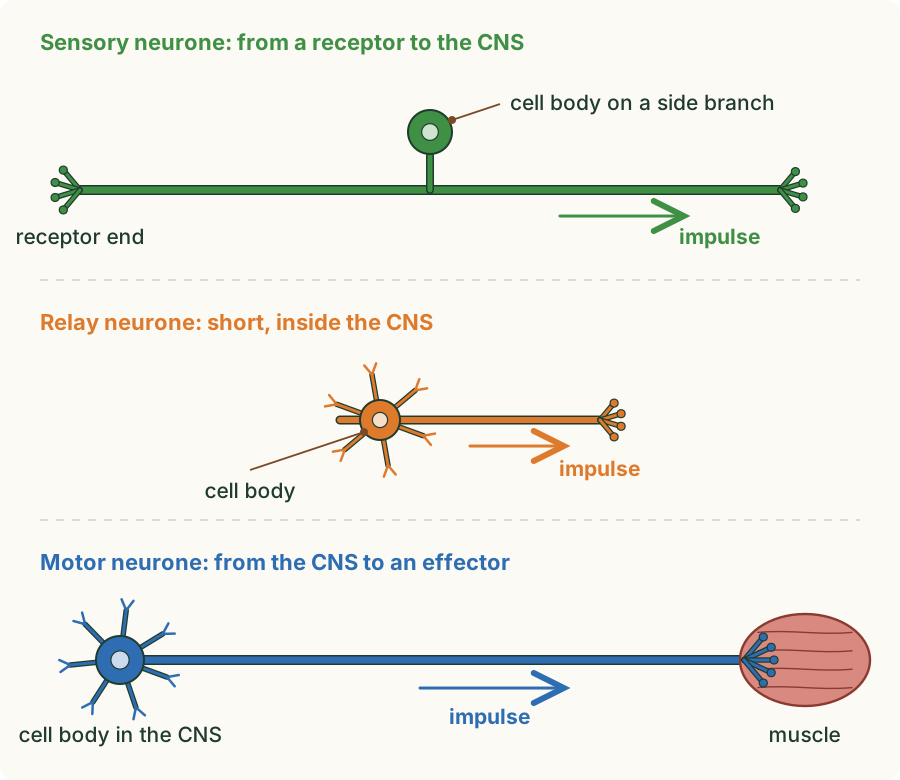
Every neurone has a cell body, the part that holds the nucleus, and long thin fibres that carry impulses. At the end of a fibre there are fine branches, which pass the impulse on to the next cell. Biologists sort neurones into three kinds by what they link.
- A sensory neurone carries impulses from a receptor to the CNS. It is long. Its cell body is on a short side branch part way along the fibre, just outside the spinal cord.
- A relay neurone lies inside the CNS and links other neurones. It is short, with its cell body among many short branches.
- A motor neurone carries impulses from the CNS to an effector, a muscle or a gland. Its cell body is at one end, inside the CNS, with many short branches round it; a long fibre runs from it to the effector.
To name a neurone in a diagram you have not seen before, look at two things: where the cell body is, and what each end is joined to. A cell body on a side branch means a sensory neurone; a short neurone inside the spinal cord or brain is a relay neurone; a fibre that ends on a muscle is a motor neurone.
Trap: "Sensory and motor neurones are named after their length." Both are long. They are named by what they link: a sensory neurone brings impulses in from a receptor, a motor neurone carries them out to an effector.
The reflex arc
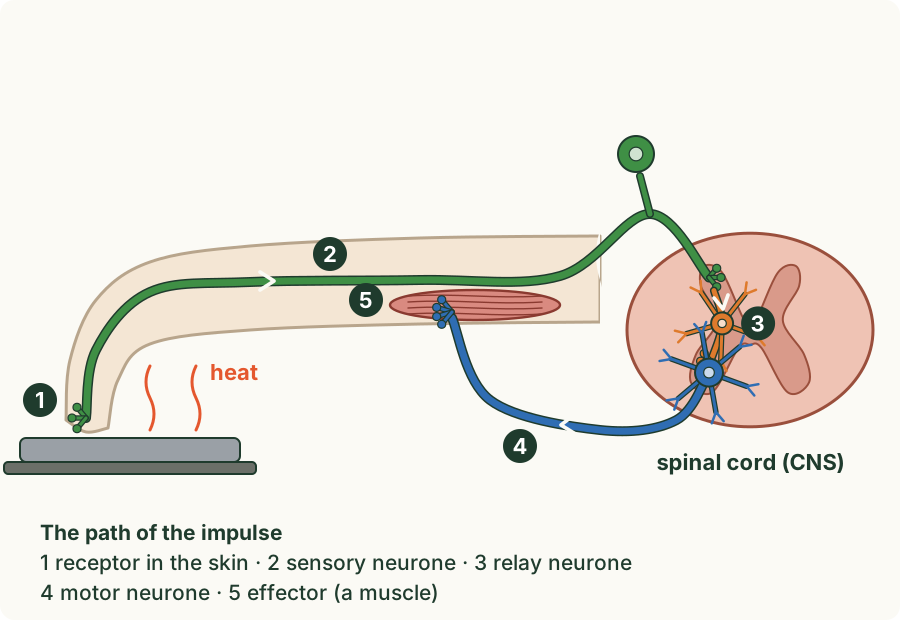
When your hand touches something hot, the impulse does not travel to your brain and back. It follows a short path through the spinal cord, called a reflex arc.
 (enlarge)
- A receptor in the skin of the fingertip detects the heat.
- An impulse travels along a sensory neurone to the spinal cord.
- Inside the spinal cord, a relay neurone passes the impulse straight on.
- An impulse travels along a motor neurone out to the arm.
- The effector, a muscle in the upper arm, contracts and pulls the hand away.
Other neurones also carry impulses up the spinal cord to the brain, so a moment later you feel the heat and know what happened. But the hand has already moved: the brain was not needed to make the response.
Trap: "When you touch something hot, the impulse goes to the brain first, which sends the hand away." The relay neurone that links the sensory and motor neurones is in the spinal cord. The brain finds out afterwards.
Run the experiment below before you read on. First predict whether the impulse must reach the brain before the hand moves. Then watch a drawn hand brush a hot plate, and tap each part of the reflex arc in the order the impulse reaches it. The glow along a neurone is only a way of showing where the impulse is: a real impulse does not give out light.
What the experiment showed
The hand pulled away before the impulse had any need to reach the brain. The path was receptor → sensory neurone → relay neurone → motor neurone → effector, and it went into the spinal cord and straight back out to the arm. Only three neurones carried the impulse, and nothing on the path had to decide anything.
Reflex actions
A reflex action is a response that happens automatically and rapidly: you do not decide to make it, and it happens very quickly after the stimulus. The reflex arc links (biologists say it integrates and coordinates) the stimulus with the right response of the effectors, which may be muscles or glands.
- Pulling your hand away from something hot or sharp: the effectors are arm muscles.
- Blinking when something comes suddenly towards your eye: the effectors are eyelid muscles.
- Saliva flowing when food touches your tongue: the effectors are the salivary glands, which release saliva.
Many reflexes, like pulling your hand away, go through the spinal cord. Some go through the brain instead, such as blinking and saliva flowing, but they still happen without a decision. What makes an action a reflex is that it is automatic and rapid, not which part of the CNS it passes through.
A reflex is quick because the path is short, with only a few neurones, and because no decision is made on the way. That speed protects the body: the hand leaves the hot surface before the skin is badly burnt, and the eyelid closes before dust or a fly reaches the eye.
Trap: "The receptor is the part that moves." The receptor detects the stimulus; the effector carries out the response. In the hot-iron reflex the receptor is in the skin of the fingertip, but the effector is a muscle in the arm.
Worked example
Naming neurones from their features
Three neurones, J, K and L, are described only by their shape and where they lie, not by name. J has its cell body at one end and a long fibre that ends on a muscle. K is short and lies inside the spinal cord. L has its cell body on a short side branch part way along. Name each neurone.
J ends on a muscle, an effector, and its cell body is at one end: J is a motor neurone. K is short and inside the CNS: K is a relay neurone. L has its cell body on a side branch: L is a sensory neurone. Check: an impulse would go L → K → J, from the receptor towards the muscle.
Worked example
Stepping on a pin
You step on a pin and your foot lifts before you feel the pain. Describe the reflex arc.
A receptor in the skin of the sole of the foot detects the pin. An impulse travels along a sensory neurone to the spinal cord, where a relay neurone passes it to a motor neurone. The motor neurone carries the impulse to the effector, muscles in the leg, which contract and lift the foot. The impulse reaches the brain afterwards, so you feel the pain after the foot has moved.
Worked example
Reflex or not?
Which of these are reflex actions? (a) blinking when a ball flies towards your face; (b) catching a falling ruler; (c) pulling your hand off a hot pan; (d) writing your name.
(a) and (c) are reflex actions: they are automatic and rapid, and you do not decide to make them. (b) and (d) are not reflexes: you decide to make them, so they take longer and could be done differently each time. The test is the decision, not the brain: blinking goes through the brain, but nothing is decided, so it is still a reflex.
Worked example
A gland as the effector
When food touches your tongue, saliva flows into your mouth. Name the receptor, the effector and the response in this reflex.
The receptors are in the tongue: they detect the food touching it. The effector is not a muscle but a gland: the salivary glands. The response is that the glands release saliva into the mouth. This is a reflex because it happens automatically, without a decision.
Key idea: A sensory neurone carries impulses from a receptor to the CNS, a relay neurone links neurones inside the CNS, and a motor neurone carries impulses from the CNS to an effector. In a reflex arc the impulse passes receptor → sensory neurone → relay neurone (in the CNS; for pulling the hand away, the spinal cord) → motor neurone → effector. A reflex action is automatic and rapid: it links a stimulus with the response of effectors, muscles or glands, without a decision.