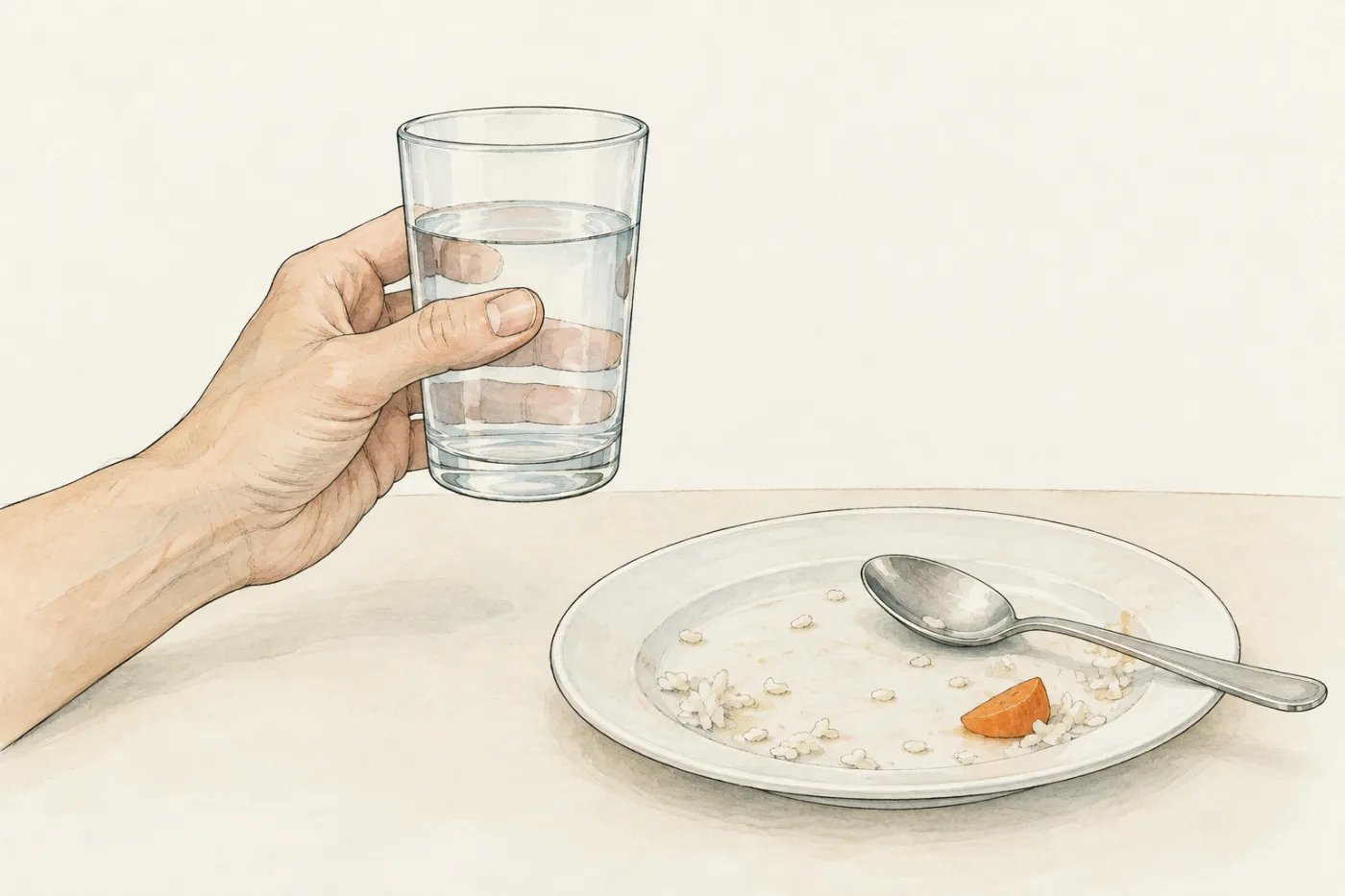
A plate scraped clean, a glass of water drunk. By the evening, almost all the digested food from this meal, and most of the water, will have left your gut and be in your blood. In this part you find out where along the gut that happens, and where all the water goes.
 (enlarge)
Digested, then absorbed
Chemical digestion breaks large insoluble molecules into small soluble ones: starch into glucose, proteins into amino acids, fats into fatty acids and glycerol. Absorption comes next: the movement of nutrients from the intestines into the blood. Only small soluble molecules can be absorbed, which is why food has to be digested first.
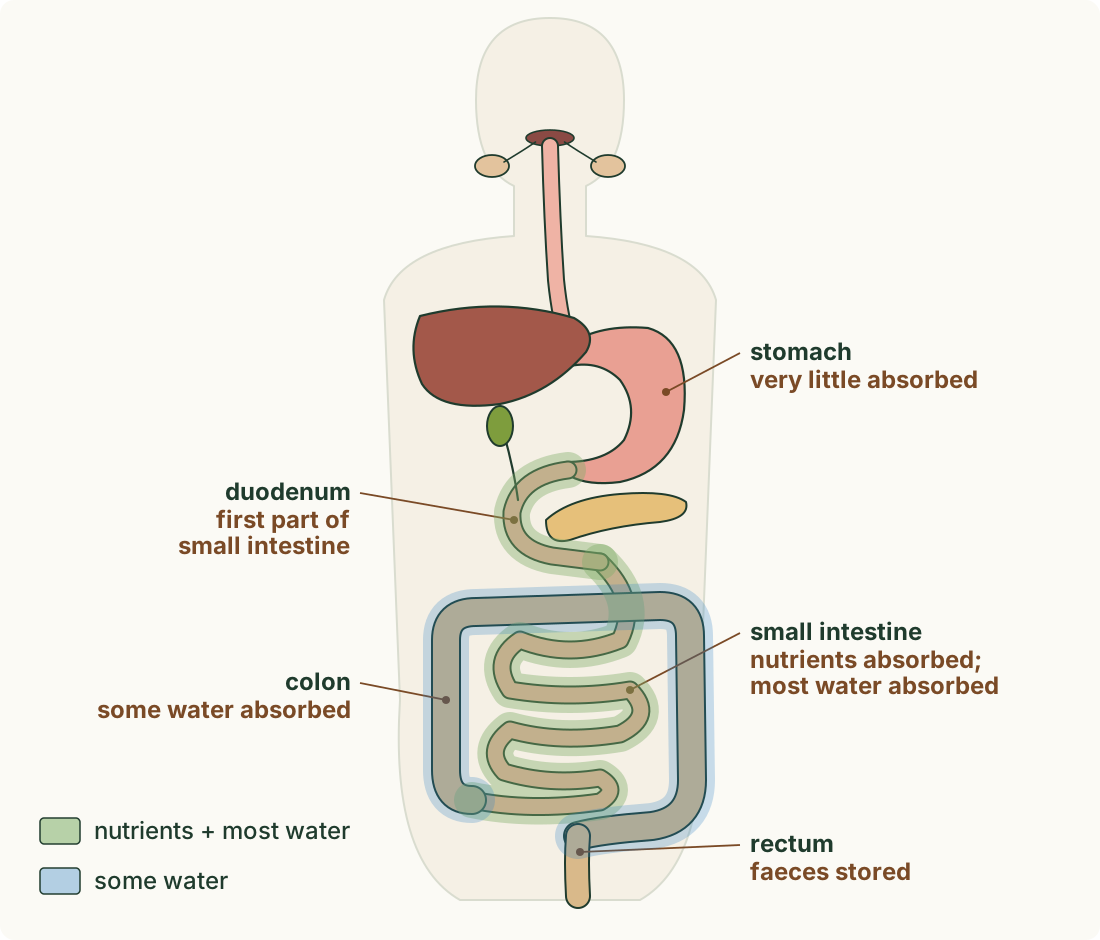
Most digestion is finished in the small intestine, and the same place absorbs what digestion makes. The small intestine is the region where nutrients are absorbed. In an adult it is about 6 m long: the duodenum is its short first part, and the long, coiled ileum makes up most of the rest. Glucose, amino acids, fatty acids and glycerol, vitamins and mineral ions all pass through its wall into the blood.
 (enlarge)
What reaches the colon, the first part of the large intestine, is mostly water, food that could not be digested, such as fibre, and dead cells from the lining of the gut. The colon absorbs some of the water. What is left is the faeces, stored in the rectum until it leaves through the anus.
Trap: "Food is absorbed in the stomach." The stomach churns food and starts to digest protein, but very little is absorbed through its wall. Nutrients are absorbed in the small intestine.
Worked example
Digested or absorbed?
Four things happen to a cheese sandwich. Which are digestion and which are absorption? (a) Amylase breaks starch into maltose. (b) Amino acids pass through the wall of the ileum into the blood. (c) Lipase breaks fat into fatty acids and glycerol. (d) Glucose moves from the small intestine into the blood.
Ask of each one: is a molecule being broken down, or is it moving through the wall of the intestine into the blood? (a) and (c) break large molecules into smaller ones, so they are digestion. (b) and (d) move small molecules from the intestine into the blood, so they are absorption. Absorption always comes after digestion: the starch in (a) is absorbed only once it has been broken down to glucose, as in (d).
Worked example
Part of the small intestine removed
After an illness, a patient has most of the ileum removed. Doctors warn that the patient may lose weight even while eating normally. Explain why.
The ileum is most of the small intestine, the region where nutrients are absorbed. With a much shorter small intestine, food passes through it more quickly and less of the glucose, amino acids, fatty acids and glycerol made by digestion is absorbed into the blood before the food moves on into the colon. The colon does not take over this job: it absorbs mainly water. The nutrients that are not absorbed leave in the faeces, so the body gets less energy and fewer raw materials from the same meals, and the patient may lose weight.
Where the water goes
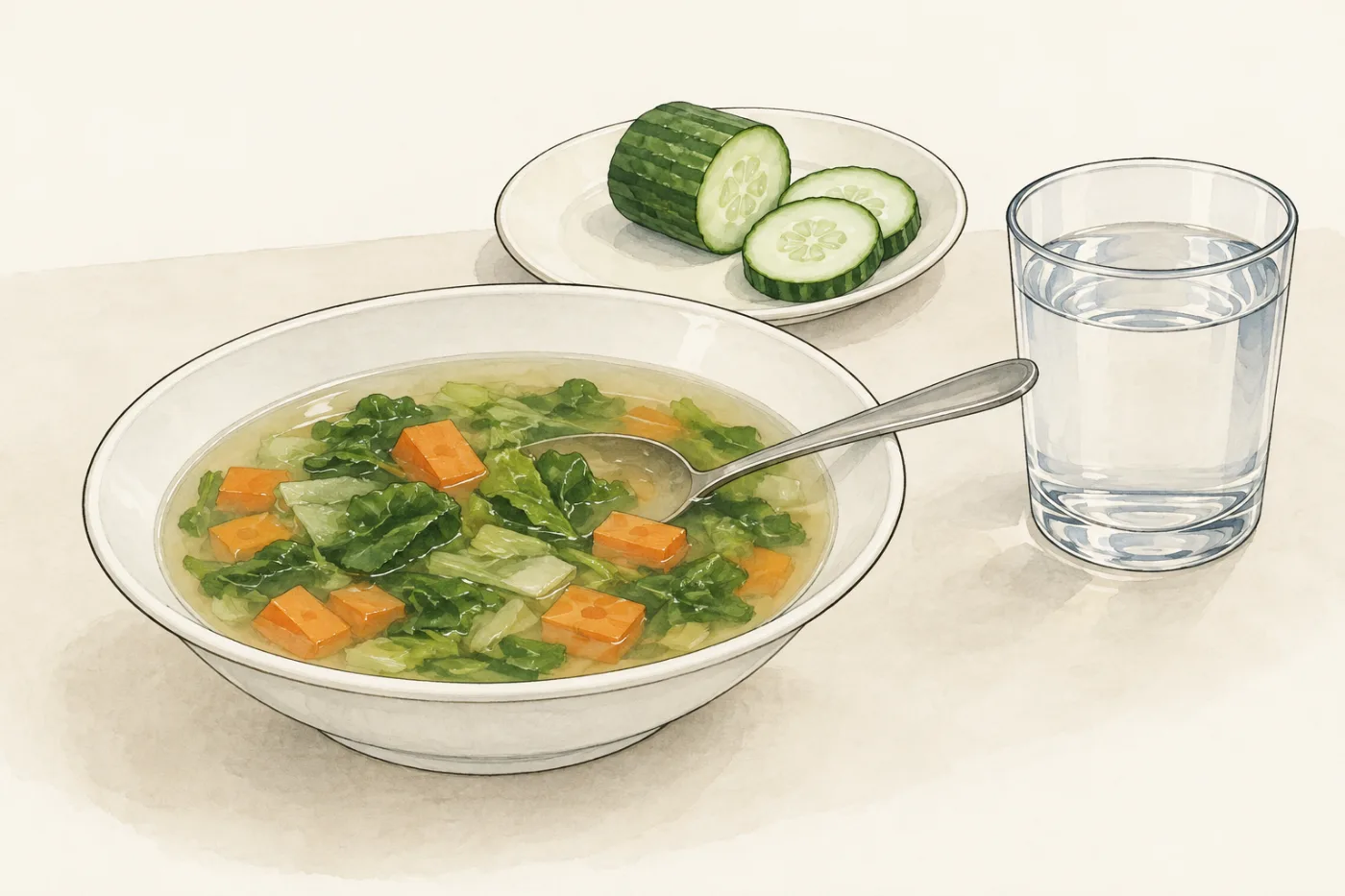
Water enters the gut in two ways: in what you eat and drink, and in the digestive juices your body makes, such as saliva, gastric juice, bile and pancreatic juice. Drinks are not the only source: soup, fruit and vegetables are mostly water.
 (enlarge)
In a typical adult day the two add up to about 9 litres, and nearly all of it is absorbed again.
Most water is absorbed from the small intestine, about 7.5 of the 9 litres, but some is also absorbed from the colon, about 1.4 litres. Only about 0.1 litres leaves in the faeces. The volumes vary from person to person and from day to day, but the pattern does not: the small intestine absorbs most of the water, the colon some.
Trap: "Water is absorbed in the colon, food in the small intestine." The colon does absorb water, but far less than the small intestine. By the time food reaches the colon, most of the water has already been absorbed.
Free play: nothing here is marked or saved
A day's water through the gut
Water enters the gut in what you eat and drink, and in the digestive juices your own body makes. Each dot is a tenth of a litre. Where does a day's water leave the gut?
Still picture: your device asks for less motion.
Try: Slide food and drink to 4 L. Where does the extra go?
- Juices
- 7.0 L
- Small intestine
- 7.5 L
- Colon
- 1.4 L
- Faeces
- 0.1 L
food and drink + juices = small intestine + colon + faeces
2.0 L + 7.0 L = 7.5 L + 1.4 L + 0.1 L
- The juices bring more water into the gut than you drink: saliva, gastric juice, bile and pancreatic juice. Much of the water the gut absorbs is the body’s own, coming back.
- The small intestine absorbs most of the water, whatever you drink; the colon absorbs most of what is left. The water they absorb goes into the blood.
- When the colon’s contents are hurried through it, it has less time to absorb water, so the faeces are watery: diarrhoea.
About this model. A model of a typical adult day with illustrative shares: real volumes vary from person to person and day to day. Here the stomach absorbs no water, and the juices are drawn joining at the mouth, the stomach and the start of the small intestine in rough shares. A day lasts ten seconds, and each dot stands for a tenth of a litre. The gut is drawn simpler and wider than it is.
Worked example
A day's water budget
On one day a person takes in 2.4 L of water in food and drink, and their gut makes 7.0 L of digestive juices. The small intestine absorbs 7.9 L of water and 0.1 L leaves in the faeces. How much water did the colon absorb, and where was most of the water absorbed?
Water entering the gut = 2.4 L + 7.0 L = 9.4 L. All of it is either absorbed or leaves in the faeces, so the water absorbed by the colon = 9.4 L − 7.9 L − 0.1 L = 1.4 L. Most of the water was absorbed in the small intestine: 7.9 L of the 9.4 L, about 84 %.
Worked example
Food hurried through the colon
During an infection of the colon, its contents pass through it much faster than usual. Suggest why the person's faeces are watery, and why a doctor tells them to drink plenty.
The colon absorbs some of the water from what passes through it. If the contents move through faster, there is less time for water to be absorbed, so more water is left in the faeces and they are watery. That water is lost from the body. The person must drink more to replace it, or their body runs short of water.
Key idea: The small intestine is the region where nutrients are absorbed: the small soluble molecules made by digestion pass through its wall into the blood. Most water is absorbed from the small intestine, but some is also absorbed from the colon.