Contents
Part 2 of 3
Reflexes
identify
Try it yourself
The diagram shows three neurones, X, Y and Z, all drawn in the same colour; the pink band is part of the spinal cord. Match each letter to the kind of neurone.
identify: name or select.
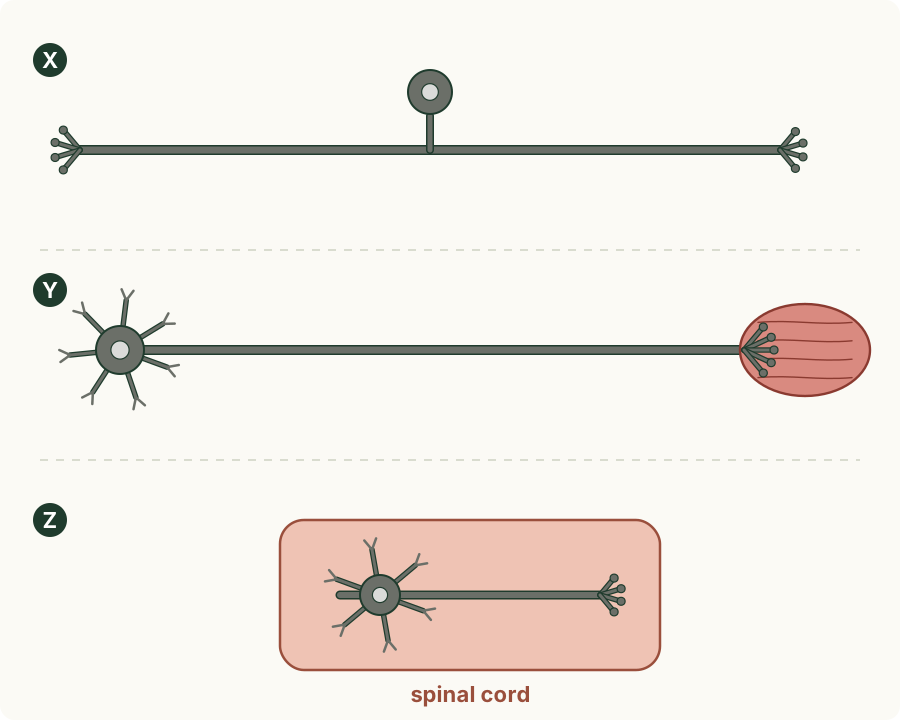 (enlarge)
Your saved work
Answers, earlier attempts and your Pause and check notes stay in this browser. Export a copy to keep, to move to another device or to hand to your teacher. Importing a copy keeps your current answers and adds earlier attempts.
Scope and sources
Cambridge IGCSE Biology 0610 · 2026–2028 v3 · Original learning materials.
The nervous system (14.1.1–14.1.10): electrical impulses along neurones; the central nervous system (the brain and the spinal cord) and the peripheral nervous system (the nerves outside them); the role of the nervous system in coordinating and regulating body functions; sensory, relay and motor neurones; the simple reflex arc and the reflex action; the synapse as a junction between two neurones; and, for the Supplement, the structure of a synapse, the events at a synapse and why synapses make impulses travel in one direction only. The eye and the pupil reflex are in the module on sense organs, hormones in the module on hormones, and drugs that act at synapses are not covered.
Apparatus, amounts and times in the experiment are illustrative. Real practical work follows a teacher-approved safety method.
Official Cambridge syllabus