A cheese sandwich holds three different kinds of food: starch in the bread, protein in the cheese, and fat in the cheese and the butter. In part 1, amylase broke starch down into sugar. But amylase does nothing at all to protein or fat. So how does your body digest a whole sandwich, and where along the gut does each job happen?
Three large molecules
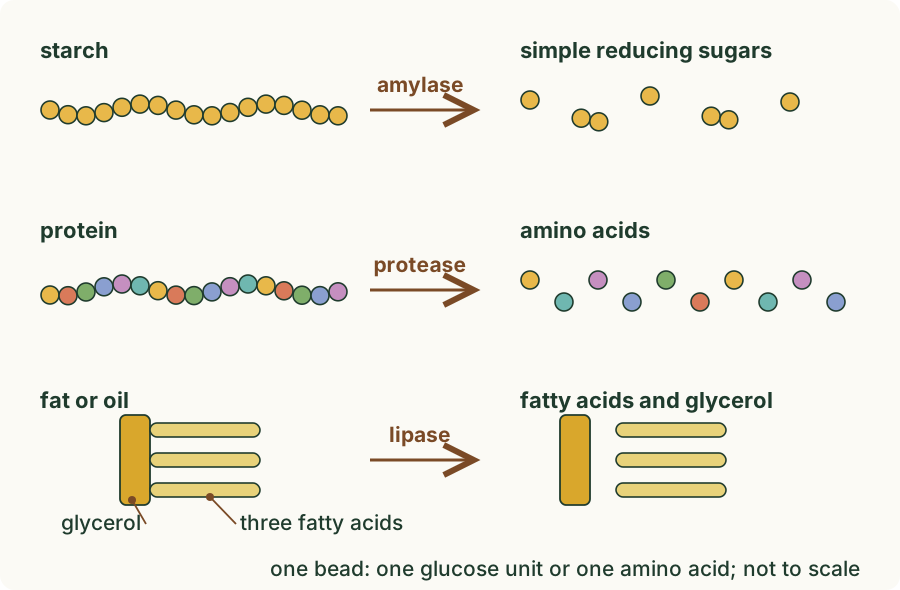
Each of the three foods is made of large molecules built from smaller units, and each is built in a different way:
- starch is a long chain of glucose units, all the same;
- protein is a long chain of amino acids; there are about 20 kinds of amino acid, joined in a different order in each protein;
- fats and oils are not chains: each molecule is one glycerol joined to three fatty acids. Fats are solid at room temperature, oils are liquid, but their molecules are built the same way.
 (enlarge)
An enzyme fits only one kind of molecule, the way a key fits only one lock, so breaking down these three kinds of molecule takes three kinds of enzyme.
One enzyme for each food
| Enzyme | Breaks down | Into |
|---|---|---|
| amylase | starch | simple reducing sugars |
| protease | protein | amino acids |
| lipase | fats and oils | fatty acids and glycerol |
Protease is the name of a group: there are several proteases, made in different places, and all of them break protein down into amino acids. Part 3 meets two of them. The products in the last column are all small soluble molecules, the ones that can be absorbed into the blood.
Trap: "Lipase breaks fat into tiny droplets." Tiny droplets are still fat: breaking fat up is physical digestion (Supplement: bile does it in the duodenum). Lipase breaks the fat molecules themselves down into fatty acids and glycerol, which are new substances.
Worked example
A pasta lunch
A lunch of pasta with a meat sauce and a spoonful of olive oil. For each food, name the main large molecule, the enzyme that digests it and the products.
The pasta is mostly starch, digested by amylase into simple reducing sugars. The meat is mostly protein, digested by protease into amino acids. The olive oil is an oil, digested by lipase into fatty acids and glycerol. Each product is a small soluble molecule that can be absorbed.
Where each enzyme is made and where it works
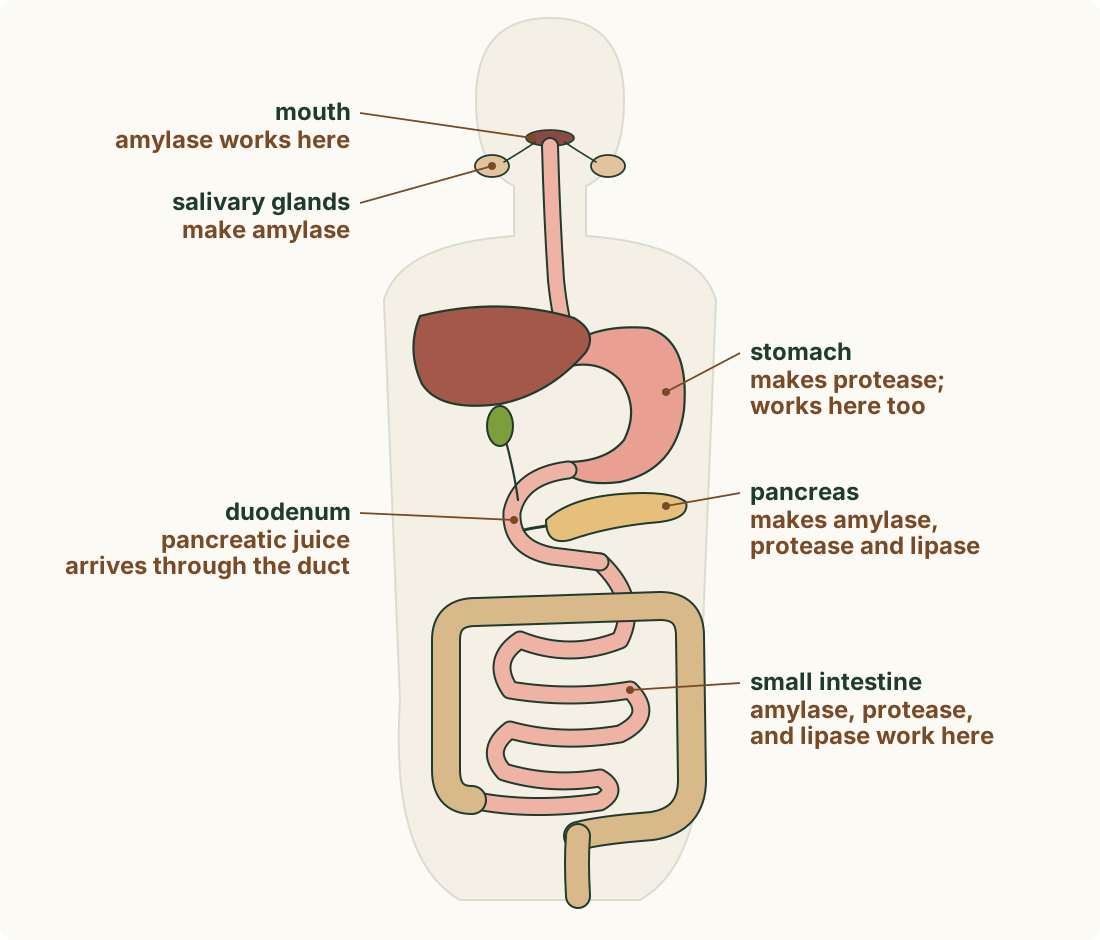
Enzymes are made by glands: groups of cells that make a substance and release it. The place where an enzyme is made is not always the place where it works. The pancreas is the clearest case: it sits beside the gut, and its juice flows along a tube, the pancreatic duct, into the duodenum, the first part of the small intestine.
 (enlarge)
| Enzyme | Secreted by | Acts in |
|---|---|---|
| amylase | salivary glands; pancreas | mouth; small intestine |
| protease | stomach; pancreas | stomach; small intestine |
| lipase | pancreas | small intestine |
The pancreas makes all three kinds, so the small intestine is where most chemical digestion is finished. The lining of the small intestine makes a few enzymes of its own as well, which finish the last steps right where the food is absorbed.
Trap: "An enzyme works where it is made." The pancreas makes amylase, protease and lipase, but none of them works in the pancreas: they work in the small intestine, after flowing along the pancreatic duct.
Worked example
Following a cheese sandwich
Follow the starch, protein and fat of a cheese sandwich along the gut. Say where each one is digested and which gland made the enzyme.
In the mouth, amylase from the salivary glands starts digesting the starch of the bread. In the stomach, protease from the stomach wall starts digesting the protein of the cheese. In the small intestine, juice from the pancreas brings amylase, protease and lipase: the rest of the starch and protein is digested, and the fat is digested by lipase. Fat is not digested at all until it reaches the small intestine, because of the glands only the pancreas makes lipase.
Key idea: Amylase breaks down starch into simple reducing sugars, protease breaks down protein into amino acids, and lipase breaks down fats and oils into fatty acids and glycerol. Amylase is secreted by the salivary glands and the pancreas, protease by the stomach and the pancreas, lipase by the pancreas. The pancreatic enzymes act in the small intestine.
Worked example
A blocked pancreatic duct
A small stone blocks a patient's pancreatic duct, so pancreatic juice cannot reach the small intestine. Which food will be digested least, and why? What happens to it?
Fat will be digested least. Of the glands, only the pancreas makes lipase, so with the duct blocked almost no fat is broken down into fatty acids and glycerol. Starch and protein are still partly digested: amylase from the salivary glands works in the mouth and protease from the stomach works in the stomach, although without the pancreatic enzymes much of them stays undigested too. Undigested fat is large and insoluble, so it cannot be absorbed: it passes through the gut and leaves the body in the faeces.