The wall of your stomach makes about two litres of gastric juice a day, and that juice contains hydrochloric acid. Its pH is about 2: about as acidic as lemon juice, and acidic enough to sting a cut. Why would your body pour acid onto your food? And what happens to that acid when the food moves on into the small intestine?
Two jobs for the acid
The acid in gastric juice has two jobs.
First, it kills harmful microorganisms. Food and drink always carry some bacteria, and a few of them can cause illness. Most of them do not survive long at pH 2.
Second, it gives the acidic pH that the stomach's enzymes need. Every enzyme works fastest at one pH, its optimum pH. Away from its optimum, the shape of the enzyme changes, it fits its food molecules less well and it works more slowly, or stops. The protease made by the stomach has an acidic optimum, so it works fastest in the acid stomach.
Two proteases, two pH values
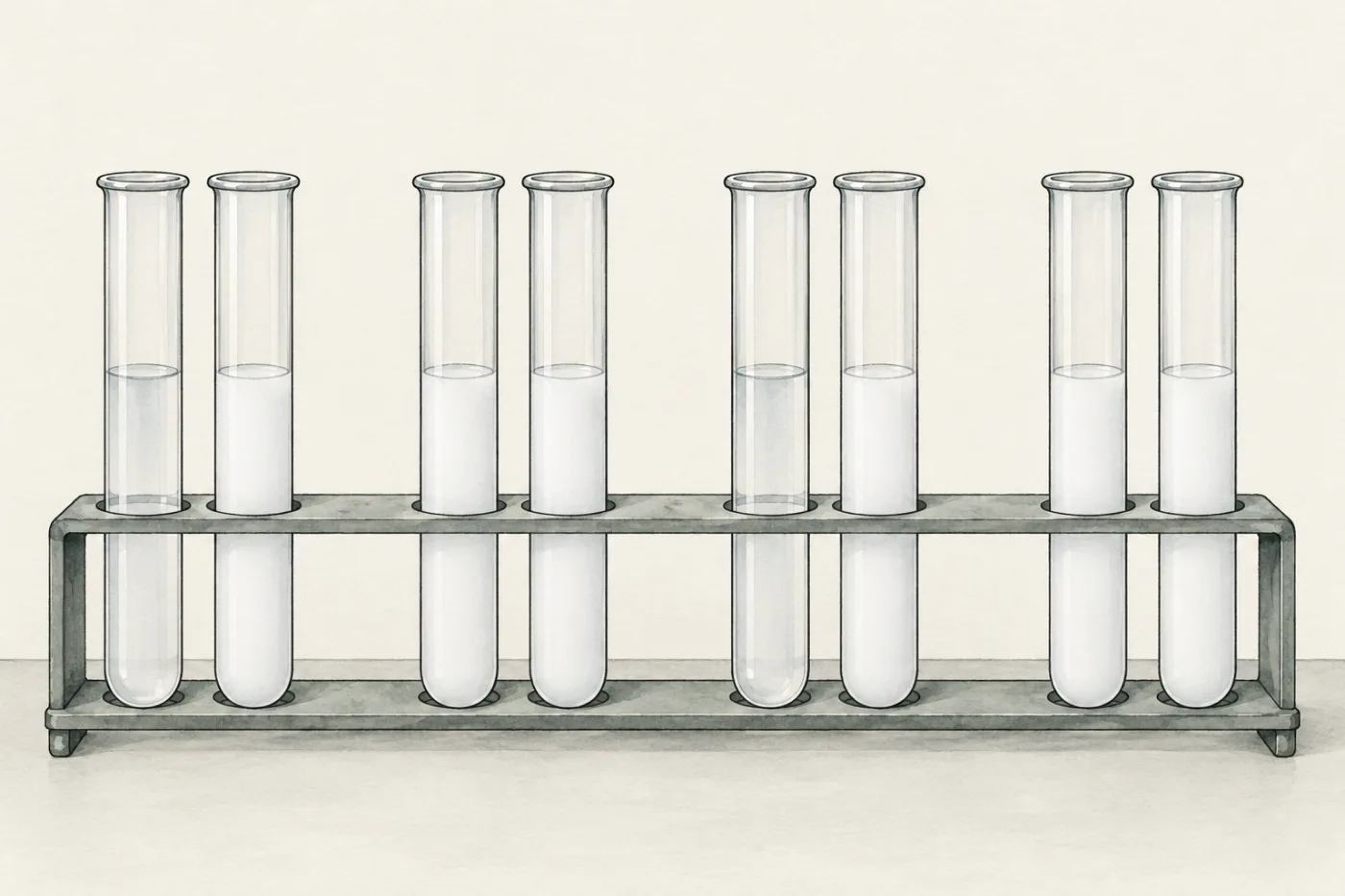
Food passes along the alimentary canal, the long tube from the mouth to the anus, and the pH is not the same all the way along it: about 2 in the stomach, about 8 in the small intestine. Do the proteases made in those two places work at different pH values? To find out, you use an egg-white suspension: cooked egg white whisked into water. It looks cloudy, because it is full of tiny pieces of insoluble protein. When a protease digests the protein into amino acids, which dissolve, the suspension turns clear. A clear tube means the protein has been digested.
Each tube also gets a buffer solution, which keeps the pH steady at one value: here, pH 2 for the acid stomach or pH 8 for the alkaline small intestine. You test two proteases (comparing them is Supplement): pepsin, the protease from the stomach, then trypsin, a protease from the pancreas. The tubes stand in a water bath at 37 °C for 10 minutes.
Before anything goes into the tubes, you choose the plan. For a fair test only the pH may change between the tubes with enzyme, and you need tubes without enzyme to show that the acid or alkali alone does not clear the egg white.
Predict first: at which pH will pepsin clear the egg white? pH 2, pH 8, both, or neither? Make your prediction, then run the experiment below before you read on.
What the tubes showed
| Tube | Enzyme | pH | After 10 minutes |
|---|---|---|---|
| 1 | pepsin | 2 | clear |
| 2 | pepsin | 8 | cloudy |
| 3 | none (water) | 2 | cloudy |
| 4 | none (water) | 8 | cloudy |
| 5 | trypsin | 2 | cloudy |
| 6 | trypsin | 8 | clear |
| 7 | none (water) | 2 | cloudy |
| 8 | none (water) | 8 | cloudy |
Pepsin digested the protein only at pH 2, and trypsin only at pH 8. The tubes without enzyme stayed cloudy at both pH values, so neither the acid nor the alkali digested the egg white on its own: the enzymes did. Supplement: each protease worked only at the pH of the place where it works in the body.
 (enlarge)
The times come from the experiment's model, a simple teaching model; real proteases at their optimum can take longer to clear a tube, but the pattern is the same.
Supplement: pepsin in the stomach, trypsin in the small intestine
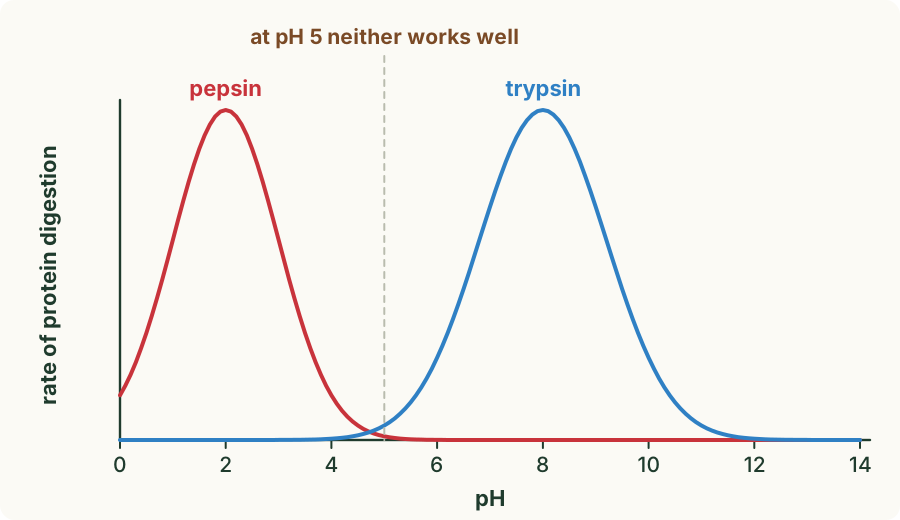
Pepsin is the protease made by the stomach. It breaks down protein in the acidic conditions of the stomach, with an optimum pH of about 2. Trypsin is a protease made by the pancreas. It breaks down protein in the alkaline conditions of the small intestine, with an optimum pH of about 8. At pH 5 neither works well.
 (enlarge)
Trap: "The acid in the stomach digests the protein." Tube 3 had acid but no enzyme, and it stayed cloudy. The acid gives pepsin the pH it needs; pepsin does the digesting.
Worked example
Medicine that reduces stomach acid
Some people take a medicine that makes their stomach make much less acid. Use the two jobs of the acid to suggest two effects this could have.
First job: the acid kills harmful microorganisms. With less acid, more bacteria in food survive the stomach, so infections of the gut are more likely. Second job: the acid gives the acidic pH for the stomach's protease. With less acid, the pH in the stomach is further from the protease's optimum, so less protein is digested in the stomach. Most of it can still be digested later, in the small intestine.
Worked example
Reading the protease graph
Supplement. Use the graph above. Which protease works better at pH 2, and which at pH 8? Explain how this suits the place where each one works.
Read upwards from pH 2: pepsin's curve is at its peak and trypsin's is almost at zero, so pepsin works better at pH 2. At pH 8 it is the other way round: trypsin works better. Pepsin works in the stomach, where gastric juice makes the pH about 2, which is its optimum. Trypsin works in the small intestine, where the conditions are alkaline, about pH 8, its optimum. Each protease is most active where it does its job.
Supplement: bile neutralises the acid
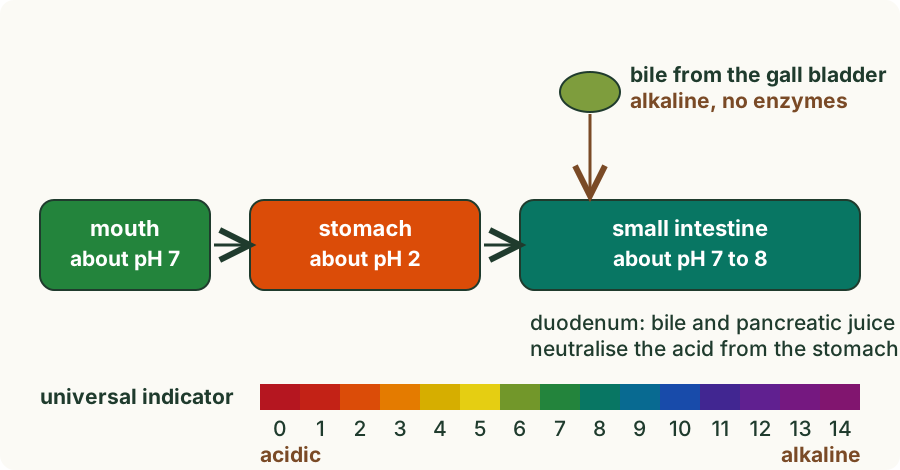
Food leaves the stomach mixed with acid, at about pH 2, and enters the duodenum. Trypsin and the other enzymes of the small intestine need alkaline conditions, so the acid has to be neutralised first. That is a job for bile. Bile is made in the liver, stored in the gall bladder and flows along the bile duct into the duodenum. Bile is alkaline, so it neutralises the acidic mixture of food and gastric juice entering the duodenum. Pancreatic juice is alkaline too, and helps.
 (enlarge)
Bile contains no enzymes. It has two jobs, and neither is digestion by enzymes: it neutralises the acid, and it breaks fats into tiny droplets, which gives lipase more surface to work on.
Trap: "Bile digests fat." Bile contains no enzymes: it neutralises the acid from the stomach and breaks fat into droplets. Lipase, from the pancreas, digests the fat into fatty acids and glycerol.
Worked example
A gallstone in the bile duct
Supplement. A gallstone blocks a patient's bile duct, so bile cannot reach the duodenum. Explain why digestion in the small intestine slows down.
Bile is alkaline and neutralises the acidic mixture entering the duodenum from the stomach. Without bile, the contents of the small intestine stay more acidic than the optimum pH of its enzymes, such as trypsin, so the enzymes work more slowly and protein, starch and fat are digested more slowly. Fat is also not broken into droplets, so lipase has less surface to work on. Pancreatic juice is still alkaline, which helps a little.
Key idea: Hydrochloric acid in gastric juice kills harmful microorganisms in food and gives an acidic pH for the optimum activity of the stomach's enzymes. Supplement: pepsin breaks down protein in the acidic conditions of the stomach and trypsin in the alkaline conditions of the small intestine; alkaline bile neutralises the acidic mixture of food and gastric juice entering the duodenum from the stomach.