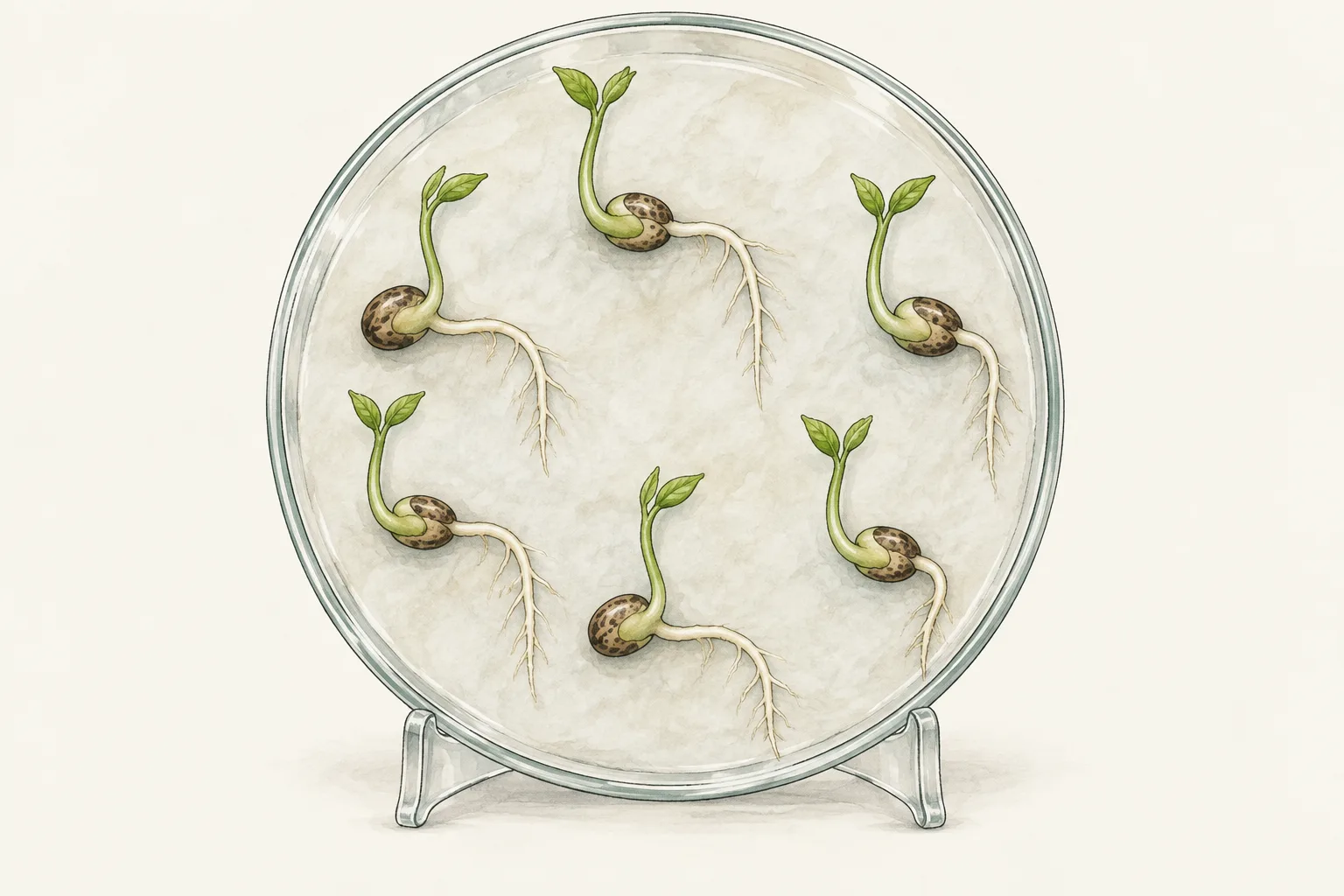
Plant a bean seed upside down and it makes no difference: its root still grows down into the soil and its shoot still grows up to the surface. Underground there is no light to follow, so what tells a root which way is down? In this part you turn a dish of seedlings on its side in the dark and watch which way the roots and the shoots turn. Then you light a second dish from one side, to see what roots do with light.
 (enlarge)
Growing with gravity
A root that meets a stone grows round it and carries on downwards, and a shoot buried under fallen leaves still comes up through them. Both are following gravity, which pulls the same way everywhere on the Earth, even in complete darkness.
Gravitropism is a response in which parts of a plant grow towards or away from gravity. A root grows towards gravity, downwards, and a shoot grows away from it, upwards. A response towards a stimulus is often called positive and one away from it negative, so roots show positive gravitropism and shoots negative gravitropism. Like phototropism, it is a growth response: the root or shoot curves because one side grows more than the other.
Trap: "A root grows down because gravity pulls it down, like a hanging string." A root is not dragged downwards: it grows down even through soil that pushes back, and a shoot grows up against gravity. Lay a seedling on its side and the root does not droop; its tip curves round as it grows until it points down again.
A dish turned on its side
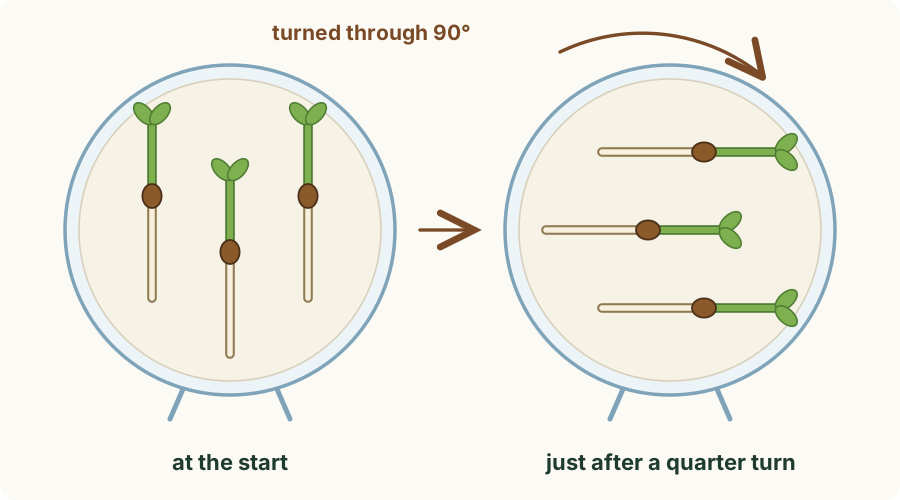
Roots in soil are hidden, so the seedlings grow on damp paper in a clear dish that stands on its edge. You use young mustard seedlings, because they are small and their roots and shoots grow quickly. At the start the roots point down and the shoots point up. Then the dish is turned through 90°, a quarter turn, so the roots and the shoots point sideways.
 (enlarge)
The turned dish then spends a day in the dark. Light from one side would also make the shoots bend, and you could not tell which stimulus caused which curve. In the dark, gravity is the only stimulus that comes from one direction, so any curve must be a response to gravity.
Before you read on, predict: a day after the turn, which way will the tips of the roots point, and the tips of the shoots?
Roots and light
A second dish of mustard seedlings stands upright, with a lamp on its right. The shoots curve towards the lamp, as the oat shoots did in the box. The roots curve the other way, away from the lamp. So the roots of these seedlings show phototropism too, but in the opposite direction to the shoots. Not every plant's roots respond to light this clearly, and gravity still keeps them growing downwards, so the mustard roots grow down and a little away from the lamp.
Run the experiment below before you read on. Predict where the roots will point after the turn, turn dish A and choose where it spends the day. Then name each response in the lens, predict what dish B's roots do beside a lamp, and switch the lamp on.
A clinostat: a control for gravity
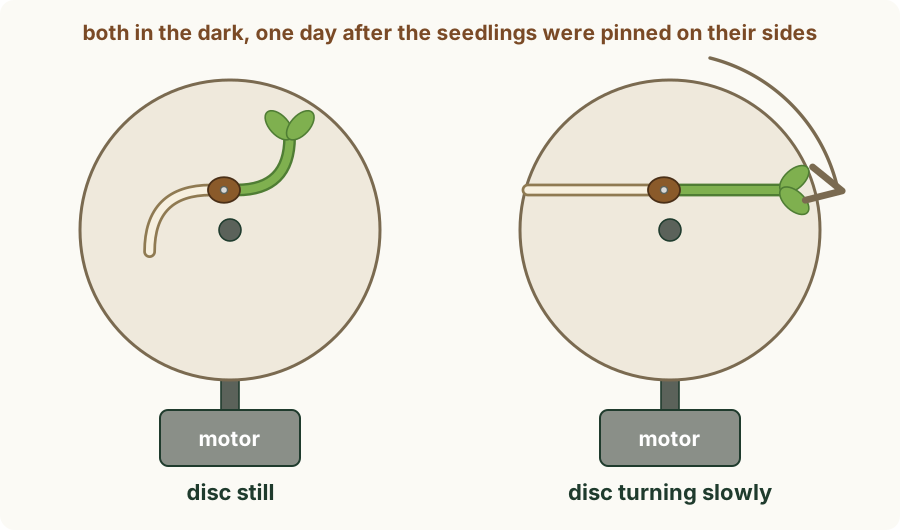
How can you be sure the curve in the turned dish was caused by gravity? Gravity cannot be switched off, but it can be stopped from acting on one side for longer than the other. A clinostat is a disc turned slowly by a motor, a few times an hour. Seedlings pinned to it lying on their sides face down, then up, then down again, so no side faces down for longer than the others. On a clinostat in the dark, roots and shoots laid sideways keep growing straight out sideways: they do not curve.
 (enlarge)
Trap: "On the turning clinostat the seedlings do not feel gravity any more." Gravity still acts on them. The clinostat turns them so that gravity acts on every side in turn, for the same time, so no side is pulled towards for longer than another.
What the experiment showed
A day after the turn in the dark, the mustard roots had curved round to grow straight down and the shoots had curved round to grow straight up: roots grow towards gravity and shoots away from it. In the dish lit from the right, the shoots curved towards the lamp and the roots curved away from it. Both responses happened by growth near the tips, which is where the roots and the shoots curved.
Worked example
Which response, and which way?
A tomato seedling in a pot is knocked over and left lying on its side on a dark shelf for two days. Its stem tip now points up. Describe the response of the stem.
The pot was in the dark, so the only stimulus from one direction was gravity: this is gravitropism. The stem grew away from gravity, upwards, so it curved until its tip pointed up. The roots inside the pot would have curved to grow downwards, towards gravity.
Worked example
Why in the dark?
A student turns a dish of seedlings on its side and leaves it on a sunny windowsill, with the window on the left. After a day the shoots point up and to the left. Explain why this result cannot show gravitropism on its own.
The shoots had two stimuli with a direction: gravity from below and light from the left. Both can change the direction in which a shoot grows, so you cannot tell how much of the turn was caused by gravity and how much by the light; the lean to the left shows that the light had an effect. To test gravitropism alone, the dish must be kept in the dark (or lit evenly from every side), so that gravity is the only stimulus with a direction.
Worked example
What the clinostat shows
Two dishes of bean seedlings are laid on their sides in the dark. Dish 1 is on a still clinostat, dish 2 on a turning one. After a day the roots in dish 1 point down; those in dish 2 still point sideways. What does dish 2 show?
Dish 2 is the control. Everything is the same as in dish 1 except that gravity acts on every side of the roots in turn, so no side faces down for longer. Its roots did not curve, so the curve in dish 1 was a response to gravity acting from one direction, not to anything else about the dish.