In the slit box the light was detected by the tip of each oat shoot, yet the curve formed lower down, in the part that was still growing longer. Something had to carry a message from the tip to the cells below it. In this part, which is all Supplement, you meet that messenger, a plant hormone called auxin, and use it to explain why a shoot curves towards light and away from gravity.
(Supplement) Two old experiments
In 1880 Charles Darwin and his son Francis grew grass seedlings by a window. Seedlings with their tips cut off, or covered with small caps that kept out the light, did not bend. Seedlings with their tips uncovered bent, even when the lower part of the shoot was buried in fine black sand. They concluded that the tip detects the light and sends some "influence" down to the region below, which then bends.
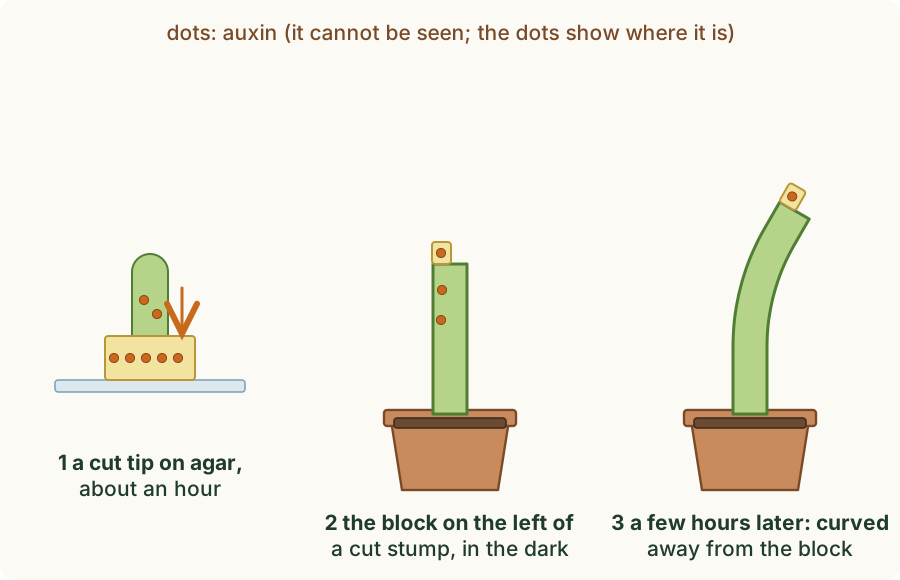
About 45 years later Frits Went cut the tips off oat coleoptiles and stood each tip on a small block of agar jelly for an hour or so. He then placed the agar block, without the tip, on one side of a cut stump, in the dark. The stump bent away from the side with the block. The tip itself was no longer there, so something that had passed out of the tip into the agar made the cells under the block grow more. That chemical is auxin.
 (enlarge)
(Supplement) Auxin controls how cells grow
Auxin is a plant hormone, a chemical that controls growth:
- auxin is made in the shoot tip;
- it diffuses through the plant from the shoot tip, down into the region below;
- there it stimulates cell elongation: the young cells take in water and grow longer.
The more auxin a cell in this region receives, the more it elongates. If both sides of a shoot get the same amount, both sides grow by the same amount and the shoot grows straight up. A shoot curves only when its two sides receive different amounts of auxin.
Trap: "Auxin makes the cells on one side divide faster." The curve forms where cells are getting longer, not where they are dividing. Auxin stimulates cell elongation.
(Supplement) Phototropism explained
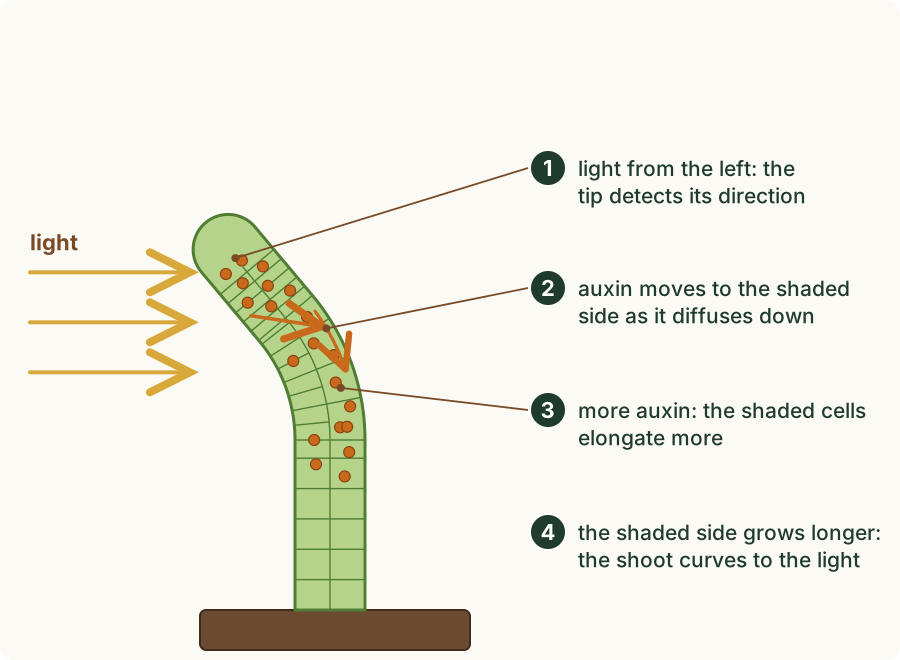
When light reaches a shoot from one side, auxin is unequally distributed: more of it moves to the shaded side. Follow the chain:
- Light comes from the left; the tip detects its direction.
- Auxin made in the tip moves towards the shaded (right) side as it diffuses down.
- The cells on the shaded side receive more auxin and elongate more than the cells on the lit side.
- The shaded side grows longer than the lit side, so the shoot curves towards the light.
 (enlarge)
Trap: "The side facing the light grows faster, so it pushes the shoot towards the light." It is the other way round: the shaded side grows faster. A side that grows longer ends up on the outside of the curve, so the shoot turns away from it, towards the light.
Trap: "Light destroys the auxin on the lit side." The explanation in this course is that auxin is unevenly distributed: it ends up mostly on the shaded side. Say that the shaded side has more auxin, not that the light has broken it down.
This also explains pot B. With a foil cap, the tip receives no light at all, so it detects no direction. Auxin is spread evenly on both sides, both sides elongate by the same amount, and the shoot grows taller but stays straight.
(Supplement) Gravitropism explained
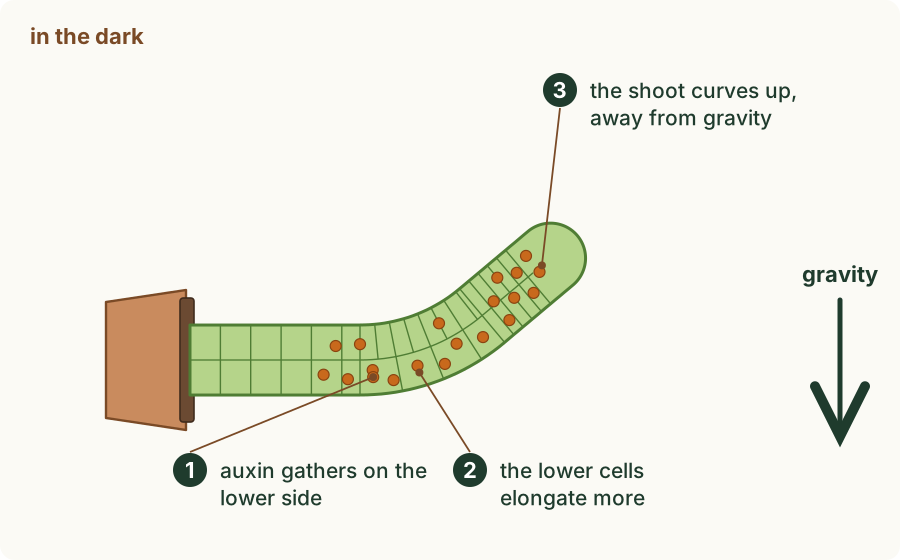
Lay a shoot on its side in the dark. Gravity acts on it from below, and auxin is again unequally distributed: more of it collects on the lower side.
- Auxin made in the tip diffuses back along the shoot and gathers on the lower side.
- The cells on the lower side receive more auxin and elongate more than the cells on the upper side.
- The lower side grows longer, so the shoot curves upwards, away from gravity.
 (enlarge)
Phototropism and gravitropism of a shoot are both examples of the chemical control of plant growth: a hormone made in one place travels to another and changes how much the cells there grow. Roots respond to gravity too, but how auxin acts in roots is beyond this course.
Run the experiment below before you read on. In the lens on a shoot tip, predict which side the auxin will collect on under light from the left, then watch it move and the cells grow. Explain why the foil-capped shoots grew straight, and finally lay a shoot on its side in the dark.
Worked example
(Supplement) Explaining the bend
A sunflower seedling on a windowsill is lit from the window on its left. Explain, in terms of auxin, why its shoot curves towards the window.
Auxin is made in the shoot tip and diffuses down the shoot. Light from the left makes the auxin unequally distributed: more of it moves to the shaded, right side. Auxin stimulates cell elongation, so the cells on the right side elongate more than those on the left. The right side grows longer, and the shoot curves to the left, towards the window.
Worked example
(Supplement) Agar on one side
A cut coleoptile stump in the dark gets two agar blocks side by side: on its left, a block that an oat tip stood on for an hour; on its right, a block of plain agar that no tip touched. Predict and explain which way the stump bends.
Auxin from the tip diffused into the first block. From there it diffuses into the cells on the left side of the stump, so those cells elongate more than the cells on the right, under the plain agar. The left side grows longer and the stump curves to the right, away from the block that carried auxin. The plain block is a control: agar on its own does not make cells grow. The experiment is done in the dark so that light cannot make the auxin move to one side.
Worked example
(Supplement) A shoot on its side
A potted bean plant is laid on its side in a dark cupboard. After a day its shoot tip points up. Explain this in terms of auxin.
Gravity makes the auxin unequally distributed: more of it collects on the lower side of the shoot. The cells on the lower side therefore elongate more than those on the upper side. The lower side grows longer, so the shoot curves upwards, away from gravity. The cupboard is dark so that light cannot cause a curve as well.