In the porch the arterioles narrowed and the person shivered; in the warm room the arterioles widened and sweat appeared. Nobody decided to do any of this. Something detected the change in temperature and switched on the right responses. In this part, which is all Supplement, you find the parts of the skin that take part, and you test what happens to the core temperature when one of the responses is switched off.
 (enlarge)
(Supplement) The parts of the skin
The skin is an organ, and seven of its parts matter for keeping the core temperature steady. You need to be able to find each of them in a diagram and in a photograph.
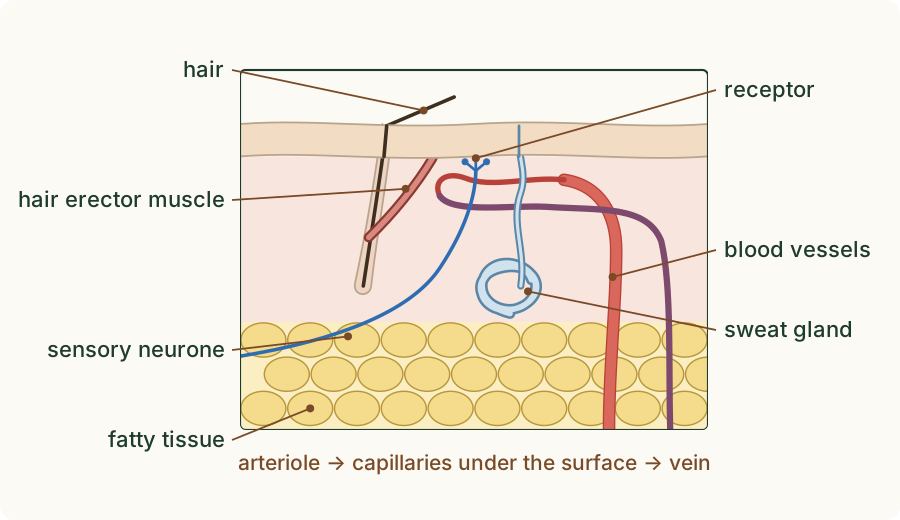 (enlarge)
| Part | What it looks like | What it does |
|---|---|---|
| hair | a thin strand growing out of a pit in the skin | traps a layer of air when it is raised |
| hair erector muscle | a small muscle joined at a slant to the side of the hair | contracts to pull the hair upright |
| sweat gland | a coiled tube deep in the skin, with a duct up to a pore | releases sweat onto the surface |
| receptor | a nerve ending near the surface | detects a change in temperature |
| sensory neurone | a nerve fibre leading away from the receptor | carries impulses towards the brain |
| blood vessels | an arteriole, the capillaries near the surface, and a vein | carry blood, and heat, close to the surface |
| fatty tissue | a layer of rounded cells under the skin | insulates: slows the loss of heat |
In a photograph you rarely see a whole skin section, but you can see some of its parts working: hairs standing up as goose bumps, beads of sweat on the surface, or skin that is flushed pink because more blood is flowing near the surface.
Trap: "The sweat gland is on the surface of the skin." Only the pore is on the surface. The gland itself is a coiled tube deep in the skin, joined to the pore by a duct.
(Supplement) Negative feedback
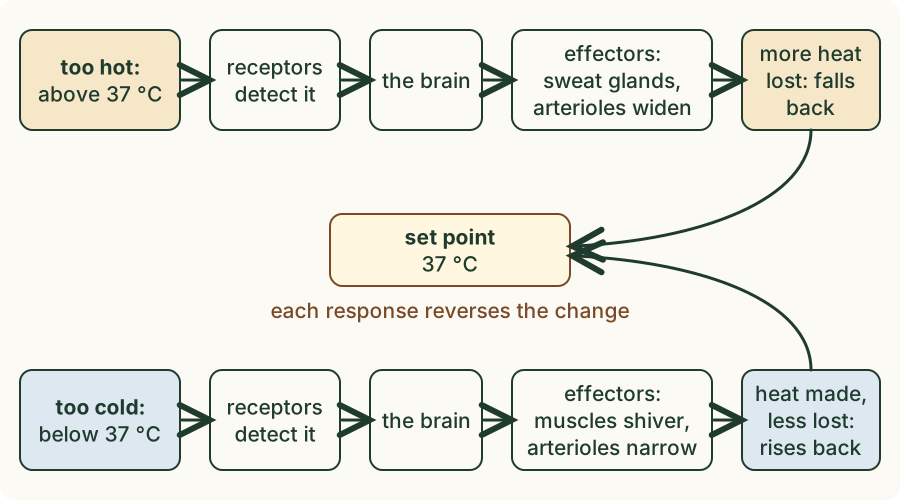
The core temperature is kept near its set point by negative feedback. Every negative feedback loop has the same parts:
- A condition changes away from its set point: for example the core temperature falls below 37 °C.
- Receptors detect the change. There are temperature receptors in the skin and in the brain itself.
- The brain coordinates the response. A small region at the base of the brain (the hypothalamus) compares the temperature with the set point and sends impulses along neurones to the effectors.
- Effectors respond: muscles shiver and the arterioles supplying the skin surface narrow.
- The response reverses the change: the core temperature rises back towards the set point. As it gets there, the receptors detect less change and the responses slow down and stop.
The feedback is called negative because the response always works against the change. If the temperature rises, the responses lower it; if it falls, the responses raise it.
 (enlarge)
Trap: "Negative feedback means the body does something bad." In negative feedback, "negative" means that the response reverses the change: a rise in temperature causes responses that lower it, and a fall causes responses that raise it.
(Supplement) Testing one effector at a time
How do you know that a response really helps? One way is to switch it off and see what happens. You cannot do this to a real person, but you can in a model. In the experiment the model person has two switches: one for the sweat glands and one for shivering. A fair test changes one switch at a time and keeps everything else the same: the room, the clothes, the 10 minutes and the starting core temperature of 37.0 °C.
Each response only works in one direction. Sweating loses heat, so it matters when the body is too warm; shivering releases heat, so it matters when the body is too cold. To test a response, you have to test it in the conditions where the body would use it.
Run the experiment below before you read on. Find the seven parts in the skin magnifier. Follow the impulses round the loop. Then predict what switching sweating off will do in the warm room, run it, and choose for yourself how to test shivering.
What the experiment showed
With sweating switched off in the warm room, the core temperature rose to 37.4 °C in 10 minutes instead of staying at 37.0 °C: without sweat to evaporate, too little heat was lost. Switching sweating off in the cold porch changed nothing (36.9 °C, the same as with every response on), because the body does not sweat in the cold. Switching shivering off did matter in the porch: the core fell to 36.6 °C instead of 36.9 °C. Each effector helps only in the direction it works in, and with one switched off, the core drifted further from the set point.
Worked example
(Supplement) Naming parts of the skin
In a diagram of the skin, part X is a coiled tube deep in the skin with a duct to the surface, and part Y is a small muscle joined to a hair. Name X and Y, and state what each does when the body is too warm and too cold.
X is a sweat gland: when the body is too warm it releases sweat onto the surface, which cools the skin as it evaporates. Y is a hair erector muscle: when the body is too cold it contracts and raises the hair, which traps a layer of air. Name the part first, then its job.
Worked example
(Supplement) The loop in order
Describe how negative feedback brings the core temperature back after a person walks into a cold room.
The core temperature falls below the set point (37 °C). Receptors in the skin and the brain detect the fall. The brain sends impulses to the effectors: muscles shiver, releasing heat by respiration, and the arterioles supplying the skin surface capillaries narrow, so less heat is lost. The core temperature rises back towards 37 °C. The response reverses the change, so this is negative feedback.
Worked example
(Supplement) A switch that changed nothing
In the model, switching off sweating in the cold porch left the core temperature at 36.9 °C, the same as with every response on. A student concludes that sweating does not help to control body temperature. Explain why this conclusion is wrong.
In the cold the body does not sweat, so switching sweating off there changes nothing. Sweating is a response to the body becoming too warm. To test it, switch it off in the warm room: there the core temperature rose to 37.4 °C instead of staying at 37.0 °C, so sweating does help. A test of an effector must be done in the conditions where it is used.
Key idea: The skin's hairs, hair erector muscles, sweat glands, receptors, sensory neurones, blood vessels and fatty tissue all take part in temperature control. The core temperature is kept near its set point by negative feedback: receptors in the skin and the brain detect a change, the brain coordinates, and effectors (sweat glands, muscles, arterioles) respond so that the change is reversed. Switch an effector off in the conditions where it is used, and the core temperature drifts further from the set point.