Contents
Part 2 of 3
Skin and negative feedback
identify
Try it yourself
Supplement: the diagram shows a section through the skin. Identify the parts labelled B and C.
identify: name or select.
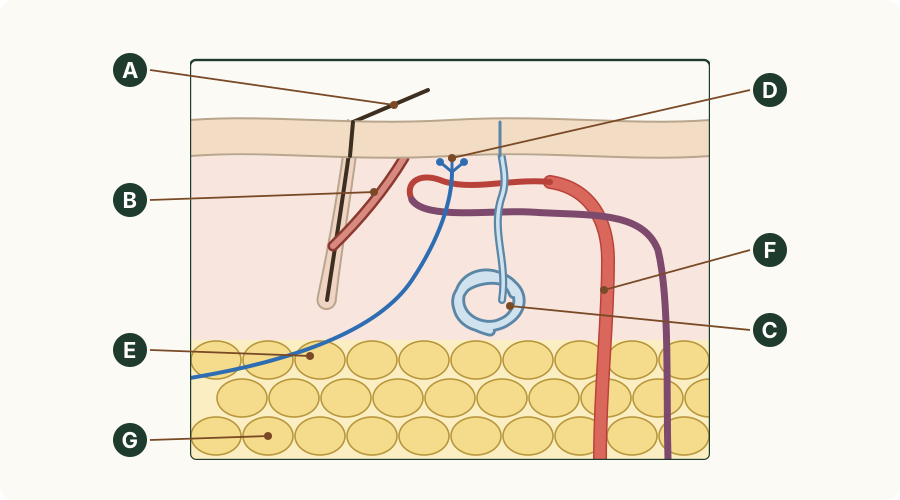 (enlarge)
Your saved work
Answers, earlier attempts and your Pause and check notes stay in this browser. Export a copy to keep, to move to another device or to hand to your teacher. Importing a copy keeps your current answers and adds earlier attempts.
Scope and sources
Cambridge IGCSE Biology 0610 · 2026–2028 v3 · Original learning materials.
Homeostasis (14.4.1–14.4.8): homeostasis as the maintenance of a constant internal environment; insulin decreases the blood glucose concentration; and, for the Supplement, homeostatic control by negative feedback with reference to a set point; the control of the blood glucose concentration by the liver and the roles of insulin and glucagon; an outline of the treatment of Type 1 diabetes; the hairs, hair erector muscles, sweat glands, receptors, sensory neurones, blood vessels and fatty tissue of the skin, identified in diagrams and images; and the maintenance of a constant internal body temperature in mammals by insulation, sweating, shivering and the role of the brain, and by vasodilation and vasoconstriction of the arterioles supplying the skin surface capillaries. Hormones, glands and adrenaline are in the module on hormones; neurones and the reflex arc in the module on nerves and reflexes; the kidney and water balance in the module on excretion. Type 2 diabetes, insulin doses and any medical advice are not covered here.
Apparatus, amounts and times in the experiment are illustrative. Real practical work follows a teacher-approved safety method.
Official Cambridge syllabus