Squeeze a soft ball as hard and as fast as you can, and count the squeezes. For the first few seconds it is easy. After a minute your forearm aches and you squeeze more slowly. After a 100 m sprint, a runner goes on panting and their heart goes on pounding for minutes after they have stopped. In this part you find out how muscles release energy when they work very hard, and why your body goes on working hard after exercise has ended.
 (enlarge)
Anaerobic respiration in muscles
Muscle cells need a lot of energy to contract. Most of the time they get it by aerobic respiration, using oxygen brought to them in the blood. During vigorous exercise, such as a sprint, the heart and lungs cannot bring oxygen to the muscles fast enough for all the energy they need. So the muscle cells also respire anaerobically, without oxygen.
The word equation for anaerobic respiration in muscles during vigorous exercise is:
glucose → lactic acid
There is no carbon dioxide and no alcohol: that is how anaerobic respiration in muscles differs from anaerobic respiration in yeast. Like yeast, though, it releases much less energy per glucose molecule than aerobic respiration, because the glucose is only partly broken down: much of its energy is still held in the lactic acid.
Anaerobic respiration lets muscles keep working hard for a short time, but not for long. When you squeezed the ball, your forearm muscles were respiring anaerobically as well, and lactic acid was building up in them as they began to ache and slow down.
Trap: "During a sprint the muscles stop respiring aerobically." They go on respiring aerobically as fast as the oxygen supply allows, and respire anaerobically as well.
Trap: "Anaerobic respiration in muscles makes alcohol and carbon dioxide." That is yeast. In muscles: glucose → lactic acid only.
Worked example
A cyclist on a steep hill
A cyclist rides up a steep hill as fast as she can. Near the top, her thigh muscles ache and slow down. Explain how her thigh muscle cells are releasing energy, write the word equation for the respiration without oxygen, and say why it gives less energy from each glucose molecule.
Riding hard up the hill is vigorous exercise: her heart and lungs cannot bring oxygen to the thigh muscles fast enough for all the energy they need. The muscle cells go on respiring aerobically as fast as the oxygen allows, and they also respire anaerobically: glucose → lactic acid, with no carbon dioxide and no alcohol. This releases much less energy per glucose molecule than aerobic respiration, because the glucose is only partly broken down: much of its energy is still held in the lactic acid. As lactic acid builds up in them, her muscles ache and slow down.
Supplement: the oxygen debt
This section is Supplement content (syllabus 12.3.6).
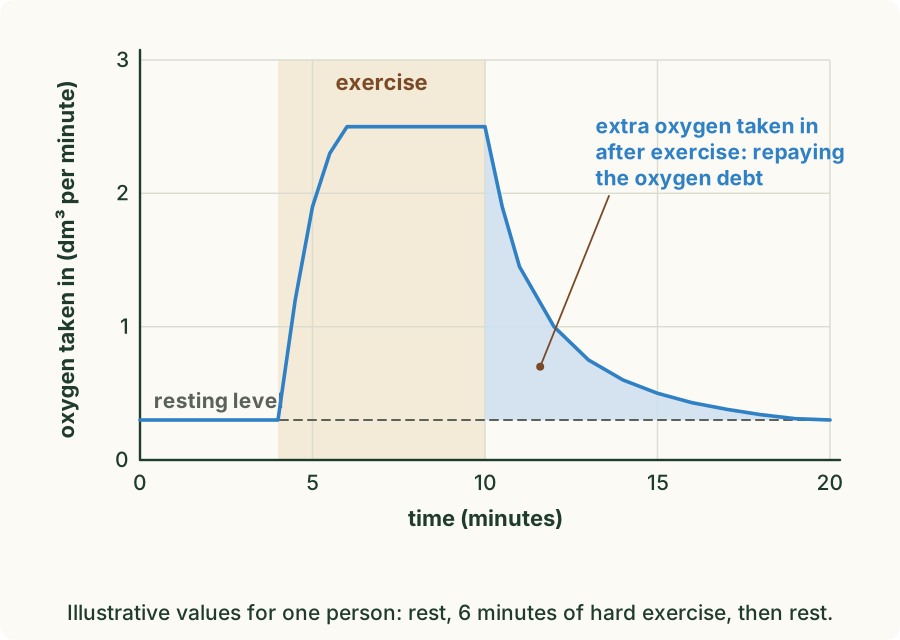
During a sprint your muscles make lactic acid faster than it can be removed, so lactic acid builds up in the muscles and in the blood. Removing it needs oxygen, and that is why you keep panting after you stop. This extra oxygen is the oxygen debt: the body "owes" it, and pays it back after the exercise.
You can see the oxygen debt by measuring how much oxygen a person takes in each minute, before, during and after exercise. The graph gives the volume of oxygen in dm³ (cubic decimetres): 1 dm³ is 1 litre, or 1000 cm³.
 (enlarge)
When the exercise stops, the oxygen taken in does not fall straight back to the resting level. For about ten minutes the person goes on taking in more oxygen than at rest. That extra oxygen pays back the oxygen debt.
Trap: "An oxygen debt means you held your breath." The person breathed hard all the way through. The debt builds up because the muscles respired anaerobically and made lactic acid, which needs oxygen to remove.
Supplement: removing the oxygen debt
This section is Supplement content (syllabus 12.3.7).
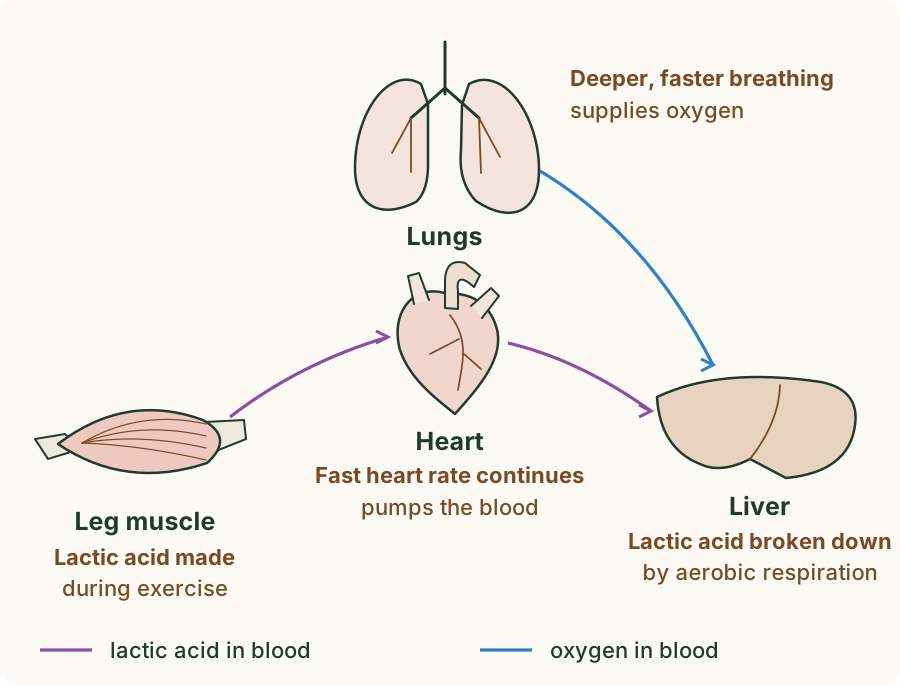
After vigorous exercise, the oxygen debt is removed in three ways:
- The heart rate stays fast for a while, to transport lactic acid in the blood from the muscles to the liver.
- Breathing stays deeper and faster for a while, to supply oxygen for the aerobic respiration of lactic acid.
- In the liver, the lactic acid is broken down by aerobic respiration.
 (enlarge)
Illustrative results for a pupil after a 2-minute sprint up and down the school stairs:
| Time after the exercise (minutes) | Heart rate (beats per minute) | Breathing rate (breaths per minute) |
|---|---|---|
| at rest, before | 70 | 14 |
| 0 | 160 | 40 |
| 2 | 125 | 30 |
| 5 | 95 | 21 |
| 10 | 74 | 15 |
The heart rate and the breathing rate both stay high long after the exercise has ended, and fall back slowly. Once the lactic acid has been removed, they are back at their resting values.
Trap: "Lactic acid is breathed out." Lactic acid is carried in the blood to the liver, where it is respired aerobically. The faster breathing supplies the oxygen for that.
Worked example
Lactic acid in a rower's blood
Supplement. During a hard 2000 m rowing race, the concentration of lactic acid in a rower's blood rises. After the race it slowly falls back to its resting level. Explain why it rises, and outline how the lactic acid is removed.
During the race the rower's muscles respire anaerobically as well as aerobically and make lactic acid faster than it can be removed, so it builds up in the muscles and the blood. Removing it needs oxygen: this is the oxygen debt. After the race the debt is paid back. The heart rate stays fast, to carry the lactic acid in the blood from the muscles to the liver. The breathing stays deeper and faster, to supply oxygen for the aerobic respiration of lactic acid. In the liver, the lactic acid is broken down by aerobic respiration. As it is removed, its concentration in the blood falls, and the heart rate and breathing go back to their resting values.
Key idea: During vigorous exercise, muscle cells respire anaerobically as well as aerobically: glucose → lactic acid. This releases much less energy per glucose molecule than aerobic respiration. Supplement: lactic acid builds up in the muscles and blood, causing an oxygen debt. After exercise the debt is removed: a fast heart rate continues to carry the lactic acid in the blood to the liver, deeper and faster breathing continues to supply oxygen, and the liver breaks down the lactic acid by aerobic respiration.