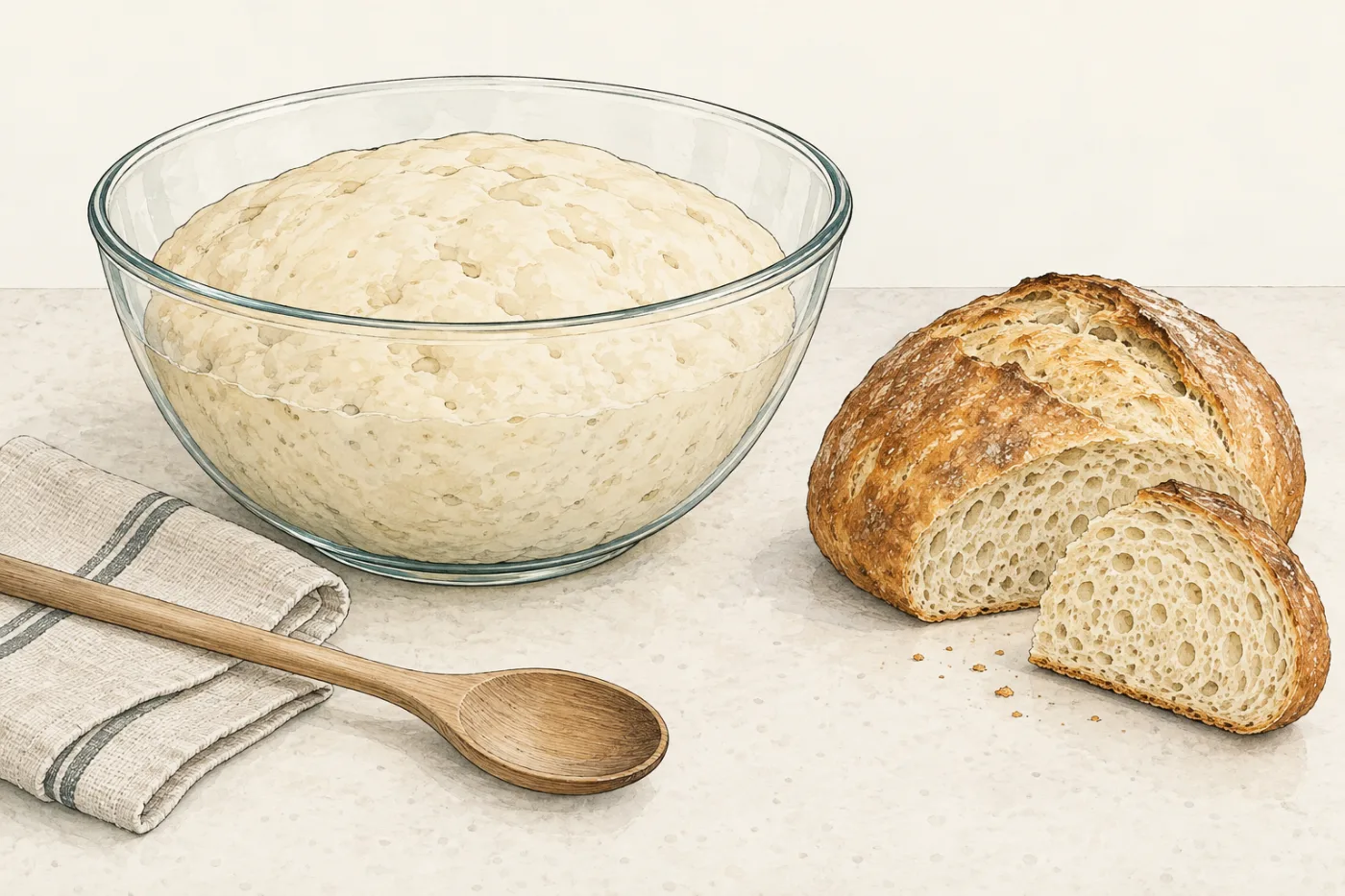
Bread dough is made with flour, water, a little sugar and yeast. Left in a warm kitchen for an hour, it swells to twice its size; in a cold fridge it hardly rises at all. Cut a baked loaf open and you see thousands of holes, each one left by a bubble of gas. Where does the gas come from, and why does warmth matter? In this part you collect the gas that yeast gives off and find out how temperature changes the rate.
 (enlarge)
Respiration without oxygen
Yeast is a fungus made of single cells, each far too small to see without a microscope. Like every living cell, a yeast cell respires to release the energy it needs, for example to grow and divide. With oxygen it respires aerobically, like the cells in part 1. In bread dough or in a sealed tube, the oxygen is soon used up, and yeast goes on respiring without oxygen.
Anaerobic respiration is the chemical reactions in cells that break down nutrient molecules to release energy without using oxygen.
In yeast, the word equation is:
glucose → alcohol + carbon dioxide
The alcohol is ethanol. The carbon dioxide forms the bubbles that make dough rise.
Supplement (syllabus 12.3.5): the balanced chemical equation for anaerobic respiration in yeast is
C6H12O6 → 2C2H5OH + 2CO2
Without oxygen, the glucose is only partly broken down: the alcohol still holds a lot of energy (it burns well). So anaerobic respiration releases much less energy per glucose molecule than aerobic respiration.
Trap: "Anaerobic respiration makes energy." Energy is never made. Both kinds of respiration release energy from nutrient molecules such as glucose; anaerobic respiration releases much less of it from each molecule.
Trap: "Yeast can only respire anaerobically." Yeast respires aerobically when it has oxygen and anaerobically when it does not.
Worked example
A balloon on a bottle
A pupil puts yeast in warm glucose solution in a plastic bottle and stretches a balloon over its neck. The yeast soon uses up the oxygen in the bottle, yet the balloon goes on filling with gas for an hour. Describe how the yeast is now releasing energy, and write the word equation.
With no oxygen left, the yeast respires anaerobically: the chemical reactions in cells that break down nutrient molecules, here glucose, to release energy without using oxygen. The word equation is glucose → alcohol + carbon dioxide. The carbon dioxide is the gas that fills the balloon; the alcohol, ethanol, stays in the solution. Anaerobic respiration releases much less energy per glucose molecule than aerobic respiration, so the yeast now gets far less energy from each glucose molecule than it did while it had oxygen.
Worked example
Molecules from yeast
Supplement. A yeast cell respires 5 molecules of glucose anaerobically. How many molecules of ethanol and of carbon dioxide does it make, and how many molecules of oxygen does it use?
Use the balanced chemical equation: C6H12O6 → 2C2H5OH + 2CO2. Each glucose molecule gives 2 ethanol molecules and 2 carbon dioxide molecules, so 5 glucose molecules give 5 × 2 = 10 ethanol molecules and 5 × 2 = 10 carbon dioxide molecules. It uses no oxygen: there is no O2 in the equation. Check the carbon: each glucose molecule has 6 carbon atoms, and 2 × 2 = 4 end up in the ethanol and 2 in the carbon dioxide, 6 in all.
Investigating temperature and yeast
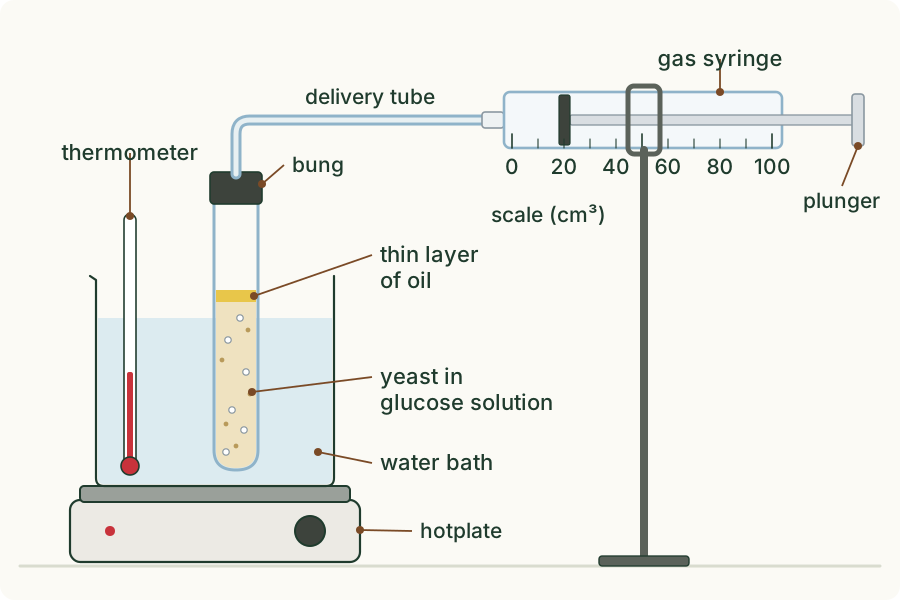
You can measure how fast yeast respires by collecting the carbon dioxide it gives off. A gas syringe collects the gas and shows its volume on a scale in cm³.
 (enlarge)
A school method:
- Boil some glucose solution, then let it cool, so that the heat does not kill the yeast. Put 10 cm³ of it in a boiling tube and stir in 1 g of yeast.
- Run a few drops of oil down the inside of the tube, so that a thin layer floats on the solution.
- Stand the tube in a water bath at the temperature you want to test. Fit the bung, and join the delivery tube to the gas syringe with its plunger pushed right in.
- Leave the tube for 10 minutes to reach the temperature of the bath. Then note the syringe reading and start the stop-clock.
- After 5 minutes, read the syringe again.
- Repeat with a fresh tube made up the same way at 20, 30, 40, 50 and 60 °C, two runs at each temperature.
Temperature is the variable you change, the independent variable. The volume of gas is the variable you measure, the dependent variable. Everything else stays the same: the mass of yeast, the volume and concentration of the glucose solution, and the times.
The volume of gas collected is the end reading minus the start reading. The rate of respiration is that volume divided by the time, in cm³ per minute.
Boiling drives out the oxygen dissolved in the solution, and the oil stops more oxygen from the air dissolving back in. So once any oxygen left is used up, the yeast respires anaerobically.
The clock starts only after the 10 minutes, because some of the first gas is air pushed out of the tube as it warms. That gas did not come from the yeast.
To check what the gas is, take the delivery tube off the syringe and put its end into limewater. Carbon dioxide turns limewater milky. And to check that the gas really comes from the yeast, time a control: a tube of the same glucose solution, made up and timed the same way, but with no yeast.
Predict first: the tube is sealed with a bung, so any gas from the yeast can only go along the delivery tube into the syringe. Once the bath is warm, what will the syringe's plunger do: move outwards, move inwards or stay where it is? Write your prediction down now.
Below you can try the first steps: warming the bath to 30 °C, then timing the first 5-minute run. Before you read on, open the full experiment and run it to the end. It also tests the gas with limewater, times a control with no yeast, and asks you to predict which temperature gives the most gas before you time fresh yeast at five temperatures. Your prediction only counts if you make it before you see the results below.
After the experiment: working out the rate
The volumes here come from an illustrative model of yeast, set up to behave the way real yeast usually does. Real results depend on the yeast, the glucose and the room.
The plunger moved outwards: the yeast was giving off gas. The syringe read 8 cm³ when the clock started and 20 cm³ after 5 minutes.
- Gas collected: 20 − 8 = 12 cm³.
- Rate of gas production: 12 cm³ ÷ 5 minutes = 2.4 cm³ per minute.
The limewater turned milky, so the gas is carbon dioxide. The control tube with no yeast gave no gas, so the carbon dioxide came from the yeast.
Results, two runs at each temperature:
| Temperature (°C) | Gas in 5 minutes, run 1 (cm³) | Gas in 5 minutes, run 2 (cm³) | Mean rate (cm³ per minute) |
|---|---|---|---|
| 20 | 5 | 5 | 1.0 |
| 30 | 12 | 13 | 2.5 |
| 40 | 21 | 19 | 4.0 |
| 50 | 9 | 11 | 2.0 |
| 60 | 1 | 0 | 0.1 |
| 30, no yeast (control) | 0 | 0 |
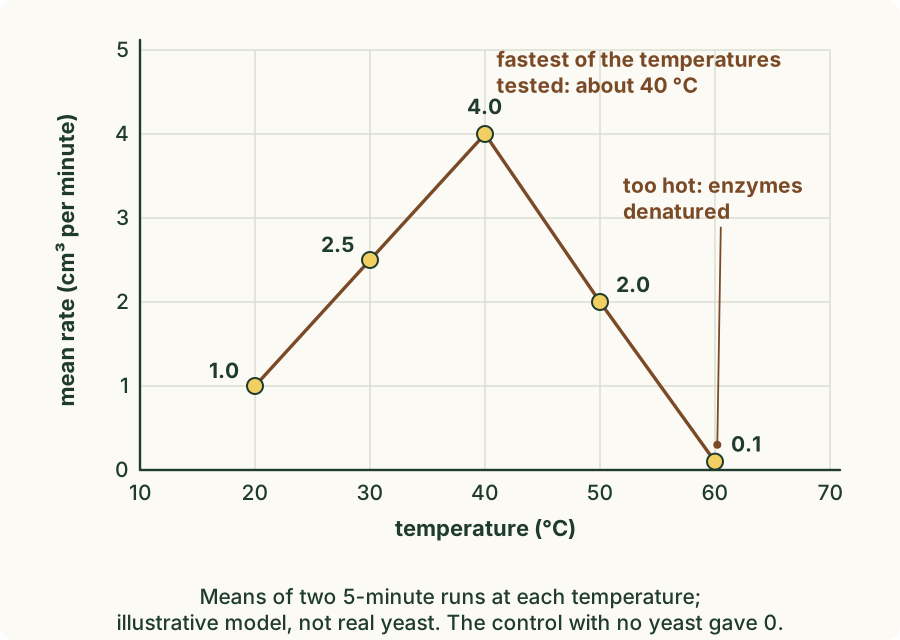
For each temperature, find the mean gas of the two runs, then divide by 5. At 30 °C: (12 + 13) ÷ 2 = 12.5 cm³, and 12.5 ÷ 5 = 2.5 cm³ per minute.
 (enlarge)
Trap: "The rate is 20 ÷ 5 = 4 cm³ per minute." 20 cm³ is where the plunger stopped, not how much gas was collected. The syringe already held 8 cm³ when the clock started: subtract first, then divide by the time.
What the results show
As the temperature rises from 20 °C, the yeast respires faster and faster, up to its fastest rate at about 40 °C in these results. Above that the rate falls, and at 60 °C the yeast gives off almost no gas.
Respiration is a series of chemical reactions, each controlled by an enzyme. As you saw with enzymes, warming speeds the reactions up, so the rate rises. Above the best temperature, the optimum, the enzymes start to be denatured: their shape changes and they stop working. At 60 °C almost all of them are denatured, and cooling the yeast down again does not undo it.
The temperatures went up in steps of 10 °C, so the real optimum could be anywhere between 30 and 50 °C. Testing more temperatures in that range, for example every 2 °C, would find it more exactly.
Trap: "The hotter it is, the faster yeast respires." Only up to the optimum. Look past 40 °C: the rate falls, because the enzymes are denatured.
Trap: "At 60 °C the yeast ran out of glucose." Every tube had the same fresh glucose solution, and at 40 °C it lasted the whole run. The heat stopped the yeast's enzymes.
Worked example
A rate at 34 °C
Another pupil runs a yeast tube at 34 °C. The gas syringe reads 7 cm³ when the clock starts and 22 cm³ after 5 minutes. Work out the rate of gas production, and say where it fits among the class results.
Subtract first: the gas collected is 22 − 7 = 15 cm³, because 22 cm³ is only where the plunger stopped. Then divide by the time: 15 cm³ ÷ 5 minutes = 3.0 cm³ per minute. That lies between the rates at 30 °C (2.5) and 40 °C (4.0). It is still lower than the rate at 40 °C, so 34 °C is below the optimum: warming still speeds up the enzymes that control respiration. One run is not enough to trust: repeat it and use the mean.
Bread and brewing
Bread. In a warm place, yeast in the dough respires fast. Its carbon dioxide forms bubbles that are trapped in the dough, so the dough rises. In the hot oven the yeast is killed, and the alcohol evaporates; the bubbles stay as the holes in the bread.
Brewing. To make beer or wine, yeast respires anaerobically in a sugary liquid kept warm. Here the alcohol is the product that is wanted, and the carbon dioxide escapes or makes the drink fizzy.
Key idea: Anaerobic respiration is the chemical reactions in cells that break down nutrient molecules to release energy without using oxygen. In yeast: glucose → alcohol + carbon dioxide (Supplement: C6H12O6 → 2C2H5OH + 2CO2). It releases much less energy per glucose molecule than aerobic respiration. To investigate temperature, collect yeast's carbon dioxide in a gas syringe for a fixed time: rate = (end reading − start reading) ÷ time. The rate rises to an optimum, about 40 °C here, then falls as the enzymes that control respiration are denatured.