Washing hung outside dries fastest on a warm, windy day, and hardly dries at all on a cold, damp, still one. Leaves lose water in a similar way: water evaporates inside them, and the vapour diffuses out. In this part you use the potometer to test what moving air and warmer air do to the rate, and what humid air does.
 (enlarge)
Planning a fair test
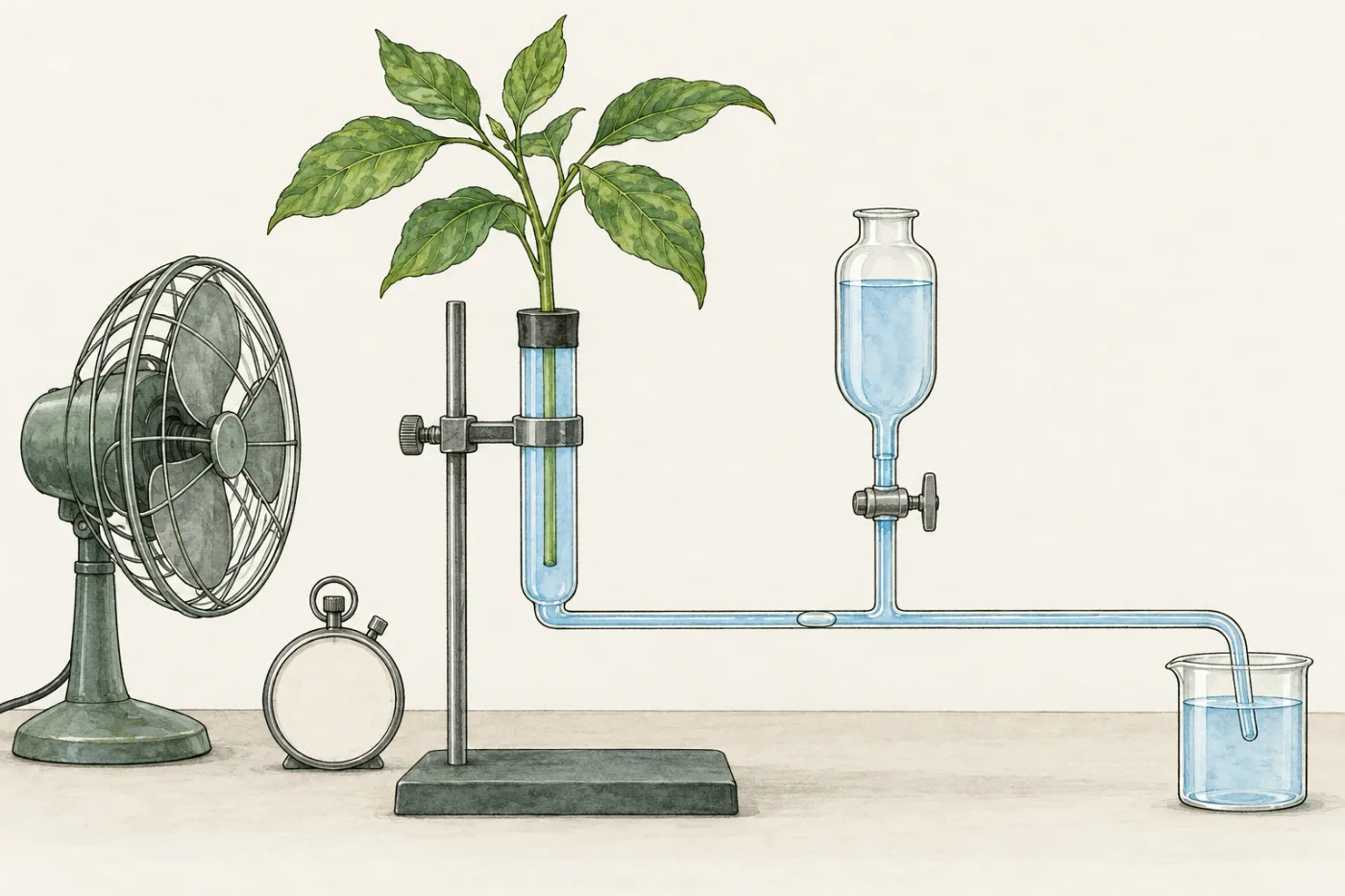
You want to know how wind speed and temperature affect the rate of transpiration. The potometer measures the rate of water uptake, which is a close estimate of it. To make it a fair test:
- Change one thing at a time. The condition you change is the independent variable: first moving air from a fan, then warmer air. The rate of water uptake, from the distance the bubble moves in 2 minutes, is the dependent variable.
- Keep everything else the same: the same shoot in the same potometer, the same light, the same time for each run, and the same edge of the bubble read each time. A different shoot would have a different size and number of leaves, so its rate would differ anyway.
- Let the shoot settle. After each change, wait 5 minutes before timing. The shoot takes a few minutes to reach its new rate.
- Repeat. Time three runs for each condition and find the mean.
- Go back to still air between tests, and time a check run. If the rate is back to about the still-air rate, the shoot itself has not changed, and the next test starts from the same place.
Trap: "Switch on the fan and the heater together, to see the biggest change." Then you could not tell which change caused the difference. Change one thing at a time.
The results
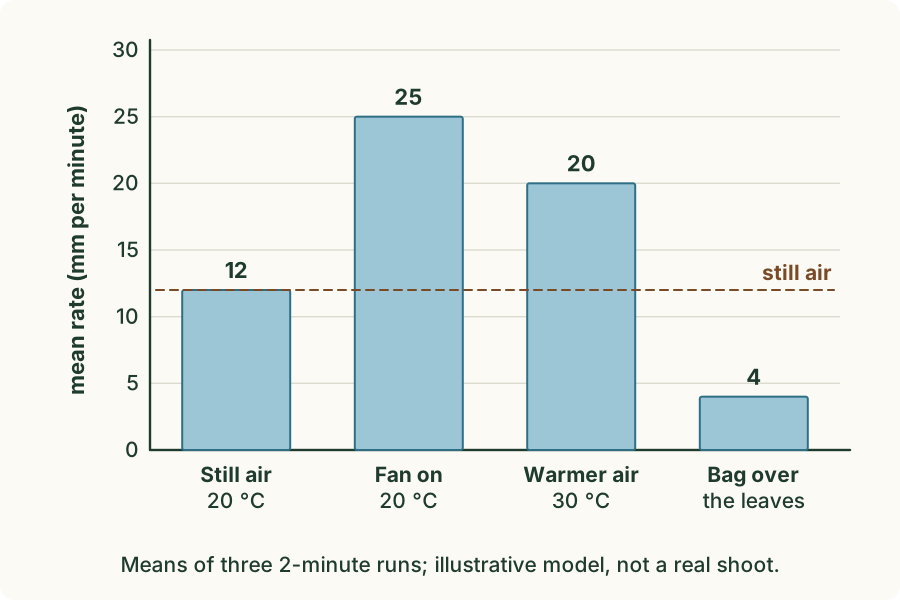
These results come from the experiment's illustrative model of a leafy shoot, not a real one. Each run lasted 2 minutes, and the bubble was pushed back to 250 mm before each run.
| Condition | Run 1 (mm) | Run 2 (mm) | Run 3 (mm) | Mean distance (mm) | Mean rate (mm per minute) |
|---|---|---|---|---|---|
| Still air, 20 °C | 24 | 22 | 26 | 24 | 12 |
| Fan on, 20 °C | 48 | 52 | 50 | 50 | 25 |
| Still air again (check run) | 24 | 24 | 12 | ||
| Warmer air, 30 °C | 38 | 40 | 42 | 40 | 20 |
| Still air again (check run) | 22 | 22 | 11 | ||
| Bag over the leaves, 20 °C | 8 | 10 | 6 | 8 | 4 |
 (enlarge)
What the results show
- Wind speed. With the fan blowing, the rate went up from 12 to 25 mm per minute, about twice as fast: in this test, moving air raised the rate. Tests at several wind speeds show the general pattern: the higher the wind speed, the faster the rate of transpiration.
- Temperature. In warmer air, at 30 °C instead of 20 °C, the rate went up from 12 to 20 mm per minute: warmer air raised the rate. Over a moderate range of temperatures, the higher the temperature, the faster the rate of transpiration.
- The check runs. Back in still air at 20 °C, the rate went back to 12 and then 11 mm per minute, close to the first mean. So the faster rates were caused by the fan and the warmth, not by a change in the shoot.
The runs for each condition are close together, so the means are reliable for this shoot.
Trap: "Hotter is always faster, however hot." This is true over a moderate range, such as 20 °C to 30 °C. In very hot, dry air a plant that is short of water can close its stomata, and then transpiration slows down.
Worked example
Describing a pattern
A pupil seals the pot of a small potted plant in a plastic bag, so that water can leave only through the leaves, and weighs it every hour. The mean loss in mass was 2.0 g per hour in still air, 3.5 g per hour with a fan on its low setting and 5.0 g per hour on its high setting. Describe the effect of wind speed on the rate of transpiration.
Give the trend first, then quote the data: the faster the moving air, the higher the rate of transpiration. The loss in mass rose from 2.0 g per hour in still air to 5.0 g per hour with the fan on high, two and a half times as fast. The same plant was used at every setting and only the speed of the air changed, so the change in rate was caused by the wind speed. The pot is sealed, so the mass lost is water vapour lost from the leaves, not water from the soil.
Supplement: explaining the effects
This section is Supplement content (syllabus 8.3.6). Each explanation is about evaporation inside the leaf or diffusion of water vapour out of it.
Temperature. In warmer air, water molecules have more kinetic energy. Water evaporates faster from the surfaces of the mesophyll cells, and the water vapour diffuses faster out through the stomata. So the rate of transpiration goes up.
Wind speed. In still air, water vapour that has diffused out of the stomata collects just outside the leaf, so the air there becomes humid. Moving air carries this water vapour away. The air outside the stomata stays drier, so the concentration gradient of water vapour between the air spaces and the air outside stays steep, and water vapour diffuses out faster. The higher the wind speed, the faster the rate.
Humidity. Humid air already holds a lot of water vapour. The difference in water vapour concentration between the air spaces inside the leaf and the air outside is small: a shallow concentration gradient. So water vapour diffuses out more slowly, and the rate of transpiration goes down. In dry air the gradient is steep, and the rate is high.
Trap: "The fan cools the leaves, so they lose less water." The fan blows air at room temperature. The rate went up, because moving air carries the water vapour away from the leaf.
Trap: "Humid air pushes water back into the leaf." Nothing is pushed in. Water vapour still diffuses out, only more slowly, because the concentration gradient is shallow.
Worked example
A shut greenhouse
Supplement. On a warm day a gardener shuts the greenhouse. The temperature inside stays the same, but the air becomes still and very humid. Explain why the plants now transpire more slowly than when the vents were open and a breeze blew through.
Work from the leaf outwards. Water still evaporates from the mesophyll cells into the air spaces. But the humid air outside already holds a lot of water vapour, and still air does not carry away the vapour that leaves the stomata, so the concentration gradient of water vapour between the air spaces and the air outside is shallow: water vapour diffuses out more slowly. With the vents open, the breeze carried the vapour away and brought in drier air, so the gradient was steep and the vapour diffused out faster.
Supplement: humid air in a bag
With a clear plastic bag tied over the leaves, the rate fell from 12 to 4 mm per minute. Water vapour from the leaves was trapped in the bag, so the air round the leaves became very humid, and droplets formed on the plastic. The concentration gradient became shallow, so water vapour diffused out of the stomata much more slowly.
This is a demonstration, not a fair test of humidity alone. The bag also stops the air round the leaves from moving, and it may warm them or change the light a little. To test humidity alone, you would need to change only the amount of water vapour in the air, for example in a closed box with a drying agent or a dish of water.
Key idea: Investigate with a potometer: change one condition at a time on the same shoot, let it settle, time three runs, and go back to still air for a check run. The higher the temperature and the higher the wind speed, the faster the rate of transpiration. Supplement: in warmer air water molecules have more kinetic energy, so water evaporates and diffuses faster; moving air carries water vapour away from the leaf, keeping the concentration gradient steep; humid air makes the concentration gradient shallow, so water vapour diffuses out more slowly.