Contents
Part 2 of 3
Teeth
identify
Try it yourself
The drawing shows four human teeth, lettered A to D. Identify the type of each tooth.
identify: name or select.
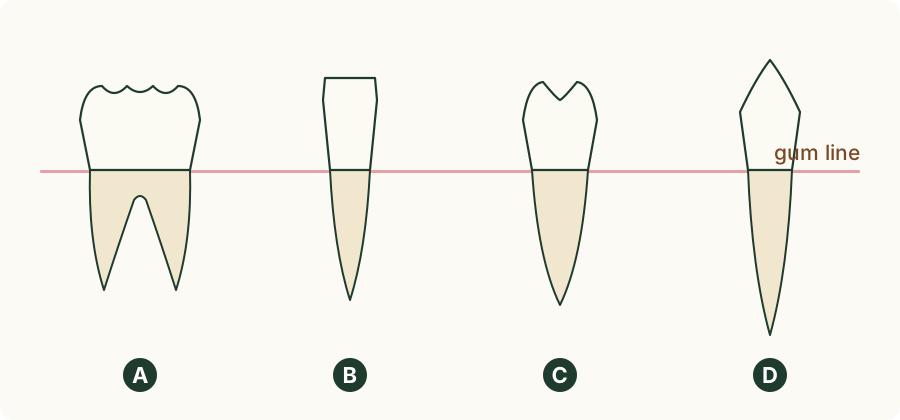 (enlarge)
Your saved work
Answers, earlier attempts and your Pause and check notes stay in this browser. Export a copy to keep, to move to another device or to hand to your teacher. Importing a copy keeps your current answers and adds earlier attempts.
Scope and sources
Cambridge IGCSE Biology 0610 · 2026–2028 v3 · Original learning materials.
The organs of the digestive system and the associated organs (7.2.1) and the five processes of ingestion, digestion, absorption, assimilation and egestion (7.2.2); physical digestion and surface area (7.3.1, 7.3.2) through the egg-white practical; the types, structure and functions of human teeth (7.3.3–7.3.5); the churning stomach (7.3.6) and bile emulsifying fats (Supplement 7.3.7). Named digestive enzymes and their products are in the chemical digestion module, villi and absorption in a later module; tooth decay is not covered. Times in the experiment come from a teaching model.
Apparatus, amounts and times in the experiment are illustrative. Real practical work follows a teacher-approved safety method.
Official Cambridge syllabus