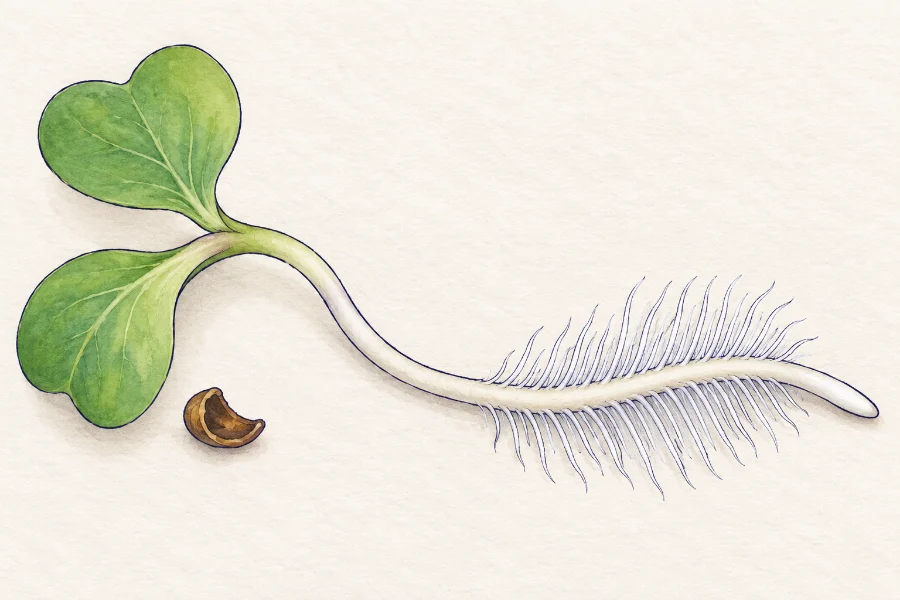
Your celery stalks had no roots: the dye went straight in at the cut end. A whole plant has to take its water from the soil, where it clings in thin films around the soil particles. Radish seeds left to grow on damp paper for a few days show where this happens. Just behind the tip of each young root grows a fuzz of very fine white hairs.
 (enlarge)
Root hair cells
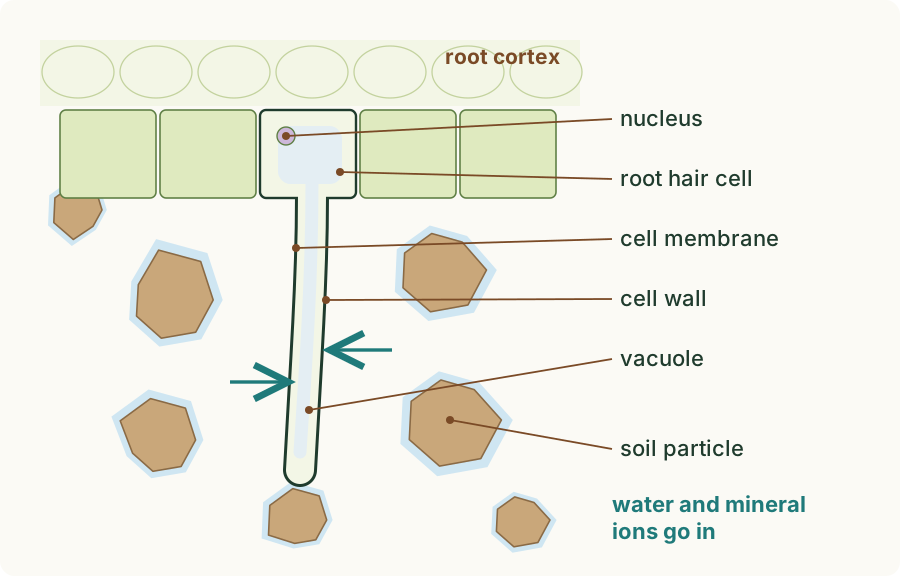
The fine hairs are root hairs. Each one is a long, thin outgrowth of a single cell in the outer layer of the root, the epidermis. The whole cell, with its hair, is a root hair cell. Like other plant cells it has a cell wall, a cell membrane, cytoplasm, a nucleus and a large vacuole, but it has no chloroplasts: it grows underground, in the dark.
 (enlarge)
Root hair cells have two functions: they take in water and they take in mineral ions, such as nitrate and magnesium ions, from the soil. The hair grows out between the soil particles, into the films of water around them.
Water goes in by osmosis: the water in the soil is a more dilute solution than the cell sap (the liquid in the vacuole) inside the root hair cell, so water moves into the cell through its partially permeable cell membrane. The root hair cells also take in mineral ions, which are dissolved in the soil water.
Trap: "Root hairs are tiny roots." Each root hair is part of one cell: a thin outgrowth of a root hair cell. A root is made of many thousands of cells.
Trap: "Root hair cells make food for the root." They have no chloroplasts and get no light. Their functions are to take in water and mineral ions.
A large surface area
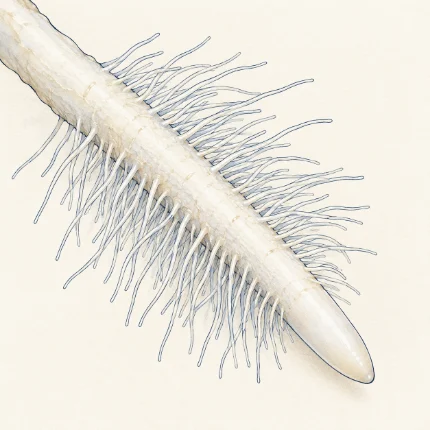
A single root has thousands of root hairs, and a whole plant has millions. Together they give the roots a very large surface area in contact with the soil water. The larger the surface area, the more water and mineral ions the roots can take up in the same time.
 (enlarge)
Gardeners see what happens when the root hairs are lost. A seedling pulled roughly out of the soil leaves most of its root hairs behind, torn off, and after it is planted again it often wilts: it cannot take up water fast enough until new root hairs grow. Seedlings moved with a ball of soil around their roots keep their root hairs, and wilt much less.
Trap: "Root hairs store water for dry days." Each hair is far too thin to store much. Their large surface area is for taking water and mineral ions in.
Worked example
Billions of root hairs
In a famous study, a single rye plant grown for a few months in a box of soil was found to have billions of root hairs. What is a root hair cell, what are its functions, and why does it help the plant to have so many root hairs?
A root hair cell is a cell in the outer layer of the root, the epidermis, with a long, thin outgrowth, the root hair, that grows out between the soil particles; it has no chloroplasts. Its functions are to take in water, by osmosis, and mineral ions from the soil water. Billions of root hairs give the roots a very large surface area in contact with the soil water, so the plant can take up more water and mineral ions in the same time.
The pathway of water
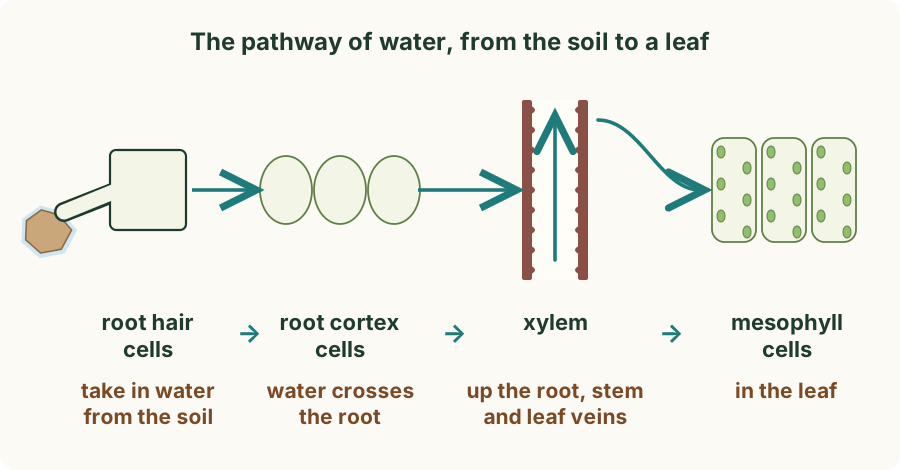
Water goes into a plant through its root hair cells and is carried to the leaves. On its way it passes through four kinds of cell, always in the same order:
- Root hair cells take in water from the soil.
- The water crosses the root cortex cells, the wide band of cells between the epidermis and the middle of the root.
- It enters the xylem in the middle of the root, and is carried up the xylem of the root, the stem and the leaf stalk into the veins of the leaf.
- In the leaf it leaves the xylem and moves into the mesophyll cells.
 (enlarge)
The mesophyll cells use some of the water in photosynthesis. Most of it evaporates from their surfaces into the air spaces of the leaf and diffuses out through the stomata as water vapour. That loss of water from the leaves is transpiration, the next module.
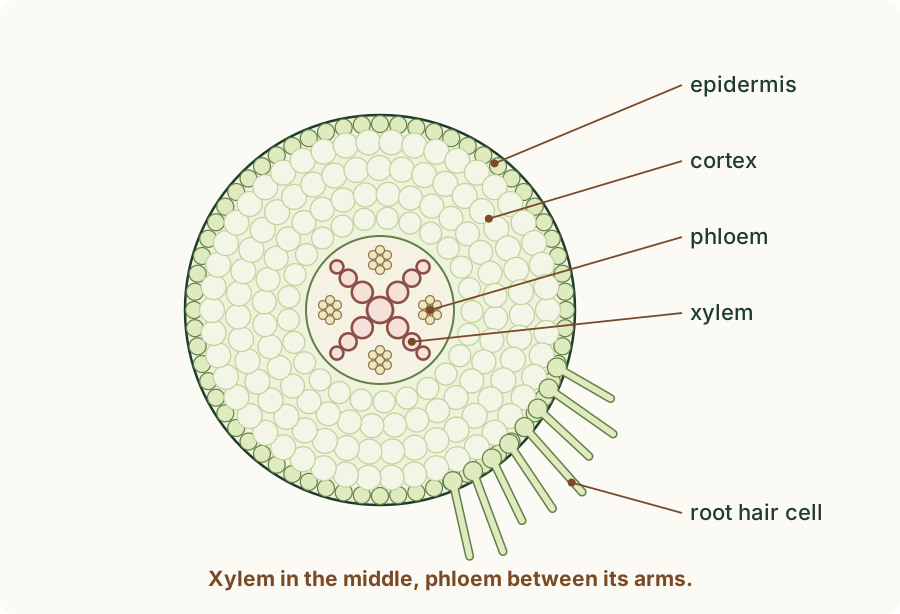
Your celery stalks showed only the above-ground part of the pathway, from the xylem of the stalk to the leaf veins. The root part comes from looking at roots: a section of a root shows the root hair cells, the cortex and the xylem in the middle, in the order the water passes through them.
Trap: "Water goes straight from the soil into the xylem." The xylem is in the middle of the root. Water must first cross the root hair cells and the root cortex cells to reach it.
Trap: "Water goes up the plant in the phloem." Your slices showed the dye going up in the xylem. Phloem carries sucrose and amino acids.
Worked example
Rain on a dandelion
After rain, a dandelion in a lawn takes up water. Outline the pathway this water takes from the soil to a cell in the middle of one of its leaves, naming each kind of cell or tissue in order.
The water passes through four kinds of cell or tissue, always in this order: the root hair cells, which take it in from the soil by osmosis; the root cortex cells, which it crosses to reach the middle of the root; the xylem, which carries it up the root, the stem and the leaf stalk into the veins of the leaf; and the mesophyll cells, which it enters when it leaves the xylem in the leaf. It cannot go straight from the soil into the xylem, and it does not go up in the phloem.
Xylem and phloem in a root and a leaf
In a root of a non-woody dicotyledonous plant, the xylem is in the middle, often shaped like a star or a cross with three to five arms. The phloem is in small groups between the arms of the xylem. Around them is the wide cortex, and on the outside the epidermis with its root hair cells.
 (enlarge)
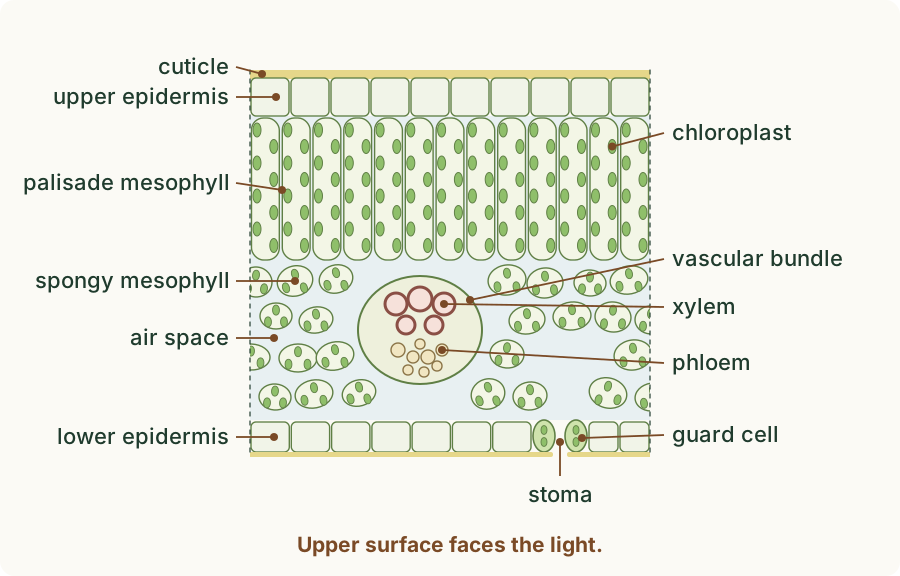
In a leaf, the vascular bundles are the veins. In each one the xylem is towards the upper surface of the leaf and the phloem towards the lower surface.
 (enlarge)
| Section | Where the xylem is | Where the phloem is |
|---|---|---|
| Stem | in a ring of bundles near the outside, on the inner side of each bundle | on the outer side of each bundle |
| Root | in the middle, shaped like a star or cross | in groups between the arms of the xylem |
| Leaf | in each vein, towards the upper surface | in each vein, towards the lower surface |
Trap: "In a root, as in a stem, the bundles form a ring near the outside." In a root the xylem is in the middle, with the phloem between its arms.
Worked example
Two slides of a buttercup
A pupil looks at two prepared slides under a microscope: a thin slice across a buttercup root and a slice across a buttercup leaf, both from a non-woody dicotyledonous plant. Describe where to find the xylem and the phloem in each.
In the root, look in the middle: the xylem is there, shaped like a star or cross of thick-walled cells, and the phloem is in small groups between its arms. It is not in a ring of bundles near the outside, as in a stem; around it are the wide cortex and the epidermis. In the leaf, look at a vein, which is a vascular bundle: the xylem is in the part towards the upper surface of the leaf, and the phloem in the part towards the lower surface.
Key idea: Root hair cells are cells of the root's outer layer with long, thin outgrowths, the root hairs; their functions are to take in water, by osmosis, and mineral ions from the soil. The many root hairs give a large surface area, which increases the uptake of water and mineral ions. Water passes through root hair cells, then root cortex cells, then the xylem, which carries it up through the root, stem and leaf, and then into the mesophyll cells. The xylem is in the middle of a root, on the inner side of the bundles in a ring in a stem, and towards the upper surface in a leaf vein; the phloem is between the arms of the root's xylem, on the outer side of a stem's bundles and towards the lower surface in a leaf vein.