A leaf is where most of a plant's photosynthesis happens, and its shape and its inside are fitted to that job. To photosynthesise fast, a leaf has to do three things at once: catch as much light as it can, let carbon dioxide reach the cells that hold chloroplasts (and let oxygen out), and bring in water and carry away the sugar it makes. In this part you look at a leaf from the outside, then cut through it and find the structures that do each of these jobs.
Broad and thin
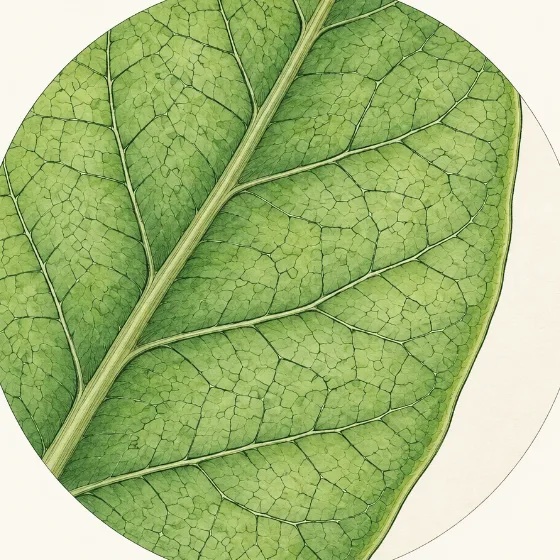
Most leaves have a large surface area and are thin.
A large, flat surface catches more light, just as a large solar panel collects more energy than a small one. It also gives a large surface for carbon dioxide to diffuse in through.
Being thin means that light reaches all the cells with chloroplasts inside the leaf. It also means that carbon dioxide has only a short distance to diffuse from the air to the cells that use it, and oxygen a short distance to diffuse out. A short diffusion distance makes diffusion fast.
 (enlarge)
The veins you can see in a leaf are its vascular bundles. In a broad-leaved plant such as a bean, a dicotyledonous plant, they branch into a net that reaches every part of the blade. They bring water in, carry sugar out, and help to hold the thin blade out flat to the light.
Worked example
Thick leaves or thin
A jade plant, which grows in dry places, has small, thick, fleshy leaves that store water. A bean plant has broad, thin leaves. Use the shape of the leaves to explain which plant's leaves are better built for photosynthesis.
The bean's leaves are. A large surface area catches more light and gives a large surface for carbon dioxide to diffuse in through. Being thin means light reaches all the cells with chloroplasts, and carbon dioxide has only a short diffusion distance from the air to the cells that use it. The jade plant's small leaves catch less light. Its thick leaves stack many cells deep: little light reaches the cells in the middle, and carbon dioxide has further to diffuse to them. Its leaves suit a different job: storing water in a dry place, where a small surface also loses less water.
Inside a leaf
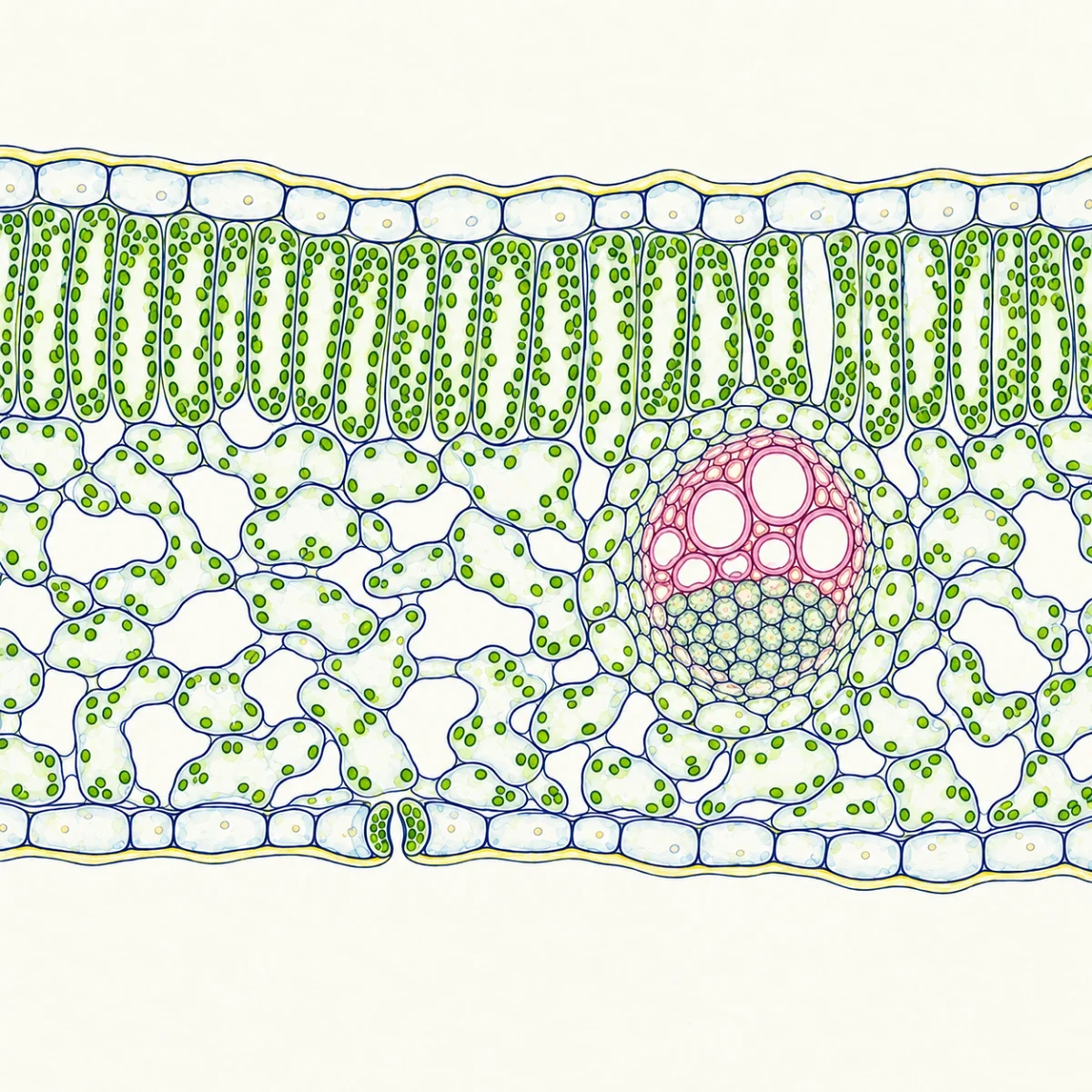
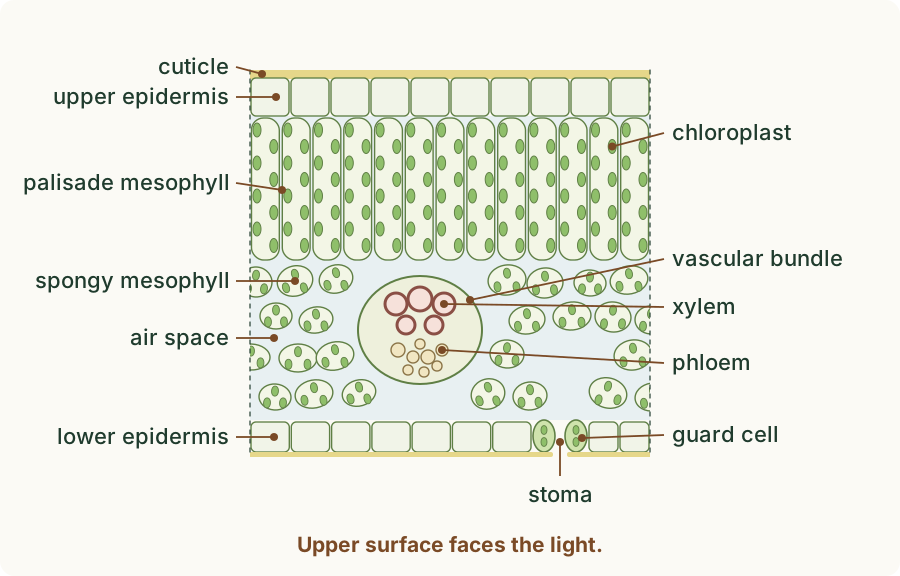
To see inside, a very thin slice is cut across a leaf, a cross-section, and looked at under a microscope. The first picture is a drawn view of what you see down a microscope in a dicotyledonous leaf; the second is a labelled diagram of the same layers. In both, the upper surface is at the top. Find each part in the drawn view first, then check it against the diagram.
 (enlarge)
 (enlarge)
From the top surface down, these are the layers:
- Cuticle: a thin, waxy, waterproof layer on the outside of the epidermis. It is transparent.
- Upper epidermis: a single layer of clear cells, with almost no chloroplasts.
- Palisade mesophyll: tall, narrow cells packed tightly side by side, each with many chloroplasts.
- Spongy mesophyll: rounded, loosely packed cells with fewer chloroplasts, and air spaces between them.
- Lower epidermis: another single layer of clear cells, with a thin cuticle. It has many small pores, the stomata (one is a stoma). Each stoma lies between a pair of guard cells, which have chloroplasts.
- Vascular bundle: a vein, seen cut across. It holds xylem, wide tubes with thick walls (upper side), and phloem, smaller cells (lower side).
Worked example
A peel from the underside
A pupil peels the thin, clear skin from the underside of a leaf and looks at it under a microscope. She sees clear, jigsaw-shaped cells with no chloroplasts and, scattered among them, many pairs of small bean-shaped cells with chloroplasts, each pair around a tiny gap. Identify the layer, the paired cells and the gaps.
The clear, jigsaw-shaped cells are the lower epidermis: a single layer of clear cells with almost no chloroplasts. Each pair of bean-shaped cells is a pair of guard cells, which, unlike the other epidermis cells, have chloroplasts, and the gap between them is a stoma. The many stomata show that this is the lower epidermis, which holds most of them. In a cross-section, the same layer is the bottom row of clear cells, and each stoma is a small gap in it between two guard cells.
How each part helps
| Structure | How it helps the leaf photosynthesise |
|---|---|
| Cuticle | Waxy and waterproof, so it cuts down water loss from the leaf's surface; transparent, so light passes through it. |
| Upper epidermis | Thin and transparent, with almost no chloroplasts, so light passes straight through to the palisade cells below. |
| Palisade mesophyll | Near the upper surface, where the light is brightest. Tall cells packed tightly side by side, with many chloroplasts, absorb as much light as possible. Most photosynthesis happens here. |
| Chloroplasts | Contain chlorophyll, which absorbs light, and are where photosynthesis happens. |
| Spongy mesophyll | Loosely packed cells give a large, moist surface inside the leaf, where carbon dioxide dissolves and diffuses into the cells. |
| Air spaces | Let carbon dioxide diffuse from the stomata to every mesophyll cell, and oxygen diffuse out. |
| Lower epidermis | Thin and clear, with almost no chloroplasts except in its guard cells; it protects the leaf and holds most of the stomata. |
| Stomata | Pores, mostly in the lower epidermis, that let carbon dioxide diffuse into the leaf and oxygen diffuse out. |
| Guard cells | Open the stomata, usually in the light, when photosynthesis needs carbon dioxide. Inside the leaf, water evaporates from the mesophyll cells, and the water vapour diffuses out through open stomata; closing them, usually in the dark, saves water. |
| Xylem | Brings water (and mineral ions) from the roots to the leaf. Water is a raw material of photosynthesis. |
| Phloem | Carries the sugar made in photosynthesis away from the leaf, as sucrose, to the rest of the plant. |
| Vascular bundles | A network of veins that reaches close to every cell, and supports the thin blade so it is held out to the light. |
Trap: "The epidermis is where most photosynthesis happens, because it is on the outside." The epidermis cells have almost no chloroplasts. Their job is to let light through and protect the leaf. The palisade cells, just below, do most of the photosynthesis.
Trap: "Xylem carries sugar." Xylem carries water and mineral ions; phloem carries sugar (sucrose).
Worked example
Darker on top
Most leaves are a darker green on their upper surface than on their lower surface. Use the structure of the leaf to explain why, and how this arrangement helps photosynthesis.
Light falls mostly on the upper surface. The cuticle and the upper epidermis are transparent, with almost no chloroplasts, so light passes straight through to the palisade mesophyll: tall cells packed tightly side by side, each with many chloroplasts. This crowded green layer, just under the top surface, makes the upper side look dark green. It sits where the light is brightest, so it absorbs as much light as possible and does most of the photosynthesis. Below it, the spongy mesophyll has fewer chloroplasts and is loosely packed with air spaces, so the lower side looks paler. Its job is different: the air spaces let carbon dioxide diffuse from the stomata, mostly in the lower epidermis, to every mesophyll cell.
Paths through the leaf
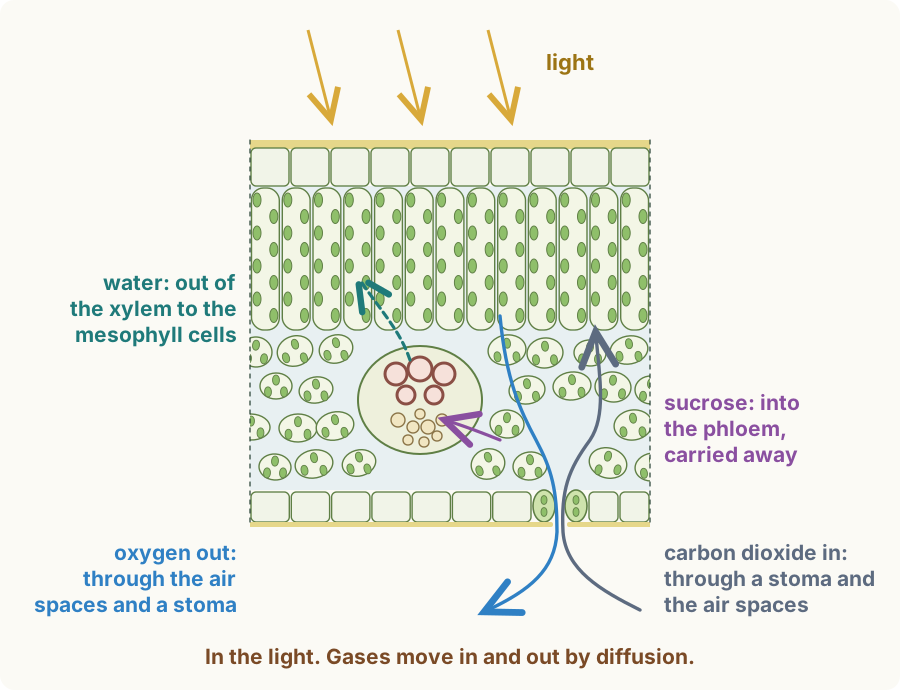
In the light, follow each substance:
- Carbon dioxide diffuses from the air, in through an open stoma, through the air spaces, and into the mesophyll cells, where the chloroplasts use it.
- Oxygen made in the chloroplasts diffuses out of the cells, through the air spaces and out through a stoma.
- Water comes in through the xylem of the vascular bundle and moves into the mesophyll cells.
- Sucrose, made from the glucose, moves into the phloem and is carried away to the rest of the plant.
 (enlarge)
Gases move along these paths by diffusion, from where they are more concentrated to where they are less concentrated. In the light, photosynthesis uses up carbon dioxide inside the leaf, so its concentration there is lower than in the air outside, and carbon dioxide diffuses in. In the dark there is no photosynthesis, only respiration, so the net movement reverses: oxygen diffuses in and carbon dioxide diffuses out, as in the dark tube of indicator.
Trap: "Stomata are for breathing in oxygen." In the light, the main gas a leaf takes in through its stomata is carbon dioxide, for photosynthesis. Stomata let any gas through: which way each one moves depends on where it is more concentrated.
Key idea: Most leaves are broad, with a large surface area to absorb light and take in carbon dioxide, and thin, so that light reaches the cells inside and gases diffuse only a short distance. A transparent waxy cuticle and a thin, clear upper epidermis let light through; the palisade mesophyll, near the top and packed with chloroplasts, absorbs most of it; the spongy mesophyll and its air spaces let carbon dioxide reach the cells and oxygen escape; stomata, opened and closed by guard cells, let these gases in and out; xylem brings water, and phloem carries sucrose away.