A fish tank full of water plants can look healthy all day, yet early in the morning the fish sometimes gulp at the surface. During the day the plants photosynthesise and add oxygen to the water. All night they only respire, like the fish: they use oxygen and give out carbon dioxide. By dawn the water is short of oxygen. A plant takes in and gives out gases all the time, but which way they go depends on the light. In this part you watch that happen with a coloured indicator that shows carbon dioxide.
Two processes, one plant
Every living cell of a plant respires all the time, in light and in dark, to release energy. Respiration uses oxygen and gives out carbon dioxide. Photosynthesis happens only in the light, in cells with chloroplasts. It takes in carbon dioxide and gives out oxygen. So in the light both processes happen at once, and what the plant takes in or gives out is the difference between them, the net gas exchange:
- In bright light, photosynthesis is faster than respiration. The plant takes in more carbon dioxide than it gives out, so overall it takes carbon dioxide in and gives oxygen out.
- In dim light, photosynthesis is slow. It can be about as fast as respiration, so the carbon dioxide taken in roughly balances the carbon dioxide given out, and there is little net exchange.
- In the dark, there is no photosynthesis, only respiration. The plant takes in oxygen and gives out carbon dioxide.
Trap: "Plants photosynthesise in the day and respire at night." Plants respire day and night. In bright light, photosynthesis is simply faster, so it hides the respiration: the carbon dioxide that respiration gives out is used up at once, and more is taken in.
Worked example
A carbon dioxide sensor in a closed box
A leafy shoot, its cut stem in a small tube of water, is sealed in a clear plastic box with a carbon dioxide sensor. With a bright lamp on the box, the reading falls steadily. With the lamp dimmed to a certain level, the reading stays the same. With the lamp off, the reading rises. Explain the three results.
The cells of the shoot respire all the time, giving out carbon dioxide; photosynthesis takes carbon dioxide in, but only in the light. In bright light, photosynthesis is faster than respiration, so the shoot takes in more carbon dioxide than it gives out, and the reading falls: the net exchange is carbon dioxide in and oxygen out. In the dim light, photosynthesis is about as fast as respiration, so the carbon dioxide taken in balances the carbon dioxide given out and the reading stays steady; the shoot has not stopped either process. In the dark there is no photosynthesis, only respiration, so the shoot gives out carbon dioxide and the reading rises.
Hydrogencarbonate indicator
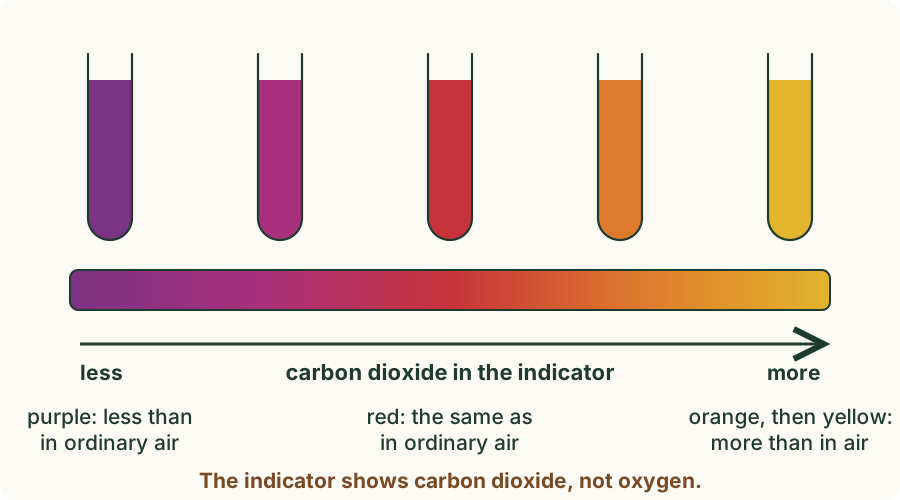
Hydrogencarbonate indicator solution changes colour with the amount of carbon dioxide dissolved in it. Carbon dioxide dissolves in water to make a weak acid, so more carbon dioxide makes the solution more acidic (a lower pH), and less carbon dioxide makes it less acidic (a higher pH). The indicator shows that change in pH:
| Carbon dioxide in the indicator | Colour |
|---|---|
| the same as in ordinary air | red |
| more than in air | orange, then yellow |
| less than in air | magenta, then purple |
The indicator starts red, because it has been left open to ordinary air. Your breath has much more carbon dioxide than air, so do not breathe into the tubes: that alone would turn the indicator yellow.
 (enlarge)
Trap: "Purple means the plant made oxygen." The indicator does not detect oxygen at all. Purple means there is less carbon dioxide than at the start: the plant has taken carbon dioxide out of the solution. You can explain that with photosynthesis, but the colour itself shows only carbon dioxide.
Worked example
Indicator in a stuffy room
Two open tubes of red hydrogencarbonate indicator are left for an hour: tube A on a bench in a crowded, stuffy classroom, tube B by an open window on a breezy day. Tube A turns orange; tube B stays red. What does each colour show?
The colour of the indicator shows the carbon dioxide dissolved in it. Red means the same as in ordinary air: tube B, in fresh air, has not changed. Orange means more carbon dioxide than in air: the many people in the stuffy room have breathed out carbon dioxide from their respiration, so the room's air holds more than ordinary air, and some of it dissolved in the open indicator. With much more carbon dioxide the indicator would turn yellow; with less than in air it would turn magenta, then purple. The indicator shows only carbon dioxide: it says nothing about oxygen.
The four-tube investigation
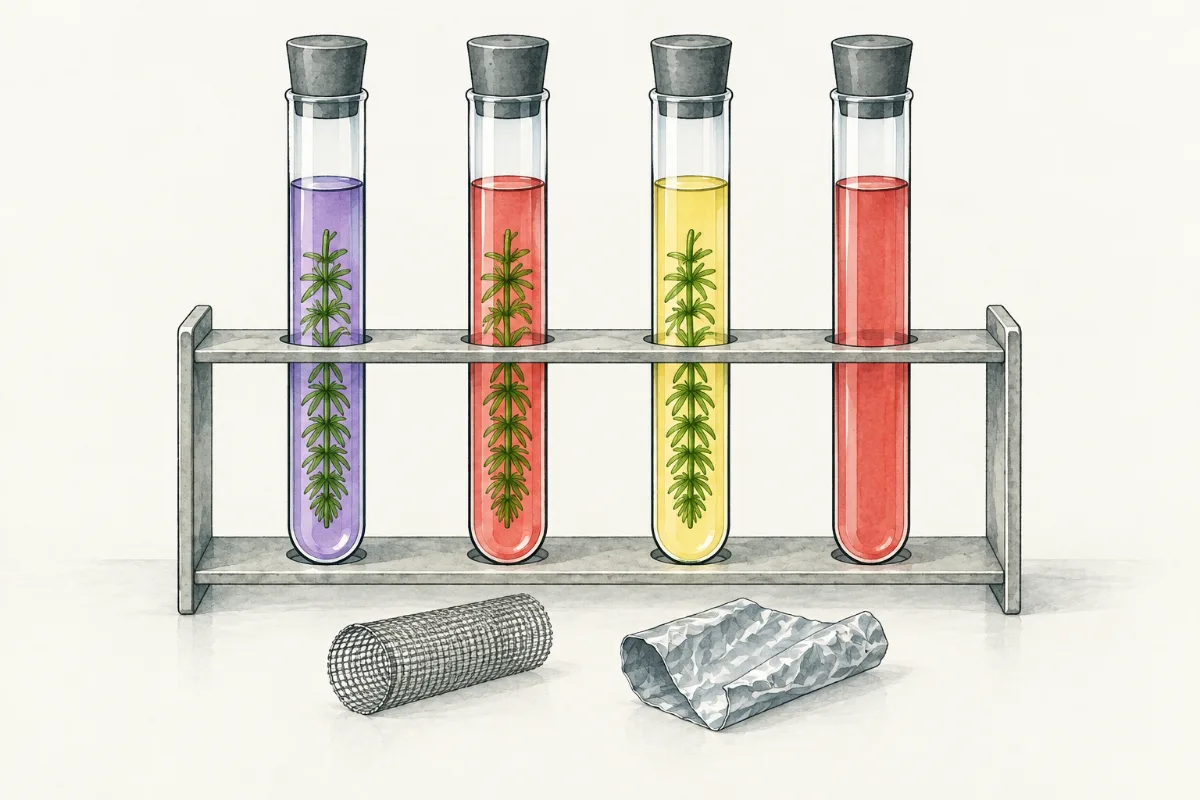
The method:
- Put the same volume of red hydrogencarbonate indicator into four boiling tubes.
- Put a sprig of pondweed of about the same size into tubes 1, 2 and 3. Tube 4 has indicator but no plant.
- Wrap tube 2 in a sleeve of gauze, which lets only dim light through. Wrap tube 3 in aluminium foil, which lets no light through.
- Close all four tubes with rubber bungs. A bung stops gases moving between the indicator and the air, so any change in colour can only come from what happens inside the tube.
- Stand all four tubes the same distance from the same lamp, at the same temperature, for about 4 hours.
- Take off the gauze and the foil, and compare the colours against a white background.
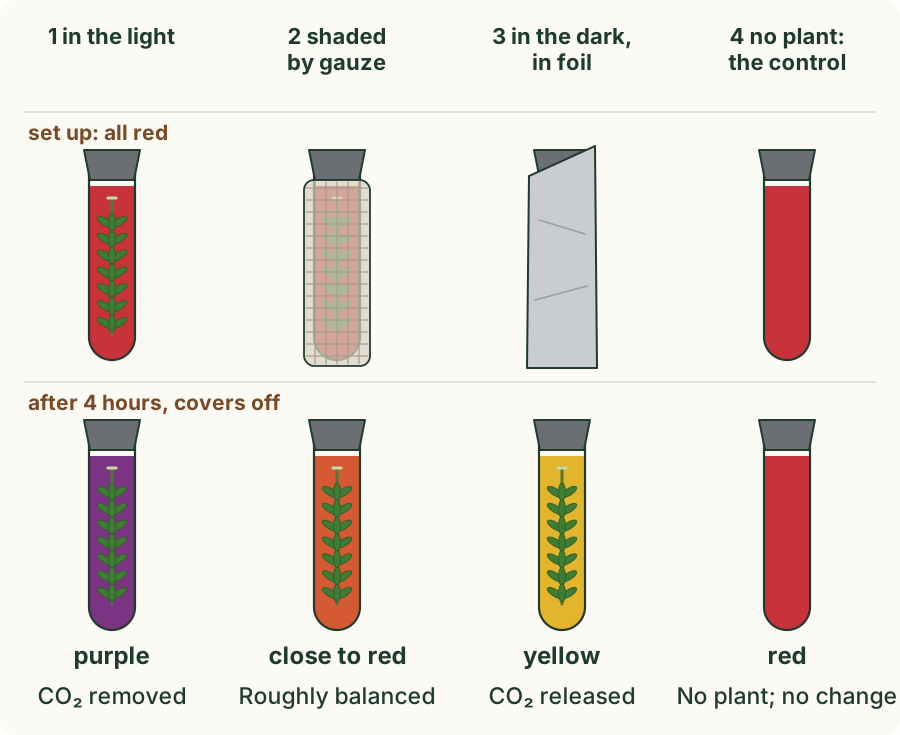
Tube 4 is the control. It is the same as the others in every way, except that it has no plant. If it stays red, the light, the warmth of the lamp, the bung and the time did not change the indicator on their own, so any change in tubes 1 to 3 was caused by the pondweed. That is also why every tube gets the same volume of indicator, and tubes 1 to 3 get about the same amount of pondweed: then the colours can be compared fairly.
 (enlarge)
Reading the colours
| Tube | Conditions | Colour after 4 hours | What happened to the carbon dioxide |
|---|---|---|---|
| 1 | pondweed, in the light | purple | less: photosynthesis took in more carbon dioxide than respiration gave out |
| 2 | pondweed, shaded by gauze | orange-red, close to the start | about the same: photosynthesis and respiration roughly balanced |
| 3 | pondweed, in the dark (foil) | yellow | more: respiration only, giving out carbon dioxide |
| 4 | no plant (the control) | red, as at the start | no change: the indicator does not change on its own |
 (enlarge)
Tube 1 and tube 3 hold the same kind of plant in the same indicator; the only difference is the light. In the light the plant removed carbon dioxide from the water; in the dark it added carbon dioxide. Tube 3 shows that the plant respires. Tube 1 does not show that respiration stopped: it shows that photosynthesis was faster.
The shaded tube is the hardest to predict. Its colour depends on how much light gets through the gauze. With a little more light it would turn slightly purple; with a little less, slightly orange or yellow. In this run it stayed close to red, so photosynthesis and respiration were roughly balanced.
Trap: "Tube 2 stayed red, so the plant in it did nothing." The plant was still respiring and photosynthesising. Two processes that roughly cancel out give little net change in carbon dioxide.
Trap: "The control tube is not needed: we know the indicator is red." Without it you could not rule out that the lamp's warmth, the bung or the time changed the colour. Because tube 4 stayed red, the changes in tubes 1 to 3 must come from the pondweed.
How far the evidence goes
The colours are judged by eye, and two people may not agree about "orange-red" and "red". Holding each tube against a colour chart, or against a row of standard tubes of indicator at known pH values, makes the judgement fairer. A colorimeter, an instrument that measures colour, would turn each colour into a number.
The sprigs were about the same size, not exactly the same. Using the same mass of pondweed in each tube, and setting up each tube more than once, would show whether the result is repeatable.
The indicator shows carbon dioxide only. It cannot tell you directly how much oxygen was made or used; that part comes from what you know about photosynthesis and respiration.
Worked example
Three sprigs and one
A pupil sets up two bunged tubes of red indicator: tube A with three sprigs of pondweed, in the light, and tube B with one sprig, wrapped in foil. After 4 hours tube A is deep purple and tube B is only slightly orange. She concludes that the pondweed changes the carbon dioxide much more in the light than in the dark. What is wrong with her investigation, and how should she put it right?
Two things differ between her tubes, the light and the amount of pondweed, so she cannot tell which one caused the difference, or compare the size of the two changes. Each tube should hold the same volume of indicator and the same mass of pondweed, so that light is the only difference. She also has no control: a bunged tube of indicator with no plant, under the same lamp for the same time. If it stays red, the lamp's warmth, the bung and the time did not change the colour on their own, so any change in the other tubes was caused by the pondweed. Setting up each tube more than once would show whether the result is repeatable.
Key idea: Respiration goes on in a plant all the time; photosynthesis happens only in the light. Hydrogencarbonate indicator is red with the carbon dioxide of ordinary air, turns yellow (through orange) with more carbon dioxide, and purple (through magenta) with less. Pondweed in bright light turns the indicator purple, because photosynthesis takes in more carbon dioxide than respiration gives out. In the dark it turns yellow, because only respiration happens and carbon dioxide is given out. In dim light the two roughly balance and the colour stays close to red. A bunged control tube with no plant stays red.