This part is Core content (syllabus 9.2.5 and 9.2.6).
The heart pumps blood to every organ, but its own muscle needs blood too. It is supplied by the coronary arteries, which branch from the base of the aorta and run over the surface of the heart. Heart muscle contracts all through life, so it respires all the time and needs a steady supply of oxygen and glucose. In this part you find out what happens when a coronary artery is blocked, what makes this more likely, and what diet and exercise can do about it.
Blocked coronary arteries
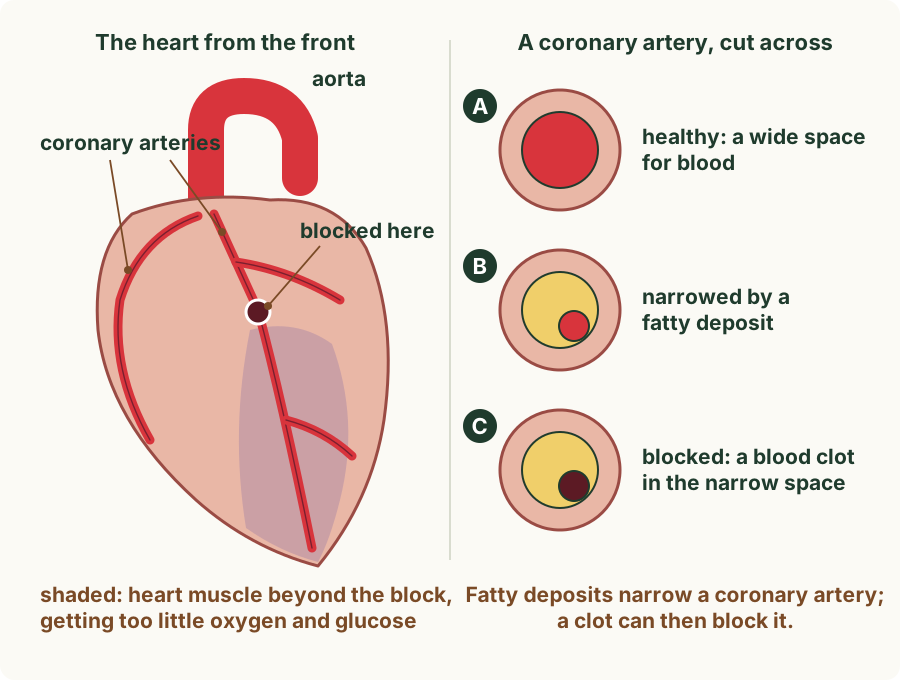
In coronary heart disease (CHD) the coronary arteries become narrowed or blocked:
- fatty deposits, containing cholesterol, build up in the wall of a coronary artery;
- they narrow the space inside the artery, so less blood can flow through it;
- a blood clot can form on the deposit and block the narrow space completely;
- the heart muscle beyond the block gets too little oxygen and glucose, so it cannot respire aerobically and cannot contract;
- that part of the heart muscle may die. This is a heart attack.
 (enlarge)
Trap: "In coronary heart disease the blood inside the heart's chambers cannot reach the muscle." The heart muscle does not take oxygen from the blood in its chambers; it gets its blood from the coronary arteries. CHD is a blockage of these arteries.
Worked example
Why a blockage stops the heart muscle
Explain why a blood clot in a coronary artery can stop part of the heart muscle working.
The clot blocks the artery, so no blood reaches the muscle beyond it. That muscle gets no oxygen or glucose, so it cannot respire aerobically and has no energy to contract. Its cells may die: a heart attack.
Risk factors
A risk factor is something that makes a disease more likely. The possible risk factors for coronary heart disease include:
- diet: a lot of saturated fat raises the cholesterol in the blood, which makes fatty deposits more likely; a lot of salt raises blood pressure;
- lack of exercise: the heart muscle stays weaker, and body mass and blood pressure are more likely to rise;
- stress: it can raise blood pressure;
- smoking: chemicals in tobacco smoke damage the walls of arteries and make blood clots more likely;
- genetic predisposition: CHD can run in families, because of genes that people inherit;
- age: the risk rises as people get older;
- sex: men are more likely than women to develop CHD at a younger age.
Some of these a person can change (diet, exercise, smoking and, partly, stress). Others they cannot change (the genes they inherited, their age and their sex).
Trap: "If you have a risk factor, you will get coronary heart disease." A risk factor only raises the chance. Many people with risk factors never develop CHD, and some people with few risk factors do.
Worked example
Which risk factors can be changed?
Here are four risk factors: smoking, age, a diet high in saturated fat, a parent who had CHD at a young age. Which two could a person change?
Smoking (by stopping) and the diet high in saturated fat (by eating less saturated fat). Age cannot be changed, and a parent with CHD points to an inherited genetic predisposition, which cannot be changed either.
Diet and exercise
Two of the risk factors can be reduced by the way a person lives.
Diet. Eating less saturated fat lowers the cholesterol in the blood, so fatty deposits in the coronary arteries are less likely. Eating less salt helps to keep blood pressure down. Taking in no more energy than the body uses helps to avoid obesity (being very overweight), which raises blood pressure and makes CHD more likely. A diet with plenty of fruit, vegetables and fibre usually has less saturated fat and salt.
Exercise. Regular exercise strengthens the heart muscle (the volunteer's resting heart rate fell from 72 to 64 in part 2), and helps to keep blood pressure and body mass down.
The limits. Diet and exercise reduce the risk, but they do not remove it: genetic predisposition, age and sex stay the same, and CHD has several causes at once. A heart-rate test shows how fit the heart is; it does not show whether the coronary arteries are narrowed.
Worked example
Discussing diet and exercise
Discuss the roles of diet and exercise in reducing the risk of coronary heart disease.
A diet low in saturated fat lowers blood cholesterol, so fewer fatty deposits narrow the coronary arteries; less salt keeps blood pressure lower; matching energy intake to energy use helps to avoid obesity. Regular exercise strengthens the heart muscle, lowers blood pressure and helps to keep a healthy body mass. But both only reduce the risk: other risk factors, such as genetic predisposition, age and sex, cannot be changed, so someone with a good diet who exercises can still develop CHD.
Key idea: Coronary heart disease is the blockage of coronary arteries: fatty deposits narrow them, a clot can block them, and the heart muscle beyond gets too little oxygen and glucose to respire and contract, and may die (a heart attack). Possible risk factors include diet, lack of exercise, stress, smoking, genetic predisposition, age and sex; a risk factor raises the chance, it does not decide. A diet low in saturated fat and salt, energy intake matched to use, and regular exercise reduce the risk but do not remove it.