This part is Core content (syllabus 9.2.4), with a Supplement section (9.2.11).
Everyone has felt their heart pounding after running for a bus. But how high does the heart rate go, how quickly does it rise, and how long does it take to settle again? A step test turns that feeling into numbers. In this part you run one with the volunteer and explain what the numbers show.
The step test
In a step test the volunteer first sits still until the heart rate is steady, and the resting heart rate is measured. Then the volunteer steps up onto a low step and down again, at a fixed rate in time with a beat, for three minutes. As soon as the stepping stops, the pulse is counted, and again at the start of every minute after that until it is back to the resting rate. The time from stopping until the heart rate is back to resting is the recovery time.
Here is the plan of this investigation:
- what changes: the activity (sitting, then stepping, then sitting again), and the time;
- what is measured: the heart rate, in beats per minute;
- what stays the same: the same volunteer, the same step height, the same stepping rate and the same three minutes, and the same way of counting each time.
Decide, then step
In the experiment below the volunteer wears a heart-rate sensor, a strap around the chest that measures the rate while they step. After the stepping you count the pulse by hand, and you choose how long the first count lasts.
Decide first: how long will you count the pulse straight after the stepping stops: 15 seconds, 30 seconds or a whole minute? Make your choice in the experiment, then run the step test.
What the graph showed
 (enlarge)
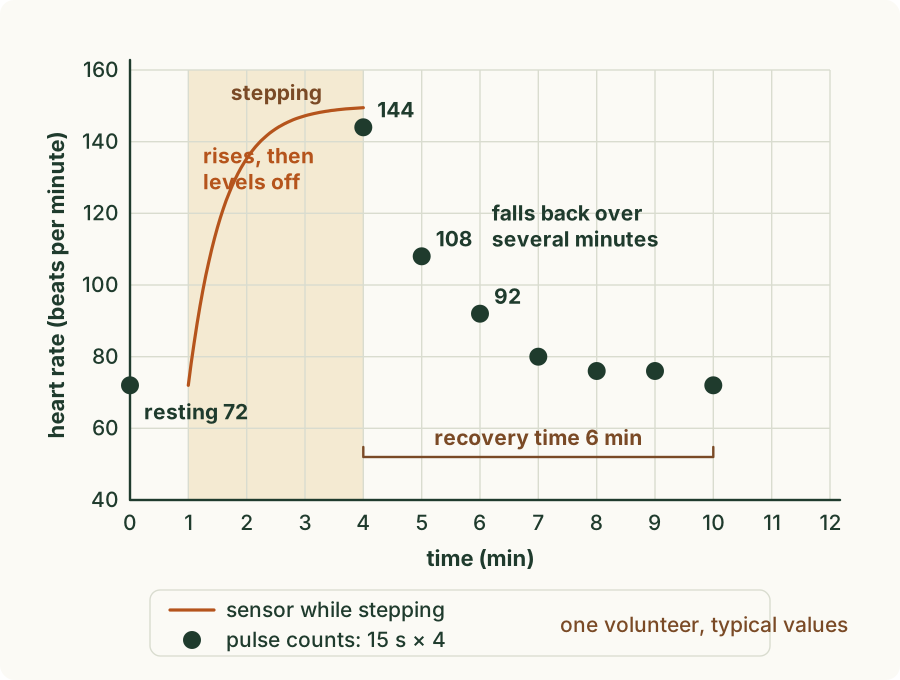
- During the stepping the heart rate rises quickly, then levels off (stops rising and stays at about the same height).
- When the stepping stops the heart rate falls, quickly at first, then more slowly.
- After a few minutes it is back at the resting rate. For this volunteer the recovery time was 6 minutes.
Worked example
Reading the graph
Use the step-test graph. By how much did the heart rate rise, and what was the recovery time?
At rest the rate was 72 beats per minute; the first count after stopping was 144 beats per minute. The rise was 144 − 72 = 72 beats per minute: the rate doubled. The stepping stopped at 4 min and the count was back to 72 at 10 min, so the recovery time was 10 − 4 = 6 minutes.
How long to count
The heart rate falls quickly once the activity stops. A count that lasts a whole minute, started straight away, adds up beats from a falling rate, so it gives a lower number than the rate at the moment of stopping. A short count, such as 15 seconds × 4, is closer to the highest rate. But in a short count a mistake of one beat becomes a mistake of 4 beats per minute, so short counts are repeated or checked against a sensor. A heart-rate sensor gives a reading every few seconds, even while the volunteer moves.
Trap: "A heart rate in beats per minute has to be counted for a whole minute." Beats per minute is a unit, not a counting time. Straight after exercise a 15 s count × 4 is better, because the rate is falling all through a one-minute count.
Worked example
15 seconds or one minute?
Straight after the stepping, one group counts 36 beats in 15 seconds; another counts 129 beats in the first whole minute. Explain the difference.
The 15 s count gives 36 × 4 = 144 beats per minute, the rate just after stopping. The one-minute count gives 129, lower, because the heart rate was falling during the minute, so it is an average of a high rate at the start and a lower rate at the end.
Why the heart beats faster (Supplement)
 (enlarge)
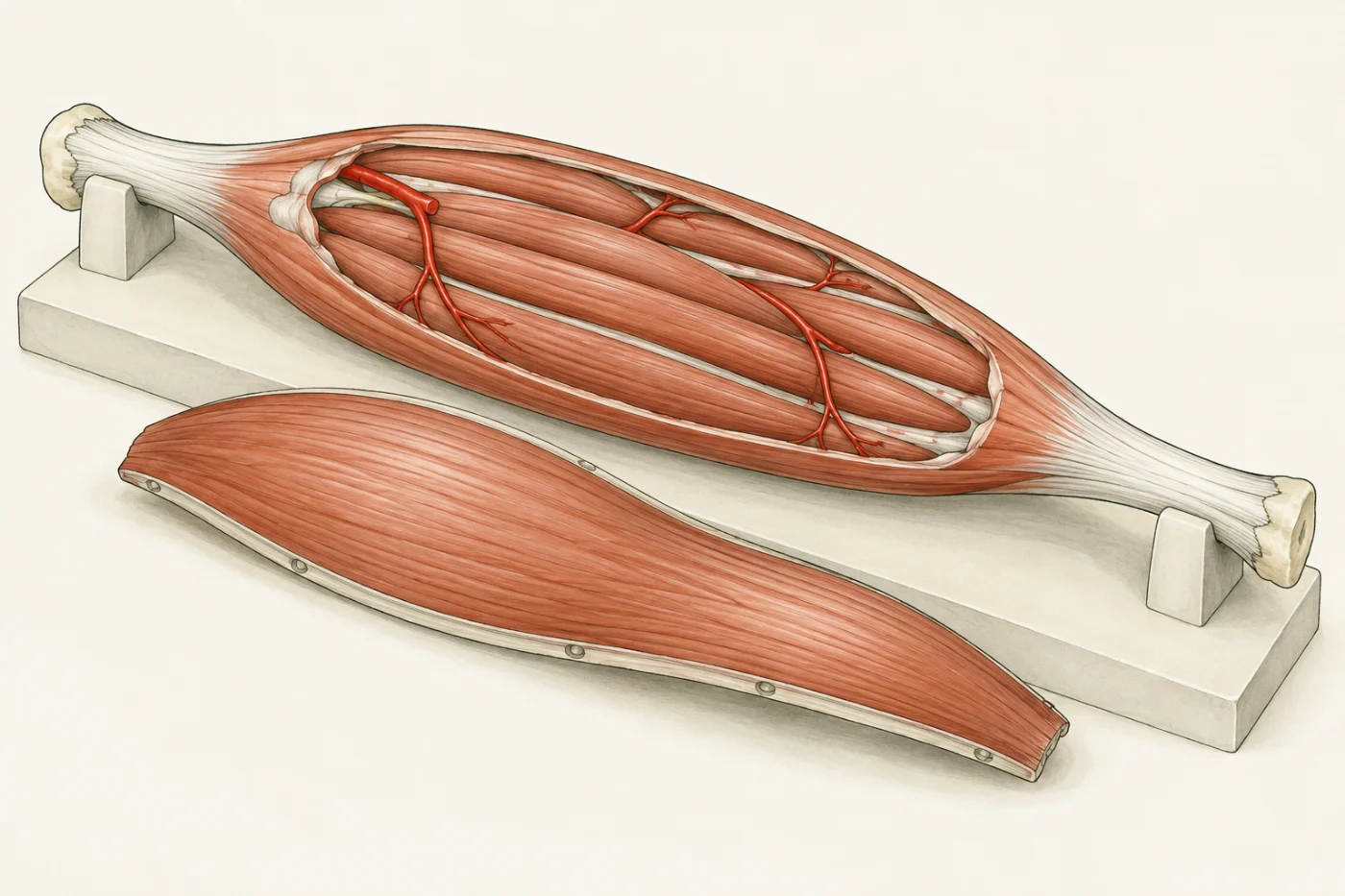
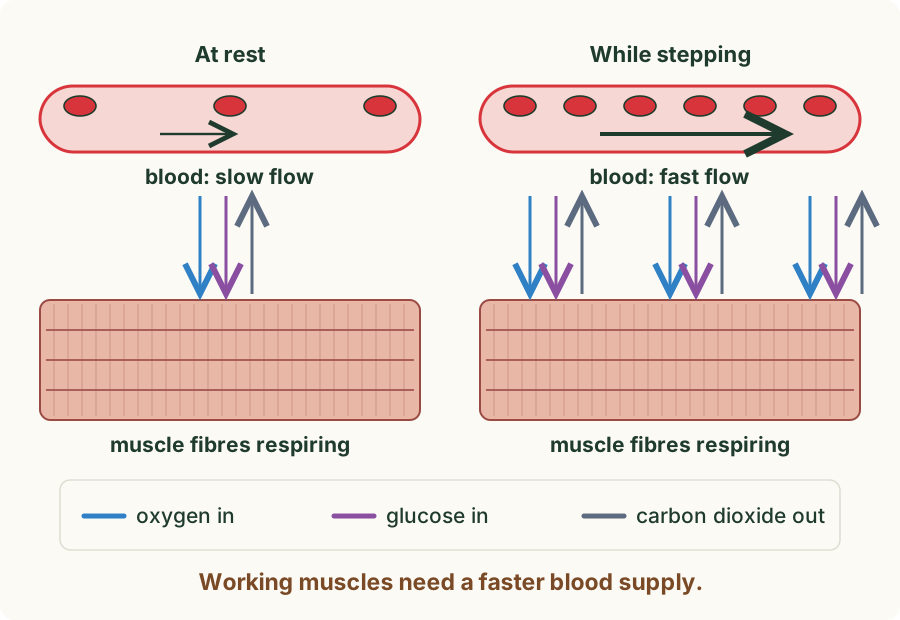
Muscles are made of fibres that need energy to contract. They get it from aerobic respiration, which uses oxygen and glucose and makes carbon dioxide. Blood brings the oxygen and glucose and takes the carbon dioxide away.
 (enlarge)
During physical activity:
- the muscles contract more often and more strongly, so they need more energy;
- their cells carry out more aerobic respiration;
- so they need more oxygen and glucose, and they make more carbon dioxide;
- the heart beats faster (and more strongly), so more blood flows to the muscles each minute, bringing oxygen and glucose faster and removing carbon dioxide faster.
After the activity stops, the heart rate stays raised for a while, because the blood is still carrying away what the muscles made. When the muscles worked too hard to get all their oxygen in time, they also made lactic acid by anaerobic respiration. The fast heart rate carries the lactic acid in the blood to the liver, where it is broken down by aerobic respiration, which needs oxygen. This removes the oxygen debt that you meet in the respiration module. The extra carbon dioxide is carried to the lungs and breathed out.
Worked example
Explaining the rise (Supplement)
Explain why the volunteer's heart rate rose during the step test.
The leg muscles contracted more, so they needed more energy. Their cells carried out more aerobic respiration, which needed more oxygen and glucose and produced more carbon dioxide. The heart beat faster to pump more blood per minute to the muscles, delivering oxygen and glucose and removing carbon dioxide more quickly.
After eight weeks of regular exercise
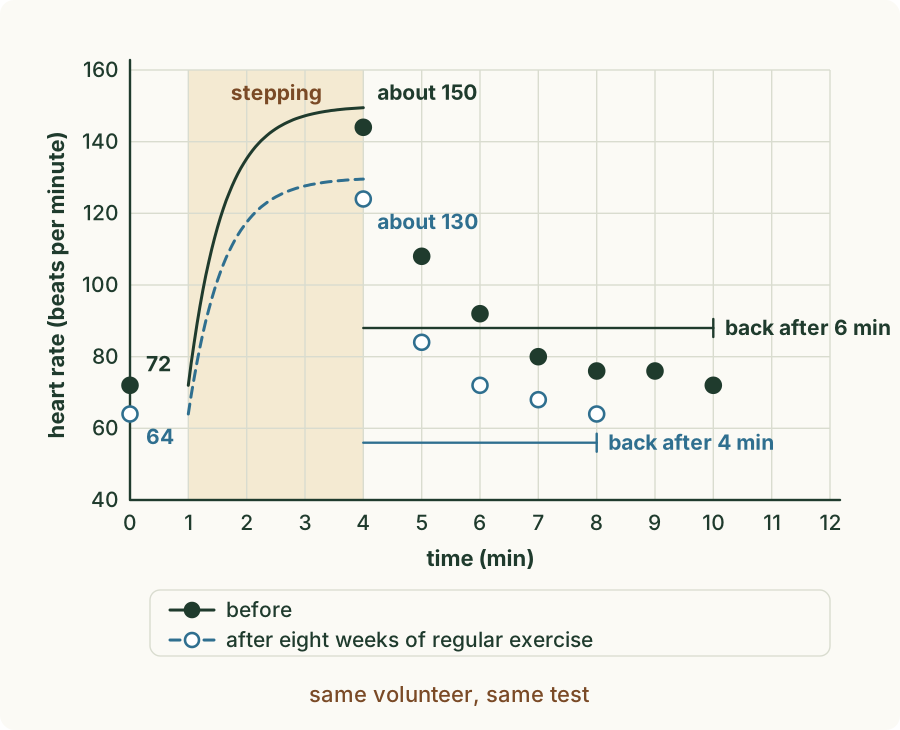
The same volunteer did the same step test again after eight weeks of regular exercise.
 (enlarge)
Worked example
Before and after
Use the graph to describe three differences in the second test, and suggest a reason for the lower resting rate.
The resting rate fell from 72 to 64 beats per minute; the rate at the end of the stepping was about 130 instead of 150; and the rate was back to resting after 4 minutes instead of 6. Regular exercise makes the heart muscle stronger, so it pumps more blood with each beat; fewer beats per minute then give the body the same blood flow at rest.
Key idea: During physical activity the heart rate rises, then levels off; afterwards it falls back to the resting rate over several minutes (the recovery time). Fair tests keep the person, the activity and the counting method the same; a 15 s count × 4 straight after stopping catches the high rate that a one-minute count averages away. (Supplement) Contracting muscles carry out more aerobic respiration, so they need more oxygen and glucose and make more carbon dioxide; the heart beats faster to pump more blood to them each minute, and stays raised afterwards to carry lactic acid to the liver (removing the oxygen debt) and the extra carbon dioxide to the lungs.