Contents
Part 2 of 3
Lungs and gas exchange
identify
Try it yourself
The diagram shows the breathing system. Match each letter to the part.
identify: name or select.
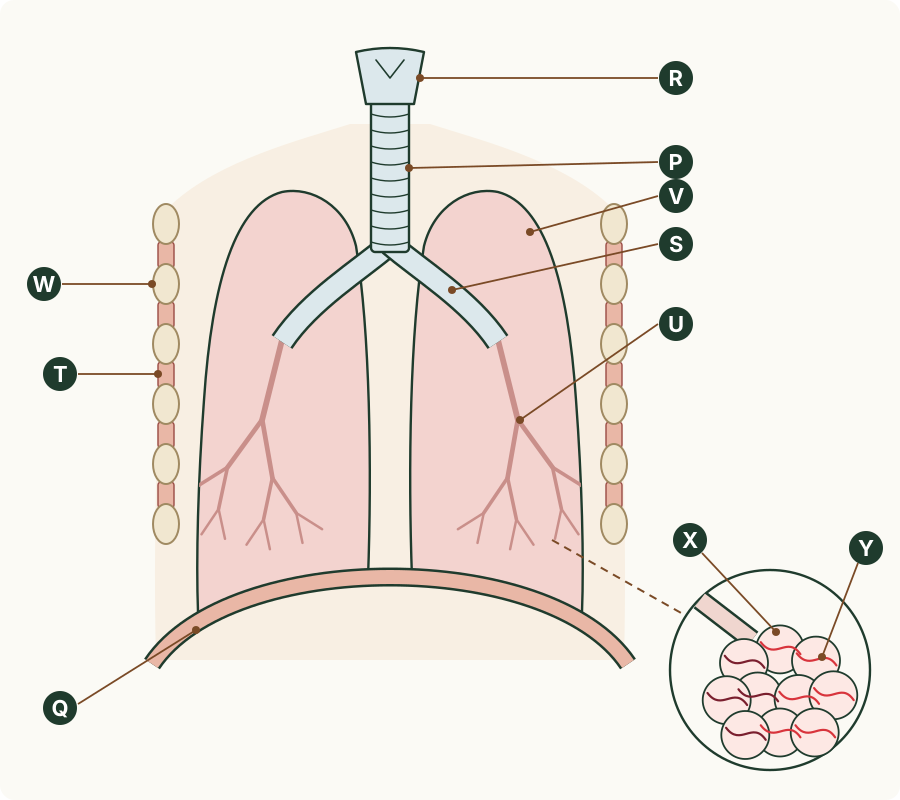 (enlarge)
Your saved work
Answers, earlier attempts and your Pause and check notes stay in this browser. Export a copy to keep, to move to another device or to hand to your teacher. Importing a copy keeps your current answers and adds earlier attempts.
Scope and sources
Cambridge IGCSE Biology 0610 · 2026–2028 v3 · Original learning materials.
Gas exchange in humans (11.1.1–11.1.5): the features of gas exchange surfaces, the parts of the breathing system and their capillaries, investigating inspired and expired air with limewater, the differences in their composition, and the effect of physical activity on the rate and depth of breathing; for the Supplement (11.1.6–11.1.11), the internal and external intercostal muscles, the cartilage of the trachea, how the ribs, intercostal muscles and diaphragm ventilate the lungs, why the two airs differ, how a rise in carbon dioxide in the blood speeds up breathing, and how goblet cells, mucus and cilia protect the breathing system. Respiration in cells and the oxygen debt are in “Respiration”; lung volumes other than the volume of one breath, and smoking, are not covered. The results in the experiment come from a teaching model.
Apparatus, amounts and times in the experiment are illustrative. Real practical work follows a teacher-approved safety method.
Official Cambridge syllabus