Contents
Independent final check
Explain without the key
state / give
Final check
(a) State the four components of blood. (b) The drawing shows part of a stained blood smear, as you would see it in a photomicrograph. Give the letter of a red blood cell and the letter of a white blood cell, and one feature of each that you used.
state: give a concise answer. give: produce an answer from the information or from memory.
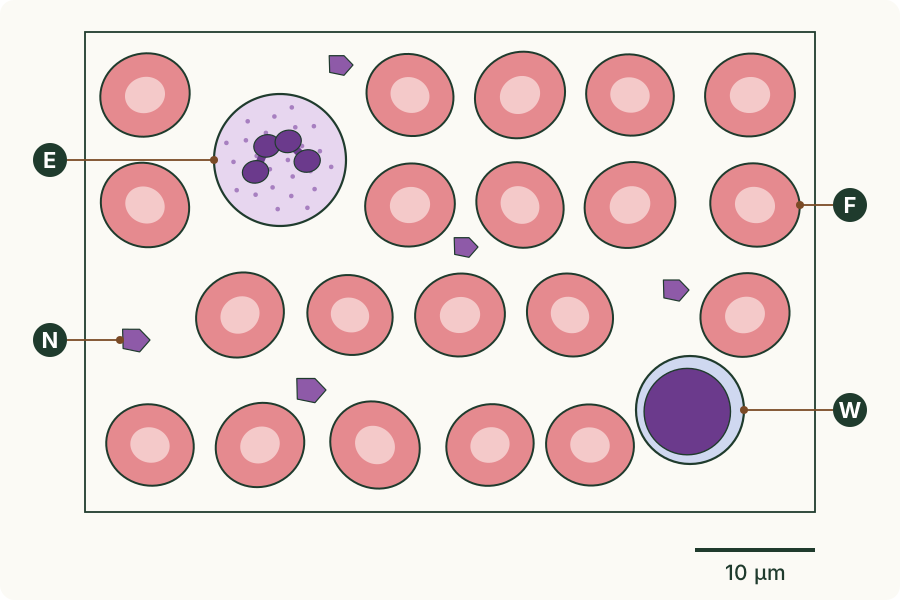 (enlarge)
Your saved work
Answers, earlier attempts and your Pause and check notes stay in this browser. Export a copy to keep, to move to another device or to hand to your teacher. Importing a copy keeps your current answers and adds earlier attempts.
Scope and sources
Cambridge IGCSE Biology 0610 · 2026–2028 v3 · Original learning materials.
Blood (9.4.1–9.4.7): the components of blood (red blood cells, white blood cells, platelets and plasma), red and white blood cells in photomicrographs and diagrams, the functions of red cells (oxygen and haemoglobin), white cells (phagocytosis and antibody production), platelets (clotting) and plasma (what it carries), and the roles of clotting; for the Supplement, lymphocytes and phagocytes told apart and their functions, and clotting as fibrinogen turned into a mesh of fibrin. The vessels are in “Blood vessels”, the heart in “The heart and double circulation” and antibodies and immunity in “Immunity and vaccination”; blood groups are not covered.
Apparatus, amounts and times in the experiment are illustrative. Real practical work follows a teacher-approved safety method.
Official Cambridge syllabus