In the first part you found the four components of blood: red cells, white cells, platelets and plasma. Each has its own job. In this part you follow a red cell from the lungs to a tissue, watch two kinds of white cell meet bacteria, and find out what the plasma carries.
Red blood cells carry oxygen
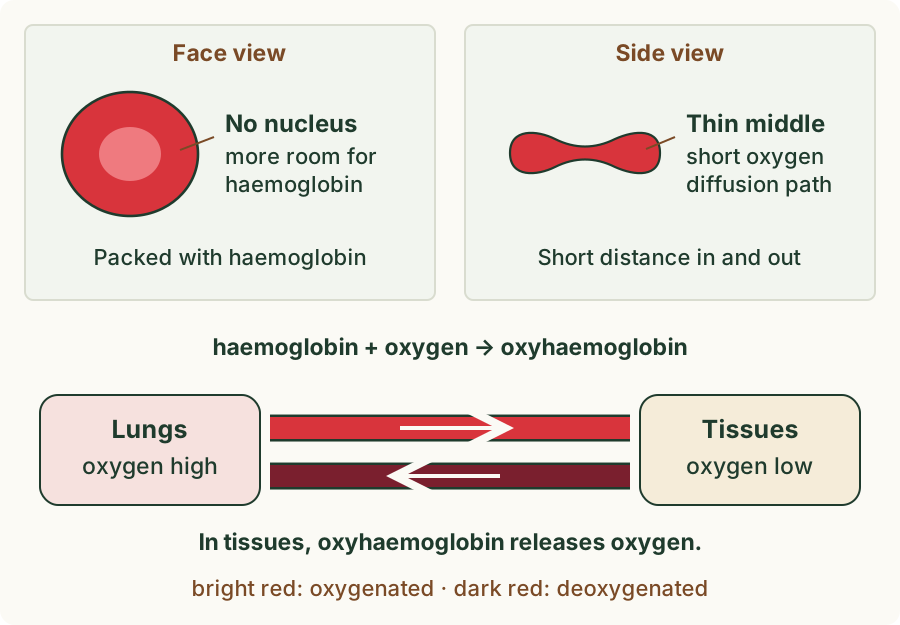
A red blood cell is packed with haemoglobin, a red protein. In the lungs, where there is a lot of oxygen, haemoglobin combines with oxygen to form oxyhaemoglobin. The blood carries it round the body. In a tissue, where the cells use oxygen in respiration and there is little of it, oxyhaemoglobin gives up its oxygen, and the oxygen passes into the cells.
 (enlarge)
Two features help a red cell carry a lot of oxygen. It has no nucleus, which leaves more room for haemoglobin. And it is a disc that is thinner in the middle, so no part of the cell is far from its surface: oxygen has only a short way to go in and out.
Blood with a lot of oxyhaemoglobin is bright red; blood that has given up much of its oxygen is dark red. It is never blue.
Trap: "Red cells are filled with oxygen." The oxygen is not a gas inside the cell. It is carried combined with haemoglobin, as oxyhaemoglobin, and released where oxygen is low.
Run the next part of the experiment below before you read on: follow one red cell from the lungs to a tissue, then watch what the white cells do when bacteria get into the blood.
White blood cells defend the body
A pathogen is a microorganism that causes disease, such as some bacteria and viruses. White blood cells defend the body against pathogens in two ways.
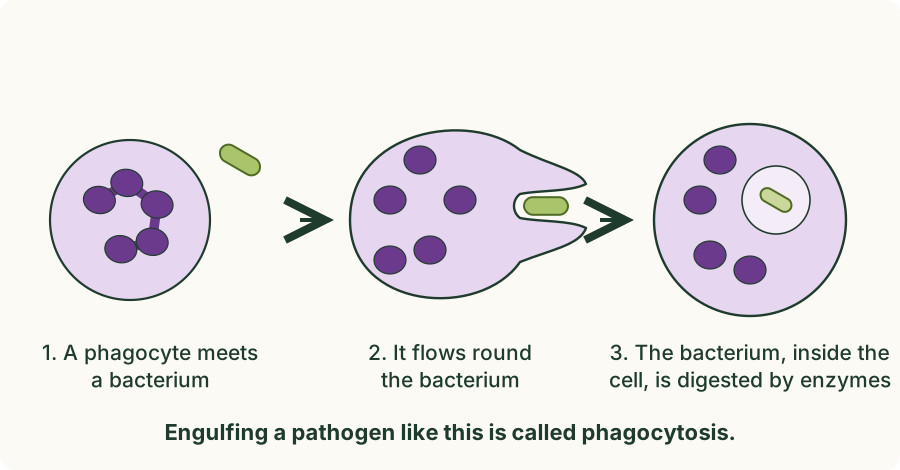
- Phagocytosis: some white cells flow round a pathogen and take it into the cell, where enzymes digest it. This is called engulfing the pathogen.
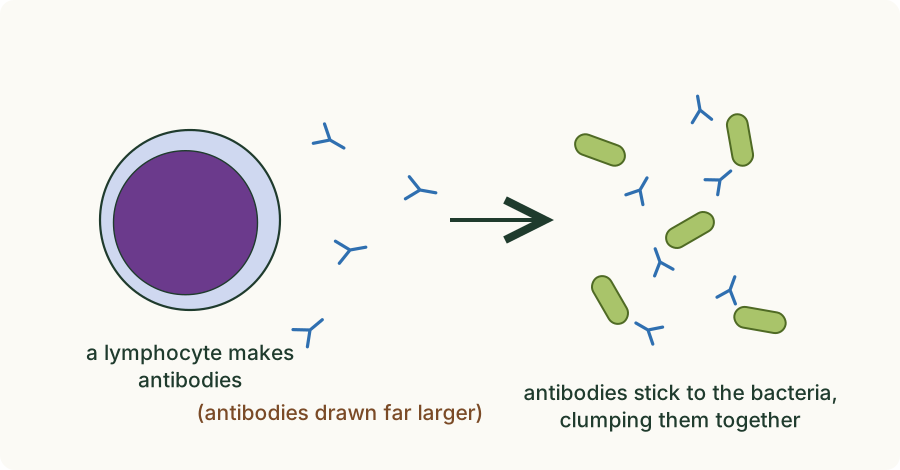
- Antibody production: some white cells make antibodies, proteins that stick to pathogens. Antibodies can clump pathogens together and mark them, so that they are easier to destroy.
 (enlarge)
(Supplement) The two jobs are done by the two kinds of white cell you met in the smear. Phagocytes engulf pathogens by phagocytosis. Lymphocytes produce antibodies.
 (enlarge)
Trap: "Lymphocytes engulf bacteria." Lymphocytes make antibodies; it is phagocytes that engulf. And antibodies do not "eat" bacteria: they are proteins, not cells.
Platelets
Platelets are fragments of cells. They help blood to clot at a cut, so that the bleeding stops. You will see what a clot is in the third part.
Plasma carries substances
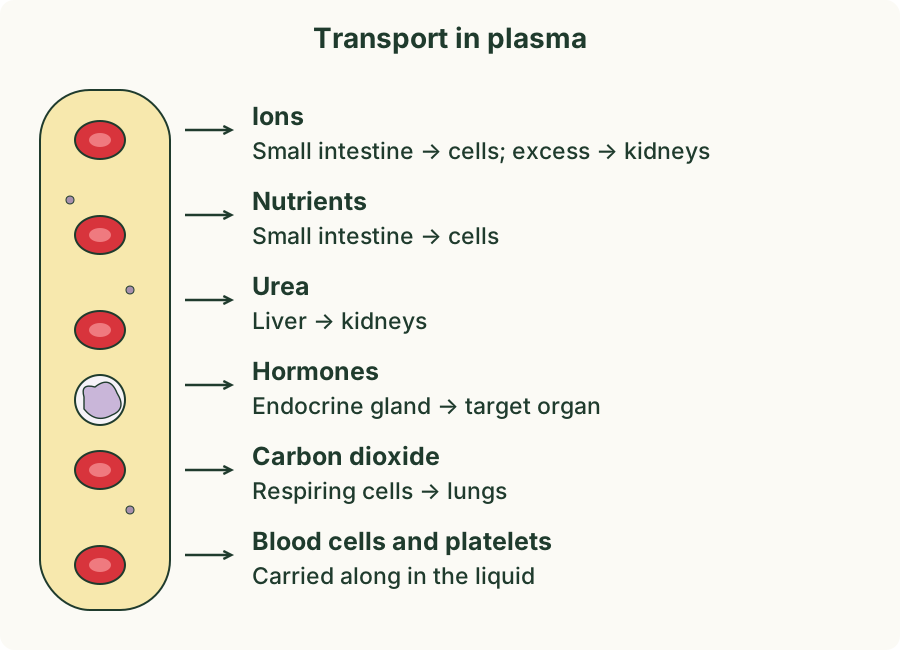
Plasma is the liquid part of blood. It carries the blood cells and platelets along, and many substances dissolved in it, from where they enter the blood to where they leave it.
 (enlarge)
| substance | carried from | carried to |
|---|---|---|
| ions, such as sodium and chloride | the small intestine, where they are absorbed | all the cells; extra ions to the kidneys |
| nutrients, such as glucose and amino acids | the small intestine | the cells, which use them |
| urea, a waste | the liver, where it is made | the kidneys, which remove it in urine |
| hormones, such as insulin | the gland that makes them | their target organs, the organs they act on (insulin acts on the liver, for example) |
| carbon dioxide | respiring cells | the lungs, where it is breathed out |
Most carbon dioxide is carried in the plasma, not by the red cells. Red cells carry the oxygen.
The ions in plasma also keep the blood at the right concentration. A red cell keeps its disc shape only in a solution as concentrated as plasma: in pure water it swells and bursts, in strong salt solution it shrinks.
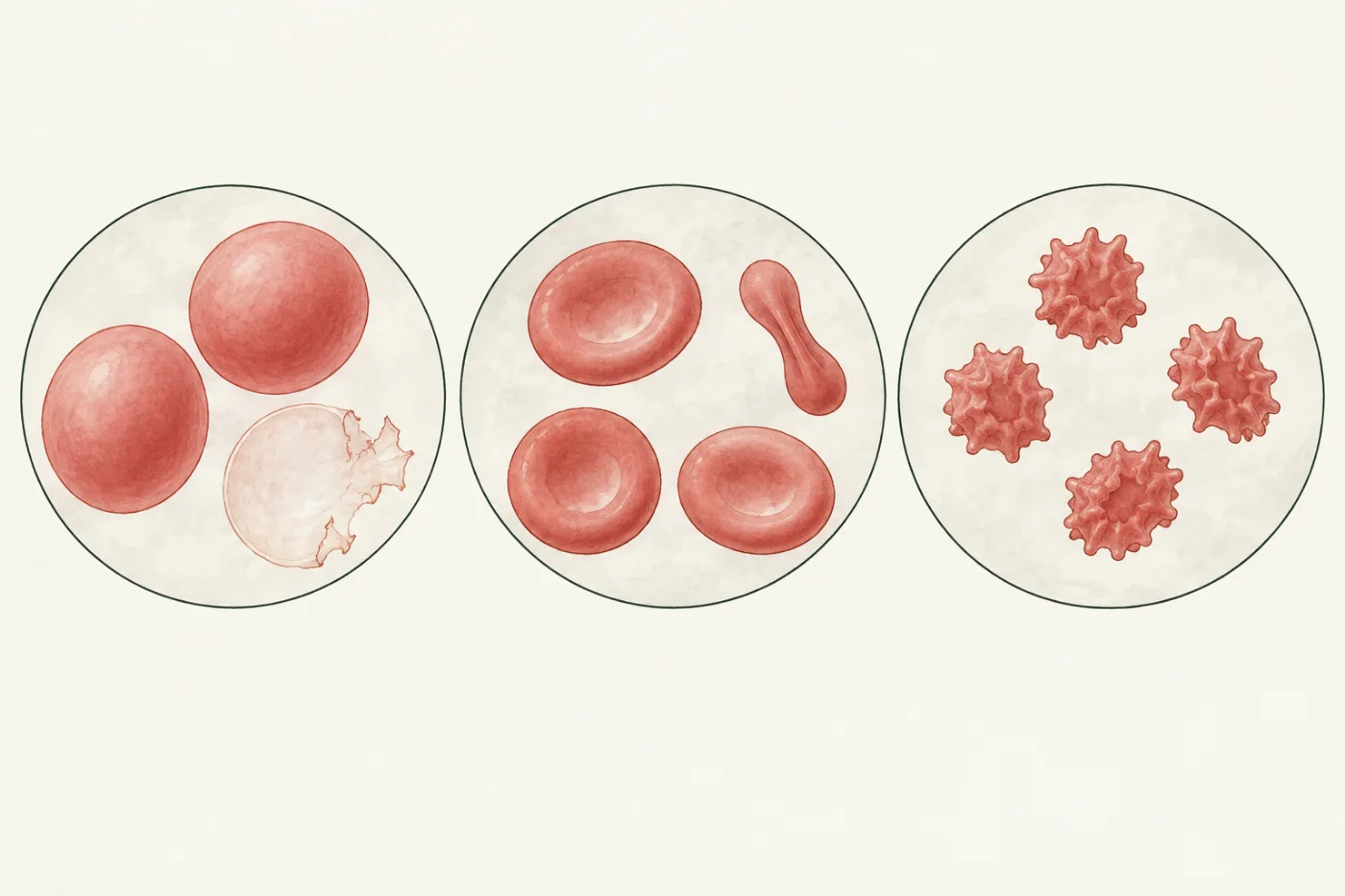 (enlarge)
Worked example
Built to carry oxygen
Explain how two features of a red blood cell help it carry oxygen.
A red cell is packed with haemoglobin, which combines with oxygen in the lungs to form oxyhaemoglobin and gives it up in the tissues. It has no nucleus, so there is more room inside it for haemoglobin, and so more oxygen can be carried. (Its thin middle also means oxygen has only a short way to go into and out of the cell.)
Worked example
From where to where
A person eats a meal rich in starch. Name the substance the plasma carries away from the small intestine after starch has been digested, and say where it is taken. Then name a waste the plasma carries, and where it is taken.
Starch is digested to glucose, which is absorbed in the small intestine and carried in the plasma to the cells all over the body, which use it in respiration. A waste carried in the plasma is urea, made in the liver and carried to the kidneys, which remove it in urine. (Carbon dioxide, carried from respiring cells to the lungs, is also a correct answer.)
Worked example
A phagocyte at work
(Supplement) Bacteria enter a cut in the skin. Describe what a phagocyte does to them.
The phagocyte moves to the bacteria and flows round one of them, taking it into the cell. Inside the phagocyte, the bacterium is digested by enzymes. This is phagocytosis, and one phagocyte can engulf many bacteria in turn.
Worked example
Antibodies
(Supplement) Which white blood cells produce antibodies, and how do antibodies help to protect the body?
Lymphocytes produce antibodies. Antibodies are proteins that stick to pathogens such as bacteria. This clumps the pathogens together and marks them, so phagocytes can engulf and destroy them more easily.
Key idea: Red blood cells transport oxygen: their haemoglobin combines with oxygen in the lungs and gives it up in the tissues. White blood cells defend the body by phagocytosis and by producing antibodies. Platelets help blood to clot. Plasma transports blood cells, ions, nutrients, urea, hormones and carbon dioxide. (Supplement) Phagocytes engulf pathogens by phagocytosis; lymphocytes produce antibodies.