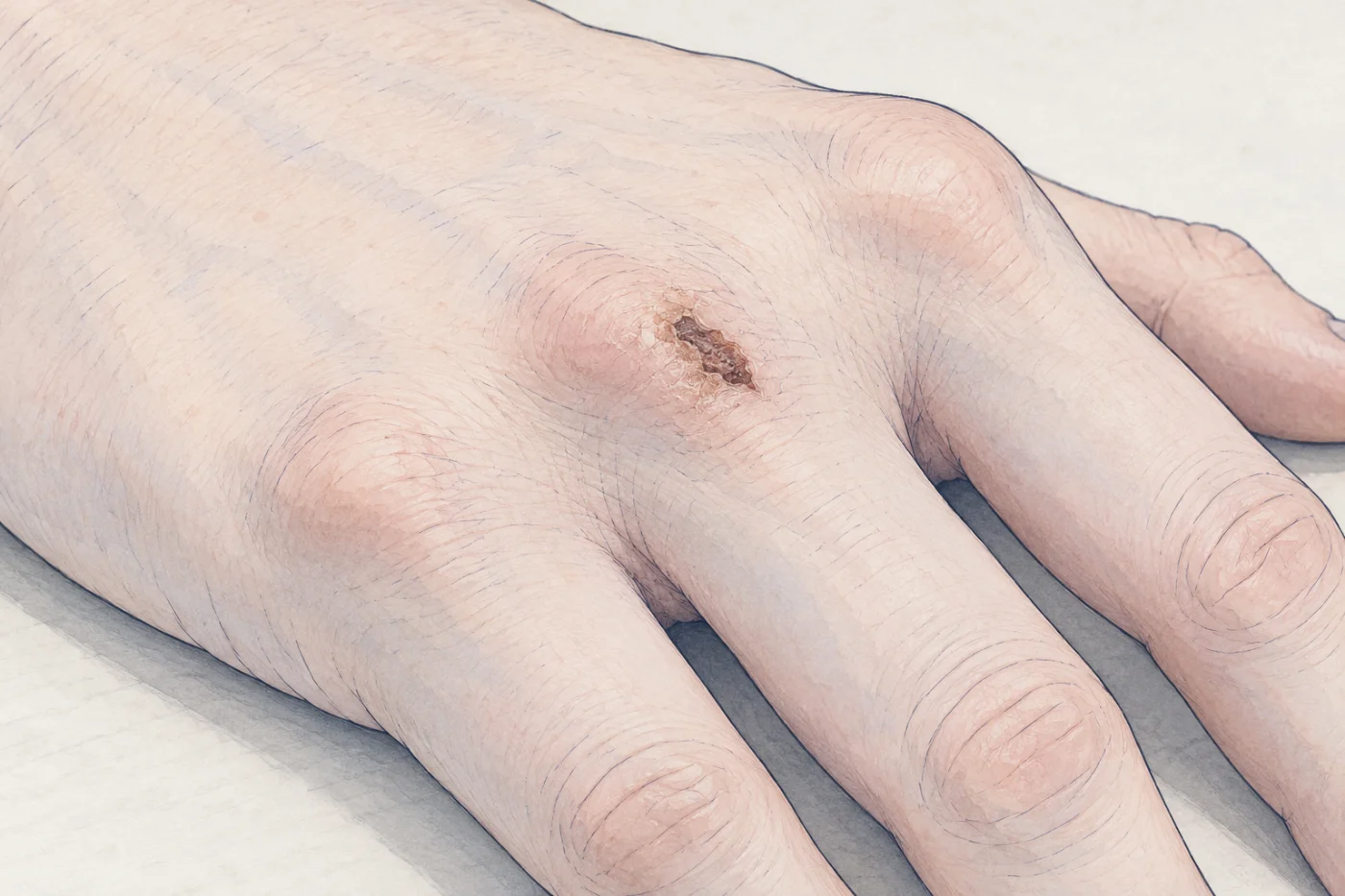
A small cut bleeds for a minute or two and then stops. A few days later there is a dark, dry crust over it. Blood is a liquid that flows freely through your vessels for your whole life, yet at a cut it turns solid within minutes. In this part you find out why that matters and what happens at the cut.
 (enlarge)
Why blood clots
When a vessel is cut, blood starts to escape. Within a few minutes the blood at the cut clots: it turns into a jelly-like plug, a clot, that seals the cut. Clotting has two roles.
- It prevents blood loss. Without clotting, even a small cut would keep bleeding.
- It prevents pathogens entering. A cut is an opening through the skin, and the clot closes it, so bacteria and other pathogens cannot get in through it.
The top of the clot dries and hardens into a scab. New skin grows underneath, and when it is complete the scab falls off.
What happens at a cut
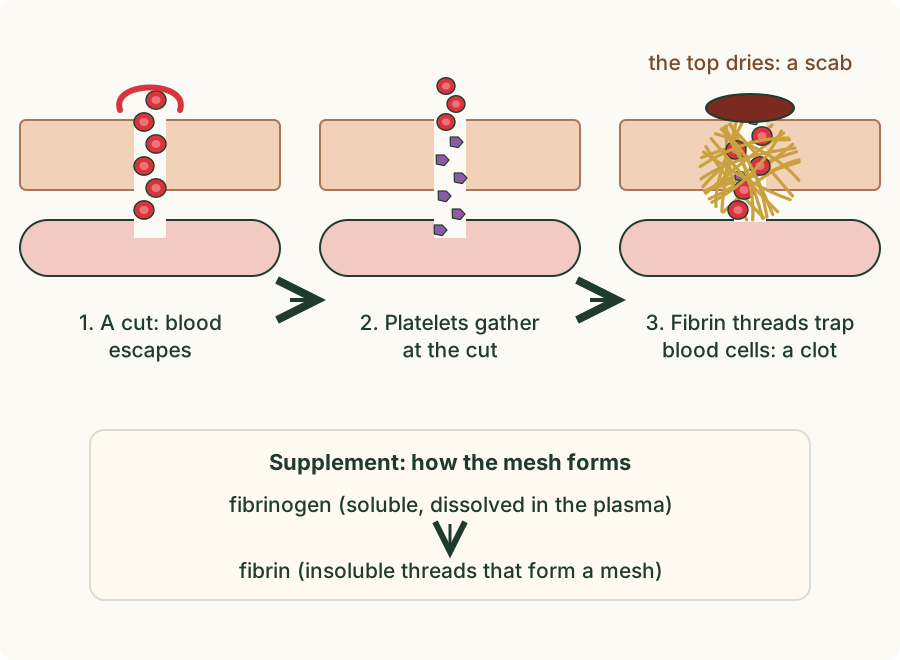
Platelets start the process. At the cut, platelets gather and stick to the damaged vessel. They help the blood at the cut to clot. (You do not need the details of how they do it.)
 (enlarge)
Run the last part of the experiment below before you read on: predict what would happen at a cut if the blood could not clot, then make a cut and watch.
(Supplement) Fibrinogen and fibrin
The plasma contains a protein called fibrinogen. It is soluble: it is dissolved in the plasma, so it flows along with the blood and does nothing while the blood is in the vessels. At a cut, fibrinogen is converted into fibrin, which is insoluble: it comes out of solution as long, sticky threads. The threads cross each other and form a mesh over the cut. Red blood cells and platelets are caught in the mesh, and together they make the clot.
Trap: "Platelets turn into fibrin." Platelets are fragments of cells; they help start the clot. Fibrin is made from fibrinogen, a protein dissolved in the plasma.
Trap: "A clot is a lump of red cells." The red cells give a clot its colour, but what holds it together is the mesh of fibrin threads that traps them.
Worked example
Stopping the bleeding
A pupil cuts their knee in a fall. Give the two roles of the clot that forms in the cut.
The clot seals the cut, so it prevents blood loss: the bleeding stops. It also closes the opening in the skin, so it prevents pathogens, such as bacteria, from entering the body through the cut.
Worked example
Soluble to insoluble
(Supplement) Describe how a clot forms, using the words fibrinogen, fibrin and mesh.
At a cut, fibrinogen, a soluble protein dissolved in the plasma, is converted into fibrin, which is insoluble. The fibrin forms long threads that make a mesh over the cut. The mesh traps red blood cells and platelets, and this forms the clot.
Worked example
Blood that clots slowly
Some people have blood that clots much more slowly than usual. Suggest two problems this could cause after a small cut.
Because a clot takes longer to form, the cut keeps bleeding for longer, so the person loses more blood. The cut also stays open for longer, so there is more time for pathogens to enter the body through it. (People with this condition must take care with cuts and may need treatment to help their blood clot.)
Worked example
A scab
Explain why you should leave a scab alone rather than pick it off.
A scab is the dried top of a clot. It covers the cut while new skin grows underneath. Picking it off opens the cut again: it may bleed again, and pathogens can enter through the opening, which is what the clot was preventing.
Key idea: Blood clots at a cut. Clotting prevents blood loss and prevents pathogens from entering the body; platelets help the clot to form. (Supplement) In clotting, the soluble protein fibrinogen is converted into insoluble fibrin, which forms a mesh of threads that traps blood cells.