In the 1700s, sailors on long voyages ate the same food for months: hard ship's biscuit and meat preserved in salt, both of which keep for a long time. They had plenty to eat. Yet after weeks or months at sea, many fell ill. Their gums swelled and bled, old wounds opened again, their skin bruised at a touch, and they grew too weak to work. In 1747 a ship's doctor, James Lind, gave twelve sick sailors the same food and added a different extra for each pair: cider, vinegar, sea water, two oranges and a lemon, or one of two other mixtures. Within a week, the pair given oranges and lemons were almost well. What did the fruit have that the biscuit and salted meat did not?
In this part you stock a store room for a long winter and find out what makes a diet balanced, and what happens when it is not.
Stocking a polar station
Imagine a research station far inside the Arctic Circle. In winter, no ship or plane can reach it: for 16 weeks of polar night, the team lives on what is in the store room. Most fresh food would spoil long before spring, so the shelves hold food that keeps: tins, dried foods and sacks, with a freezer for frozen fruit and vegetables. Water comes from a tank of melted snow.
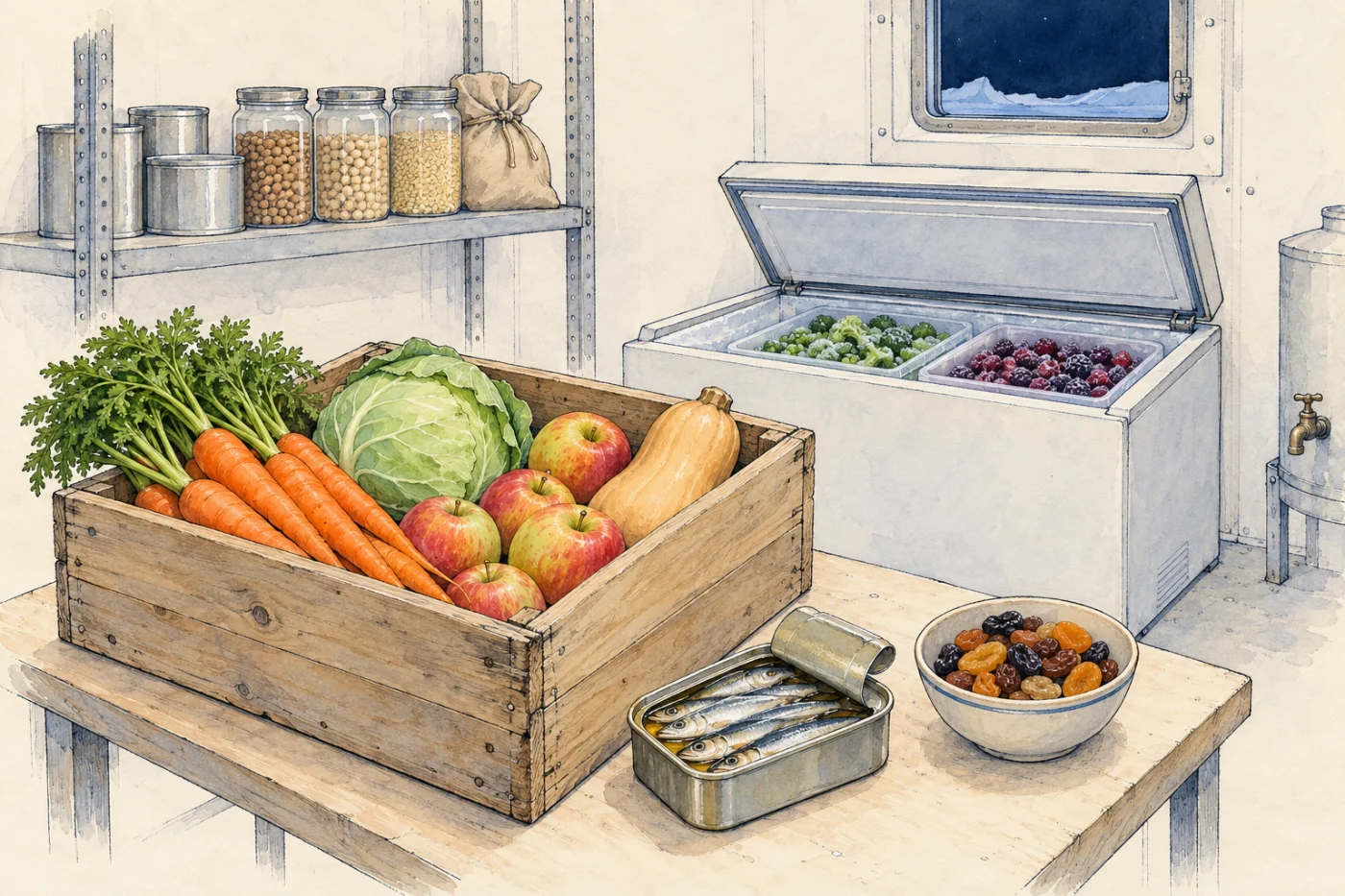 (enlarge)
In the experiment, you pack the team's winter crate with eight boxes. Each box supplies a share of what the team needs of each nutrient. Gauges on the front of the crate show how many weeks of each nutrient the crate holds. During the winter, each gauge goes down by one week every week. A nutrient whose gauge empties before the 16 weeks are over is short: the team is not getting enough of it.
The first crate is already packed, the way the old ships were: three tins of ship's biscuit, two sacks of white rice and three jars of salted meat. That is a lot of food.
Predict first: which nutrients could run short in this crate before the end of the winter? Use what you found out in part 1 about where each nutrient comes from. Write your prediction down now.
Below you can try the first steps: making your prediction and running the first winter. Before you read on, open the full experiment and run it to the end. It also asks what the empty gauges mean for the team, lets you repack the crate until it lasts the winter, and compares your crate with the first one. Your prediction only counts if you make it before you see the results below.
What a balanced diet is
The first crate held plenty of food, and some of its gauges were far above the 16-week line. Carbohydrate lasted more than twice the winter. Yet vitamin C ran out at once, and vitamin D, calcium and fibre were gone within a few weeks. Plenty of food is not the same as the right food.
A balanced diet is a diet that contains all the nutrients the body needs (carbohydrates, fats and oils, proteins, vitamins, mineral ions, fibre and water), each in the right amount. "Balanced" does not mean equal amounts: the body needs far more carbohydrate than vitamin C. It means none too little, and none far more than is needed. In the station, the crate has room for only eight boxes, so a box of something the team already has plenty of takes the place of a box of something it needs. And as part 1 showed, the body stores spare energy as fat.
The right amounts are not the same for everyone. A growing child, a person doing hard physical work in the cold and a person who is ill all need different amounts, which is why the gauges in the model are for this one team in this one winter.
Trap: "A balanced diet has equal amounts of every nutrient." Each nutrient is needed in its own amount, and some, like vitamins, in very small amounts.
Trap: "More food makes a diet more balanced." Doubling the biscuit and salted meat would add carbohydrate and protein the team already had enough of, and still no vitamin C at all. A gap is only filled by a food that contains the missing nutrient.
Worked example
Nothing runs short
A team packs a crate for the 16-week winter. Its gauges show carbohydrate 52 weeks, fat 38, protein 20, vitamin C 17, vitamin D 18, calcium 19, iron 21 and fibre 18. No gauge empties before the spring. Is this a balanced diet?
Check both parts of the definition. A balanced diet contains all the nutrients the body needs, each in the right amount. The first part is met: every gauge lasts the 16 weeks, so no nutrient is too little. The second is not: the crate holds more than three times the carbohydrate the winter needs and more than twice the fat, and the body would store the spare energy as fat. So the crate is not balanced. Swapping some of the starchy and fatty boxes for other foods would bring it closer to balanced.
Too little vitamin C: scurvy
The sailors' illness is called scurvy. It is caused by too little vitamin C in the diet. Without vitamin C, the body cannot make the protein that holds the skin, the gums and the walls of blood vessels together, so the gums bleed, the skin bruises easily and wounds heal slowly or open again. Ship's biscuit and salted meat contain almost no vitamin C. Oranges and lemons are rich in it, which is why Lind's sailors recovered so fast.
Scurvy is not an infection: no one catches it from anyone else. It is a deficiency disease, caused by a nutrient missing from the diet, and the diet can prevent and cure it. In the polar station, the frozen blackcurrants and frozen vegetables in the freezer and the tinned mandarins on the shelf are the foods that supply vitamin C. Tinning heats the fruit, so the mandarins keep only some of theirs.
Too little vitamin D or calcium: rickets
Rickets is a disease of children's bones. It is caused by too little vitamin D or too little calcium. Calcium is what makes bones hard, and vitamin D is needed to absorb calcium from food, so without enough of either, a child's growing bones stay soft and weak. The bones of the legs may bend under the child's weight, and the wrists and knees may swell.
Rickets was once common in children in smoky industrial cities, where little sunlight reached their skin. Remember from part 1 that the skin makes vitamin D in sunlight. In the polar night there is no sunlight at all, so the team cannot make vitamin D in their skin: it must come from the crate. The adults in the team are too old to get rickets, but their bones need vitamin D and calcium too.
Trap: "Rickets is caused by too little vitamin C." Too little vitamin C causes scurvy, which shows in the gums and skin. Rickets shows in the bones, and comes from too little vitamin D or calcium.
Worked example
Two patients
A doctor sees two patients. Child A has legs that bend outwards and swollen wrists. Adult B bruises easily, and has gums that bleed and a cut that has not healed in weeks. Name each disease and state its cause.
Match each set of signs to the part of the body it shows in. Child A's signs are in the bones: they have stayed soft and weak and bent under the child's weight. This is rickets, caused by too little vitamin D or too little calcium (for example when little sunlight reaches the skin, so little vitamin D is made). Adult B's signs are in the gums, skin and wounds. This is scurvy, caused by too little vitamin C in the diet. Both are deficiency diseases: neither is caught from another person, and a diet with enough of the missing nutrient prevents each.
Filling the gaps
When you repacked the crate, every gap needed a food that supplies the missing nutrient, and to make space for it, you took out foods the crate had far more of than the team needed:
- vitamin C: frozen blackcurrants, frozen vegetables or tinned mandarins;
- vitamin D: oily fish such as tinned sardines, egg powder, or a plant drink fortified with vitamin D;
- calcium: milk powder, cheese, sardines eaten with their bones, or a fortified plant drink;
- fibre: crispbread, dried beans, nuts, dried fruit, frozen vegetables and frozen blackcurrants.
There is more than one balanced crate. A crate with no animal foods at all can be balanced too, if it has beans and nuts for protein and iron, nuts for fat, and a fortified plant drink for vitamin D and calcium: few plant foods contain vitamin D unless it has been added.
Worked example
One food for two gaps
A crate's gauges for the 16-week winter show protein 12 weeks and fibre 5 weeks; carbohydrate lasts 40 weeks, and every other nutrient lasts the winter. The crate is full. What should the team change?
First name the gaps, then look for a food that contains the missing nutrients. Protein and fibre both run out before the 16 weeks are over, so the crate is not balanced. Dried beans contain both: they are rich in protein, and their cell walls supply fibre. To make room, take out a box of something the crate has far more of than the team needs: carbohydrate lasts 40 weeks, so a tin of ship's biscuit can go. More biscuit or rice would not help: they add mostly carbohydrate, which the crate already has far too much of.
Water from the tank
The crate has no gauge for water, because the team gets its water from the tank of melted snow. Water is still part of a balanced diet, and the team needs it every day: as the solvent for the reactions in their cells, to carry substances in the blood plasma, to carry waste out in urine and to cool down by sweating, even in the cold, when they work hard.
Key idea: A balanced diet contains all the nutrients in the right amounts. Too little vitamin C causes scurvy; too little vitamin D or calcium causes rickets in children.