The coldest temperature ever measured in the open air on Earth was about −89 °C, at a research station in Antarctica. A home freezer runs at about −18 °C. Liquid nitrogen, which some doctors use to freeze warts off skin, is at about −196 °C, and deep space, far from any star, is about −270 °C. Is there any limit? Could something always be made a little colder? In the last part, the air molecules hitting a speck of smoke made it jiggle. In this part you use a model of the same air, cool it, and watch what happens to the molecules, to the speck, and to the energy of their motion, to find out how cold anything can be.
Temperature and moving particles
Anything that moves has kinetic energy, the energy of its motion: the faster it moves, the more kinetic energy it has. The particles of a solid, a liquid or a gas are always moving, so they all have kinetic energy. They do not all move at the same speed, though. Collisions keep changing each particle's speed, so at any moment some particles are fast, some slow and most in between. What matters is the average kinetic energy of the particles.
The temperature of a substance is a measure of that average. When a substance is hotter, its particles move faster on average, so their average kinetic energy is greater. When it is colder, its particles move more slowly, and their average kinetic energy is smaller. In a solid, the particles vibrate faster when it is hotter; in a liquid or a gas, they move about faster.
On a real bench, this is hard to see with the smoke cell. Warming the cell from 20 °C to 60 °C makes the air molecules only about 7 % faster, so the jiggle hardly changes, and the warm glass sets up slow drifts of air. So this part uses a model of the air, which you can cool far further than any freezer.
Cool the air in the model
What is on the bench. The same microscope and smoke cell. The view through the eyepiece now shows a model, not to scale: the orange speck among the many tiny, fast molecules of the air. With it is a model thermometer, which shows the temperature of the air in the model, starting at 20 °C. The model can cool its air, or set it to any temperature you need. A graph is ready for the average kinetic energy of an air molecule against the temperature.
What you do. Predict how the speck's jiggle will change if the air in the model is colder: less, the same, or more. Then cool the model to −100 °C and watch the molecules and the speck. Explain what you see. Next, record the average kinetic energy of an air molecule at four temperatures, from 100 °C down to −200 °C, and look at the line through the points. Read where the line, carried on to colder temperatures, reaches zero kinetic energy. Last, cool the model air as far as it will go.
What the experiment showed
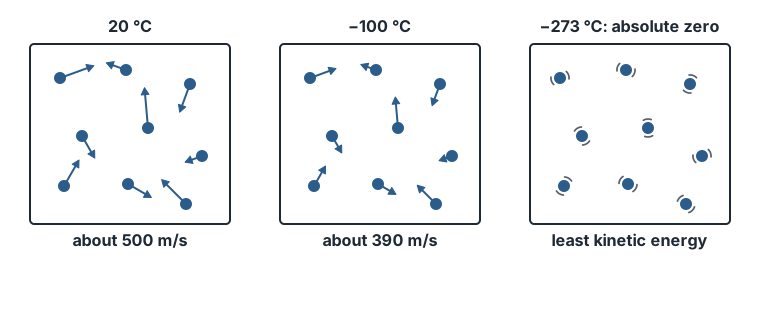
Do the experiment before you read on. At 20 °C, the model air molecules moved fast, in random directions, at a range of speeds, and the orange speck jiggled as they hit it. Cooled to −100 °C, the molecules moved more slowly, and the speck jiggled less: its jumps were smaller. Nothing else changed: the same speck, among the same number of molecules.
The model gave the average kinetic energy of an air molecule at four temperatures. The energies are tiny, so they are given in units of 10−21 J, a thousand million million millionth of a joule. The table also gives the typical speed of an air molecule at each temperature. In the table, θ (the Greek letter theta) stands for the temperature in °C.
| θ / °C | 100 | 20 | −100 | −200 |
|---|---|---|---|---|
| average kinetic energy of a molecule / 10−21 J | 7.73 | 6.07 | 3.59 | 1.51 |
| typical speed / m/s | 567 | 502 | 386 | 251 |
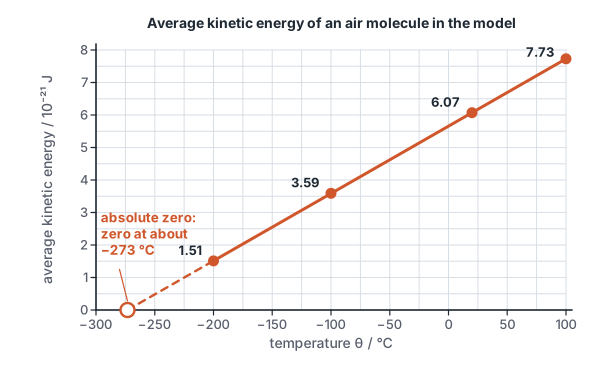
The colder the air, the smaller the average kinetic energy, and the slower the molecules. The four points lie on a straight line. For every 100 °C colder, the average kinetic energy falls by the same amount, about 2.07 × 10⁻²¹ J. From 100 °C to −200 °C, 300 °C colder, it falls from 7.73 to 1.51, which is 6.22, or 2.07 for each 100 °C.
 (enlarge)
At −200 °C there is still 1.51 left. At 2.07 for every 100 °C, that runs out about 73 °C further down. So the line, carried on to colder temperatures, reaches zero kinetic energy at about −273 °C. When you cooled the model air as far as it would go, it stopped at −273 °C. There, the model molecules hardly moved: they had the least kinetic energy they can have.
Why colder means a smaller jiggle
The speck jiggles because air molecules hit it unevenly. In colder air, the molecules move more slowly, so each one hits the speck less hard. The hits are still uneven and random, so the speck still jiggles, but each uneven push is smaller, so its jumps are smaller. The colder the air, the gentler the hits, and the less the speck jiggles.
 (enlarge)
Trap: “In colder air the speck shrinks, so it jiggles less.” The speck is the same size at −100 °C as at 20 °C. It jiggles less because the molecules hitting it are slower, so their hits are gentler.
Trap: “Cooling takes some of the molecules away.” Nothing was taken out of the model: the same number of molecules is still there. Each of them moves more slowly.
Absolute zero
Kinetic energy cannot be less than zero: a particle cannot move more slowly than not moving at all. So the temperature cannot go on falling forever. There is a lowest possible temperature, about −273 °C, where the particles have the least kinetic energy they can have. It is called absolute zero. Nothing can be colder than absolute zero, and in fact nothing can quite reach it: scientists have cooled tiny clouds of atoms to within a billionth of a degree of it, but never all the way.
The model is idealised. Real air would not stay a gas all the way down: it turns to liquid at about −190 °C and to a solid at about −210 °C, long before −273 °C. The model keeps it a gas so that the line can be followed. Every substance has its least kinetic energy at the same temperature, though: absolute zero is about −273 °C for everything. The module Gas pressure and temperature finds the same temperature from the pressure of a gas, and builds a temperature scale that starts there.
In the model, the kinetic energy at absolute zero is exactly zero. Real particles are a little different: even at absolute zero they keep a tiny trembling motion that cannot be taken away. That is why the right words are least kinetic energy, not “the particles stop”.
Trap: “At absolute zero the particles stop completely.” They have the least kinetic energy they can have, but real particles still keep a tiny motion. Say “least kinetic energy”, not “no motion”.
Trap: “With a better freezer you could get below −273 °C.” At −273 °C the particles already have the least kinetic energy they can have. There is no energy of motion left to take away, so nothing can be colder.
Trap: “At 0 °C the particles have no energy.” 0 °C is just the temperature at which ice melts. The particles there still move fast: in the model, an air molecule at 0 °C has about 5.66 × 10⁻²¹ J of kinetic energy, nearly as much as at 20 °C. Zero kinetic energy is about 273 °C colder.
Worked example
Reading the energy graph
Use the graph of average kinetic energy against temperature. (a) Read the average kinetic energy of an air molecule at 0 °C. (b) Show that the line falls by about 2.07 × 10⁻²¹ J for every 100 °C colder. (c) Find the temperature at which the line, carried on, reaches zero. (d) Explain why the graph cannot be carried on below that temperature.
(a) At 0 °C, the line is at about 5.7, so the average kinetic energy is about 5.7 × 10⁻²¹ J. It is not zero: 0 °C is far above the coldest possible temperature. (b) From 100 °C to −200 °C is 300 °C. The energy falls from 7.73 to 1.51, a fall of 6.22. For each 100 °C: 6.22 ÷ 3 = 2.07, in units of 10−21 J. (c) At −200 °C there is 1.51 left. At 2.07 for every 100 °C, that runs out after 1.51 ÷ 2.07 × 100 = 73 °C more. −200 − 73 = −273 °C. (d) Below −273 °C the line would give a negative kinetic energy, and that is impossible: a particle cannot move more slowly than not moving. So −273 °C, absolute zero, is the lowest possible temperature, where the particles have the least kinetic energy.
Worked example
Hotter, colder, coldest
Three sealed boxes of the model air are at 100 °C, 20 °C and −200 °C, each with a speck of smoke in it. (a) In which box do the molecules move fastest, and in which does the speck jiggle most? (b) In which box does it jiggle least? Explain. (c) A pupil says that if the coldest box were cooled to −273 °C, the speck would stop jiggling because the molecules would stop. Correct the pupil.
(a) At 100 °C: the hottest air has the fastest molecules, with the greatest average kinetic energy, 7.73 × 10⁻²¹ J. They hit the speck hardest, so it jiggles most. (b) At −200 °C: the molecules are slowest, with an average kinetic energy of only 1.51 × 10⁻²¹ J, about a quarter of that at 20 °C, so their uneven hits are gentlest and the speck jiggles least. (c) At −273 °C, absolute zero, the molecules would have the least kinetic energy they can have, so the speck's jiggle would be as small as it can be. But real particles keep a tiny motion even there, so it is wrong to say that they stop. Real air would not even be a gas by then: it turns to liquid at about −190 °C.
Case closed
How cold can anything get? Cooling the air in the model slowed its molecules, so their hits on the speck were gentler and the speck jiggled less. The higher the temperature, the faster the particles move and the greater their average kinetic energy. The four points lay on a straight line, which fell by about 2.07 × 10⁻²¹ J for every 100 °C and reached zero kinetic energy at about −273 °C, where the model stopped cooling. That is the lowest possible temperature, absolute zero, where the particles have the least kinetic energy they can have. Nothing can be colder. Real air would have turned to liquid at about −190 °C, but absolute zero is the same for every substance.
About this model
The air in the model is an ideal gas: its molecules are tiny, they bounce off each other and off the speck without losing energy, and they stay a gas at every temperature. The average kinetic energy of a molecule is set by the temperature of the air, and their typical speed comes from it, using the average mass of a molecule of real air. Real air at ordinary temperatures behaves almost exactly like this; real air below about −190 °C is a liquid, so the cold end of the model is an idealised line, not a measurement. The view is not to scale: the molecules are drawn far bigger, far fewer and far slower than real ones, so that you can see them hit the speck. In the model, the kinetic energy at absolute zero is zero; real particles keep a tiny motion even there. The speck itself is a model too: on a real bench, the temperature of a smoke cell can only be changed a little.