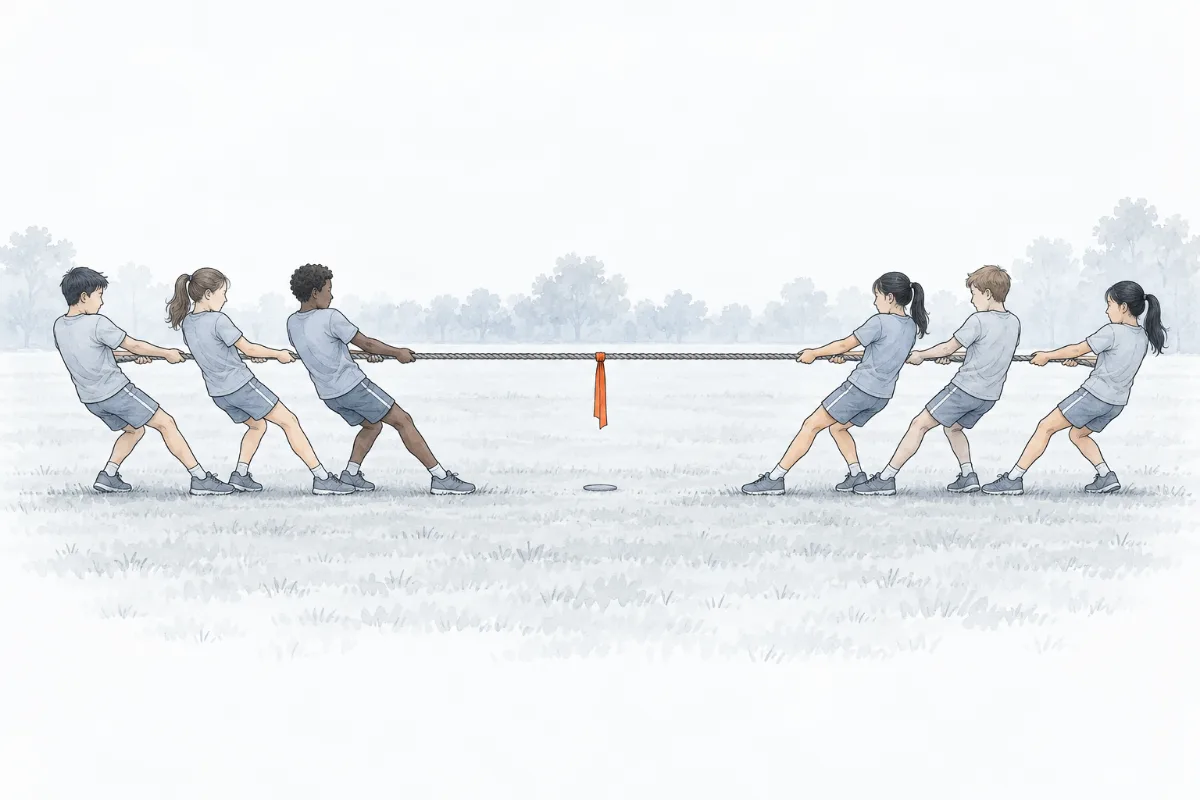
It is sports day, and two teams of three are pulling on a long rope. For ten whole seconds the orange ribbon in the middle hangs still over the mark on the grass. Six people are pulling as hard as they can, so there are big forces on that rope. Then one pupil's foot slips, and the ribbon starts to slide towards the other team. What changed? There were forces all along. What changed was whether they cancelled out.
 (enlarge)
Forces as arrows
A force is a push or a pull. It has a size, measured in newtons (N), and it acts in a direction. So we draw a force as an arrow. The arrow points in the direction of the force, and a longer arrow means a bigger force. A force meter measures a force: it is a spring in a tube, and the harder you pull its hook, the further the spring stretches along the scale.
To see what one object will do, draw it on its own, with every force that acts on it. Each force is an arrow that starts on the object and is labelled with its size. This is a free-body diagram. It leaves out everything else, because only the forces on the object decide how it moves.
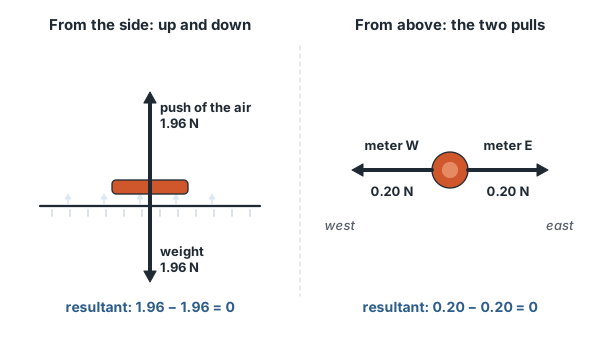
In this part you will pull a small plastic puck across an air table. Its weight is the pull of the Earth on it: weight = mass × g, where g is the gravitational field strength, 9.8 N/kg. The puck has a mass of 0.20 kg, so its weight is 0.20 kg × 9.8 N/kg = 1.96 N, downwards. Air blowing up through tiny holes in the table pushes the puck up with a force of the same size. Two force meters pull it sideways, one towards the west and one towards the east.
 (enlarge)
Adding forces along a line: the resultant
Usually several forces act on an object at once. What matters is their combined effect. The resultant force is the single force that would have the same effect as all of them together.
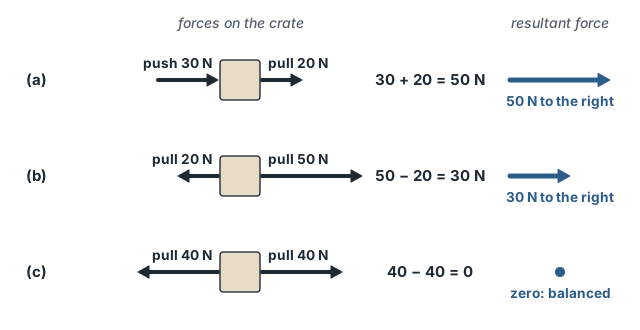
When the forces act along the same straight line, finding the resultant is a sum. Forces in the same direction add up. Forces in opposite directions take away, and the resultant points the same way as the bigger side. It helps to choose one direction as positive, say to the right, and count forces the other way as negative.
 (enlarge)
A resultant is not finished until it has a size and a direction: “30 N to the right”, not just “30 N”. When the resultant is zero, as in crate (c), the forces are balanced. When it is not zero, they are unbalanced.
Trap: “Balanced forces means there are no forces.” The crate in (c) has two forces of 40 N on it. They are balanced because they are equal in size and opposite in direction, so their resultant is zero. The rope in the tug-of-war had six people pulling on it while the ribbon stayed still.
Trap: “To find the resultant, add up all the numbers.” Only forces in the same direction add. In (b), 50 N to the right and 20 N to the left give 30 N, not 70 N.
Worked example
The tug-of-war
Team A pulls the rope to the left with a total of 700 N. Team B pulls it to the right with a total of 680 N. Find the resultant force on the rope. Then a fourth pupil joins team B and pulls to the right with 200 N. Find the new resultant.
The forces act along one line, in opposite directions, so subtract: 700 N − 680 N = 20 N. The bigger pull is to the left, so the resultant is 20 N to the left, and the ribbon starts to move towards team A. With the fourth pupil, team B pulls with 680 N + 200 N = 880 N to the right. Now 880 N − 700 N = 180 N, so the resultant is 180 N to the right. Taking right as positive gives the same answers with signs: −700 + 680 = −20 N, then −700 + 880 = +180 N.
Balanced forces: at rest, or steady in a straight line
What does an object do when the forces on it are balanced? If it is at rest, it stays at rest. That part is easy to believe. The surprise is what happens if it is already moving. With no resultant force, it keeps moving, in a straight line, at a constant speed. It does not slow down and stop.
So an object either remains at rest or continues in a straight line at constant speed unless a resultant force acts on it. A force is not needed to keep something moving. A force is needed only to change the way it moves.
Everyday life seems to say the opposite. Slide a book across a table and it soon stops. That is because a force does act on it: friction from the table, against the motion. Friction is a real force, and so it is part of the resultant. You meet friction properly in Acceleration, falling and drag. The air table in this part blows away almost all of it: the puck floats on a thin layer of air, so nothing rubs. On the air table you can see what an object does when the forces really are balanced.
Trap: “A moving object needs a forward force to keep it moving.” A space probe far from any planet, with its engines off, carries on at the same speed in the same direction for years. A car needs its engine on a level road only because friction and air resistance push back on it. When the forward force balances them, the car keeps a steady speed.
Worked example
A lift at a steady speed
A lift car with its passengers has a mass of 600 kg. It moves up at a steady 2.0 m/s. Calculate the force of the cable on the car. Take g = 9.8 N/kg.
The weight of the car is 600 kg × 9.8 N/kg = 5880 N, downwards. The car moves in a straight line at a constant speed, so the resultant force on it is zero: the forces are balanced. The only other force is the cable's pull, so the cable pulls up with 5880 N. It would be the same with the lift going down at a steady speed, or standing still. The cable pulls harder than 5880 N only while the resultant force on the car is upwards: while it speeds up on the way up, or slows down on the way down.
Unbalanced forces change the velocity
Now suppose the forces do not cancel. A resultant force changes the object's velocity. Velocity is speed in a given direction, so it can change in two ways: the speed can change, or the direction of motion can change, or both.
Which one happens depends on the direction of the resultant force compared with the motion:
- A resultant force along the motion makes the object speed up.
- A resultant force against the motion makes it slow down. If the force keeps acting, the object stops and then starts to move the other way.
- A resultant force at an angle to the motion changes its direction: the path curves towards the side the force pulls.
Worked example
Steering a space probe
A space probe drifts through deep space at a constant velocity, with every engine off. Describe its motion when it fires (a) a thruster that pushes it forwards, (b) one that pushes it backwards, (c) one that pushes it sideways. What happens when each thruster stops?
With the engines off, there is no resultant force, so the probe keeps a constant speed in a straight line. (a) A forward push is along the motion, so the probe speeds up. (b) A backward push is against the motion, so it slows down; if it kept firing long enough, the probe would stop and then move backwards. (c) A sideways push changes its direction: the probe's path curves towards the side it is pushed. In each case, when the thruster stops, the resultant force is zero again. The probe then carries on in a straight line at whatever speed and direction it had at that moment.
Pull a puck on an air table
To see all this without friction getting in the way, you will pull a puck on an air table and watch exactly how it moves.
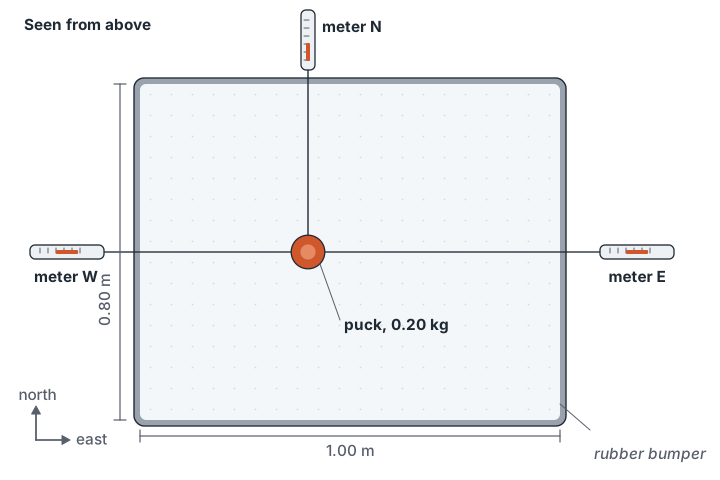
What is on the bench. An air table, 1.00 m from west to east and 0.80 m from south to north, with a blower that sends air up through hundreds of tiny holes in its top. A rubber bumper runs round the rim. On it floats an orange plastic puck, 0.20 kg. Three force meters, W, E and N, can pull it towards the west, the east and the north, from 0 to 0.40 N in steps of 0.05 N. A meter set to 0 N does not pull at all: its string hangs slack. Each meter moves along with the puck and holds its pull steady, so each pull keeps the same size and direction. An overhead camera looks straight down and draws the puck's position as a dot every 0.1 s. A speed–time graph is drawn as the puck moves. The runs are shown at half speed, but the graph keeps the real times.
 (enlarge)
What you do. There are five runs. First, meters W and E both pull with 0.20 N, and the puck is at rest. Predict what it will do when you let go, then let go. Second, with the same pulls, nudge the puck east and predict: will it slow down, keep a steady speed or speed up? Third, set meters W and E yourself so that the resultant force is 0.10 N east, and let go. Fourth, set them so that a puck nudged east will slow down, and nudge it. Last, only meter N pulls, with 0.05 N, while the puck is nudged east. Predict its path, then watch the dots and the graph.
What the experiment showed
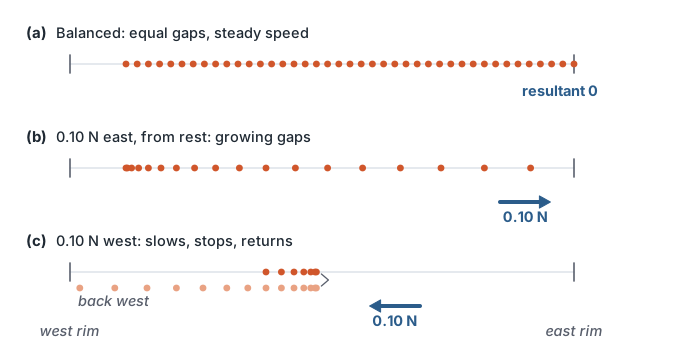
Do the experiment before you read on. With 0.20 N west and 0.20 N east, the puck stayed exactly where it was for the whole 2.0 s. The pulls were balanced, so the resultant was zero, and an object at rest stayed at rest.
Nudged east at 0.20 m/s with the same balanced pulls, the puck did not slow down. The dots were evenly spaced, 2 cm apart for every 0.1 s, and the speed–time graph was a flat line. The puck crossed to the east rim in 4.0 s at a constant speed, in a straight line. Once the nudge was over, nothing was pushing it along, and nothing needed to.
To get a resultant of 0.10 N east, meter E had to pull 0.10 N harder than meter W: for example 0.30 N east and 0.20 N west, or 0.10 N east and nothing west. Any pair with that difference gave the same run. From rest the gaps between the dots grew, and the speed–time line rose steadily. The puck reached the east rim after 1.79 s at about 0.89 m/s, still speeding up. A pair with a different difference gave a different run: a smaller resultant gave a gentler speeding up, and a resultant towards the west sent the puck the other way.
For the fourth run, meter W had to pull harder than meter E, so that the resultant pointed against the motion. With 0.20 N west and 0.10 N east, the resultant was 0.10 N west. The puck, nudged east at 0.30 m/s, slowed down, with shrinking gaps. It stopped after 0.6 s, 9 cm further on, and then came back west, faster and faster. The force did not just stop the puck: it went on changing the velocity, the other way.
 (enlarge)
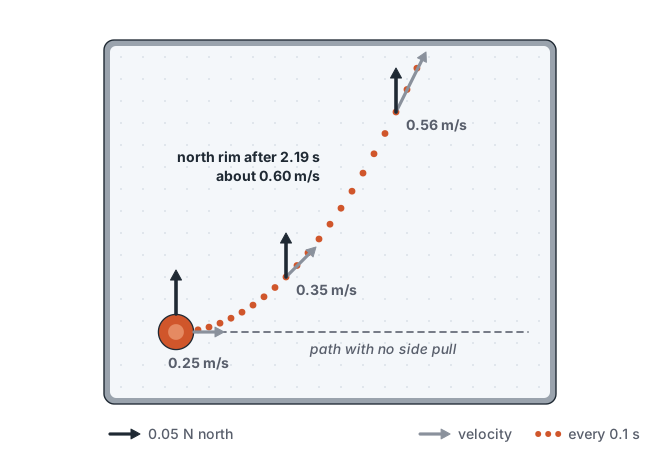
In the last run, the only pull was 0.05 N north, at right angles to the puck's motion east. The puck did not turn sharply to the north, and it did not carry straight on. Its path curved towards the north, more and more. It reached the north rim after 2.19 s, about 0.55 m east of where it started. The resultant force changed the direction of motion.
Its speed changed too: from 0.25 m/s at the start to about 0.60 m/s at the rim. The pull kept pointing north, but the puck's direction turned towards the north. After the first moment, the pull was no longer at right angles to the motion, and part of it acted along the motion. A force that stays at right angles to the motion all the way round is different. You will meet it in part 3, where a string makes a puck go round in a circle.
 (enlarge)
| Run | Resultant force | What the puck did |
|---|---|---|
| 1 at rest | 0 | stayed at rest |
| 2 nudged east | 0 | steady speed in a straight line, 0.20 m/s |
| 3 from rest | 0.10 N east | sped up: 0.89 m/s at the rim after 1.79 s |
| 4 nudged east | against the motion (west) | slowed, stopped, came back west |
| 5 nudged east | 0.05 N north | curved north, and sped up to 0.60 m/s |
Case closed
The ribbon in the tug-of-war hung still because the two teams' pulls were equal and opposite: the resultant force on the rope was zero, and the forces were balanced. When a foot slipped, one pull became smaller, so the resultant was no longer zero. Along a straight line, the resultant is found by adding forces in the same direction and subtracting forces in opposite directions. With no resultant force, an object stays at rest, or keeps moving in a straight line at constant speed. A resultant force changes the velocity: it speeds the object up, slows it down, or changes its direction.
About this model
The air table, the puck and the force meters are simulated. A real meter's pull wobbles as the person holding it walks along; in the model each pull keeps exactly the same size and direction. The model also has no friction at all, and no air resistance, while a real air table has a little of both, so a real puck slowly loses speed. The puck's motion follows from the resultant force, the mass of 0.20 kg and nothing else. Every run is shown at half speed, but the times and speeds on the graph are the real ones.