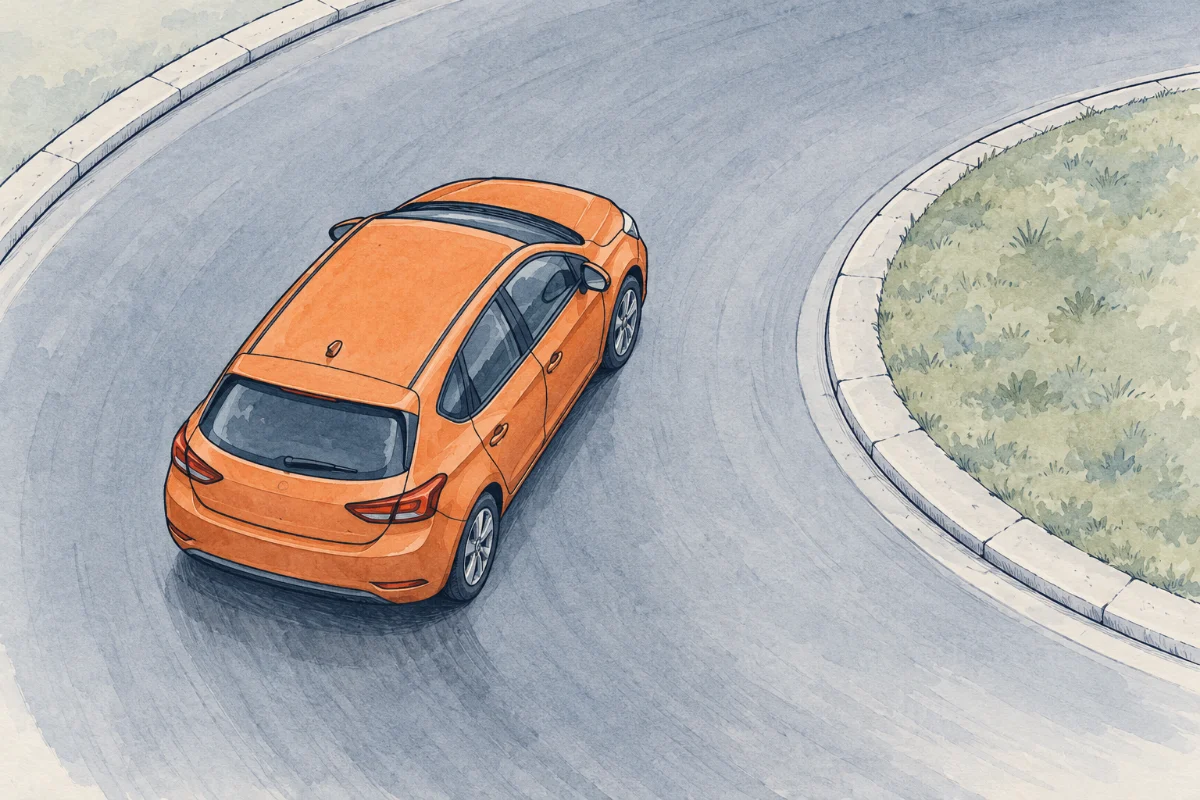
An orange car drives round a roundabout at a steady 10 m/s. The needle on its speedometer does not move at all. In the back seat, you feel yourself pressed against the door on the outside of the bend. So is there a force on the car? Which way does it point: outwards, as it feels, or inwards? And what would happen if it suddenly stopped acting? Everything in this part is Supplement content.
 (enlarge)
Supplement: Force, mass and acceleration
In part 1, a resultant force changed the velocity of the puck. Now the question is how quickly. You met acceleration in Acceleration, falling and drag: it is the change in velocity per unit time, a = Δv ÷ Δt, in m/s². An acceleration of 0.50 m/s² means the velocity changes by 0.50 m/s every second.
Two things decide the acceleration. A bigger resultant force gives a bigger acceleration. A bigger mass gives a smaller acceleration from the same force: a full shopping trolley is harder to get moving than an empty one. Both are in one equation:
resultant force = mass × acceleration, or F = ma
F is in newtons (N), m in kilograms (kg) and a in m/s². In fact this equation defines the newton. A resultant force of 1 N gives a mass of 1 kg an acceleration of 1 m/s². Rearranged, a = F ÷ m and m = F ÷ a.
F must be the resultant force. If several forces act, find their resultant first, as in part 1, then use F = ma. A car’s engine may push it forwards with 3000 N. If 1000 N acts against the motion, only the 2000 N that is left accelerates the car.
Supplement: Force and acceleration in the same direction
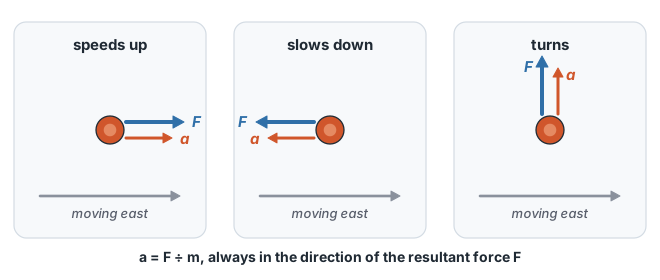
Force and acceleration are both vectors. In F = ma the mass is a scalar, with no direction, so the acceleration always points the same way as the resultant force. This is true whichever way the object is moving.
 (enlarge)
When the resultant force is along the motion, the acceleration is along the motion too, and the object speeds up. When the force is against the motion, so is the acceleration: the velocity changes backwards, and the object slows down. A deceleration is just an acceleration that points against the motion. And when the force is at right angles to the motion, so is the acceleration. The velocity changes sideways: the object turns.
Trap: “The acceleration points the way the object is moving.” It points the way the resultant force points. A puck moving east with a resultant force towards the west accelerates towards the west: it slows down.
Worked example
An e-scooter
An e-scooter and its rider have a mass of 90 kg. The resultant force on them is 180 N forwards. They start from rest. Calculate (a) their acceleration, (b) their speed after 3.0 s.
(a) a = F ÷ m = 180 N ÷ 90 kg = 2.0 m/s² forwards, in the same direction as the resultant force.
(b) The velocity grows by 2.0 m/s every second. After 3.0 s, it has grown by 2.0 m/s² × 3.0 s = 6.0 m/s. So the speed is 6.0 m/s. If the rider were heavier, the same force would give a smaller acceleration.
Free play: nothing here is marked or saved
Push or brake the e-scooter
W07’s numbers: a resultant force of 180 N forwards on 90 kg of scooter, rider and parcels. Brake, or load the rack: which way does the acceleration point, and how big is it?Supplement
Still picture: your device asks for less motion.
Try: Choose Rolling. Is the acceleration any different?
- Resultant force F
- 180 N →
- Mass m
- 90 kg
- Acceleration a
- 2.0 m/s² →
a = F ÷ m = 180 N ÷ 90 kg = 2.0 m/s²
a points forwards, like F: each second the speed grows by 2.0 m/s, to 6.0 m/s after 3.0 s.
- W07: 180 N on 90 kg gives 2.0 m/s² forwards, so from rest the speed after 3.0 s is 6.0 m/s.
- The acceleration points the way the resultant force points, not the way the scooter moves: brake while rolling forwards and a points backwards, so the scooter slows down.
- The same force on twice the mass (60 kg to 120 kg) gives half the acceleration, because a = F ÷ m.
About this model. There is no air resistance or friction here, so the motor’s push or the brakes’ force is the resultant force. Brakes only act on a moving scooter: at rest they give no force, and a scooter that stops stays at rest. A real e-scooter speeds up at about 1–2 m/s² and is limited to about 7 m/s; the sliders go further so that arrows can be compared. The arrows F and a are drawn to their own scales, so they are the same length only at 60 kg; v has a third scale. The rider and the scooter are 60 kg, and each parcel on the rack is 15 kg, drawn smaller than real. The picture rides with the scooter: the lane slides past at its speed and the far bank more slowly. The stopwatch replays the first 3.0 s. The dashed grey arrows are F and a before your last change.
Worked example
A lift starting and stopping
A lift car and its passengers have a mass of 800 kg. Take g = 9.8 N/kg. (a) As it starts upwards from rest, the cable pulls up with 8640 N. Find its acceleration. (b) Near the top, still moving up, the cable pulls with only 7040 N. Find its acceleration now, and describe its motion.
The weight is 800 kg × 9.8 N/kg = 7840 N, downwards. (a) Resultant = 8640 N − 7840 N = 800 N, upwards. a = F ÷ m = 800 N ÷ 800 kg = 1.0 m/s² upwards. The lift moves up and accelerates up, so it speeds up.
(b) Resultant = 7840 N − 7040 N = 800 N, but now downwards: the weight is bigger. a = 800 N ÷ 800 kg = 1.0 m/s² downwards. The lift is still moving up, but its acceleration points down, against the motion. So it slows down, ready to stop at the top floor. The direction of the motion and the direction of the acceleration are not the same thing.
Push the puck, then send it round
Back to the air table, for three experiments.
What is on the bench. The air table, the orange puck of 0.20 kg and a second puck that can sit on top of it, making 0.40 kg. Meter E pulls with a steady force, and a speed–time graph is drawn for each run. For a second experiment, a pin stands at the centre of the table. A string runs from the pin to the puck, with a small force meter in it. The pin can let the string go at a mark. The runs are shown at half speed, with the real times on the graph.
What you do. First, pull one puck from rest with 0.10 N, as run A, and read its acceleration from the gradient of the graph. Before runs B and C, predict: will the acceleration halve, stay the same or double? Run B pulls the same puck with 0.20 N. Run C pulls two pucks, 0.40 kg, with 0.20 N. Next, push the puck so that it goes round the pin at 0.50 m/s on a circle of radius 0.25 m. Predict its path when the pin lets go of the string, and read the meter. Last, change one thing at a time: a faster speed, a smaller circle or a heavier puck. Before each one, predict whether the meter will read more, the same or less.
What the experiment showed
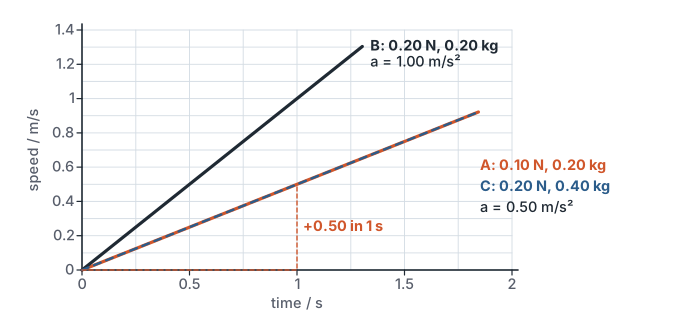
Do the experiment before you read on. In each straight run the speed–time line was straight, so the acceleration was constant. Its gradient gave the acceleration.
| Run | Resultant force F | Mass m | Acceleration a | F ÷ m |
|---|---|---|---|---|
| A | 0.10 N | 0.20 kg | 0.50 m/s² | 0.50 |
| B | 0.20 N | 0.20 kg | 1.00 m/s² | 1.00 |
| C | 0.20 N | 0.40 kg | 0.50 m/s² | 0.50 |
Doubling the force on the same mass doubled the acceleration. Doubling the mass as well brought it back to 0.50 m/s². In every run, a = F ÷ m. Over the 0.85 m to the rim, run A took 1.84 s and reached 0.92 m/s. Run B took only 1.30 s and reached 1.30 m/s. Run C followed run A’s line exactly.
 (enlarge)
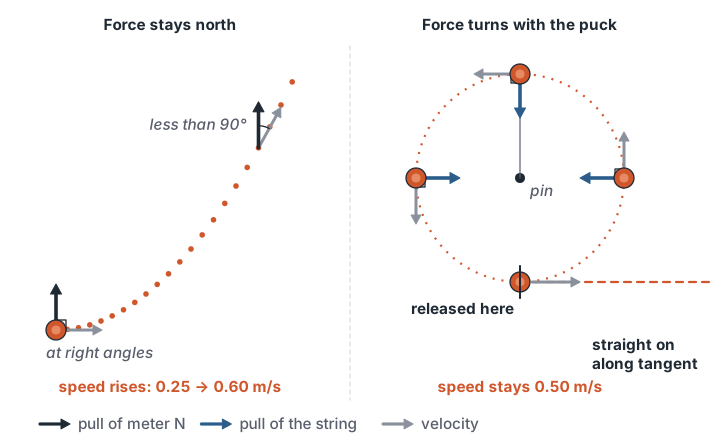
On the circle, the meter in the string read a steady 0.20 N. The string pulled the puck towards the pin, the centre of the circle, the whole way round. The speed stayed at 0.50 m/s, and one turn took 3.14 s. When the pin let go of the string at the mark, the puck did not fly straight out from the pin. It did not keep curving, either. It went straight on, in the direction it was moving at that moment, and reached the rim 0.9 s later.
 (enlarge)
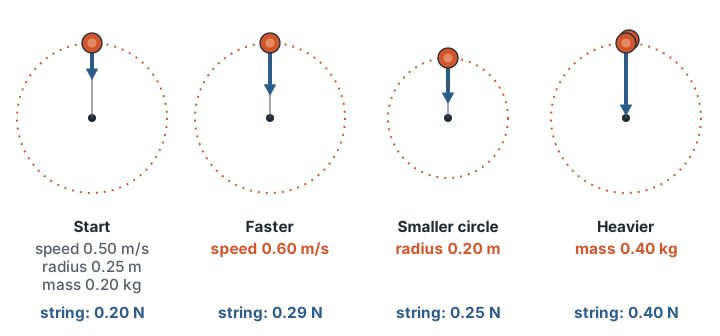
Then came the three changes, one at a time. Each time the meter read more than 0.20 N. Going faster, at 0.60 m/s on the same circle, it read 0.29 N. On a smaller circle, radius 0.20 m, at the same speed, it read 0.25 N. With two pucks, 0.40 kg, at the same speed and radius, it read 0.40 N.
 (enlarge)
Supplement: Going round in a circle
Compare the circle with run 5 of part 1. There, a force pointed north the whole time, while the puck turned towards the north. At the start the force was at right angles to the motion. Soon it was not, and part of it pulled along the motion, so the puck sped up as well as turning. The path was a curve, but not a circle.
The string is different. It always pulls towards the centre, and on a circle the direction to the centre is always at right angles to the direction of motion. As the puck turns, the force turns with it. A force that stays at right angles to the motion never pulls along it or against it. So the speed does not change, and only the direction does, all the way round. That is motion in a circle.
The puck moves at a constant speed, but its velocity keeps changing, because its direction keeps changing. So it is accelerating, all the time. By F = ma, its acceleration points the same way as the resultant force: towards the centre.
When the string is let go, there is no resultant force any more. The puck carries on in a straight line at constant speed, in the direction it had at that moment. That line just touches the circle at the point of release, at right angles to the radius there. It is the tangent to the circle.
The meter showed three rules. Each compares a steady circle with another, changing one thing and keeping the other two the same.
- With the mass and the radius the same, a bigger force goes with a bigger speed. To go faster, the puck needed a harder pull: 0.29 N instead of 0.20 N.
- With the mass and the speed the same, a bigger force goes with a smaller radius. The smaller circle needed a harder pull: 0.25 N.
- With the speed and the radius the same, a bigger mass needs a bigger force. Two pucks needed 0.40 N.
Trap: “Something going round is pushed outwards.” No outward force acts on the puck. The only sideways force is the string’s pull, inwards. In the car, you feel pressed against the door because your body tends to carry straight on, along the tangent, while the car turns under you. The door then pushes you inwards, round the bend with it.
Trap: “Constant speed means zero resultant force.” That is true only in a straight line. Going round a circle at a constant speed, the direction keeps changing. A resultant force towards the centre is needed all the time.
Worked example
Whirling a conker
Jo whirls a conker on a string, in a horizontal circle above her head. Describe what changes, and why, if she (a) makes it go round faster on the same length of string, (b) uses a heavier conker at the same speed and radius, (c) pulls the string in to make the circle smaller, at the same speed. (d) Then the string snaps. Describe the conker’s path, seen from above.
(a) For the same mass and radius, a bigger speed needs a bigger force towards the centre. Jo feels the string pull harder on her hand. (b) A bigger mass at the same speed and radius also needs a bigger force. (c) For the same mass and speed, a smaller radius needs a bigger force too. In each case the string must pull harder. If it cannot, it snaps. (d) Once the string snaps, there is no force towards the centre. Seen from above, the conker moves off in a straight line along the tangent to the circle, the way it was moving when the string broke. It does not fly outwards from the centre. Seen from the side, its weight then makes it fall as well.
Case closed
The car on the roundabout keeps a steady speed, but its direction keeps changing. So its velocity changes, and it accelerates towards the centre of the roundabout. By F = ma, the resultant force on it points the same way: inwards, towards the centre. It is not outwards. That force comes from the road, through the tyres. If it stopped, on a patch of ice, the car would carry straight on along the tangent. In a straight line, F = ma gives the size of the acceleration, a = F ÷ m, always in the direction of the resultant force. Going round a circle, a bigger speed, a smaller radius or a bigger mass each needs a bigger force towards the centre.
About this model
The air table, the pucks, the pin and the meters are simulated. In the straight runs, each pull keeps exactly the same size and direction. A real meter held by a moving hand wobbles. There is no friction and no air resistance, so a real puck would need a little more pull to match these runs. On the circle, the string has no mass and does not stretch, and the pin lets go at exactly the mark. The meter in the string reads the inward pull. The runs are shown at half speed, with the real times on the graph.