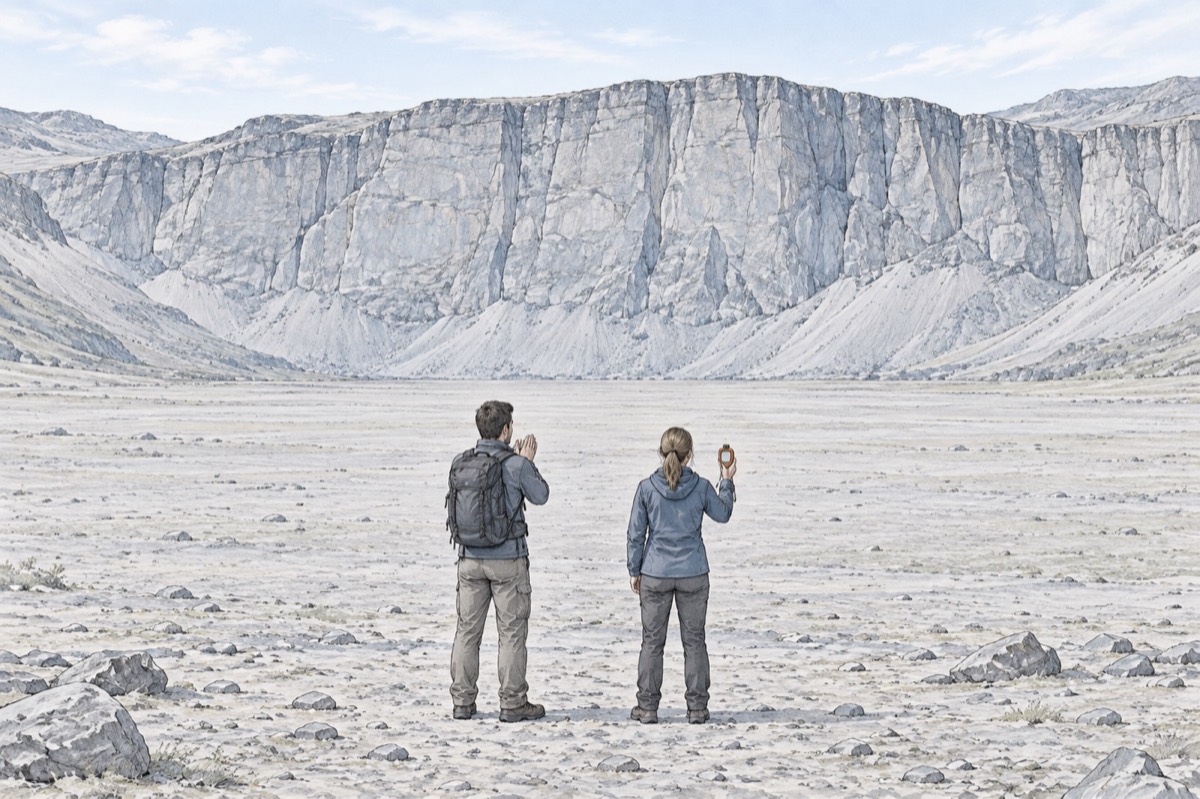
Two walkers stand on a wide, flat plain facing a tall cliff. One claps once. A moment later both hear a second, fainter clap coming back from the cliff, although nobody clapped again. Where does the second sound come from, and why does it arrive late? Predict whether the delay would be longer or shorter if the walkers moved closer to the cliff. In this part you will explain echoes and then use them, with a tape measure and a stop-clock, to measure the speed of sound in air.
 (enlarge)
Sound bounces back
Sound is a wave that spreads out from its source through the air. When the wave meets a hard surface such as a cliff, a brick wall or the side of a building, much of it is reflected, in the same way that light is reflected by a mirror. An echo is the reflection of sound waves: the reflected sound reaches you after the sound that came straight from the source.
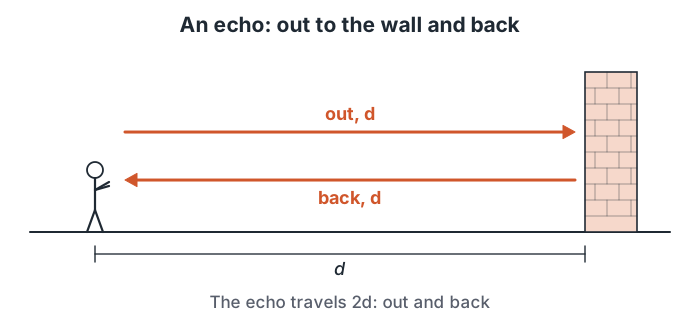
The echo arrives late because it has further to go. If the cliff is a distance d away, the clap travels d to the cliff and then d back again. By the time you hear the echo, the sound has travelled 2d.
 (enlarge)
Which surfaces give a clear echo? A hard, flat and large surface reflects sound well. Soft materials such as curtains, cushions and fresh snow reflect little: they absorb much of the sound, so their echo is weak. The surface must also be far enough away. Your ear hears two short sounds separately only when they arrive about 0.1 s or more apart. In 0.1 s sound in air travels about 34 m, there and back, so the reflecting surface must be more than about 17 m away. A nearer wall still reflects sound, but the reflection arrives so soon that it merges with the original sound and makes it seem longer. That is why a small tiled room rings instead of giving a separate echo.
Trap: “The echo time is the time for the sound to reach the wall.” The echo time covers the journey to the wall and back. Use the whole time with the whole path 2d, or halve the time before you find the distance to the wall.
Worked example
How far is the cliff?
A walker claps and hears the echo from a cliff 1.2 s later. Take the speed of sound in air as 340 m/s. Calculate the distance from the walker to the cliff.
In 1.2 s the sound travels distance = speed × time = 340 m/s × 1.2 s = 408 m. This is the journey there and back, 2d, so the cliff is half of it away: d = 408 m ÷ 2 = 204 m. Check the answer the other way round: a cliff 204 m away gives a path of 408 m, and 408 m ÷ 340 m/s = 1.2 s.
Measuring the speed of sound
An echo can be turned round. Measure the distance the sound travels and the time it takes, and you can calculate its speed: speed = distance ÷ time, where the distance is the whole path of the sound.
A method for a school field:
- Find a large, flat wall with open ground in front of it. Measure a distance d of about 100 m straight out from the wall with a long tape measure or a trundle wheel, and stand at that mark.
- Clap two wooden blocks together once and listen for the echo.
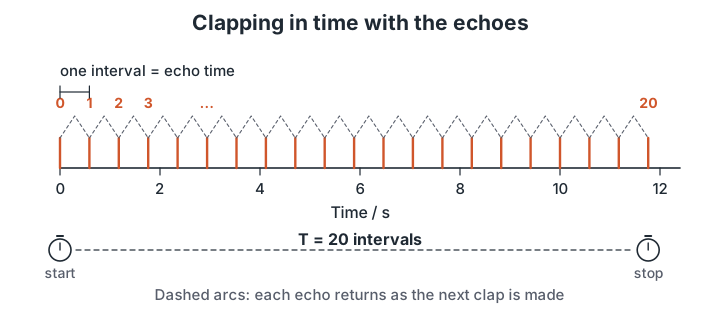
- Clap in a steady rhythm, adjusting it until each clap is made at the moment the echo of the clap before arrives. Then the time between claps equals the echo time.
- A partner starts a stop-clock on one clap, counted as “zero”, and stops it on the 20th clap after that. The stop-clock time T covers N = 20 intervals between claps.
- In each interval the sound travels to the wall and back, 2d. In N intervals it travels 2d × N, so speed v = 2dN ÷ T.
- Repeat the timing several times. Leave out any time that is clearly different from the rest (an anomalous result, or anomaly, for example when the rhythm was lost), and take the mean of the others.
 (enlarge)
Why time 20 intervals instead of one echo? A person takes roughly 0.1–0.2 s to react when starting and stopping a stop-clock. One echo from 100 m lasts only about 0.6 s, so a reaction delay of that size could change the time by a quarter or more. Twenty intervals take about 12 s; the same delays are now a small fraction of the total, and dividing by 20 shares them out. A longer distance helps in the same way, as long as the echo is still clear.
Worked example
Twenty-five intervals
A pupil stands 80 m from a wall. The partner times 25 intervals between claps and the stop-clock reads 11.6 s. Calculate the speed of sound.
The sound travels 2 × 80 m = 160 m in each interval, so in 25 intervals it travels 160 m × 25 = 4000 m. Speed = distance ÷ time = 4000 m ÷ 11.6 s = 344.8… m/s, which is 345 m/s to 3 significant figures. This lies inside the expected range for air, about 330–350 m/s. Check the echo time too: 11.6 s ÷ 25 = 0.464 s for each interval, long enough to hear separately.
Another way: see the flash, hear the bang
A second method uses two observers a measured distance apart, for example 600 m across an open field. One raises two wooden boards high and bangs them together. The other starts a stop-clock on seeing the boards meet and stops it on hearing the bang. Light crosses 600 m in about two millionths of a second, so the sight of the boards arrives practically at once, and the time measured is the time for the sound alone. Then v = d ÷ t, with d the distance between the observers. Here the sound makes one journey only, so there is nothing to halve. A starting pistol works the same way: the timer starts on the flash and stops on the bang.
The time is short, about 2 s, so reaction delays matter even more. Repeat many times and take a mean. Swapping the observers and repeating reduces the effect of any wind that carries the sound one way.
Worked example
Across the field
Observers stand 600 m apart. The mean time from seeing the boards meet to hearing the bang is 1.75 s. Calculate the speed of sound to 3 significant figures.
The sound travels 600 m once, in 1.75 s. Speed = 600 m ÷ 1.75 s = 342.857… m/s = 343 m/s to 3 significant figures. Notice the difference from the echo method: here the distance is the gap between two people, and the sound covers it once.
Try it in the experiment
In the experiment you stand on a school field 100 m from a wall. Predict how far the clap travels before its echo returns, time one echo by hand, then use the clapping rhythm to time 20 intervals. Calculate the speed and decide which repeat to leave out of the mean. The field and its timings are a model; on a real field the same method works with wooden blocks, a trundle wheel and a stop-clock.
Not to scale · no sound played
Returning to these ideas
Try the return questions at the next lesson without rereading first, then mix them with earlier wave questions after one or two weeks and again several weeks later. These are suggested review intervals, adjustable by your teacher. An immediate correct retry is useful practice; it does not show that you remembered the idea days later. The final check uses new cases, and its self-check criteria are teaching points, not official Cambridge marks.