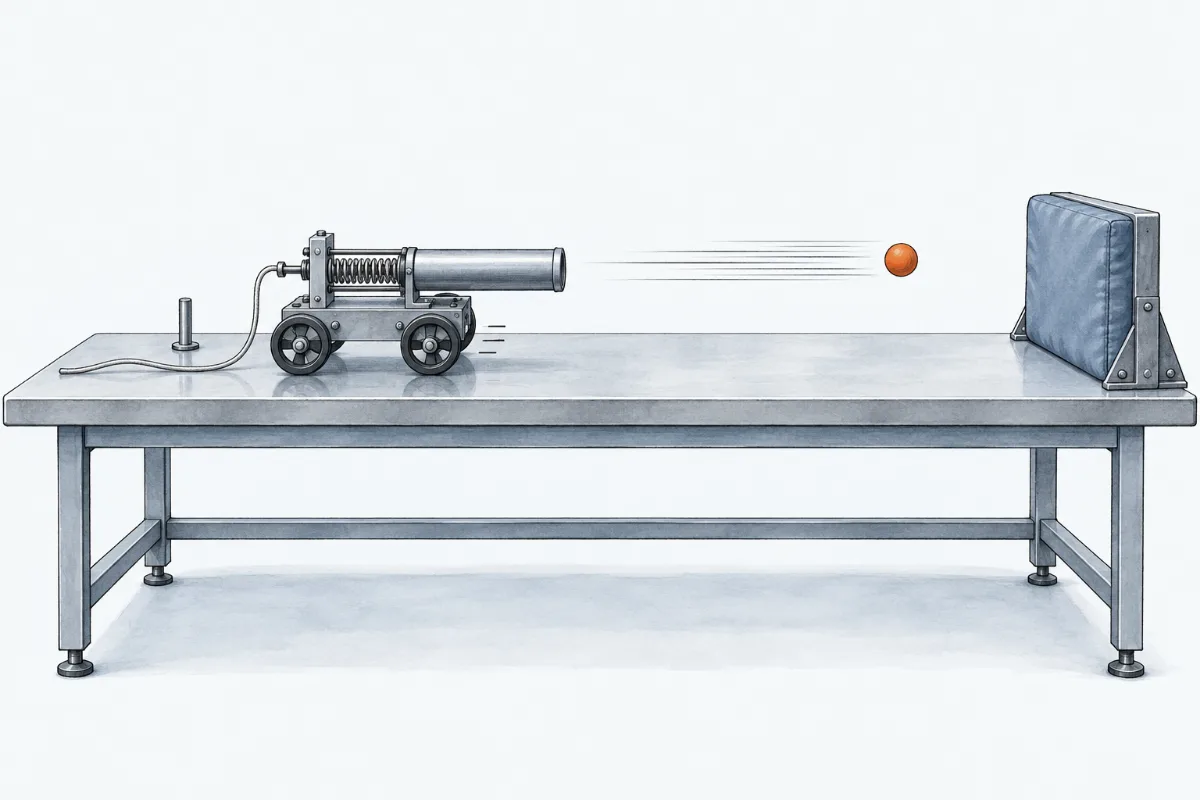
A toy cannon stands on wheels, perfectly still. A spring inside it fires a ball forwards, and at the same moment the cannon rolls backwards. Nothing outside the cannon pushed it back. The spring pushed the ball forwards, so why does the cannon move the other way? By the end of this part you can work out how fast it rolls back.
 (enlarge)
Momentum = mass × velocity
A loaded lorry and a bicycle both roll towards you at the same slow speed. The lorry is much harder to stop. A golf ball rolled gently towards you is easy to stop; the same golf ball hit hard is much harder to stop, because it is so fast. How hard a moving object is to stop depends on its mass and on its velocity together. Physicists call this its momentum.
Momentum is mass × velocity. As an equation:
p = mv
where p is the momentum, m the mass in kilograms and v the velocity in metres per second. The unit of momentum is the kilogram metre per second, kg m/s.
Worked example
Trolley, lorry and runner
A 0.50 kg trolley rolls along a track at 0.60 m/s. What is its momentum? What is the momentum of a 12 000 kg lorry moving at only 0.50 m/s? And a 70 kg runner has a momentum of 560 kg m/s: how fast is the runner going?
For the trolley, p = mv = 0.50 kg × 0.60 m/s = 0.30 kg m/s. For the lorry, p = 12 000 kg × 0.50 m/s = 6000 kg m/s: twenty thousand times the trolley's, although the lorry is slower. For the runner, rearrange the equation: v = p ÷ m = 560 kg m/s ÷ 70 kg = 8.0 m/s. Always use the mass in kilograms: 500 g is 0.50 kg.
Momentum has a direction
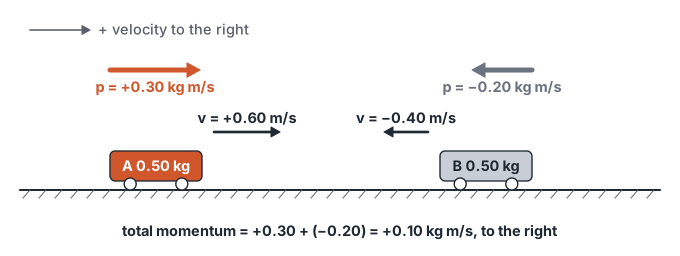
Velocity is speed in a given direction, so momentum has a direction too: the direction the object is moving. In a straight line you pick one direction as positive, usually to the right. Momentum to the right is then positive and momentum to the left is negative.
 (enlarge)
Trap: “Two trolleys of the same mass moving at the same speed have the same momentum.” Only if they move the same way. If one moves right and the other moves left, their momenta are equal in size but opposite in sign, for example +0.30 kg m/s and −0.30 kg m/s. Added together, they make zero.
Worked example
Two trolleys heading for each other
Trolley A, 0.50 kg, moves to the right at 0.60 m/s. Trolley B, also 0.50 kg, moves to the left at 0.40 m/s. Taking right as positive, what is their total momentum?
A's momentum is 0.50 kg × (+0.60 m/s) = +0.30 kg m/s. B moves to the left, so its velocity is −0.40 m/s and its momentum is 0.50 kg × (−0.40 m/s) = −0.20 kg m/s. The total is +0.30 + (−0.20) = +0.10 kg m/s, to the right. Forgetting the minus sign would give 0.50 kg m/s, which is wrong.
Conservation of momentum
When two objects collide, they push on each other. One gains momentum and the other loses exactly the same amount. So if nothing outside the two objects pushes on them, the total momentum stays the same:
The principle of conservation of momentum: when no resultant force from outside acts on a group of objects, their total momentum stays the same.
total momentum before = total momentum after
This is true for every collision, whether the objects stick together, bounce apart or crumple, as long as there is no resultant force from outside. On a level track the trolleys' weight is balanced by the track pushing up, and friction is small, so the total momentum of two trolleys stays the same while they collide.
Trap: “Momentum is lost when a trolley hits a wall and stops.” The wall is fixed to the Earth, so it pushes on the trolley from outside the trolley. That outside force takes the trolley's momentum away. The trolley's momentum goes to the wall and the Earth, which are so massive that their speed doesn't change noticeably. The total momentum of the trolley and the Earth together is still conserved.
Worked example
Two wagons couple together
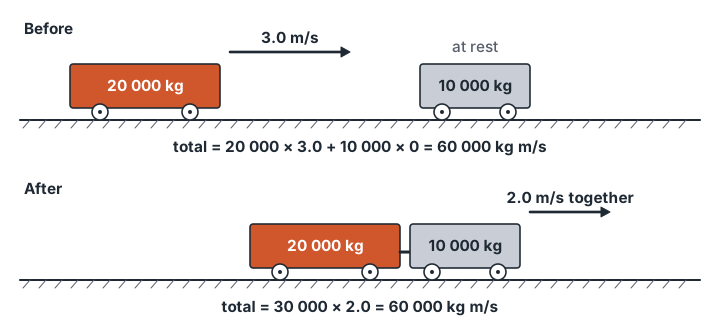
A railway wagon of mass 20 000 kg rolls at 3.0 m/s into a wagon of mass 10 000 kg standing still. They couple together and move off as one. How fast do they move?
 (enlarge)
Total momentum before = 20 000 kg × 3.0 m/s + 10 000 kg × 0 = 60 000 kg m/s. After, the wagons move together, a mass of 30 000 kg with one velocity v. Total momentum after = 30 000 kg × v. The two totals are equal, so 30 000 × v = 60 000 and v = 2.0 m/s, to the right. The joined wagons are slower because the same momentum is shared by a bigger mass.
Worked example
A trolley that bounces back
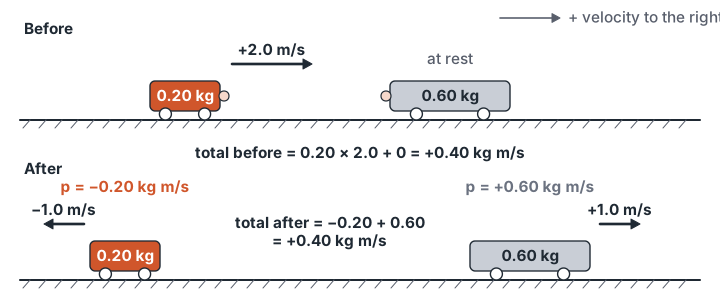
A 0.20 kg trolley moves to the right at 2.0 m/s and hits a 0.60 kg trolley at rest. Springy bumpers make it bounce back, to the left, at 1.0 m/s. What is the velocity of the 0.60 kg trolley after the collision?
 (enlarge)
Take right as positive. Before: 0.20 kg × (+2.0 m/s) + 0 = +0.40 kg m/s. After: the small trolley's momentum is 0.20 kg × (−1.0 m/s) = −0.20 kg m/s, and the big trolley's is 0.60 kg × v. So −0.20 + 0.60 v = +0.40, which gives 0.60 v = 0.60 and v = +1.0 m/s, to the right. If you forget that the bounce is negative, you get v = 0.33 m/s, which is wrong.
Explosions: starting from rest
When a cannon fires, or two trolleys at rest are pushed apart by a spring between them, the total momentum before is zero. So the total momentum after is zero too: the two parts move off in opposite directions with momenta equal in size. The lighter part moves faster. The backward movement of a gun or a cannon when it fires is called its recoil.
Worked example
How fast does the cannon roll back?
The toy cannon has a mass of 2.0 kg and stands still. It fires a 0.050 kg ball forwards at 8.0 m/s. How fast does the cannon roll back?
Take forwards as positive. Total momentum before = 0, because nothing is moving. The ball's momentum after is 0.050 kg × 8.0 m/s = +0.40 kg m/s. The total after must still be zero, so the cannon's momentum is −0.40 kg m/s. Its velocity is −0.40 kg m/s ÷ 2.0 kg = −0.20 m/s: it rolls backwards at 0.20 m/s. The cannon is 40 times heavier than the ball, so it moves 40 times more slowly.
Free play: nothing here is marked or saved
Toy cannon recoil
W05’s toy cannon: 2.0 kg, standing still, fires a 0.050 kg ball forwards at 8.0 m/s. Change the masses and the speed: what happens to the two momenta, and to their total?Supplement
Still picture: your device asks for less motion.
Try: Take the plates off: set the cannon to 0.5 kg. Which numbers change, and which stay the same?
- Ball’s p
- +0.40 kg m/s
- Cannon’s p
- −0.40 kg m/s
- Cannon’s v
- −0.20 m/s
total after = 0.050 kg × 8.0 m/s + 2.0 kg × v = 0
v = −0.40 kg m/s ÷ 2.0 kg = −0.20 m/s
Cannon: 40 times the ball’s mass, so 1/40 of its speed.
- W05: the ball’s momentum is 0.050 kg × 8.0 m/s = +0.40 kg m/s, so the 2.0 kg cannon’s is −0.40 kg m/s, and it rolls back at 0.20 m/s.
- Before it fires nothing moves, so the total momentum is zero. Nothing outside pushes along the floor, so the total is still zero after: the ball and the cannon move off in opposite directions with momenta equal in size, whatever their masses and the speed.
- The lighter part moves faster. The cannon is 40 times heavier than the ball, so it rolls back 40 times more slowly; with its plates off it is only 10 times heavier, and it rolls back four times as fast.
About this model. The floor is level and the wheels turn freely, so nothing outside pushes the cannon or the ball along the floor; gravity and the floor act only up and down. The ball falls a little as it flies, which does not change its momentum along the floor. The picture runs 20 times slower than real and stops as the ball reaches the cushion, because the cushion then pushes on it from outside. The cannon alone is 0.5 kg and each iron plate 0.5 kg. A real toy spring would fire a heavier ball more slowly; here you set the speed yourself. The ball is drawn bigger than a real one, and bigger when it is heavier; the two momentum arrows are drawn to one scale.
Collide two trolleys
Now try it on the bench, with real numbers that you measure yourself.
What is on the bench. A track with an end stop at each end. Trolley A (orange) and trolley B (grey) each have a mass of 0.50 kg, and a 0.50 kg block can be added to either of them. A motion sensor at each end of the track measures the velocity of the trolley nearest to it; velocity to the right counts as positive, so a trolley moving left gives a negative reading. On the tray are the noses you can fit to the trolleys: Velcro pads that make them stick, and magnets that make them bounce apart without touching. A velocity–time graph draws both trolleys as they move.
What you do. B waits in the middle of the track and you push A into it, at 0.60 m/s every time. First fit the Velcro, predict how fast the joined trolleys move, then push and work out the momentum before and after. Then swap the Velcro for the magnets, predict what A does, and push. Last, decide how to make A bounce back, and check that the total momentum is still the same.
What the experiment showed
Do the experiment before you read on. With the Velcro, A hit B and they stuck together. The joined trolleys moved off at 0.30 m/s, half A's speed, because the same momentum was now shared by twice the mass. With the magnets and equal masses, A stopped completely and B moved off at 0.60 m/s, the speed A had had. With the block on B, A bounced back at 0.20 m/s and B moved on at 0.40 m/s.
| Collision | Before (A only) | After | Total momentum after / kg m/s |
|---|---|---|---|
| Velcro | 0.50 kg × 0.60 m/s = 0.30 kg m/s | together: 1.00 kg × 0.30 m/s | 0.30 |
| magnets, equal masses | 0.50 kg × 0.60 m/s = 0.30 kg m/s | A: 0; B: 0.50 kg × 0.60 m/s | 0.30 |
| magnets, block on B | 0.50 kg × 0.60 m/s = 0.30 kg m/s | A: 0.50 kg × (−0.20 m/s); B: 1.00 kg × 0.40 m/s | −0.10 + 0.40 = 0.30 |
Every time, the total momentum after the collision was 0.30 kg m/s, the same as before. With springy bumpers like the magnets, a trolley that hits an equal trolley at rest stops. If it hits a lighter trolley, it carries on more slowly. It bounces back only from a heavier trolley, so putting the block on A, or pushing A harder, would not have made A bounce back.
Case closed
The cannon and the ball started at rest, so their total momentum was zero. The spring pushed the ball forwards and, just as hard, pushed the cannon backwards. The ball gained forward momentum and the cannon gained exactly as much backward momentum, so the total stayed zero. The heavy cannon rolls back slowly while the light ball flies off fast. Momentum is mass × velocity, it has a direction, and with no resultant force from outside, the total momentum is the same before and after.
About this model
The track, the trolleys and the sensors are simulated. The track is level and there is no friction while the trolleys are recorded, so nothing outside pushes them along the track during a collision. Each push sends A off at exactly 0.60 m/s, and the masses are exact. The magnets are modelled as perfectly springy, so no energy is lost when the trolleys bounce apart; real magnets and real trolleys lose a little, and the speeds after would be slightly smaller. Each collision takes a short time, 0.06 s with Velcro and 0.15 s with the magnets, and during it the total momentum stays the same at every instant. After the recording, the trolleys roll on until the end stops halt them.