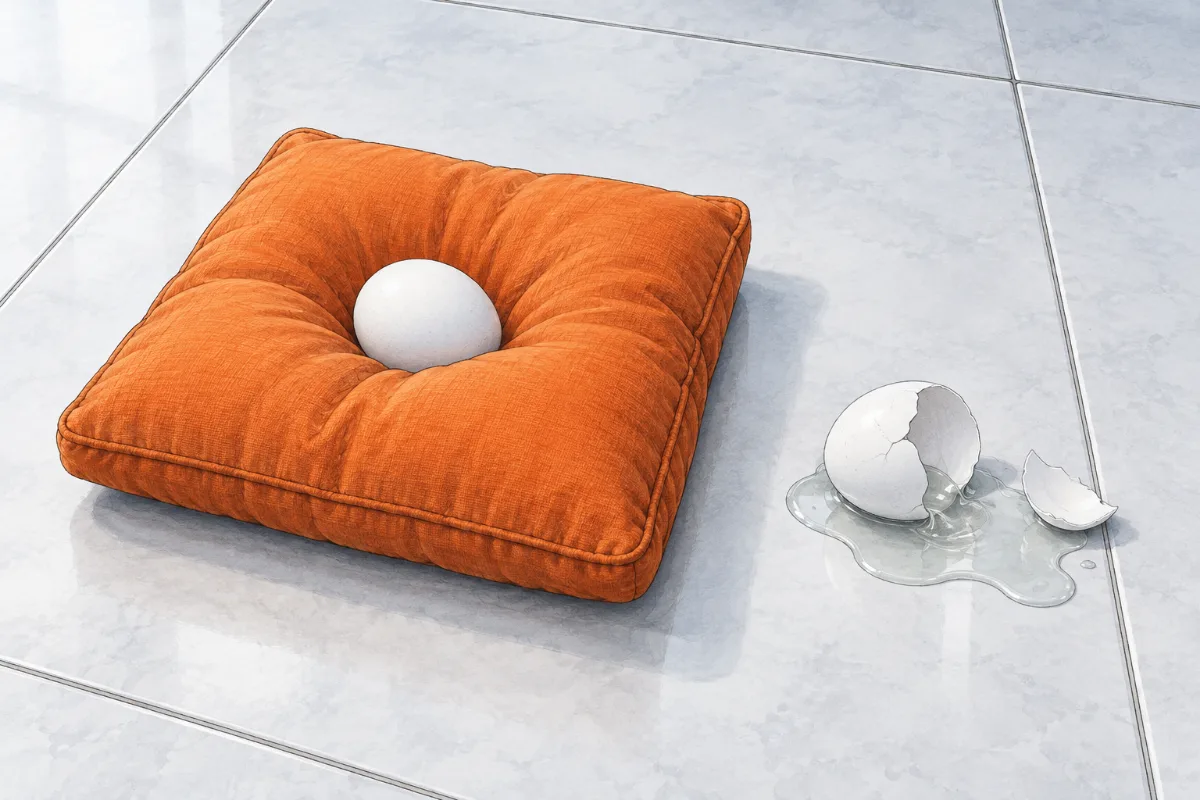
Drop an egg onto a hard floor and it smashes. Drop the same egg from the same height onto a thick cushion and it survives. The egg hits both at the same speed and ends up at rest both times, so it loses exactly the same momentum. Why does the floor break it and the cushion not? By the end of this part you can work out the force on the egg in each case.
 (enlarge)
Impulse = force × time
To change an object's momentum, a force must act on it for some time. A big force for a short time can do the same job as a small force for a long time. The product of the force and the time for which it acts is called the impulse:
impulse = F∆t
where F is the force in newtons and ∆t (say "delta t") the time for which it acts, in seconds. ∆ means "change in", so ∆t is the length of time from when the force starts to when it stops. The unit of impulse is the newton second, N s.
The impulse of the resultant force on an object is equal to the change in its momentum:
impulse = F∆t = ∆(mv)
∆(mv) is the change in momentum: the momentum after minus the momentum before. Because of this, the newton second and the kilogram metre per second are the same unit: 1 N s = 1 kg m/s.
Worked example
Kicking a football
A footballer kicks a 0.45 kg ball that was at rest. The ball leaves the boot at 20 m/s, and the boot touches it for 0.010 s. What impulse does the boot give the ball, and what is the average force on it?
The impulse equals the change in momentum: ∆(mv) = 0.45 kg × 20 m/s − 0 = 9.0 N s. Rearrange impulse = F∆t to find the force: F = impulse ÷ ∆t = 9.0 N s ÷ 0.010 s = 900 N. That is the average force over the 0.010 s. The force starts at zero, rises to a peak and falls back to zero, so for part of the time it is much bigger than 900 N.
Force = change in momentum ÷ time
Divide both sides of F∆t = ∆p by ∆t, using p for momentum:
F = ∆p ÷ ∆t
This is the definition of resultant force: the resultant force on an object is its change in momentum per unit time, the rate at which its momentum changes. The same change in momentum over a longer time needs a smaller force. When the mass doesn't change, ∆p ÷ ∆t = m∆v ÷ ∆t, and ∆v ÷ ∆t is the acceleration, so this is the same as F = ma.
Trap: “A bigger change in momentum always means a bigger force.” The force also depends on the time. A 100 kg crate pushed from rest to 2.0 m/s gains 200 kg m/s of momentum. Pushed for 10 s, that needs only 20 N; stopped by a wall in 0.10 s, the same 200 kg m/s needs 2000 N.
Worked example
The egg on the floor and on the cushion
A 0.060 kg egg hits the ground at 5.0 m/s and stops. On the floor it stops in 0.0020 s; on the cushion it stops in 0.10 s. What is the average force on the egg each time?
Change in momentum = 0.060 kg × 5.0 m/s = 0.30 kg m/s, the same both times. On the floor, F = ∆p ÷ ∆t = 0.30 ÷ 0.0020 = 150 N. On the cushion, F = 0.30 ÷ 0.10 = 3.0 N. The cushion makes the egg stop over a 50 times longer time, so the force is 50 times smaller. 150 N cracks the shell; 3.0 N doesn't.
Impulse is the area under a force–time graph
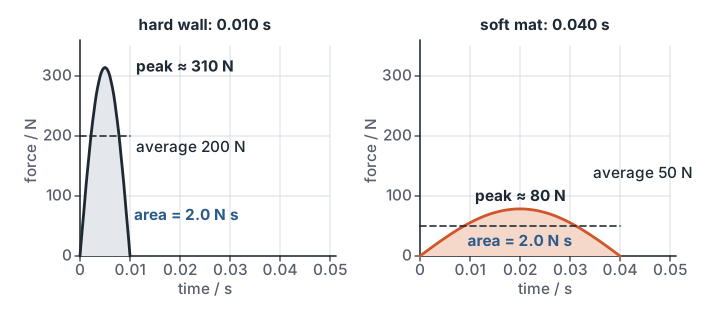
During an impact, the force changes from moment to moment. A force sensor can draw a graph of force against time. The area under the force–time graph is the impulse, so it is the change in momentum. If the graph is a triangle, its area is ½ × base × height: a force that rises to 60 N and falls back to zero in 0.050 s gives an impulse of ½ × 0.050 s × 60 N = 1.5 N s.
 (enlarge)
Trap: “The force in an impact is the highest point of the graph.” The highest point is the peak force, and the force is that big only for an instant. In F = ∆p ÷ ∆t, F is the average force over the whole time ∆t. The average is never bigger than the peak; in an impact, where the force rises and falls, it is smaller.
Worked example
A ball bounces off a wall
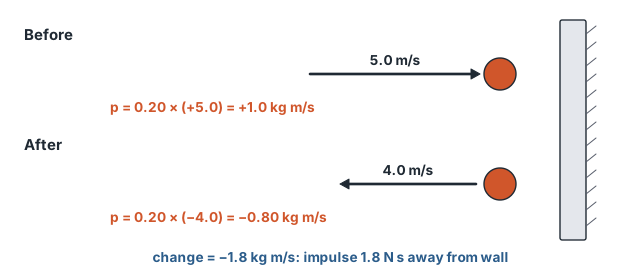
A 0.20 kg ball hits a wall at 5.0 m/s and bounces straight back at 4.0 m/s. It touches the wall for 0.030 s. What is the change in its momentum, and the average force of the wall on it?
 (enlarge)
Take towards the wall as positive. Momentum before = 0.20 kg × 5.0 m/s = +1.0 kg m/s. Momentum after = 0.20 kg × (−4.0 m/s) = −0.80 kg m/s. Change = after − before = −0.80 − 1.0 = −1.8 kg m/s. So the impulse is 1.8 N s, away from the wall, and the average force is 1.8 N s ÷ 0.030 s = 60 N, away from the wall. If you forget that the ball's direction has changed, you get only 0.20 N s, which is wrong. A bounce changes the momentum more than a stop does.
Crumple zones, airbags and seat belts
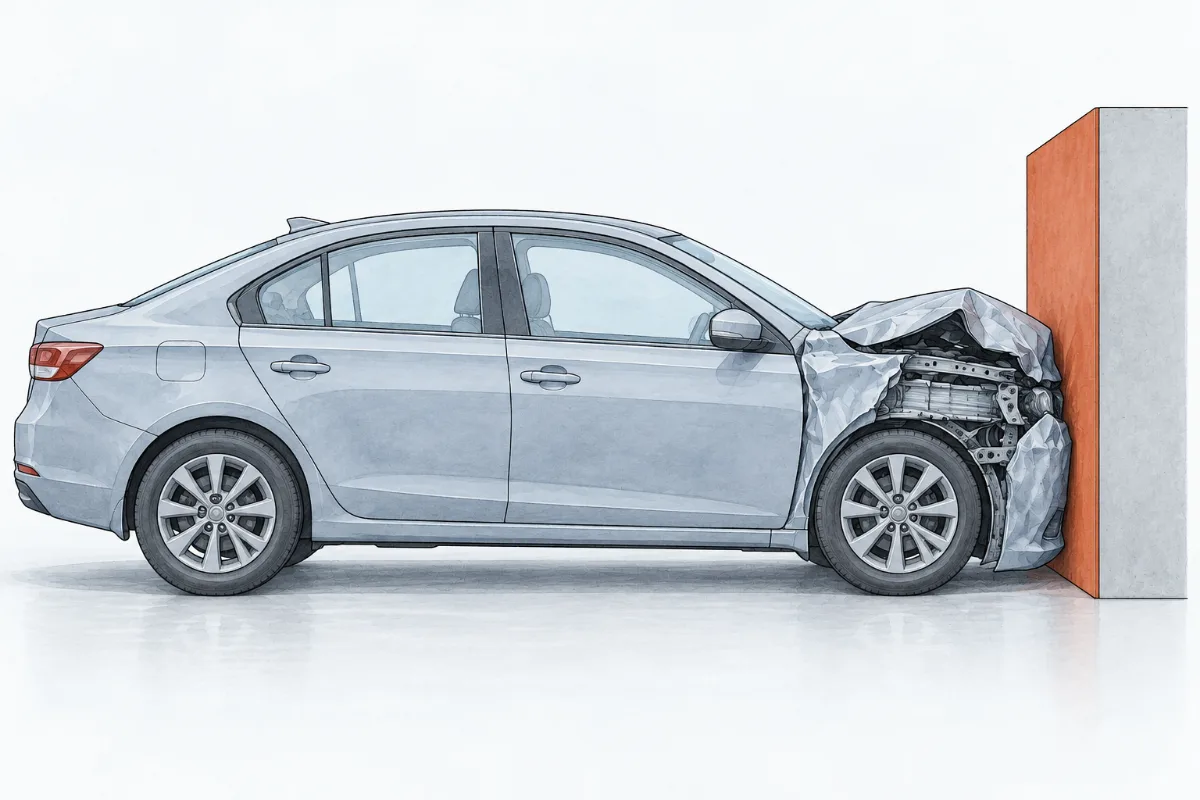
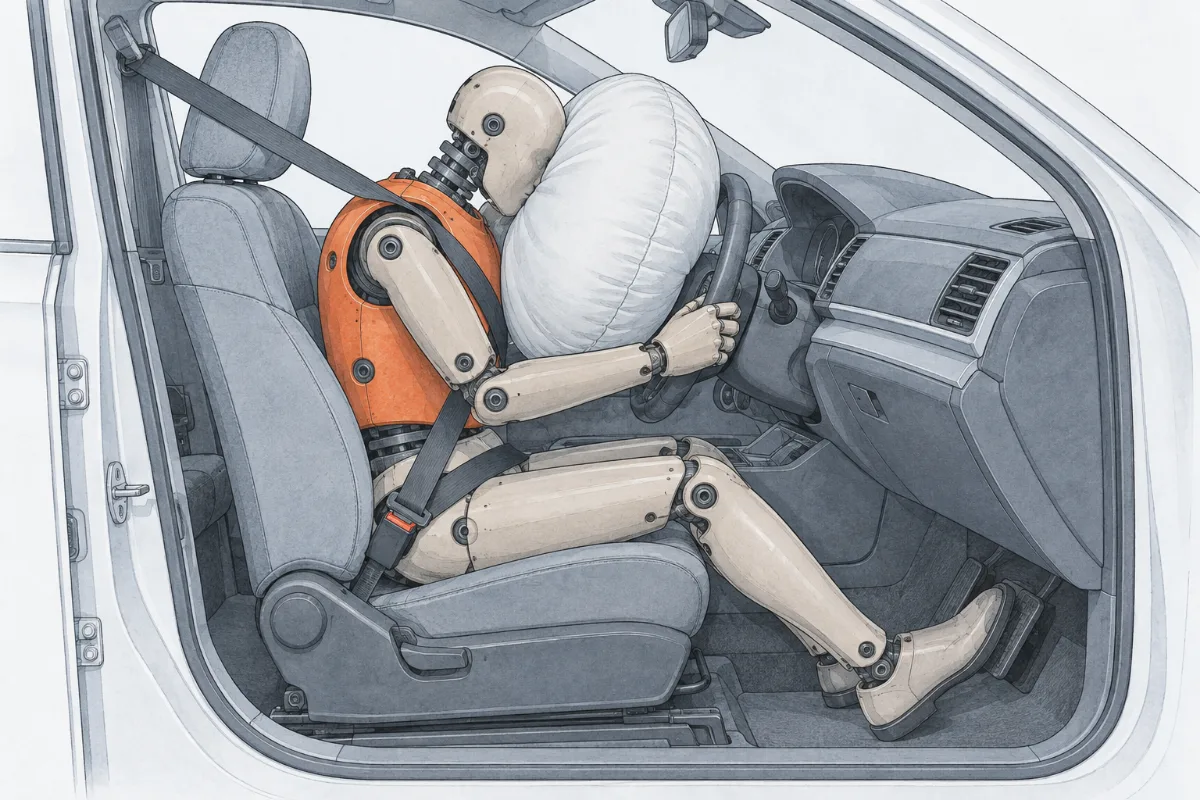
In a crash, a car and the people in it stop: their change in momentum is fixed by their mass and their speed. The only thing safety features can change is the time over which they stop. The longer that time, the smaller the force, F = ∆p ÷ ∆t, and the less damage is done to people.
 (enlarge)
- A crumple zone at the front of a car is built to squash in a crash. While it crumples, the car keeps moving for a little longer, so it stops over a longer time and the force on the cabin is smaller.
- An airbag inflates in front of a passenger. The head sinks into it and stops over a longer time than if it hit the steering wheel, and the force is spread over a bigger area.
- A seat belt stretches a little, so the body stops over a longer time, and it holds the body back from hitting the windscreen.
A cycle helmet has a foam lining that crushes when the head hits the ground, so the head stops over a longer time. Crash mats, padded dashboards and bending your knees when you land from a jump all work in the same way.
 (enlarge)
Worked example
Airbag or steering wheel
In a crash, a driver's head, of mass 5.0 kg, moves forwards at 14 m/s and must stop. Hitting the steering wheel, it stops in 0.010 s. Sinking into an airbag, it stops in 0.10 s. Find the average force on the head each time.
Change in momentum = 5.0 kg × 14 m/s = 70 kg m/s, whatever stops the head. Steering wheel: F = 70 ÷ 0.010 = 7000 N. Airbag: F = 70 ÷ 0.10 = 700 N. The airbag makes the head stop over a 10 times longer time, so the average force is 10 times smaller.
Crash test on the bench
Now find out on the bench what a crumple zone does to the force.
What is on the bench. The same track and trolley A, 0.50 kg. A force sensor is fixed to the right-hand end of the track, and it draws a graph of force against time while something presses on it. On the tray are two noses for A: a stiff one, and a crumple nose that squashes like a car's crumple zone. A motion sensor at the left end measures A's velocity. The impact is over in less than a fifth of a second, so the bench plays it ten times slower for you to watch.
What you do. Fit the stiff nose and push A into the force sensor, at 0.60 m/s as before. Work out its change in momentum. Then predict how the graph changes with the crumple nose, fit it and push A again at the same speed. Work out the average force with each nose.
What the experiment showed
Do the experiment before you read on. Both times, A hit the force sensor at 0.60 m/s and stopped without bouncing back, so its change in momentum was 0.50 kg × 0.60 m/s = 0.30 N s both times. The two graphs looked very different:
| Nose | Contact time / s | Change in momentum / N s | Average force / N | Peak force / N |
|---|---|---|---|---|
| stiff | 0.020 | 0.30 | 0.30 ÷ 0.020 = 15 | about 24 |
| crumple | 0.15 | 0.30 | 0.30 ÷ 0.15 = 2.0 | about 3 |
The stiff nose gave a tall, narrow peak; the crumple nose gave a low, wide hump. The shaded areas under the two graphs were equal, because the area is the impulse, 0.30 N s both times. The crumple nose made the trolley stop over a time more than seven times longer, so the average force was more than seven times smaller.
Case closed
The egg loses the same momentum on the floor and on the cushion, so the impulse on it, F∆t, is the same. The floor stops it in a very short time, so the force is big enough to crack the shell. The cushion squashes and stops the egg over a much longer time, so the force is small. Impulse is force × time, it equals the change in momentum, and the resultant force is the change in momentum per unit time. Crumple zones, airbags and seat belts save lives by making the stop take longer.
About this model
The trolley, the noses and the force sensor are simulated. The track is level and there is no friction, so A always reaches the sensor at 0.60 m/s, and both noses stop it without any bounce. The force from each nose rises and falls smoothly, in the shape of half a sine wave, lasting 0.020 s for the stiff nose and 0.15 s for the crumple nose; real noses give less tidy curves. The impact is shown ten times slower than it really happens, but the graph's time axis shows real seconds.