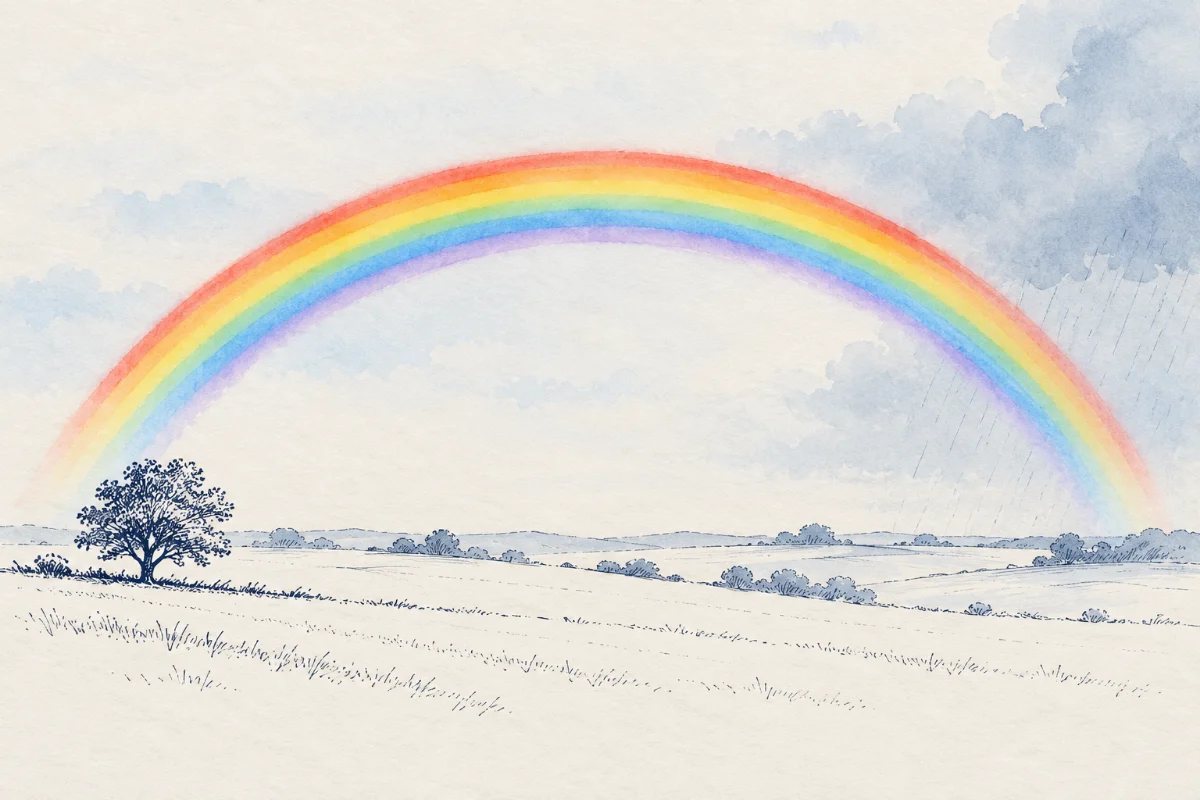
After a summer shower the Sun comes out behind you, and a rainbow stands over the wet field ahead: red along the outside of the arc, then orange, yellow, green, blue and violet on the inside. A minute ago the same sunlight fell on the field, and it was white. Where did the colours come from? And what lies beyond the red edge of the bow, where the sky looks plain grey? In 1800 the astronomer William Herschel asked a question like that with a glass prism and a few thermometers, and found something that nobody can see. This part is about splitting white light into its colours, and about the radiation on either side of the colours that your eyes cannot see.
 (enlarge)
White light through a prism
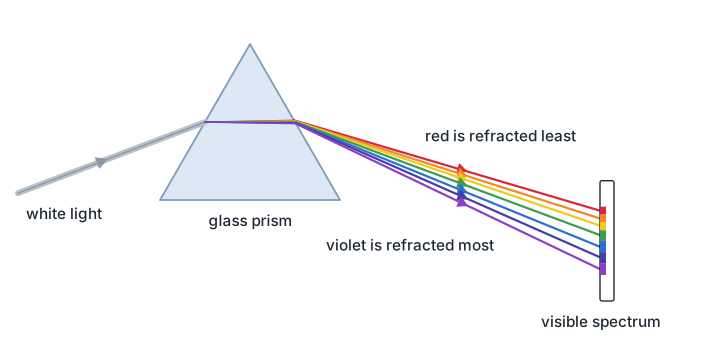
A prism is a block of glass with flat faces; the usual one is a triangular prism, with faces at 60° to each other. When a narrow beam of sunlight passes through it, the light is refracted twice: once where it enters the glass and once where it leaves. A beam that goes in white comes out as a band of colours spread side by side, like a small rainbow. On a white card, the colours show in order: red, orange, yellow, green, blue, indigo and violet. This band is the visible spectrum.
White light is a mixture of all these colours. In a vacuum, and very nearly in air, they all travel at the same speed, but in glass each colour is slowed by a slightly different amount, so each is refracted by a different amount: violet light is refracted the most and red light the least. Every time the light crosses a face of the prism the colours bend apart a little more. Splitting white light into its colours by refraction is called dispersion.
 (enlarge)
Trap: “The glass of the prism colours the light.” The colours were already in the white light; the prism only spreads them apart. Isaac Newton showed this by sending one colour from his spectrum through a second prism: it was bent again, but stayed the same colour. And a second prism turned the other way gathers the spread-out colours back into white light.
The seven colours in order
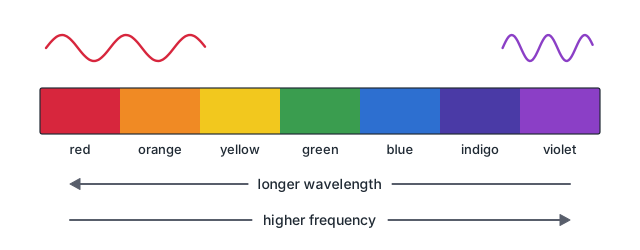
The seven colours of the spectrum are traditional: Isaac Newton named seven, and in fact each colour fades into the next without a sharp edge. A way to remember the order is “Richard Of York Gave Battle In Vain”: red, orange, yellow, green, blue, indigo, violet.
Light is a wave, and each colour has its own wavelength and frequency. Red light has the longest wavelength and the lowest frequency of the seven; violet light has the shortest wavelength and the highest frequency. The wavelengths are tiny: about 0.0007 mm for red and 0.0004 mm for violet. The two orders always go opposite ways, because every colour travels at the same speed in air, and for a wave speed = frequency × wavelength (v = fλ): a wave with more crests passing each second must have its crests closer together.
 (enlarge)
Trap: “Violet is refracted most, so violet has the longest wavelength.” The colour that bends most has the shortest wavelength and the highest frequency. Red, bent least, has the longest wavelength and the lowest frequency.
Worked example
Ordering colours
(a) Put green, red, violet and yellow light in order of frequency, lowest first. (b) Put the same colours in order of wavelength, shortest first. (c) Which of them does a prism refract the most?
(a) In the spectrum from red to violet the frequency rises: red, yellow, green, violet. (b) The wavelength falls from red to violet, so the shortest wavelength comes first: violet, green, yellow, red, the frequency order turned round. (c) The prism refracts violet light the most. Lowest frequency first: red, yellow, green, violet; shortest wavelength first: violet, green, yellow, red; violet is refracted most.
On the prism bench
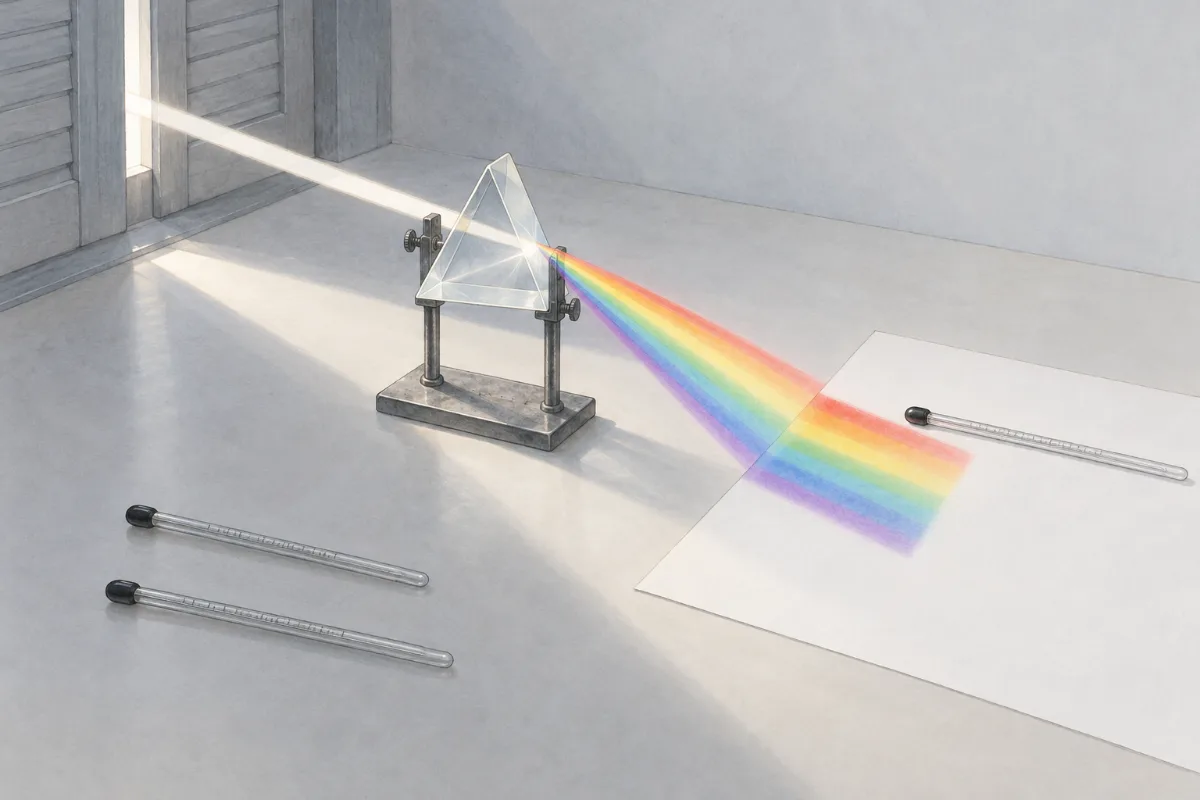
Now repeat the experiment that Herschel did, with a glass prism and some thermometers.
What is on the bench. A dark room with a sunny window. The blind is closed, except for a narrow slit, 2 mm wide, that lets in a thin beam of sunlight. The beam falls on a glass prism standing on a stand, and the light from the prism lands on a large white card lying on the bench below it. Next to the card wait four thermometers, all reading the room temperature of 20.0 °C. Their bulbs are painted black, so they absorb whatever falls on them well, as you found in Thermal radiation. There is also a strip of white card painted with the ink of a security pen, the kind used to write postcodes invisibly on bikes, and, for the last step (Supplement), a red laser pointer.
What you do. Predict what the prism does to the white sunlight, then turn it until the colours appear on the card, and decide their order. Then lay one thermometer in the blue, one in the red, one just beyond the red where nothing can be seen, and one in the shade beside the card, as a control. Predict which reading rises most, and wait 5 minutes. Next, predict what the security-pen strip shows just beyond the violet, and lay it there. Finally (Supplement), aim the red laser through the prism instead of the sunlight. Never look at the Sun, even through the prism, and never look into a laser beam or shine it at anyone.
What the experiment showed
Do the experiment before you read on. The thin beam of white sunlight came out of the prism as a fan of colours, and on the card it made a band about 9 cm wide: red at one end, nearest the straight-on line, and then orange, yellow, green, blue, indigo and violet. The violet light had been refracted the most and the red light the least.
After 5 minutes, the thermometers read like this (values from the model, see “About this model” at the end). The time was sped up: in a real room you wait the full 5 minutes.
| Where the black bulb lay | At the start | After 5 minutes | Rise |
|---|---|---|---|
| in the blue | 20.0 °C | 21.0 °C | 1.0 °C |
| in the red | 20.0 °C | 22.4 °C | 2.4 °C |
| just beyond the red, where nothing was seen | 20.0 °C | 23.2 °C | 3.2 °C |
| in the shade beside the card (control) | 20.0 °C | 20.0 °C | 0.0 °C |
Every thermometer in the light warmed up, so visible light heats things that absorb it. But the biggest rise of all was just beyond the red, where the card looked dark. Something from the Sun was arriving there, passing through the prism and being refracted even less than red light, and it carried energy into the black bulb. The control in the shade did not change, so the rises came from what fell on the bulbs, not from the room warming up.
Beyond the other end, the security-pen strip glowed pale blue just past the violet, where the card looked dark. In the colours, the strip only looked the colour of the light on it, and in the shade it stayed plain white. So something invisible arrives beyond the violet too, refracted even more than violet light.
(Supplement) The red laser beam came out of the prism as one red spot on the card, bent about as much as the red of the spectrum, but not spread into colours.
Infrared and ultraviolet
The spectrum does not stop where your eyes stop seeing it. Beyond the red end is infrared radiation (“infra” means below: its frequency is below that of red light). Herschel found it in 1800 with thermometers like yours: your skin feels it as warmth, and it is the same infrared that hot objects give out, which you met in Thermal radiation. Beyond the violet end is ultraviolet radiation (“ultra” means beyond: its frequency is beyond that of violet light). A year later, in 1801, Johann Ritter found it with paper soaked in a silver chemical, which darkened fastest just beyond the violet. Some inks and paints glow when ultraviolet falls on them, which is how the security-pen strip showed it.
 (enlarge)
Trap: “Infrared is red light that is too faint to see.” Infrared is not a colour at all: it is radiation with a longer wavelength and lower frequency than red light, and your eyes cannot detect it however bright it is. The thermometer beyond the red warmed the most, yet the card there looked dark.
Worked example
A control thermometer
A class repeats Herschel’s experiment on another day, with four thermometers with blackened bulbs that all start at 19.5 °C. After 10 minutes they read: in the violet 20.3 °C, in the yellow 21.0 °C, just beyond the red 22.1 °C, and in the shade beside the card (the control) 19.8 °C. (a) Find the rise of each thermometer. (b) Why did the class use a control, and what does it show today? (c) What do the results show about the region beyond the red?
(a) Rise = final reading − starting reading: violet 20.3 − 19.5 = 0.8 °C, yellow 21.0 − 19.5 = 1.5 °C, beyond the red 22.1 − 19.5 = 2.6 °C, control 19.8 − 19.5 = 0.3 °C. (b) The control is the same kind of thermometer, left for the same time, but out of the light. It shows how much the room itself warmed: 0.3 °C. Taking that away, the light added about 0.5 °C in the violet, 1.2 °C in the yellow and 2.3 °C beyond the red. (c) The biggest rise is beyond the red, where no light is seen: invisible radiation arrives there, and it heats what absorbs it. This is infrared.
Supplement: Light of a single frequency
The red of the spectrum is not one single wave: it is a band of slightly different frequencies, from deep red to the edge of orange. Light that has just one frequency is called monochromatic. A laser gives light that is very nearly monochromatic, and so does a sodium street lamp, with its deep yellow glow. That is what the laser showed on the card: a prism cannot spread monochromatic light into colours, because there is only one frequency in it to refract, so the beam is bent but stays one colour.
Trap: “Monochromatic light means light of one colour band, such as all the red light of the spectrum.” Monochromatic means one frequency. The red band of a spectrum still holds many frequencies, which a prism spreads out a little.
Worked example
Which light is monochromatic?
Supplement. Three beams are sent, one at a time, through the same glass prism onto a white card: (a) a narrow beam from a filament lamp, (b) the beam of a green laser pointer, (c) the yellow light of a sodium street lamp, through a narrow slit. For each beam, say whether it is monochromatic and describe what the card shows.
(a) The filament lamp gives white light, a mixture of very many frequencies, so it is not monochromatic: the prism spreads it into a spectrum from red to violet. (b) The laser gives light of very nearly one frequency, so it is monochromatic: the card shows one green spot, bent by the prism but not spread into colours. (c) The sodium lamp’s light is also very nearly one frequency: the card shows one narrow yellow line. Only the filament lamp’s white light is spread into a spectrum; the laser and the sodium lamp give monochromatic light, which the prism bends but cannot spread.
The electromagnetic spectrum
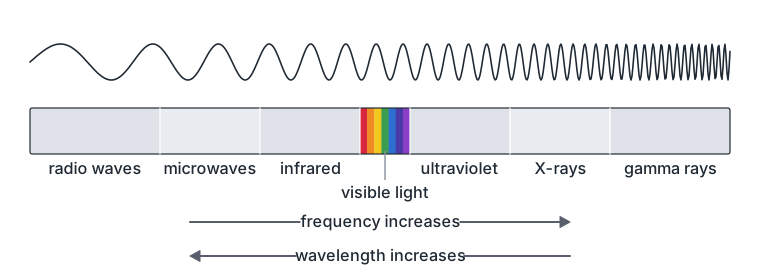
Visible light, infrared and ultraviolet are three members of one family of waves: the electromagnetic waves. All of them are transverse waves, as you saw in Waves, and all of them travel at the same very high speed in a vacuum. The whole family, in order, is the electromagnetic spectrum. It has seven main regions. From the lowest frequency and longest wavelength to the highest frequency and shortest wavelength, they are:
radio waves, microwaves, infrared, visible light, ultraviolet, X-rays, gamma rays.
The regions run into each other without sharp edges, and visible light is only a very narrow band in the middle. Radio waves can be longer than a football pitch, while the wavelength of gamma rays is far smaller than an atom. Along the spectrum, the frequency rises as the wavelength falls, just as it does from red to violet.
 (enlarge)
Trap: “Radio waves are sound waves, because a radio makes sound.” Radio waves are electromagnetic waves, like light; they can cross the vacuum of space, where sound cannot travel. A radio receives them and turns the signal they carry into sound.
Worked example
Ordering regions
(a) Put X-rays, radio waves, visible light and microwaves in order of frequency, lowest first. (b) Which of these four has the longest wavelength? (c) Which region lies between visible light and X-rays?
(a) In the electromagnetic spectrum the frequency rises from radio waves to gamma rays, so the order is radio waves, microwaves, visible light, X-rays. (b) The lowest frequency goes with the longest wavelength: radio waves. (c) Between visible light and X-rays lies ultraviolet. Radio waves, microwaves, visible light, X-rays; radio waves have the longest wavelength; ultraviolet lies between.
Case closed
Back to the rainbow. Each raindrop does what the prism did: sunlight is refracted as it enters the drop, reflected off the back of it and refracted again as it leaves, and each colour is refracted by a slightly different amount. So the colours leave each drop in slightly different directions, and you see red from drops higher in the sky and violet from drops lower down: a band of colours with red on the outside of the arc. And beyond the red edge of the bow? The raindrops send infrared there too, refracted even less than red. Your eyes cannot see it, but a camera that detects infrared photographs it as a band just outside the red. Inside the violet edge there is ultraviolet, just as on the card. The colours you see are only the narrow middle of a much wider spectrum.
About this model
The room, the sunlight, the prism, the thermometers, the strip and the laser are simulated. The prism is made of a dense glass that spreads the colours widely; even so, the band of about 9 cm on the card is drawn two or three times wider than a real prism this close to the card would make it, so that each colour, and the bulbs lying in them, can be seen. The slit is narrow, so the colours overlap only a little. The temperature rises are the model’s values, chosen to show the pattern that Herschel found: every part of the spectrum heats a black bulb, and the bulb just beyond the red warms most. A real spectrum from a glass prism squeezes the red end together and spreads the violet end, so the red end gets more energy for each centimetre of card; real rises depend on the weather, the time of day and the thermometers, and a passing cloud can spoil a run. Ordinary glass absorbs much of the Sun’s ultraviolet, so a real glass prism shows only a little of it; the strip’s glow is drawn brighter than a real one, so you can see it. A real laser pointer is very nearly monochromatic, with a very narrow spread of frequencies.