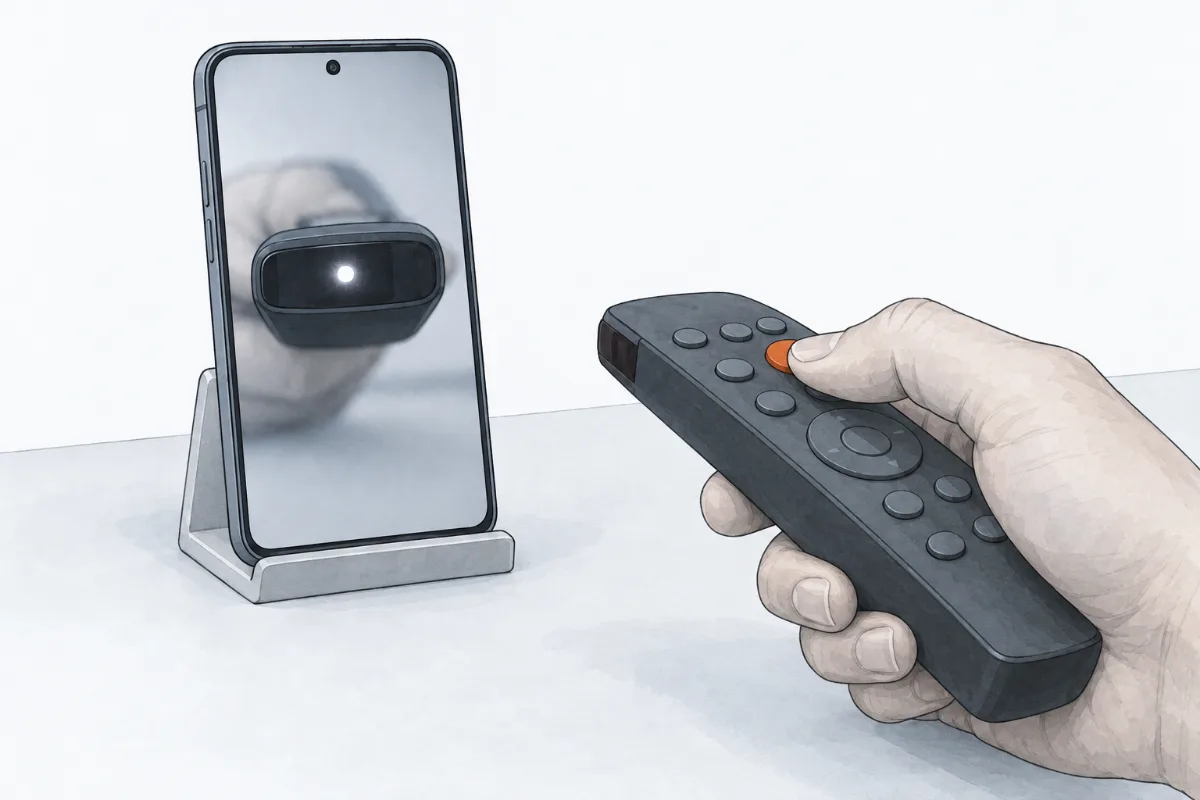
Point a TV remote at the camera of a phone, press a button, and watch the phone’s screen. Look at the front of the remote itself and you see nothing at all; on the screen, a small light flashes on and off. The remote talks to the television with infrared, which your eyes cannot detect but the camera can. Every region of the electromagnetic spectrum is at work around you like this, in phones and kitchens, in banks and hospitals, mostly unseen. This part is about what each region is used for and why, and about what too much of it can do to the body.
 (enlarge)
One family, one speed
Radio waves, microwaves, infrared, visible light, ultraviolet, X-rays and gamma rays are all electromagnetic waves. They differ in frequency and wavelength, but in a vacuum all electromagnetic waves travel at the same high speed, the speed of light. The light from the Sun, and the infrared and ultraviolet that come with it, cross the empty space to the Earth in the same time: about 8 minutes. A space probe’s radio message travels exactly as fast as the light from the probe’s lamp, and the X-rays that astronomers detect from a distant star have crossed space as fast as its light.
Trap: “Gamma rays have the highest frequency, so they travel fastest.” In a vacuum every region travels at the same speed. A higher frequency means a shorter wavelength, not a higher speed: speed = frequency × wavelength stays the same.
Supplement: The speed of electromagnetic waves
In a vacuum, electromagnetic waves travel at 3.0 × 10⁸ m/s: 300 000 kilometres every second, fast enough to go round the Earth more than seven times in one second. In air their speed is approximately the same, only a tiny fraction slower. In glass and water they are slower, which is why they are refracted, as you saw in Refraction.
To find how long a signal takes, use time = distance ÷ speed, with the speed 3.0 × 10⁸ m/s. The Sun is 1.5 × 10¹¹ m away, so its light takes 1.5 × 10¹¹ m ÷ 3.0 × 10⁸ m/s = 500 s, a little over 8 minutes, to reach you.
Worked example
A message from Mars
A rover on Mars sends a radio message to the Earth, and at the same moment its lamp flashes. (a) Does the light of the flash, seen through a large telescope on the Earth, arrive before, after or with the radio message? (b) Supplement. The two planets are 9.0 × 10¹⁰ m apart. How long does the message take to arrive?
(a) Light and radio waves are both electromagnetic waves, and in the vacuum of space they travel at the same speed, so the light of the flash arrives with the radio message. (b) Time = distance ÷ speed = 9.0 × 10¹⁰ m ÷ 3.0 × 10⁸ m/s = 300 s, which is 5 minutes. The light of the flash arrives with the message; (Supplement) the message takes 300 s, 5 minutes.
Uses, region by region
Each region has uses that fit what it does: what it passes through, what absorbs it, and what gives it out.
| Region | Typical uses | Why it suits the job |
|---|---|---|
| Radio waves | radio and television transmissions; astronomy (radio telescopes); radio frequency identification (RFID) tags | they travel long distances and spread round hills and buildings; stars and galaxies give them out; a tag in a travel card, a library book or a pet’s microchip answers a reader held close to it |
| Microwaves | satellite television; mobile phones; microwave ovens | they pass through the atmosphere and clouds to a satellite and back; short waves suit the small aerial in a phone; water in food absorbs them and heats up |
| Infrared | electric grills; remote controllers for televisions (short-range communication); intruder alarms; thermal imaging; optical fibres | surfaces absorb it and warm up; it does not pass through walls, so it stays in the room; warm bodies give it out, so a detector or a camera can sense people in the dark; it travels a long way along very clear glass fibres |
| Visible light | vision; photography; illumination | eyes and camera sensors detect it |
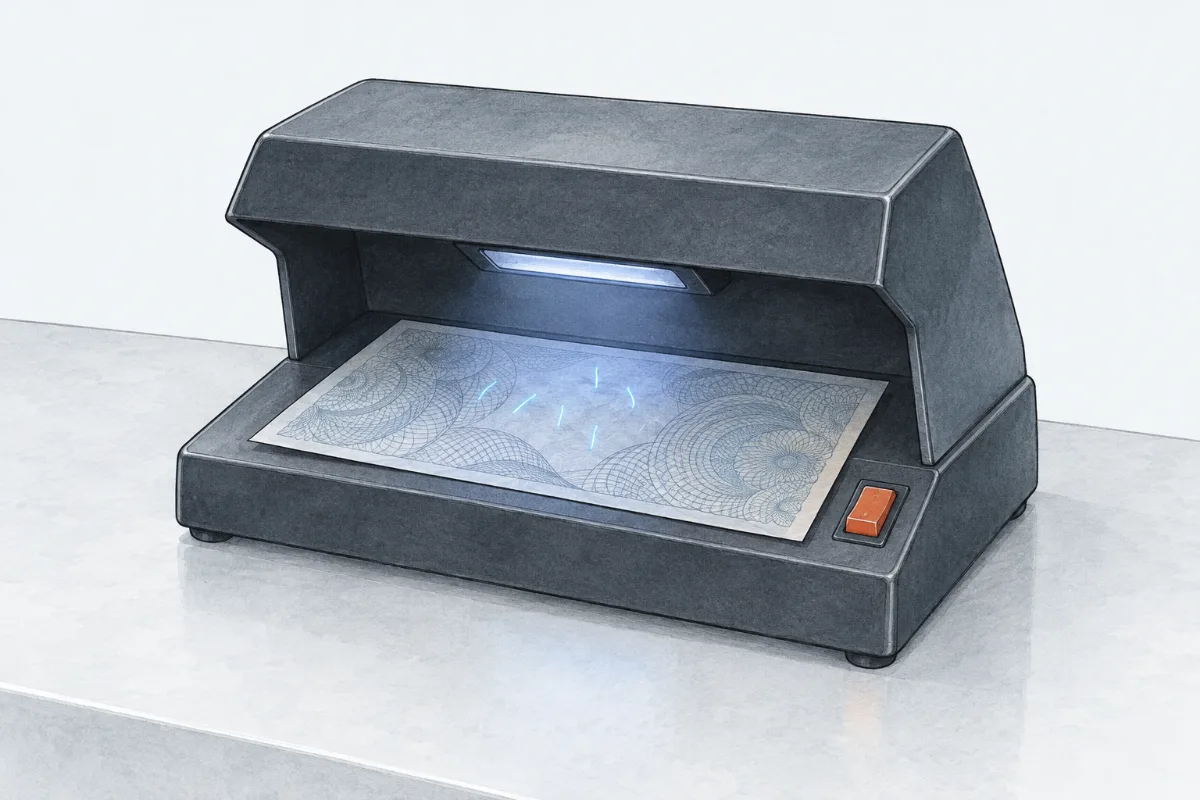
| Ultraviolet | security marking; detecting fake bank notes; sterilising water | it makes special inks glow; it kills bacteria and viruses |
| X-rays | medical scanning; security scanners | they pass through soft materials such as skin, muscle, clothes and bags, but bone and metal absorb them |
| Gamma rays | sterilising food and medical equipment; detection of cancer and its treatment | they pass right through packaging and kill bacteria; a substance that gives out gamma rays shows where cancer cells are, and a beam aimed at a tumour kills its cells |
Two of these you can see working for yourself. A remote control flashes a code in infrared, and the detector on the television reads it; the camera of a phone shows the flashes. A bank note checker shines ultraviolet on a note: a real note has marks and fibres printed in ink that glows under ultraviolet, and many fakes do not. In the same way, a security pen writes a postcode on a bike in ink that is invisible in daylight and glows under an ultraviolet lamp.
 (enlarge)
Trap: “Bones show up on an X-ray picture because they reflect X-rays.” The X-rays pass through skin and muscle to the detector behind, but bone absorbs them, so the bone leaves a pale shadow on the picture where fewer X-rays arrive.
On the spectrum ladder
Now match devices to the regions they use.
What is on the bench. A spectrum ladder card: seven rungs, one for each region, with radio waves on the bottom rung (the longest wavelength and the lowest frequency) and gamma rays on the top rung (the shortest wavelength and the highest frequency). Beside it lie seven device cards: a radio and television mast, a microwave oven, a TV remote, a camera, a bank note checker, an X-ray machine and a radiotherapy machine for treating cancer.
What you do. Place each device on the rung of the region it uses: choose a device, then a rung. When a device is in its place, the card says what that device uses the region for, and the harm that too much of the region can do to the body; the table under the card collects them. When all seven are placed, decide what is the same for every rung.
What the experiment showed
Do the experiment before you read on. From the bottom of the ladder to the top: the mast on radio waves, the oven on microwaves, the remote on infrared, the camera on visible light, the note checker on ultraviolet, the X-ray machine on X-rays and the radiotherapy machine on gamma rays. Each region does a different job because each interacts differently with matter: radio waves pass through walls, microwaves heat the water in food, ultraviolet makes inks glow, X-rays pass through skin and muscle but not bone, and gamma rays pass right through the body.
What is the same for every rung is the speed in a vacuum. The wavelength and the frequency change from rung to rung, the wavelength getting shorter and the frequency higher as you climb, but every region travels through a vacuum at the same speed, (Supplement) 3.0 × 10⁸ m/s.
Too much of a good thing
Electromagnetic waves carry energy, and the body absorbs some of it. In small amounts most regions do no harm, but too much of some of them, or too long in them, is harmful.
- Microwaves pass into the body and are absorbed by the water in it, causing internal heating of body cells. That is why a microwave oven has a metal mesh in its door and stops as soon as the door opens.
- Infrared is absorbed by the skin, and too much causes skin burns: standing too close to a fire or a grill.
- Ultraviolet damages the surface cells of the skin and the eyes. You cannot feel ultraviolet: the warmth of sunshine is mostly its infrared, and sunburn shows only hours later. Too much sunlight causes sunburn and, over the years, can lead to skin cancer and eye conditions, such as cataracts, which cloud the lens of the eye. Sunscreen, hats and sunglasses that block ultraviolet protect you.
- X-rays and gamma rays pass deep into the body, and on the way they can cause mutation (a change in the cell’s genetic material) or damage to cells, which can lead to cancer. So patients have only the X-rays they need, a radiographer stands behind a lead screen while taking each picture, and food is sterilised with gamma rays inside thick concrete walls.
Visible light does no harm at ordinary brightness, but never look at the Sun or into a laser beam: either can burn the retina at the back of the eye.
Trap: “X-rays cannot hurt you, because you cannot feel them.” You cannot feel X-rays or gamma rays at all, yet they can damage the cells they pass through. Feeling warmth is no guide: infrared, which you can feel, is far less dangerous to your cells than X-rays, which you cannot.
Worked example
The radiographer’s screen
A radiographer takes X-ray pictures of broken arms, dozens of them every day. (a) Explain why the bones show on the picture. (b) State one harmful effect of X-rays on the body. (c) Each patient has one X-ray picture taken. Explain why the radiographer stands behind a lead screen for every picture, while the patient does not.
(a) X-rays pass through the skin and muscle of the arm, but bone absorbs them, so fewer X-rays reach the detector behind the bone and it shows as a pale shadow. (b) X-rays can cause mutation of, or damage to, cells in the body, which can lead to cancer. (c) The patient needs the picture, and one X-ray is a small risk. The radiographer gains nothing from the X-rays, and the risk grows with every exposure, dozens a day for years; the lead screen absorbs the X-rays. Bone absorbs X-rays, which pass through soft tissue; X-rays can damage cells or cause mutation; the radiographer would be exposed again and again, so the screen keeps their dose down.
Worked example
Which region for the job?
Name the region you would use for each job, and say why. (a) Heating a bowl of soup all through, quickly. (b) Checking that a bank note is not a fake. (c) Killing the bacteria on syringes already sealed in plastic packets. (d) Finding a lost walker on a dark hillside from a helicopter.
(a) Microwaves: the water in the soup absorbs them and heats up, inside as well as at the surface. (b) Ultraviolet: real notes have marks in ink that glows under it. (c) Gamma rays: they pass through the plastic and kill the bacteria inside, so the packets need not be opened. (d) Infrared: the walker is warmer than the cold ground, so they give out more infrared, and a thermal imaging camera shows them as a bright shape. Microwaves, ultraviolet, gamma rays, infrared.
Case closed
Back to the remote and the phone. When you press a button, a small lamp at the front of the remote flashes a code in infrared, a little beyond the red end of the spectrum. Your eyes cannot detect that wavelength, so the remote looks dark, but the sensor in a phone’s camera can detect some of it and shows it as a light on the screen. The detector on the television reads the code, and the walls of the room keep the infrared in, so your remote does not change the channel next door. That answers the module’s question too: beyond the red end of a rainbow lies infrared, and beyond that, with ever longer wavelengths, microwaves and radio waves, all of them crossing a vacuum at the same speed as the light you see.
About this model
The ladder card gives each region one rung. Real regions have no sharp edges: they run into each other, and X-rays and gamma rays overlap; gamma rays are named for where they come from, the nuclei of atoms. Each device card shows one main use, though many devices use more than one region: a phone, for example, uses microwaves to talk to the network, visible light for its screen and camera, and often infrared to sense your face. The harms listed are those of too much exposure; the everyday amounts from phones, remotes, lamps and ovens that are working properly are far below them.